Finding a Publisher – 10 Steps to Success – Part 2

I’m returning to discuss those ever important steps in finding a publisher. You can find Part I that covered steps one through five here.

Step 6 – You may have ten or maybe even twenty publishing companies still on your list. Now take a look at their websites to see for yourself what kind of books they publish. Pick out one or two books similar to your own story and discover where the publisher actually sells them. For instance are they available in book stores or only on internet sites like Amazon. Browsing the books for sale can also tell you if the books are best-sellers. Read the readers’ reviews etc. Spending time in this area can help build up a picture of the publisher, and this kind of research is always fruitful for new writers. Are the publishers small or big, successful or not, new or well established, respected or not? On this last point the internet often has blogs and comments about bad publishers. Read them but be discerning because sometimes the comments may come from an embittered author whose books were repeatedly turned down.

Step 7 – So you have now made a shortlist and want to decide where to send your precious MS. Remember you can send copies of the MS to several publishers at the same time. Better to fire off several barrels rather than just one bullet, scattered guns normally hit something; whereas, the single shot usually misses the target.

Make sure you really read the details of their submission guidelines. Each company will have a different slant as to how you contact them. Some want the whole MS; others don’t. Some want the first three chapters only; whereas, some publishers just want to see a synopsis of the book. Remember to keep strictly to the guidelines, or your MS may end up in the waste paper basket. And always send a stamped addressed envelope so that the copy can be mailed back to you. That way you are more likely to get a reply even if it’s not the one you wanted.

Step 8 – A warning! The ‘sharks’ out there often disguise themselves as bona fide publishers. They might look safe, but all they want is to chew on your money. This is not saying that ‘self-publishing’ companies are predatory. Most often they’re not because in the case of self-publishers you get what you pay for.

I am sorry to say that there are Christian companies out there in the big ocean that act like sharks. One such company contacted me and said they wanted to publish my book, but it wasn’t until the third or fourth email that they told me it would cost $18,000 up front. The contract also tied me into buying a hundred books at $10 a book. If however, you are serious about your writing, find a reputable publisher and use your best judgement to pick the right one. If it doesn’t feel right, then it probably isn’t!

Step 9 – So you’ve sent your MS off; do not despair if after a short while you don’t hear back. Just be patient, and resist contacting the publisher to find out what’s the score. Most often it takes at least three months to get even an acknowledgement or even longer. I know that you are on tenterhooks, but the best way to stay sane is to ‘forget’ about the submission and get on with the next project. If you get rejections, don’t lose heart. Some of the most famous authors had hundreds of rejections before someone smart bought the book. Remember a lot of publishers make errors in their choices. The Harry Potter series was turned down by loads of agents and publishers. Have faith and keep knocking on doors; you’ll win in the end. The writers who found success are those who never gave up believing.

Step 10 – If you are a Christian writer, here’s a Ready auto transport service you can use. In short, what it does is post three chapters of your book and a brief author bio with your contact details on their website. The website is known to many Christian publishers who take a peek on a regular basis to see if there’s anything worthwhile posted there. It’s inexpensive, and your submission stays on the website for six months. One last piece of invaluable advice for Christian writers is this: remember the Lord is keenly interested in you and your work. Pray every day for success. I found success with an agent and a publisher who were five thousand miles away from where I live.

Care to share some of your publishing experiences?

In Praise of Small Publishers

Like every writer, I dream of signing a contract with a big publishing house that will bring all its resources to launch my book onto the bestseller lists.

So far, it’s still a dream.

The reality I’m enjoying, however, is being published by a small regional press, which is giving me many of the satisfactions of being a published author without the pressure of big-time publishing. In fact, I regard my association with my current publisher as not only a great way to continue to develop as a writer, but also as a hands-on business apprenticeship which is preparing me for that future leap into the big leagues. Yes, working as a small press author means the royalties are slim, but for me, the benefits are huge.

If you haven’t considered finding a small press for your work, here are some things I’ve learned that you might find interesting and appealing about working with a smaller publisher:

  1. Small presses have very specific audiences and categories. That means you have to really define your own audience as you write your book. The benefit to this task is that your writing will be tighter and more focused, which will do three things for you: 1) improve your book; 2) target a publisher who wants this kind of book (thereby improving your chances of landing a contract!); and 3) give you a clear idea of who the readers are to whom you’ll be marketing the book upon publication.
  2. Small presses have limited resources to help you market. While this was initially a negative for me, I am now grateful that I assume primary responsibility for this very important piece of the publishing journey. I’ve learned to develop publicity contact lists, explore marketing opportunities, and pursue networking to land speaking engagements, which is a key to success for authors. Another plus here is that as a one-person marketing machine, I can react quickly to opportunities with an immediate ‘yes!’
  3. Timelines can be shorter with a small press. I can phone my publisher and talk directly to her, getting the answers I need or the extension of a deadline. I get the editing comments back, make revisions as needed, and see a final proof shortly thereafter; I can finish my book in June and have the launch party in September (not that I recommend such a tight schedule, but it has happened!). That means no long waits to see my books in print and get reader response.
  4. I work closely with the book designer, so I’m always happy with my book’s front and back covers. I’ve heard from many authors with big publishers that they have little to no input on what their book will look like; I love having a voice in those decisions!

The bottom line is that publishing with a small house can keep you closer to the publishing process in each of its stages, providing you with an education and experience that can only benefit your future career success.

Are any of you working with small presses? Care to share the joys of doing so?

Memoir Makes It Better

5 ways practicing memoir will improve both writer and writing.

There is fiction, and there is nonfiction; then somewhere in between lies memoir, their mutant spawn.

The last decade or so has been a heyday of sorts for memoir. Much of what makes the genre appealing to readers is that it combines the artfulness of fiction with the real-life validity of non-fiction. It’s the refined, literary version of reality TV.

But what appeals to memoir readers is often the same thing that confounds memoir writers. To piece together a good memoir, the tenets of fiction must be employed within the constraints of non-fiction. Likewise, the aims of non-fiction must be achieved through elements of fiction.

Still, this blurring of lines is precisely what makes memoir a worthy and worthwhile effort for any writer. Here are a few of the lessons you might find yourself picking up in the practice:

1. You Aren’t So Wonderful

In a world of bad characters and good ones, most of us would seat ourselves in the “good” group. But memoir might suggest we are being too generous in this. Try turning yourself into a protagonist: take a recent conflict in your life and record what your thoughts, actions, and interactions were in it. Leave out your motives and intentions, and instead write what actually happened. How did you respond when given a backhanded compliment, when annoyed in the check-out lane, when cut off in traffic, when insulted or demoted or hurt? Write it honestly.

I thought of myself as a capable and accomplished person, more or less—a kind one too, until I had to become a character in my memoir. The character-me was not nearly so magnanimous as the “me” that I had perceived myself to be. Seeing my unedited self on paper was startling. There was far more sin and selfishness than I would’ve been willing to admit. But that awareness made me better: more repentant, less proud, more forgiving, less afraid of making mistakes. I became newly grateful for what I have been given because I could see like never before that I don’t deserve it. And grateful is a great place from which any writer can start.

2. Characters are Complicated

Walk a mile in somebody’s shoes, as the saying goes. Real people have real complexities; this is impossible to ignore when writing memoir because the subjects you’re writing about are displaying their complexities all the time, from head to toe. Let this be a lesson. The people in your stories will be stronger subjects if you’re willing to appreciate nuance and even paradox in them. That means creating/presenting subjects who have dimension: likeable and unlikeable qualities, consistencies and inconsistencies, weaknesses and strengths alike.

3. Story Is Good

Setting, plot, characters, conflict, rising action, falling action, dialogue. Fiction writers tend to be experienced in weaving together these elements in their writing, while many non-fiction writers spend little time developing their story muscle. The result is often a non-fiction writer with a profound writing weakness: four parts tell for every one part show. Take a crack at memoir, and you’ll see that story can make a point on its own. Events and truths don’t necessarily require further explanation from an omniscient author voice. When the story you’re telling is complete, resolution is already there.

4. Reality is Simple

To keep things fair, here’s one for the fiction folks. You have zero limitations on the creativity you can bring to your story lines, which is likely why the rest of us so thoroughly enjoy your work. But memoir can remind you that most happenings in life are not extraordinary, at least not at first glance. While it can be tempting to rely on spectacular details to move your story along, often that’s an easy way out. It might take more effort and more practice in writing to instead craft a more plausible storyline that has every bit as much resonance.

5. “Interesting” is Necessary

But it should also be said that spectacular things resonate spectacularly. Few people will want to read your work if nothing in it drums up any interest. Far too often we let ourselves settle for an existence that is boring and wimpy. Ask yourself: In the last year, have I changed? Have I pursued something? Have I discovered something? Have I been part of something that matters?

We are creatures made in the image of a bold, reckless, zealous God, the One whose story grips people and sets their lives on an entirely new course. If there is nothing in your life that seems worth writing about, let memoir be an alarm that wakes you up to live bravely. Chase after something. Commit to something. Let go of something. Be moved to action. Give generously. Receive graciously. Love with tenacity. Or write some memoir, if you dare.

Finding a Publisher: 10 Steps to Success Part One

If you are a first time author and looking for a publisher, you need to know several facts about the book publishing business. It’s a big ocean to dive into, and remember: there are sharks. Like any kind of business, and book publishing is a business, there are people who want to make a quick buck out of naive and vulnerable authors, so avoid them at your peril.

Step 1 – Write the book. Publishers are not really interested in ideas. They want to see proof that a would-be author has the skill, the stamina and the discipline to finish the job. Publishers expect that a novel should be about 80,000 to 100,000 words long and, taking an average, that’s about 300 pages.

Step 2 – Before you send your MS to a publisher, have the courage to show your creation to someone who will give you an honest assessment of your writing. Don’t ask your spouse or best friend because they are not the best people to give you an honest report. Your local librarian might be a good place to start. It’s a harsh truth, but unfortunately the writing world is overcrowded with writers who have great expectations of themselves but have little talent.

Step 3 – Okay, you have written a book, and your honest critics say it is brilliant and should be published, well done! Now is the time to do some hard work trawling through the books, internet sites and writers groups who can aid you in your search and provide professional help and good advice.

In the UK there is a very useful publication called The Writer’s Handbook, and it is up-dated every year. The editor Barry Turner has done much of the leg work for you, and his handbook really is a useful and complete guide to agents, publishers, editors and copywriters.

I am sure there must be a similar publication in the USA, so go out and get your own copy. I know it seems daft, but you need to know your own book, what genre it is and even what sub-genre it falls into. Next get a highlighter pen and work your way through the handbook and mark out those publishers who publish novels similar to your own. Be meticulous in this exercise, for it will save you time in the long run. It’s a total waste of time sending your romance story to a publisher who only publishes science fiction. Read the small print carefully.

Step 4 – Having got your list of prospective publishers then check out the minutiae of the submission guidelines. Many publishers will not accept unsolicited MS. So do not waste your time, money and effort sending your MS along to one of these companies. When they say they don’t accept unsolicited MS, they mean it, and they probably have their own arcane reasons for this rule. 

Step 5 – There are many publishers who do accept ‘unsolicited’ MS especially from new authors, in the hope they are going to sign-up the ace in the pack and that might just be you.

Your publishers list may be getting shorter by now, but this is good because you are refining your search, and with every step you are closer to finding the right publisher for you.

What are some steps that you took to find the best publisher for you (if you have one)? What are steps that you need to take to find a good publisher for you and your book (if you don’t have one)?

Write With Realistic Expectations

Aspiring or first-time authors sometimes hold the misconception that they will hit it big with their first book. Visions of bestsellers dance in their heads.

It’s time for a reality check from The Agent’s Desk. One of our jobs is to manage your expectations through every stage of this long process called publishing.

The statistics have not changed much in the years that I’ve been involved in the book industry. In the entire Kingdom of Books, which includes every title sold in every category—not just Christian—only ten percent of authors make a living solely by writing books.

The authors you meet at conferences may still have day jobs, or if they freelance, they edit manuscripts, ghostwrite books, or conduct their own writing workshops. Or they still have day jobs. They work all day and then come home and write their novels at night. Or if they’re early birds like me, they hop out of bed at 4 a.m. and sit down at the keyboard before rushing out the door to make it to work on time. Some pound out two or three pages every day while riding a commuter train.

Another group of writers may be blessed with a spouse who is the sole breadwinner of the family. Mothers who are writers take care of the kids and write during nap time. I’ve known stay-at-home writer dads as well. The whole family tightens the purse strings and lives on a budget.

Of course, a few authors inherited their fortunes and live on Fantasy Island.

Here’s the reality. The average Christian novel sells about 5,000 copies. Some sell less; some sell more. You notice I didn’t say that the first-time author only sells about 5,000 copies. No, that includes experienced and newbie authors as well. Do the math.

A smaller percentage may sell 10,000 to 15,000 books each time. This is our hope for you because it will assure you a place at the table and a long-term career. Now we enter more rarefied air.

A much smaller group sells 20,000 or 25,000 books, but those are usually long-time authors or a new author who happens to write a book that hits a nerve with readers. We hope you are the exception and will publish books in this range.

Only a handful of authors sell in the 50,000 to 100,000 or more range consistently. You know their names. They live on the bestseller lists. You see their names month after month and year after year on the CBA or ECPA bestseller lists.

Then, once in awhile, an author catches lightning in a bottle, and you have a series such as Left Behind or a single book title like The Shack.

So please, if you are a newcomer to publishing, adjust your expectations, and if you knock it out of the ballpark, you’ll be as ecstatic as your agent and your publisher. We pray for bestsellers!

Image: Nutdanai Apikhomboonwaroot / FreeDigitalPhotos.net

The Slow Loris Road to Publishing

I’m what you might call the slow loris of book publishing.

 Are you familiar with the slow loris? I know it sounds like a Dr. Seuss character, but the slow loris is actually a real animal – a tiny primate with big, puppy-dog brown eyes and a round head (so far, nothing in common with me, in case you’re wondering). The slow loris is also described as a slow and deliberate climber.

Yup, that’s me: the slow, deliberate climber.

It took me two and a half years to write my first (and at this point, only) book. In my defense, I also had a toddler and a newborn at the time, as well as a part-time job, so I wrote only in the very early mornings and in the evenings, after the kids were tucked into bed. I wrote every day, slowly and deliberately ticking off chapters one by one until I had a completed manuscript. I marvel at writers who crank out two or three books in a single year. I know people that do this, and they are very good, fast writers. I am not. I am methodical, and my editing is nothing short of painfully laborious.

After I finished writing and editing my book, it took me another two years to land an agent. Again, I was slow and deliberate in the querying process. I purchased The Guide to Literary Agents and The Christian Writers’ Market Guide, and scoured the exhaustive lists of agents, categorizing each with the letters A, B or C. “A” designated a top-choice agent; “B” were the agents I considered good, but second-tier; and “C” was reserved for those I might query in desperation. I researched the agents online and then crafted a personal query letter for each. I queried most of my “A” list and some on the “B” list before Rachelle Gardner (top of the “A” list, by the way) offered me a contract (truth be told, I queried her twice).

 “Whew!” I thought, after I’d finished cartwheeling across the living room the day Rachelle offered me representation. “Now the process will finally start moving along! Let’s roll, baby!”

I assumed once the manuscript was out of my slow loris hands (claws?) that the pace would accelerate.

That was last February.

My memoir has not yet sold to a publisher. I’m not saying it won’t sell eventually. I am simply stating that in the nearly 365 days since I accepted representation from Rachelle, it hasn’t sold. As it turns out, Rachelle chooses the slow loris approach, too, if the market demands it. Sometimes, as she noted in a recent post, publishers aren’t in the market for a particular genre (in this case, memoir), so she puts the manuscript aside and patiently waits for a better opportunity.

I admit, being the slow loris is frustrating at times. I see some of my favorite authors publish one book, and then a second, and I wonder, “What about me? What about my book? Why doesn’t my book sell?” Doubt creeps in. And insecurity. I begin to question my ability as a writer, my story, even my choice to pursue this publishing dream.  I contemplate ditching writing all together and taking up needlepoint.

In the end, though, I continue to stick with it. After all, slow lorises, in addition to their slow, deliberate climbing skills, are also known for their ability to cling to a tree in one spot for an exceptionally long period of time, patiently waiting for the perfect meal to wander into proximity.

“Everything in its own time,” Rachelle reminds me.

I’m patient. I can wait.  I am a slow loris.

{For the record, the slow loris is also the only mammal with a toxic bite. Just saying.}

What animal would you choose as a metaphor for your journey to publishing or your writing style {please don’t say cheetah or I may die a little inside}?

The publishing business: all that glitters

The morning began as usual, checking my twitter, facebook and email accounts before I stuck a toe out of my warm, cozy covers.
 
Did my post post?
 
Did my scheduled tweets tweet?
 
Did anyone RT them? Comment on them? Reply to them? Even see them?
 
Get more speaking engagements. Submit more articles. Write more controversial stuff, like her. Write more edgy stories, like him. Promote more books for people so they’ll someday help promote me. Comment on that-one-blog so the agent notices. Read three more blogs and comment on them, too.
 
My posts and tweets and updates sound stupid. My blog looks outdated. The only responses I ever get are crickets chirping. I shoulda posted a link to that one-really-good-writing-article. Why didn’t I RT so-and-so? People might pay more attention to my writing if I RT someone with a little more Klout. I’m too messed up for that industry professional. I’m not messed up enough for the other.
 
Does any of this stuff matter?
 
And when was the last time I added a word to my manuscript?
 
Oh, yeah, my manuscript. The thing that pulls my heart. The story that makes my gut churn with excitement and fear, possibility and hope.
 
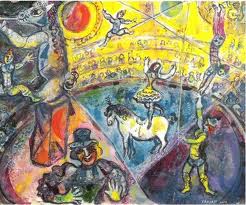
The publishing journey glitters. Veteran authors, publishing houses, editors and MFAs pull us like the sparkling bodice of a circus dancer, flipping and tumbling effortlessly through the air, her partner eagerly waiting to catch her in his arms and raise her into the air for applause.
 
And yet, we who write for publication must be careful. We sit in the dark stands under the Big Top, munching on popcorn, coveting glow-in-the-dark necklaces, lost in the illusion and elusive space between what is real and who we are.
 
Like many of you, I’ve been a hobo on this circus train since my youth, curled in a small, black space under a box car, hoping no one will find out I’m there, spying, watching and mimicking every move . . . while at the same time hoping the Ringmaster will discover me, dress me in the finest costume of tulle and sequins and tights, crown me princess in the center ring.
 
At some point, as each of us steps into the publishing business, we must decide to whom–and for whom–we will perform. I suppose a piece of every life involves some degree of performance. But how big a piece we give up, well that part’s up to us.
 
Good magicians, like good circus performers, don’t tell you their secrets. But I will tell you mine, and it is this: YOU are the main act.
 
You’re it.
 
Because you are the artist.
 
No matter which trapeze the business has you swinging from–commodity or compadre–you’re the one with the words. Anything the business brings beyond that is a side show compared to the talent, skill and gift you bring to the center ring . . . a gift that can’t be enhanced or revealed, covered or consumed by a shiny costume.
 
I re-discovered this recently as I read over pages of a document my grandfather left my grandmother, printed words etching a burning love story into the cold stone of history.
 
My history.
 
The beginnings of another new novel.
 
You have a history too, and from behind the cage bars it scratches and roars to be told. Feeding it isn’t enough. You must let it loose and tame it. Balance the weight of it on a small, round stand. Parade it carefully in front of the masses.
 
There’s a hoop only you can soar through. A tightrope only you can walk. A story only you can tell.
 
Don’t lose it in the spotlight. Don’t let it become ensnared and choked out by the ropes and pulleys, smoke and mirrors.
 
Do this, and you’ll survive–and perhaps even thrive–in the publishing circus.

Because all that really glitters in this great show is you.

What about you? How do you remain true to yourself and be the best possible steward of the gifts (and time) God’s given you, while walking the tightrope of the industry?

Celebrate Your Book With a Party!

November 4, 2011 was starred, circled, highlighted and otherwise bolded on my wall calendar, computer calendar, and represented in a countdown ticker on my desktop.

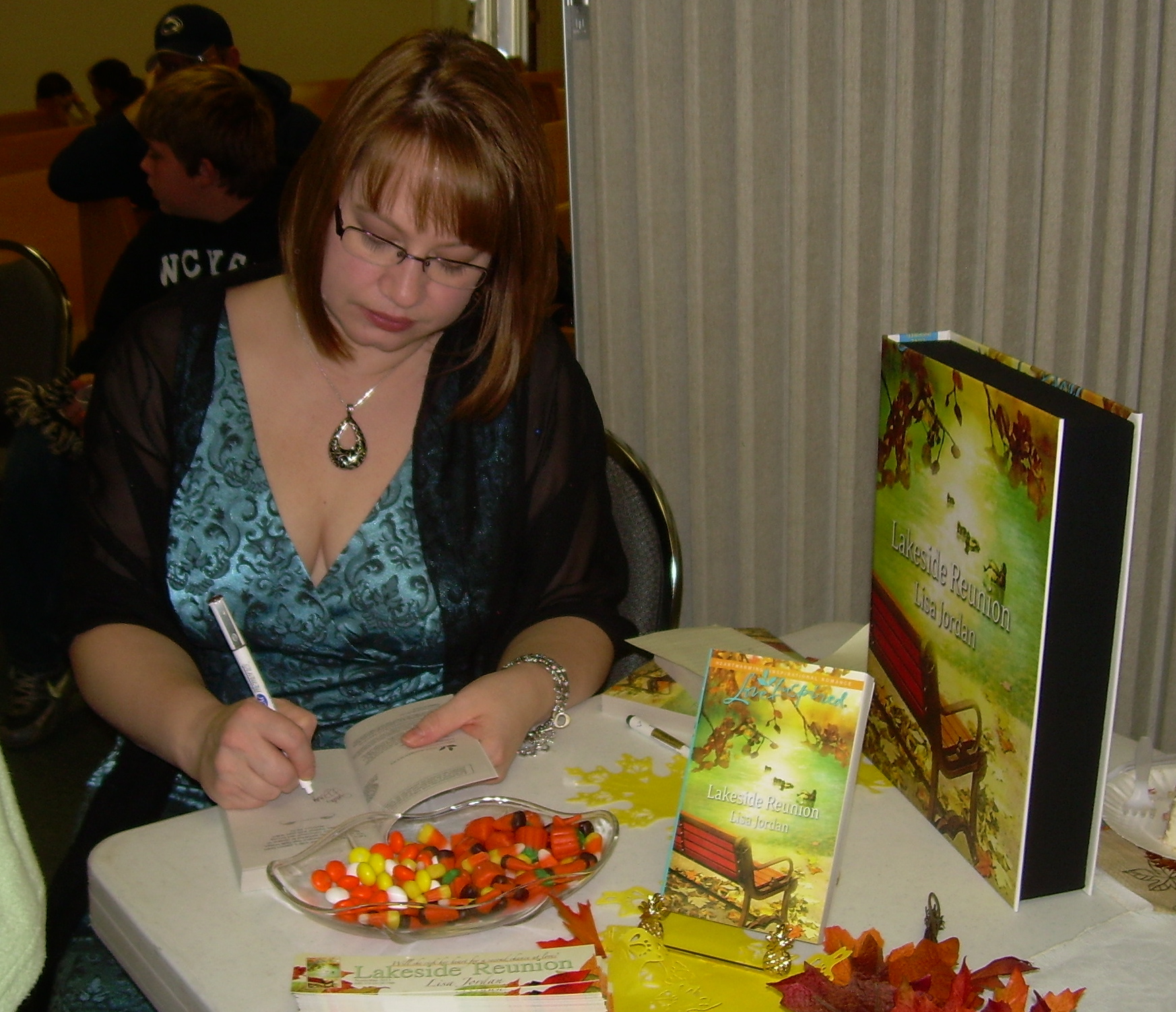
What’s so special about that date, you ask? My book launch party for Lakeside Reunion, my debut novel, which released in November by Love Inspired.

After receiving the call from Rachelle that launched me from an unpublished author into the publishing world, I envisioned hosting a book launch party to celebrate this dream-turned-reality with family and friends.

I set the date, searched online for book launch information, and came across articles by Deborah Vogts and Ava Pennington on the CAN site. Their articles are very informative, so if you’re in the planning stages, check out their great advice.

Following their leads, I created a budget, then enlisted family and friends to help. I chose to host the party at my church because it wouldn’t cost me anything and it would be a good marketing opportunity for our church.

Once I saw my cover, I decided to keep a simple, yet classic theme of leaves. What better symbolizes autumn?

As silly as it may sound, I compared myself to a bride-to-be preparing for her wedding day. If you’ve planned a wedding or helped with one, you know what I’m talking about—budgets, food, décor, and we can’t forget the dress.

I sent out almost 100 invitations to family and friends across the country. I wanted them to celebrate with me (and buy my book)!

I kept the menu simple–cinnamon roll mini pancakes to go with the breakfast theme in the book, apples & caramel dip, candy corn M & Ms, cake, cider, coffee and tea. We had plenty of food leftover so people don’t attend to eat.

The building anticipation created a roller coaster of emotions—would anyone show up, would I sell any books, would I run out of food, what if they hate the book? The day couldn’t arrive fast enough—the day was approaching too quickly. I still had too much to do! What was I thinking having a book launch party anyway?

The weekend of my party, my prayer partner and close friend Reba J. Hoffman flew up from Florida to attend. My friend Carolyn, who was one of the first to read Lakeside Reunion in its infancy ten years ago, drove up from Virginia to share in my special day. My family rallied around me. My Coffee Girls surprised me with a large keepsake box. What I pictured in my head was nothing compared to what played out on that gorgeous autumn afternoon.

Tears flowed. Cameras flashed. I laughed. I hugged. I signed. God used little ole me to write a story that touched hearts. One of my mother’s friends shared how Lindsey’s story helped her cope with her husband’s recent death. As family members and friends celebrated this milestone in my life, I gave God the glory. After all, had it not been for Him, none of that day would have been possible.

What about you? Did you have a book launch party? What special moment stood out to you? If you haven’t had one yet, are you planning one for your book? What expectations do you have?

Rejection!

Rejection is an ugly word, especially to a writer. But we need to keep it in perspective.

To help you put rejection into perspective, I’d like to discuss my shoes.

I have a pair of lovely leather shoes. I really like my shoes. They are stylish, look good with many types of clothing, and are comfortable to wear for many hours. I love, love, love my shoes.

A few months ago, I noticed my shoes were beginning to look worn out and were no longer attractive to wear with dress pants. I thought about purchasing another pair of shoes, and then I had the bright idea to bring them to a shoe repairman. The repairman put new heels on my shoes, polished the leather, and blackened the soles. After some effort and work, my leather shoes are spiffed up and look as good as new.

Now, if I offered my shoes to someone and they don’t love them like I do, should I be heartbroken? Does their rejection of my shoes make me less of a person? Does it make my shoes less attractive? Does it make me less worthy?

Think about it, I bet my shoes wouldn’t fit just anyone. They wouldn’t be right for a number of people with different tastes and different needs. But that doesn’t make my shoes less valuable or less worthy.

That’s the way I look at rejection. My manuscript (shoes) is polished and ready to go out into the world. But perhaps the agent/editor (consumer) needs a different size or is looking for a different style. It’s easy to look at the situation from this perspective and see that it’s not always personal when your manuscript (shoes) is rejected! Sometimes the rejection is not about the story or craft but for other reasons, some of them simply being reasons of timing.

Rejection is an ugly word, especially to a writer. But we need to keep it in perspective. If we’ve been gifted/called to write, then we should keep writing and polishing our manuscripts. After all, many successful writers have suffered rejection.

Now that you’ve gotten the fear of rejection out of your mind, put your new confidence to the test by planning to attend a writer’s conference this year. Many writers will testify that their career got on the fast track after they attended their first conference. You meet other writers, editors, agents, and learn about the craft and the industry at conferences. Your competence and enthusiasm for your writing gets a great boost by attending conferences.

Don’t stress about rejection, keep moving forward in your career.

How do you shrug off rejection? How do you keep it in perspective?

Happy Thanksgiving from the Water Cooler Family to Yours

Photo by Tom Gill

Thanksgiving has always been a great time for Americans to reflect on what is going right in their lives.

There are other moments throughout the year like our birthday or the upcoming New Year’s holiday that lend themselves to the same moment of gratitude.  However, this holiday asks the same question with a wonderful twist.

Instead of what might be the usual, what-about-me, we’re asked to remember others, especially those who can’t be with their families like our servicemen and women stationed all over the world and in harm’s way in Iraq and Afghanistan. That gives all of us a moment to step out of ourselves and remember what really matters to us.

For many of us it’s the people seated at the table right around us, and we get to say directly to them on Thanksgiving day just how much they mean to us. But there are also many others who touch our lives every day, and mean so much to us for their unflagging support and cheers of encouragements, who are scattered all over the world.

For the writers at the Water Cooler that includes you.

All of us at the WordServe Water Cooler want to take a moment to say thank you to everyone who has joined in our fun. Thank you for taking the time to share your thoughts and feelings here at the blog on the rollicking, fast-paced world of writing, publishing and marketing. We have all grown to feel like one big family.

For writers, who spend a lot of their career waiting to hear from editors or critics or booksellers, it’s a very special and sometimes rare gift to create such a supportive community. We look forward to all of the great conversations, book news, writing tips, and platform building to come.

A great big thank you as well to our agents at the WordServe Literary Agency, Greg, Rachelle and Barbara for all of your guidance, hard work and for always going that extra mile. We are all very grateful. Happy Thanksgiving everyone!