Is a Backlash Coming?

This may be more honest than a long-time agent should admit, but I have a lot more questions and not as many answers these days about where the book industry is going. As I talk with other agents, most of us are having banner years. More deals. More money. More ongoing royalties being paid out. After our three-year downturn, we’re all enjoying the upturn.

What gives?

Haven’t we all been told that e-readers, self-publishing and social networking were going to spell the end to traditional publishing? That quality literary partners (good agents) would soon be a thing of the past? That anyone could make a mint by self-pub’ing their 20,000 word “books” or their 5,000 word articles, or 200,000 word personal family sagas. All they really needed was a thousand or more Facebook friends and 5,000 to 50,000 Twitter followers. If they had a daily blog with 4,000 subscribers, then self-publishing that book they wanted out NOW instead of a year from now would be like printing money.

I love to read all of the prognostications about the end of publishing as we know it . . . almost as much as hearing about what day the world will end (which means, not very much). We have end-time prophets and we have “end of publishing” prophets.  Both, if they play their words and products right, are making a lot of money and scaring a lot of people.

Yes, the publishing industry is going through some major transitions. But where will this ultimately lead us—not 2 years from now, but 10 or 20 years from now? Is anyone’s crystal ball really so good that they KNOW physical books will go the way or the 8-track tape or be a luxury few can afford?

Are we dealing with fads that may come and go or true culture change that alters not only what platform we read our books on, but how and when and why we buy them?

How many e-readers are being purchased by new buyers versus those repeat buyers who are already hooked on them and have now bought 2, 3 or 4? Will e-readers be affordable enough to catch on overseas?

Do people with e-readers actually buy more books because they’re cheaper?  If so, how is this bad for publishing as long as the royalty structure is fair and the author is rewarded?

Why is it that (depending on which report or blog you read) overall only mass market books and a few genres of hard cover are going down in sales and not print books as a whole? In many categories, e-book sales going up doesn’t always translate across the board to print book sales going down.  People are still buying print books and printers are finding cheaper ways of printing them—faster.

Will the medical profession be treating more carpel tunnel and more eye strain because of e-readers? Will our necks and brains and fingers and forearms be able to handle the constant movements needed to be plugged into phones and e-readers and notebooks 8 to 12 hours a day? If not, then what?

Do people really want to read whole books on their phone? Music, yes. Books….?

Are readers of books so dumb that they won’t be able to tell how qualitatively different books published by traditional publishers are than self-published books that have slap-dash covers, design and editing?

Was the movie the end of books? Was TV the end of movies in theaters? Was I-Tunes the end of people wanting new music? Are e-readers the end of people wanting to read and buy whole (and physical) books?

How many social networking platforms can one person with a family and a job actually keep up on? And will there be a social networking backlash in the coming years?

How many books are bought through someone reviewing or mentioning a book from a Facebook or Pinterest account, versus actual word of mouth, face to face?

Will people start rebelling against social media and want to engage in actual relationships again? If so, how will people find out about good books again?

Will Amazon’s takeover of the world survive their politics? Or will people of all walks and faiths make sure one distributor doesn’t corner the market?

In the meantime, as I’m finding some of these answers, I’m still excited about finding new voices with great stories and great messages. I still love seeing great authors with strong sales continue to grow in their reach. I’m still privileged to work with professional editors who add value to a book’s content and improve the author’s overall work. I’m still convinced that “distribution is your destiny,” and that publishers add huge value to the overall sales of books because of their distribution networks.

And as you can read, I have lots of unanswered questions. What about you? What are the questions you’re wondering about as it relates to the long-term future of publishing and/or your career?

Publishing Is Publishing

This Fourth of July, I watched the fireworks from the exotically landscaped grounds of a ritzy Malibu mansion overlooking Santa Monica Bay. I was admiring an Anna’s hummingbird perched in a tree that could have been invented by Dr. Suess when a beautiful woman I’d never met before came up to me to find out how to get her children’s books published.

“They rhyme,” she told me. She had written them together with her three children, whom she homeschooled.

She seemed sweet, one of those amazing moms who can take charge of all children present (in this case, at least twenty of them)—supervising them in the pool, sunscreening them on a schedule only she knew about, braiding hair to keep it out of faces, correcting their behavior toward one another, taking one to the bathroom, moving them en masse to the trampoline, seeing to it every last picky eater among them got something to eat, keeping track of the dog—and all the while initiate and maintain extended conversations with various of the adults present.

“Well,” I said. “I don’t have any experience whatsoever in children’s books. I write nonfiction for adults.”

“Yeah, but I heard you write, um, like, spiritual books.”

I nodded.

“And they’re published, aren’t they? So they’re, you know, regular books, right? Like, you can buy them in bookstores? I mean, publishing is publishing, isn’t it?”

It intrigued me that she was seeking my advice at all. I was such an oddity at that party. Visiting from Oklahoma. Not rich. The only woman present with grey hair. Not at all the sort of person someone like her would go to for advice about anything—except maybe birdwatching. I seemed to be the only one at the party paying attention to the magnificent hummingbirds and house finches and hawks whooshing around us.

But she was right, I guessed. Publishing is publishing. I recommended she get the latest edition of Writer’s Market.

“Did that already,” she said.

“And I think I’ve seen a special Writer’s Market just for kids’ books.”

“Got that too. Read it cover to cover.”

“Then you know what to do. Write a proposal that has all the parts they ask for and send it out to agents listed in the book who represent the sort of thing you’ve written.”

“You mean a query letter?”

“Yes, that too. I mean, for publishing adult nonfiction, you’d need a book proposal, but maybe with kids’ books you can get everything you need to say said in your query letter. Send it to agents who seem in the same place professionally as you are—that is, just beginning your career as a writer.”

“But don’t I need to copyright my stuff first? I mean, they could just steal my ideas.”

I said I didn’t think copyrighting was necessary. Why would an agent want to steal her ideas? “Agents make money from selling your book to publishers,” I told her, “not by stealing ideas and writing books of their own. They get fifteen percent of whatever you make. They want you to make money.”

She seemed unconvinced.

“Well,” I said, “Just do whatever it says to do in your children’s Writer’s Market.”

“I did all that,” she said. “So what do I do now?”

“You wait to hear back. And then, if you don’t get any takers, you revise and do it all again with another list of agents. If your stuff is good, eventually you’ll find someone who wants to represent you.”

“But how long should I wait? I mean, it’s been a few weeks already. Isn’t there anything else I can do?” This woman was a doer. As we spoke, she was rearranging the bowls of dips and crudités that the pool-wet children had left in disarray.

“No,” I told her. “Just write. Revise. Submit. And wait. That’s all I know about how to get published. Unless it’s different with children’s books. Which I’m guessing it isn’t. I mean, publishing is publishing, right?”

So what do you think? Is all publishing the same? If it’s different, how is it different? If it is the same, how is it the same?

Thoughts on Publishing: What Would the Wright Brothers Do?

“If we worked on the assumption that

what is accepted as true really is true,

then there would be little hope for advance.”

~Orville Wright

A lot of hoopla surrounds the publishing industry, these days more than ever. In the midst of the business, it’s easy to forget the original dream and heart of the artist.

This is not a new phenomenon.

Nor is it unique to the publishing industry.

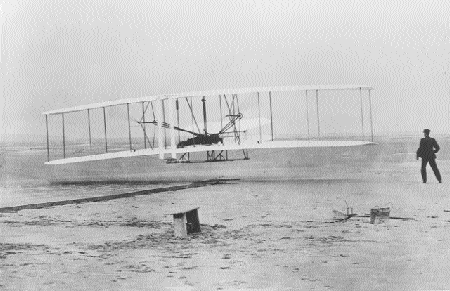
Take the Wright brothers, for example. I wonder if Orville and Wilbur had today’s airplane industry in mind when they first sketched out their dream to fly. I assume they were two wildly imaginative, brilliant brothers who had a knack for ingenuity, and who simply wanted to feel their feet leave the ground. Who simply wanted to fill their lungs with air free from the heavy, constant pull of gravity.

Sure, they must’ve been pleased to see the initial progress of their invention, how flight began to morph into bigger, stronger vehicles which allowed others to feel weightless freedom, too.

But what would they think now?

Of the pushing and shoving and security detail in airports? Of gunfire, like rain pouring from silver wings? Of hijackings? Of crashes? Of bankrupt airlines? Of their beautiful, wooden machine used as weapons of mass destruction on 9/11 nearly a century after liftoff?

Of course, modern-day airplanes are still a marvel. Their massive engines bring orphans into the arms of adoptive parents; soldiers into the embrace of waiting wives and newborns; food to the starving; medicine to the dying; peace to the war-torn; relief to the hopeless.

All of these things–the good and the bad–began with a dream which lolled around the hearts of two gangly boys for years, and which eventually tamed the winds on a lonely, sandy beach.

And so it is with the publishing business. A single page of script begins as it did with the Wright brothers, with a small dream in a great, big heart. From there, the dream takes flight. And after that, it becomes a part of the industry–an industry which carries words to distant places.

Some stories give life and hope.

Others tear down and destroy.

Much ado is made over the various branches of publishing: self, electronic, traditional, mainstream, Christian, small press, large press, and on and on and on. I suppose this is not new. But the industry is merely a vehicle for syntax to take flight.

Our job as authors is to keep the original dream alive, despite commercialism, competition, money, and what all the writing blogs say.

If you’re an author (like me) who follows Jesus, our job carries the even weightier responsibilities of strengthening, encouraging, and comforting. As Christ-followers, we must choose building up over being edgy for the sake of being edgy. We must choose loving accurately over nosediving into the murky waters of what itching ears would have us say.

Write brave, yes.

After all, neither flying nor faith are safe.

But write with prayer, precision, and while feeling the weight of the cross on our wrist.

*************

“The desire to fly is an idea handed down to us by our ancestors who, in their grueling travels across trackless lands in prehistoric times, looked enviously on the birds soaring freely through space, at full speed, above all obstacles, on the infinite highway of the air.”

~Orville Wright

*************

What about you?

How do you stay true to your dreams and the truth you long to pen upon blank pages?

How have the Wright brothers (re)impacted you today?

Another Brick in the Publishing Wall

FreeDigitalPhotos.net

Inevitably, whenever I read an article about the publishing business lately, Amazon’s name crops up—often to highlight how they’ve become the big, bad wolf trying to blow down the publishers and booksellers with a huff and a puff of discount prices, a far-reaching distribution channel, and the ability to sell direct to consumers. Much heft, in particular, has been placed on pricing as the lynchpin that could make traditional publishers and bookstores obsolete. No doubt (and for good reason) they fret over this more than the average reader, and time will tell if price and reach are the mortar holding it all together. Meanwhile I’d like to explore another factor influencing why and from where customers buy because I don’t believe it’s all about price, and I don’t believe it’s all about marketing and promotion, either. What about convenience? Selection? Fulfillment? What about how well the seller delivers on the overall customer experience at every touch-point and every interaction?

FreeDigitalPhotos.net

Yes, I admit I’m a bit of a harpy about the ‘customer experience’ (call it a hazard of my day job), but it’s the one thing that keeps me coming back again, even if I can get something cheaper elsewhere, and when not done right, it’s the one thing that drives me away faster than I can pluck a hair from my chinny-chin-chin. Why do you think people who buy only from certain bookstores do that? Nostalgia for traditional publishing or because the experience and interactions they have in those places make them feel good? I’m guessing it’s the latter.

And do you think people who buy mainly from Amazon do that solely for the price, or might it have something to do with Amazon’s wide selection, easy to use website, quality packaging, fast (often free) shipping, easy returns, overall solid reputation, and available, empowered customer service? It just might. I’ve been buying everything from books, games, and gifts to guitars, clothing, and Cuisinarts through Amazon since 2004. Every time, they’ve worked hard to build my loyalty by delivering a consistently extraordinary customer experience.

FreeDigitalPhotos.net

When I think about my experiences with other sellers, they’ve been average or infrequent. With publishers (traditional and electronic), it’s a mixed bag. As a consumer, I don’t have many. As a writer, I’ve mostly been rejected or ignored. I realize this is par for the course in the publishing industry, and I don’t doubt I deserved the rejection at the time, but being ignored is memorable. I’m expected to provide thoughtful responses to hundreds of emails a day (and, no, email isn’t central to my day job), so it chafes a little when publishers say they don’t have the time to respond at all, ever. These may be ego-bruising realities for a writer, but as consumers who buy a lot of books (and the occasional Cuisinart, for that matter), engaging us only when it’s self-serving isn’t the way to build a positive, lasting relationship.

On the flip side, Amazon isn’t perfect.  I hear some Indie authors say they’re unhappy with Amazon’s KDP Select customer service, and they feel ignored or unappreciated. Amazon may, in fact, be wading into dangerous territory if they don’t figure out how to deliver the same service excellence to indie writers as they do elsewhere. But given the overwhelming number of positive experiences I’ve had with Amazon, I might be willing to forgive the first lapse or two.

FreeDigitalPhotos.net

If publishers and booksellers intend to compete profitably in a world where customers are ever-evolving in their expectations and where the likes of Amazon exist, they have their work cut out to deliver the kind of experience that builds loyalty (read: profitable behavior). There is no silver bullet. It takes time to build a reputation. Amazon isn’t the only threat to houses of sticks and straw. There’s a hurricane of savvy customers brewing.

What about you? Have you ever decided to purchase from somewhere (or not) solely based on an excellent or poor experience?

Disclosure: I have two contemporary romances published with Avalon Books, which was recently acquired by Amazon Publishing. I had drafted this blog post before I was aware of the acquisition, and it in no way impacted my depiction of Amazon here.

Top 5 Self-Editing Tips: Structure

Writing is rewriting, and rewriting is self-editing. “But isn’t that the job of the editor after I’ve made the sale?” No. Some writers think running spell-checker is self-editing. Not so much.

“But won’t rewriting my work edit the life out of it?” No, but it will catch the eye of an agent or editor as a well-written manuscript and may lead to a sale.

Obsessive editing during the writing process will destroy your work. However, after you’ve written the first draft, gain some distance and perspective on your manuscript by setting it aside for a few weeks or a couple of months. Now it’s time to rewrite.

Here are my top 5 self-editing tips in their order of importance for polishing your work to a high sheen.

  1. Structure: Think of the structure of your work as an arched bridge spanning a great river. If the contractor takes short cuts (such as using less cement, steel, or fewer bolts) because she’s bored with the process and rushes to the end, the bridge is weakened and will collapse.  The same holds true for both ends of the bridge. If too much cement is used at either end of the bridge, it will collapse from the added weight.

For the purposes of this post, I’ll concentrate on the structure of novels. If the structure of your story is solid, the reader will continue to turn the pages until the ending scene.

The material of the structure is comprised of the elements of the story arc (the basic story thread) held in place by a beginning, middle, and end. Pretty simplistic, huh? Yet the three-act structure has worked since Aristotle’s days whether you write plays, scripts, short stories, or novels.

Sydney Harbor Bridge

Some authors maintain they have a four-, five-, six-, or even eight-act structure. I maintain if you break down the parts of their story arcs, you will discover classic Aristotelian structure.

Using the bridge analogy, a car drives onto the bridge. This is the point in the novel when you can lose a reader in the first page or two. I’ve thrown many a book (or manuscript) on the pile beside my bed if nothing happens right away. The author might as well have written “blah, blah, blah-blah, blah.”

A novel that piques the reader’s interest starts as far into the story as possible. I don’t want to know that the protagonist’s parents left him stranded in a snowstorm when he was a toddler and that’s why he’s terrified of snow (or abandonment). That’s back story. The story should begin with stasis (a state of equilibrium) and then the main character, pressed with conflict, reveals her goal.

One of my favorite movies is Indiana Jones and The Raiders of the Lost Ark. The story throws you into the action, and the back story―Indy’s character, profession, the setting, and the antagonist―are revealed as Act 1 plays out.

As the story progresses into the middle (Act 2) and the bulk of the novel, you should have rising and falling tension as your protagonist encounters numerous obstacles or crises.

The main turning point, or big surprise, comes in the middle of the novel. By this time the reader believes he has the story figured out. You need to turn his assumptions on their head. The major turning point should be such a shock that no one sees it coming. It should keep your reader up at night turning pages.

The crises continue. Will he? Won’t she? Oh, no! What will happen to this character your reader has invested her time in? Will everything turn out all right? How will the story ever end on a happy, satisfying note now?

Tension mounts and we reach another major turning point before we head into the final third act. Every turning point should be a surprise to the reader.

The crises are unrelenting until we reach the climax halfway through the third act. The protagonist faces off against the antagonist. The clash of the titans ensues. A woman faces her attacker or her paralyzing fear. The antagonist is not always a person. A man pushes his wife out of the path of a stampeding herd of cattle. Will he live? You get the picture.

Tie up all the loose ends of your storyline in the denouement―the final resolution of the plot or story arc. Is your ending satisfying? Does the main character live happily ever after? If you live and write in America, trust me, she better if you want to succeed as a professional author. Americans are eternal optimists.

To be continued…

How will you self-edit your novel to make sure your structure is strong enough to carry your storyline through to the end?

Photo credit: Sydney Harbour Bridge with the Opera House in the background by Ian.

With Us Here Tonight

Shortly after my first book was published, I gave a book talk at our local library.

Then I gave another talk at another library. And then a third library.

Then a Rotary Club called me. A few months later, I found myself the featured speaker at a Shriners dinner. Last month I presented a talk at the National Eagle Center. Birding festivals, book conferences, annual meetings, schools, service organizations–I’ve addressed them all.

Wait a minute. I thought I was a writer, not a speaker.

Guess what? Book authors get to do both!

The fact is, you NEED to do both if you’re going to successfully build your readership and market your writing. That means you should work on your public speaking skills, and the best way to do that is to take every opportunity you find for a speaking engagement. Develop the following five types of speeches, and you’ll be ready for anyone!

The Sound Bite is the one you will use a bazillion times. It’s the one-liner you’ll utter every time someone asks you what your book is about. It’s also one of the hardest to compose because you need to distill your book and its value down to one sentence. My sound bite for my series is “The Birder Murders is a humorous series about a really nice guy who happens to find bodies when he’s out birding.”

The Book Talk is the speech that focuses on your book’s content. If it’s nonfiction, you can give a general review of the topic itself, or focus on just one chapter’s point and why it’s important. If it’s fiction, you discuss characters, their relationships, the plot, how you came up with all of it, what you want to accomplish with it. This works best with audiences who have already read your book because they will have questions about what they’ve learned and/or enjoyed from reading it.

The Business Talk is about your experience with the publishing business of being an author. The changes we’ve seen in publishing, including the growth of e-books and marketing paradigms, is a topic that appeals to audiences composed of business people or future authors.

The Writing Talk is about your own process of writing a book. Do you do research? Conduct interviews? Journal or set word goals? The beauty of a Writing Talk is that it is appropriate for a variety of groups, and depending on the slant you give it for the group you’re addressing, it works equally well as a classroom talk, a keynote address for a gathering of library supporters, an awards speech, a writers conference, a book club… you name it.

The Topic Talk is the newest talk in my own arsenal of speeches. Because my books are about nature, I’ve started giving talks about nature education and conservation issues. If it is mentioned in my books, it’s fair game for a talk and a great way to use extra research.

Here is a great resource to help you to continue to develop your public speaking skills.

What talks could you present for your book? Do you have any ideas for talks that I have not mentioned?

Seeking a Revelation

source: Fotolia via MS Office

We’ve all been there—happily plowing through a manuscript when we’re suddenly brought to a squealing halt. Or maybe it comes on gradually, like so much mud solidifying as we try to trudge through until we find ourselves frozen in place, blinking at the ground and wondering what happened.  It could be our outline didn’t foresee all it might have, or we wandered down an unexpected path only to find it’s a dead end. Or perhaps our characters took on lives of their own and staged a coup when we weren’t looking. However we got there, we’re stuck, and being stuck mid-project is no fun. So what’s a writer to do? 

We could ditch the whole thing. Occasionally that is the right answer, but being persistent writerly-types, thank goodness that’s not our first inclination. There are lots of ways to get unstuck which leave us with a better manuscript in the end. Here are my top five:

  • Walk away for at least 30 days. It never ceases to amaze me how insightful this can be. When you’re writing, you’re close to the material. You leave a part of you on the page, and sometimes it’s hard to see the forest for the trees. Many writers know this, and they take frequent steps back from their material in the hopes of approaching it later with a less familiar eye. It’s tempting to think a week or two is sufficient, and sometimes it is. But if you’re really stuck, I highly recommend walking away for a full month to get a truly fresh perspective. That distance can do wonders for improving your writing on the next go-round.
Source: Wikipedia
  • Ask for help. While many writers recognize the value of a critique group for the craft side of writing, I’m surprised how few ask for help with storyline. Asking for help does not make you weak. It makes you resourceful. I recently rewrote the entire end to my novel because an editor thought it predictable. I asked a trusted critique partner for help. She brainstormed with her daughter (this was a YA story) and came up with a slew of possibilities. One contained the thread of an idea I ultimately spun into a much better ending. And let’s not forget the power of prayer. Realizing you don’t have all the answers and asking for guidance from above is simultaneously humbling and empowering. Just remember to let go of any preconceived ideas and be open to whatever form inspiration may take.
  • Print it. This isn’t the first time you’ve heard this, but it works. Seeing your work in print is strangely insightful. You will plainly see things you don’t when looking at it on the computer.
  • Push through. To put it bluntly, give yourself permission to write crap. Knowing the next chapter or two will be ‘throw away’ material is incredibly freeing. It takes the pressure off and lets you work through the block. Not everything you write needs to be brilliant. You’re not going to go with that first or second draft anyway, right? So give yourself permission to make a mess before you refine it all.
  • Read in your chosen genre or non-fiction category. Some writers worry if they do this they’ll either find someone beat them to the punch or they’ll inadvertently pick up another author’s voice or idea. In the case of the former, you’re better off knowing this sooner than later so you can make your story stand out as different. In the latter, you can influence this: you’re a disciplined, creative being, not a machine that regurgitates what you’ve read without your knowledge. The benefits of understanding what’s successful (or not) in your chosen field far outweigh the possible risks. Read—and keep a pencil handy for when the revelation hits.

How do you get through when you find yourself ‘stuck’ during a writing project?

Third Day Give Me a Revelation

Print on Demand: Edison Style

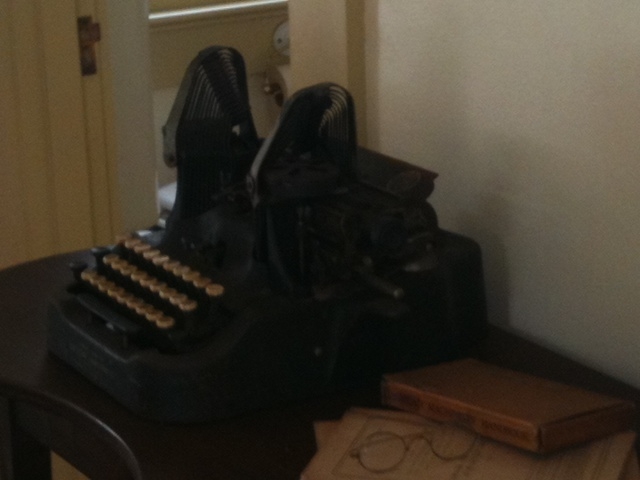
Thomas Edison Typewriter
Edison’s Keyboard

Steam swooshed onto the platform as the metallic black-horse eased to a stop in Detroit. 

The clunky train rocked The Grand Trunk Western Railway passengers in their seats. Cargo slid in the holding bays.

A twelve year old boy steadied himself against precious equipment, secured in the baggage department. Coins jingled in his near-full pockets. The odor of hot ink and ironed paper mixed with burnt coal.

And the train wasn’t the only thing rocking. The innovative boy smiled while he tallied sales of The Grand Trunk Herald. Demand for his real-time newspaper was on the rise.

Thomas Edison birthed a fresh era of news publishing in 1862. He sold the voice of his original publication by the copy, or for a mere eight cents per month, by subscription.

In the volcanic and news-hungry climate of Civil War America, Edison hit on a popular niche. For the first time ever, passengers could devour the contents of a paper written on a moving train. A pre-pubescent Thomas couldn’t know he would soon change the culture of a publishing world.

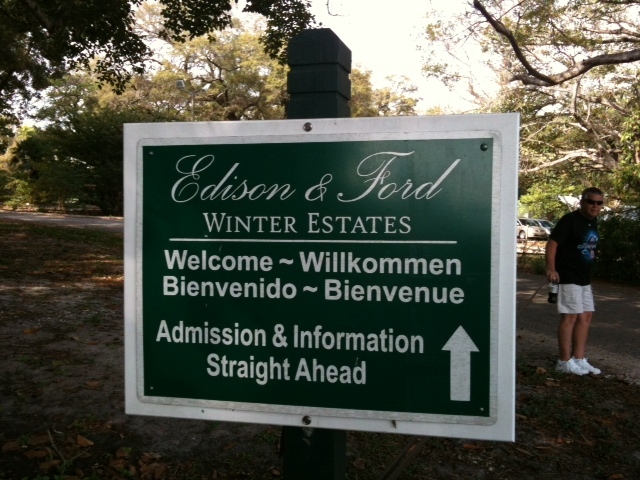
Recently, I visited Thomas Edison’s Winter Home in Fort Myers, Florida. It was there I learned the factual details of my embellished account above. But it made me think about the culture of American publishing during that time of war, financial upheaval, and emotional decision-making. Not so different from today.

Edison & Ford Winter Estates
Edison Winter Estates Entrance Sign

So it makes me wonder, if we were to rewind time, how would people in Edison’s time react to things we take for granted today? Could the folks living in that era have imagined CNN, the Internet, texting, social media, online videos, and other forms of immediacy news?

But I also reflect on those businesses who felt threatened by the young, creative upstart. They probably didn’t appreciate what they viewed as infringement on their market. Did they make changes in their own processes, as a result of the Edison transformation?

And how does all of this affect us as professionals, and the aspiring, in a writing world today?

What does the future hold for those of us impassioned to share a message through words? I believe young Edison provides a stellar example of how to face adversity. Thomas didn’t bemoan the times.

He exemplified a brilliant mind who took action where others surely complained. He paid attention when people expressed frustration. He heard those who wished to know what was going on in the war and in other parts of the country.

He turned ordinary news into newsprint customers couldn’t wait to buy.

Thomas Edison refused to let a depressive environment get him down. In today’s volatile publishing market, it’s a lesson we can learn.

No one knows exactly what tomorrow’s finished books will look like. Print on demand is making waves. But Edison’s style reminds us to keep our ears, minds, and eyes open. After all, what we do today may impact people one hundred years in the future.

Like passengers in Edison’s era, we may be readers, writers, editors, or publishers. But we all ride toward the same end. The enjoyment of great books. We can bemoan rocking motions, temporary stops, and a change in the news, but we can’t prevent innovation.

We have a single choice if our destination is writing for publication–climb on, and try to enjoy the ride.

Can you hear the whistle? The train is preparing to leave the station. All aboard!

What innovative ways might our books reach readers’ hands in the future? Those of us who author, how can we help publishers invent new ways to sell our books?

Honoring the Writer’s Call

Remember the Call

As ambassadors of the written word, we’re called to awaken people to truth. Rubbing words together, we set the world on fire!

Above publishers and agents, God’s our number one boss. With pure, submitted hearts, we make it our mission to please him first.

Am I on the right track, Father? What do you want me to share today? These are the questions we ask.

We try not to judge and compare ourselves with other writers because we know God equips each of his instruments for different specific tasks.

When fearful, overwhelmed, and wondering why we chose this career/ministry path in the first place, we remember… God never calls us where his grace won’t sustain us.

So let’s not get tired of doing what is good. At just the right time we will reap a harvest of blessing if we don’t give up. Gal. 6:9

Persevere in the Call

When tempted to distraction by potentially good things like social media, movies, and chats, we’re privileged to consult our boss: “Please show me what to do and give me the strength to carry it through.”

When tempted to discouragement by trials, we understand they’re God’s method of making us stronger, more Christ-like, and more effective in our writing.

And we know that God causes everything to work together for the good of those who love God and are called according to his purpose for them. Rom. 8:28

Because we clearly know we have been called to write, we persevere when people judge us, and we remind ourselves it only matters what God thinks, and the Lord sees every heart. 1 Chron. 28:9

We persevere when our paychecks are sparse because we know God will supply all our needs from his glorious riches, which have been given to us in Christ Jesus. Phil. 4:19

We persevere when the road is rough and slow and we can’t see ahead because we know who leads us each step of the way. (Ps. 37:23)

Balance the Call

Balance starts with rest, and rest starts with prayer. Jesus walked a tight deadline, but rose before dawn to commune with his Father. He snuck away from the crowds to reconnect. Do we sneak away from our characters to bless the Word of words?

Jesus waited on His Father for wisdom and wants us to do the same; but it takes trust.  (James 1:5-6)  When it comes to trusting in the Lord with all our hearts, we often get it backwards, and lean on our own understanding first. Then, when things go awry, we cry “Help me!” and ask him to direct our path. He will, but we must first acknowledge him.  Prov. 3:5-7

Jesus only spent three years in ministry; however, his thirty preparation years were just as important because they defined and nurtured the Father/Son relationship, enabling him, in the right time, to turn the world upside down by submitting to His Father’s peculiar but brilliant plan of reaching the Jews first, then the Gentiles.

God writes a different plan for each one of us. He calls some of us to blog first, others to write books first, and still others to do both at the same time – in balance.

Whether we’re writing, speaking, networking or spending time with the family, God isn’t just interested in what he’s doing through us; He’s interested in what he’s doing in us.  He wants us to joyfully trust him so we can honor him with our calling.

“For I know the plans I have for you,” says the LORD. “They are plans for good and not for disaster, to give you a future and a hope.”  Jer. 29:11

Please talk to us about remembering, persevering, and balancing God’s call to write. We’d love to hear your stories, lessons, insights, and experiences.

And what is God reminding you about today?

Your Book: Impacting the Final Product

I recently had a conversation with an editor at a medium-sized publishing house. She shared a few horror stories of difficult authors she has worked with over the years. Authors with giant egos and immoveable demands. Authors who argued and insisted they knew what was best.

I was quite stunned to hear this. Then I got sad and then a little mad. Isn’t it presumptuous to think that an author knows more than an entire team of experts at a publishing house?

There will always be times when an author must take control of some of the details of their own books and career. But authors of faith ought to consider a bit more of consistent humility during the publishing process. Here are a few reasons why:

1. The publisher is taking a risk, spending a great deal of money, and they want the book to succeed as much as you. I read one agent’s stats. Of the 2,000 proposals he looked at, he selected 20. Of those 20 selected I’m guessing a publisher bought 10. Publishers pour thousands of dollars into your book, usually more than $20,000 when it’s all said and done. They assign teams to consider titles, covers, fonts, layout, book length, back cover copy, catalogue copy, marketing and ad copy, etc. Your book endures several types of edits. Those of you who are published know it takes at least a solid year to edit, design, print, market and distribute a book, and the publisher is betting on you with the realization that only 10 to 20 percent of books earn back their advance.

2. Editors understand how important your book is. I recently read these comments from an editor:

When an author submits a text to an editor, the author has handed over a sacred object, one that has been countless hours in the construction, and into which the author has poured immeasurable amounts of his or her mind, body, and spirit. The author and everything he or she has put into a text becomes vulnerable to the suggestions, revisions, and deletions of the astute and discriminating editor. The author must trust the editor to do his or her job forthrightly, honestly, and in full awareness of personal biases and areas of intellectual and creative weakness.…. Manuscript in hand, the editor holds an object as precious as a newborn baby, and the posture he or she assumes is that of midwife, responsible for the nurture and health of the ideas to which an author has given birth.

3.  Editors are eager to change the culture together with you. They are for you, not against you. David Zimmerman, editor for InterVarsity Press, shares, 

On a good day I’m a midwife, holding authors’ hands and breathing anxious breaths alongside them, helping them through the arduous and emotionally wrenching work of bringing their gift to publication. I get to be a witness to the evolution of great ideas, to be the sounding board of audacious thoughts, to be the student of great undiscovered teachers. I get to celebrate countless milestones with authors, from the news of their book’s acceptance for publication to the signing of their contract to the registration of their book with the Library of Congress and the Copyright Office, to the book’s first printing, first sale, first review, first reprint. I even get to dole out money to authors, demonstrating the real material value of the thoughts in their heads.

4. God loathes pride. If you are a good writer, and I’m guessing you are if you’ve caught the eye of agents and editors, your gift comes from God. God crafted you with the ability to put words side by side in a way that causes people to think, cry, and laugh. Your gift impacts the world. The only response to that gift is gratitude.

Praying for your agent, editors, design team, publishing house, and readers is a much more productive way to control the outcome of your book. Trust that they want the same result as you.

Humble yourselves before the Lord, and he will lift you up.

(James 4:10)

How has God asked you to demonstrate humility during the publishing process?