The Blessing in a NO

Ever feel like you just can’t catch a break? Nothing seems to be going your way? Have you ever heard no so many times it starts to lose its meaning? Welcome to the world of writing.

In the last three years, I have heard no so many times that I have learned to laugh and look for the next open door. When I first started hearing no it was a foreign concept to me. All my life I worked hard for what I had – job, grades, academic standing – and then I put one foot into the real world, and for some reason none of my achievements carried much weight. Crazy how that works, isn’t it? But it took a series of closed doors to teach me the blessing in no.

  • Applied to grad school at Texas Tech – No
  • Applied to 11 other grad schools (About the eighth letter, I started laughing instead of crying.) – 11 No’s
  • Moved back home and applied for A LOT of jobs – A LOT of No’s
  • Wanted to move out of state – No
  • Applied for more jobs and internships – More No’s
  • Submitted my book for publication – A lot of silence (which equals a “no” in the publishing world)

Starting to get the picture? No started to lose its meaning. But the more I heard that dreaded word, the more I began to find my way. Know what happened when I stopped trying to make things happen and allowed the Lord to direct my steps? A lot of those no’s became yesses in directions I never would have explored.

  • Got an acceptance letter to Focus on the Family Institute in the same month I was rejected from Tech. The Lord changed my life. – Yes
  • Found a freelance writing position two days after my most recent job rejection. – Yes
  • Attended a writers conference and was accepted into a writing course with a mentor doing the exact same thing a graduate degree in writing would have given me for an eighth of the cost. Found Christian authors to encourage me. – Yes
  • Attended another conference and found agents and editors who are interested in my book. At least I’m on the right track. – Yes

The Lord began to open doors to all the things I had been pursuing, except He determined the direction and the timing! It turns out that I’m in pretty good company. In the Bible:

The Lord told Abraham to leave everything He knew and travel to a land He would show him.

Abraham prayed for a child, and the Lord said no until Abraham was so old it seemed impossible, and then the Lord blessed Abraham with Isaac, the promised child.

Jonah didn’t want to go to Nineveh to preach. He ran away but the Lord said no to Jonah’s direction. He sent a whale to swallow him and then spit him up on the beach near Nineveh. It changed that city.

Mary probably expected to go into her marriage a pristine virgin. The Lord said no to that plan. She was still a virgin, but she was shamed by her people with a child, who turned out to be the Christ child – the One who changed the world.

My no’s seem pretty insignificant in the grand scheme of things. The Lord used redirection in the Bible for His glory and the good of His people. There is blessing in this dreaded word.

In his heart a man plans his course, but the LORD determines his steps. (Proverbs 16:9).

I follow my own way so much. But the Lord wants to tell me YES. He just wants to do it in His own time and in His own way. Just as He has been faithful in all His covenants and promises in the Bible until now, I know that He will be faithful to answer my no’s with yesses in far better ways than I could. They never look like what I thought or planned. They are always, always better.

Trust Him with your no’s. Embrace closed doors. They are blessings in disguise! He is so FAITHFUL!

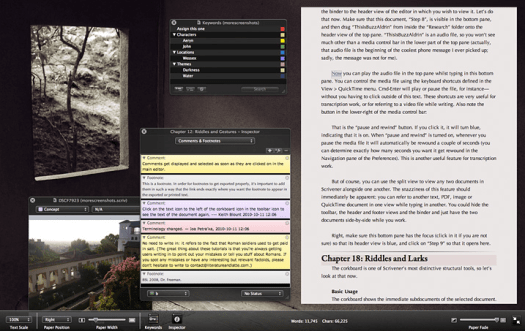
On Beyond Index Cards: A Review of Scrivener Software for Writers

My first novel, slated for publication with David C. Cook in early 2014, involved hours and reams of research. I researched everything from fossils, to barbecue restaurants, the history of Haiti, pecan recipes, and more. I organized text, web links, and photos into dozens of Word documents, which I then had to flip open and closed while writing and editing each chapter. Add this to the half-dozen internet browser screens I had open for research, and, well, my computer was on the verge of crashing.

So was my brain.

At the time I didn’t know any better, so I never lamented the process. But now that I’ve found Scrivener, a software program for writers of any genre, I marvel at how I ever kept my sanity. Currently neck-deep in an intense season of editing, I’m especially glad I can dump my manuscript in there, blow it up, and put it back together again with Scrivener.

Now, I will warn you. What you’re about to read may sound like an infomercial, but it’s not. I downloaded the trial version (highly recommended), quite skeptical about how much easier this could really make my writing life. But after just two days, I bought the software outright. First of all, this little slice of computer engineering GENIUS only cost $45—a small price to pay for sanity. An even smaller price to pay for the time it’s saved me, and the fun it brings to the novel writing process.

What’s so great about Scrivener? Below, I’ve summarized my personal favorite aspects of the program—so far. And I say “so far” because the software has so much depth of capabilities and bells and whistles, I discover something new and even more fun every time I use it.

1. Love me a Trapper Keeper!

I am a true child of the 80s. When I took my kids back-to-school shopping earlier this fall, I teared up, grieving that they shall never know the true beauty of the Trapper Keeper. Oh, sure, we found imitation versions on the shelves, but nothing close to the ultimate office supply nerd’s dream machine contraption, which kept everything in check, even when the bully on the football team rounded the corner and flipped my books in the air, sending everything—including my fragile, Love’s Baby Soft ego—to the floor.

Well, never fear those bullies again. Scrivener is your virtual Trapper Keeper. The  program holds everything you need for your novel—websites, photos, places to jot down random thoughts and ideas, references, and notations—everything. And since it’s all in one location, nothing falls out.
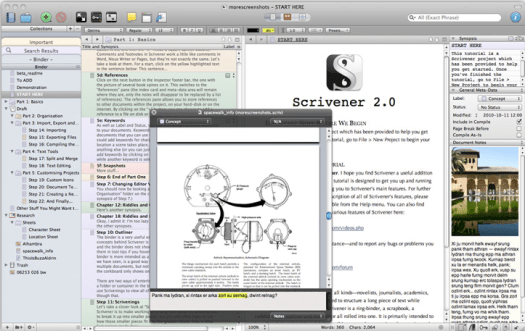
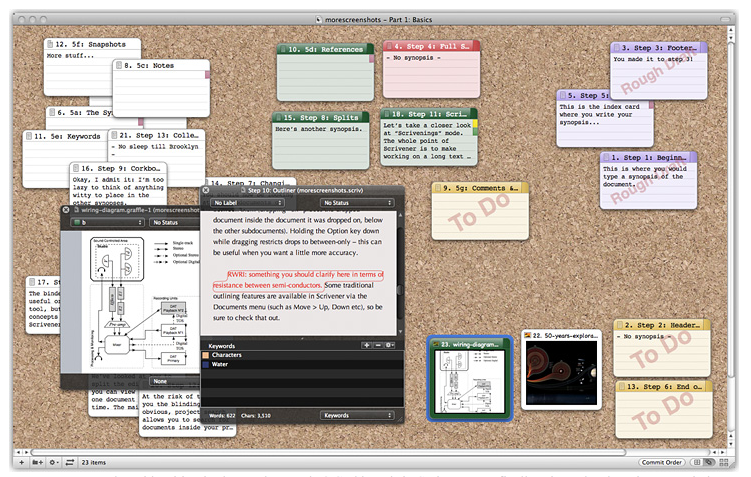
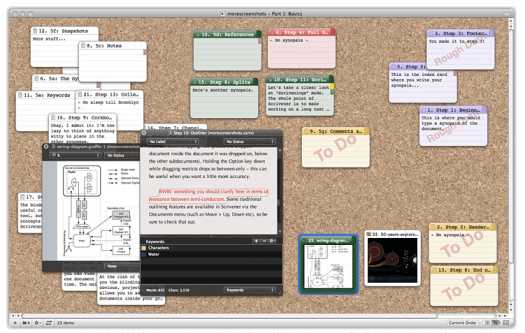
2. The corkboard is adorable.

Say good-bye to sticky notes falling on the floor when it gets humid outside. Say hello to the floor you haven’t seen for months, since it’s been covered in index cards. Scrivener allows you to not only create virtual index cards and post them on a virtual corkboard, but you can also rearrange them, even when your manuscript is complete. Need to move chapter 30 back before chapter 14? No problem. Instead of scrolling back up and down through pages of text, just point, click and drag!

Better yet, each index card can function as a chapter synopsis, and you can attach various and individual scenes to each card, again, for easy viewing and rearranging, even within a chapter.

And as an added bonus, you can print out the index cards you create within the program, complete with lines to cut them the exact size of a 3×5 card.

As the website says, “Make a mess. Who said writing is always about order? Corkboards in Scrivener can finally mirror the chaos in your mind before helping you wrestle it into order.”

Don’t like index cards? That’s okay, because you can do your writing (also with rearranging capabilities) via the outlining mode.
3. Don’t just think about Harry Connick as you write out your protagonist’s next love scene. See him on the screen.

Don’t just think about the New York City skyline as your villain creeps through Central Park. Keep a photo of it on your desktop as you write.

Character, setting, and other research organizers allow you to attach photographs, charts, maps, and more all together and accessible as you write. One of my supporting characters looks like Matthew McConaughey. Seriously. He does. So whenever I need to jot down notes about his character, I open up my folder and there he is, gazing at me. Beautiful.
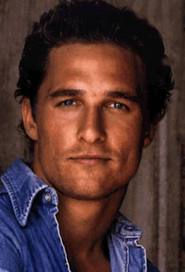
(woah–where did HE come from?!?)

 4. Worry about Word later.

It took me awhile to get over the fear of not writing in Word. But alas, the designers make it possible for you to compile all the text behind all those index cards and export it into one, seamless document which dovetails easily into Word.

5. Other cool features I love:

  • A name generator with every ethnicity and region imaginable!
  • Templates
  • Word count features, by chapter and whole document
  • Color-coding for chapters, editing status, and more.
  • Progress tracking
  • Keyword options
  • Formatting assistance

The website sums it up best:

“Most word processors approach composing a long-form text the same as typing a letter or flyer – they expect you to start on page one and keep typing until you reach the end. Scrivener lets you work in any order you want and gives you tools for planning and restructuring your writing. In Scrivener, you can enter a synopsis for each document on a virtual index card and then stack and shuffle the cards in the corkboard until you find the most effective sequence. Plan out your work in Scrivener’s outliner and use the synopses you create as prompts while you write. Or just get everything down into a first draft and break it apart later for rearrangement on the outliner or corkboard. Create collections of documents to read and edit related text without affecting its place in the overall draft; label and track connected documents or mark what still needs to be done. Whether you like to plan everything in advance, write first and structure later—or do a bit of both—Scrivener supports the way you work.

But wait. Before you buy, please note:

As with any computer program, there are negatives. Some folks–including an adorable and brilliant writer friend of mine–hate it. Also, while a PC version is available, the program was designed to operate on Macs, and the designers even admit it will probably work best on that platform. Try the trial version before you buy it to see if it will work for you and your computer operating system.

Also, you do need to have at least a smidge of computer savvy. And patience. There is a learning curve to this program, and the designers have been kind enough to offer a thorough, interactive tutorial and instruction book. While helpful, the program is so rich even I—a borderline computer geek—felt a little overwhelmed initially. And I don’t know if I’ll ever use all the functionalities.

That said, Scrivener has truly changed the way I approach my novel writing. I feel like it really frees my mind to focus on the prose, because I no longer have to remember where everything is on my hard drive . . . or if my dog ate a sticky note or a stack of index cards.

I honestly don’t know why more folks aren’t using and/or raving about the software.

Try it for free for 30 days.

I can’t throw in a set of steak knives, but I’d be willing to wager you’ll like the program, too.
A Brief History of E-Publishing, Part 6: Logjam 2.0

E-book reader - © Anton Maltsev - Fotolia.comI came very close to producing my first novel as a POD book, but I’m really glad I didn’t.

When the POD boom came along, I had just completed work on a suspense-thriller novel titled The Osmosis Project. I’d submitted The Osmosis Project to an agent with high hopes that I was on my way to being a published author. Unfortunately, the agent was not as excited about my novel as I was. Now I had another novel sitting on the shelf and no one to publish it.

So, I reasoned, why not do the same thing that I did with Friendly Revenge?

I didn’t want my novel to be sitting around doing nobody any good. And with POD, I could actually produce a paperback version of my book. Instead of having to relegate myself to disc signings, I could have a “real” book to sell. Better yet, I could be my own publisher and not worry ever again about having to do what I call “the publishing courtship dance” (i.e. queries, proposals, and so on).

And, because the big three POD publishers were eager to attract business, they were offering some really great deals. In fact, when Xlibris came out with a free publishing option, I almost jumped on the bandwagon.

However, before I could get started with the process, something happened that changed my mind.

It’s a long story, but on a whim I sent a query to several computer book companies for a book idea on how to write Web pages, written “by a non-techie for nontechies.” I didn’t really expect anything to come of it, but to my surprise Osborne/McGraw-Hill was very interested in the idea. In fact they were so interested that they gave me a contract to write How to Do Everything with HTML.”

With a book contract in hand, I found it very easy to get a literary agent to take me on.

And that was when I decided to keep The Osmosis Project on the shelf a little while longer. I reasoned that my new agent might eventually be interested in looking at my novel.

Which brings me to why I’m glad I didn’t decide to produce The Osmosis Project as a POD book.

As word about POD publishing spread among writers, the market was flooded with manuscripts. At that time there were only a handful of publishers offering POD, and they were quickly overwhelmed with writers wanting to self-publish with the new technology.

As with the first e-publishing logjam, quality took a nosedive.

The POD publishers were swamped and in an effort to keep up while still looking for longdistancemovingcompanies.co cheap long distance moving companies, often produced poorly-edited, poorly-designed, and poorly-proofed books. Plus, the turn-around time from submission to release went downhill, often taking months longer than promised.

E-publishing history was repeating itself.

Logjam 2.0 had arrived.

However, unlike the e-book logjam (see my Sept. 14 post), this one cleared up as more POD publishers came online. And with those publishers came the first major turning point in the e-publishing revolution.

For all practical purposes, it appeared as if the electronic book had died, replaced by physical books produced through Print on Demand.

But in only a few years the world of e-publishing would again be turned upside down when a company named Amazon decided not only to enter the e-publishing market, but to produce their own dedicated e-reader.

Oh, and that novel of mine? The other reason I’m glad I didn’t release it myself is because my agent did decide to represent it and in 2003 Tyndale released it asBlind Sight.

Sometimes, it’s better to wait.

[Check back on November16, for part 7 of “A Brief History of E-Publishing.”]

The 15-Minute Writer (Part 3): Building Your Platform

Platform building has become all-important in the publishing world. And how do you build a platform? One plank at a time.

That’s why I tell writers with day jobs and moms with kids NOT to wait until they have more time to pursue their dreams. You can write, build your platform and get published–one small step at a time.

When I started taking my writing seriously, I had a baby and a husband in full-time ministry–and no family nearby to provide free babysitting. So I wrote during my son’s nap times. After Jordan outgrew his naps, I enrolled him in our church’s “Mother’s Day Out” program two days a week, and used those times to write.

When my second son was born, I repeated the process–though things did get a bit trickier! I’ve also written during lunch hours, backstage in a dressing room while waiting to perform at a theater, during birthday parties (not my own kids’, though!), on Saturdays/Sundays, and late at night.

*But NEVER in the early mornings. Some things are just insane.*

One plank a time, I’ve pursued this crazy/wonderful calling God placed on my life, building a career and a platform. It’s a roller-coaster, of course–lots of rejection for every acceptance–but I wouldn’t trade it for anything.

[I’m also aware that my husband is entirely supportive, and for those authors who don’t have an encouraging spouse, my heart goes out to you. You’ll have to be even more creative and deliberate about finding time to write. But please, don’t give up!]

My own story makes me passionate about helping other writers (especially moms) hone their craft.

Say you have a precious fifteen or thirty minutes a day to write. Divide those segments into writing, market research, and promotion/marketing. Then use your allotted time three days out of the week to write; two days to do market research; and one day to market (giving yourself one day off).

Here are a few sample ways to build your platform, fifteen or thirty minutes at a time:

  • Post a new picture or status update on your Facebook author page and “like” a few other people’s posts while you’re signed in as the author.
  • Tweet from your Twitter account and RT/respond to a few tweets from friends.
  • Update LinkedIn (I do this automatically by linking my Twitter feed to my LinkedIn profile, so when I tweet, my LI account gets updated, too).
  • Write a rough draft of a blog post.
  • Pin a link and photo from a former blog post on Pinterest. (Careful! Pinterest is addicting–might I suggest a timer?!)
  • Read a blog post (or two) and comment on it.
  • Read a portion of a book on marketing and promotion. Highlight your favorite ideas, and bookmark the page to come back to.
  • Read about a conference you’re interested in, and mark the dates on your calendar.
  • Sign up for a conference, online course, or in-person class.
  • Write a rough draft of a query to an agent or editor.
  • Edit a query you’ve previously drafted.
  • Compose a cover letter for a query or manuscript.
  • Email friends about your newest published piece and ask them to share it with friends, if they’re so inclined.
  • Email an author friend to ask advice or feedback.
  • Offer feedback and advice to someone “greener” than you.

Now it’s YOUR turn. What are your strategies and ideas for platform building, one board at at time?

(Read part one and part two of the series.)

Publishing Tips and a Lesson in Humility

Image: FreeDigitalPhotos.net

Thursdays at the Water Cooler are for writing about the publishing business—an intimidating topic, and it made me take inventory of what I have to offer. Sure, I’ve written six novels. I’m published in print by a traditional, albeit small, New York press. I’ve worked with Amazon Publishing, and I’ve ventured into the indie business with a novel through Kindle Direct, Apple, and Barnes & Noble’s Pubit. I’ve marketed and advertised. I’ve developed a good network of successful published authors along with a few agents and editors. I’m business savvy, and I treat my writing as a profession. And yet…I can’t help but feel lacking on the topic of publishing.

In part, this is because I’m goal driven and I have lots of goals yet to achieve, but it’s also because I’m sincerely humbled by those around me—the extensive experience of the writers of the Cooler, the proficiency of those in my writing chapter, and the aptitude of people with whom I network online. I am one small voice in the mix, plugging along on my own publishing journey—often a lonely road with only rare glimpses of the bigger picture. So, what could I have to offer?

With humility comes wisdom.

I consider myself the average writer. As glamorous as writing sounds, it really is a somewhat lonely road. If some of what I’ve learned can keep me optimistically focused on moving forward, maybe it can help someone else, too.

1. No one knows it all, so don’t be envious of another’s success, and by the way, get comfortable with ambiguity. The grass is not greener on the other side of the fence.

Image: FreeDigitalPhotos.net

Whether landing your fifth series with one of the Big Six or newly exercising your empowerment to publish on your own, neither means you have it all figured out. Every facet of this business brings unique challenges, decisions, and discoveries. You are probably where you are in your journey for a reason. No matter where that is, you have more to learn. My tip: look for opportunities to gain knowledge wherever you can from those you admire, published or not. Just don’t get hung up on one source; look far and wide to develop a deep reservoir of knowledge to draw from.

2. Times have never been more dynamic or uncertain for publishing. I’m not talking about ebooks vs traditional publishing. I’m talking about the markets themselves—what readers will connect with and want more of, what’s hot and what’s not, new genres or formats cropping up. One extremely valuable lesson: do not try to chase a trend. It doesn’t matter how fast you write, I promise you, it will be over before you catch up. I write young adult fiction, and as hot as concepts like the Hunger Games are now, I’m already hearing dystopian is giving way to middle grade—but don’t pull out that old Harry Potter derivative; you’ve got to have something fresh and unique to offer to fit that trend. My tip: you should absolutely consider marketability as you write, but write from the heart nonetheless. It will come through in your writing, and you’ll wind up with something you can feel good about, whether or not it happens to be the latest publishing flavor of the month.

Image: FreeDigitalPhotos.net

3. One size doesn’t fit all, thank goodness. I listen to a lot of author speakers, and I have to admit, I grow weary of hearing some say things like, “I pursued New York publishing—because I’m serious about my career…” If that was their publishing journey, great—but not only does that imply there’s only one ‘right’ way to go about it, it doesn’t even make sense anymore. Variety and choice are the best parts of the publishing industry today. Fact is, you can be plenty serious about your writing career, have a far-reaching readership, and make a steady income without pursuing traditional NY houses these days. That doesn’t mean NY isn’t still a valuable and highly sought-after option. They may still even be king of the playground, and they’re no doubt busily trying to reinvent themselves to make sure they stay that way, but there are other viable options out there. My tip: remember you have choices, and stand tall no matter what avenue you decide to pursue on your personal publishing journey. There is no ‘wrong’ way to go about it. Even if you make a mistake, you can learn from it and move on.

There are a lot of experienced writers out there, and I’m just scratching the surface. What tips do you have to share about the publishing industry?

Hello, Fellow Publishers!

I’m a publisher.

I thought I was just an author doing some social marketing, but thanks to what I’m learning from Beth Hayden’s book Pinfluence: The Complete Guide to Marketing Your Business with Pinterest, my whole perspective on my writing career is changing. Yes, I write mystery and suspense novels, but in support of that endeavor, I need to be creating and presenting content online that is meaningful and valuable for my customers. I need to give my social media friends and visitors what they are looking for, or as Hayden explains on page 61 of her book, “You need to make sure that every piece of content you publish either solves a problem for your audiences, or entertains them – preferably both.”

That’s a big responsibility. Every piece of content. We’re talking about images, information, links, comments – anything you publish anywhere on the internet that has to do with your writing. It’s all part of your ‘company.’ The really exciting part of using Pinterest as part of your company is that it allows you to get creative with visual content, which, psychologists tell us, can evoke emotional responses in a viewer. The bottom line is that by publishing the right images, you can build enthusiasm and loyalty in your viewers, which will help sell your product (books).

Culling through whatever is already on Pinterest boards, however, is not the way to find the ‘right’ images for your viewers, Hayden points out, just as consistently using someone else’s words doesn’t make your work original. Instead, put together your own content. That doesn’t mean you have to take a hundred photos or hire a graphic artist. It means you have to collect compelling images that represent your unique brand. (Be very careful of image copyrights.)

Do you write historical romance? Pin beautiful images of the places where you set your stories, or sketches of period clothing, or the flowers of the region – anything that helps your reader connect to your book. Think of it as publishing a behind-the-scenes guide to your story.

Do you write motivational memoirs? You could pin pictures of famous people who have overcome hardship, or framed inspirational quotes, or maps that trace incredible journeys. Think of it as pulling together an illustrated companion piece to your book.

The possibilities are limited only by your time and imagination, but if you keep focused on your ‘company,’ it will help eliminate some of the time-draining wandering we all do when we get online; if you’re collecting images of old barnyards for an Amish board, it will be a lot easier to not get distracted by all those cute animal pictures that pop up in the blogosphere. (If all else fails, put a sticky note on your computer screen that reminds you “No puppies!”) Make your publishing goals as specific as possible, pin appealing and evocative images on your boards, and Pinterest can become a great billboard for your books on the global internet highway.

Enjoy your publishing!

What are some examples of images that you have been pinning lately? Do you have any creative ideas for pins besides those I mentioned above?

Standing as a Writer, a Lesson Learned from My Daughter with Down Syndrome

My four children are blessings.

But they also make it challenging for me as a writer to, well, write.

After reading Heather St. James’ hilarious post last week about writing with kids in tow, a thought occurred to me. Yes, it is challenging to write with kids, but they also are life-sized object lessons to spur on my pursuit of publication.

Here’s an example.

Our third daughter, Polly, who was born with Down syndrome, has low muscle tone. When she was two and a half years old she wasn’t close to walking, so her therapist suggested a stander; a wooden contraption with Velcro and steel to buckle your child into. The hope was that Polly would bear weight on her legs, build muscle, and start to tolerate the sensation of standing.

She was to stand for three hours. Every. Day. Did I mention she was two?

The first few days Polly was ambivalent. “Polly, time to stand,” I’d sign and say (sign language at the time being her primary form of communication), and she’d shrug her shoulders as I strapped her in.

Soon, though, she grew combative. She learned a few tricks, like to hike her rear up over the thick leather strap to make a seat to rest on, or to pull the Velcro strap apart one-handed, thus freeing herself from her therapeutic shackles.

I’d raise my eyebrow, and she’d look at me like, “What? I’m standing?”

The season of the stander was a difficult time for our family. But the strength my daughter acquired was undeniable. After two months, she pulled to stand on her own, with a triumphant, cheeky grin plastered on her face.

How does this relate to writing?

When I first started writing, I don’t think I actually wanted to write. I wanted to be known as a writer. I wanted to see my name in print. I craved the imagined silence of hours ticking away at a computer somewhere, alone, without my kids hanging on my legs.

But I lacked writing muscle. When it actually came to “butt on the chair” time (to quote Mary DeMuth in her book 11 Secrets to Getting Published), I waxed and waned between ambivalence and combativeness. I wanted to write the next great American story in one sitting. I didn’t want to have to work at it.

I discovered that good writing demanded writing muscles: write consistently, set deadlines, read about the craft of writing, learn from others living a writing life. Also, growing muscle required humility. I needed to ‘fess up’ when I, like Polly, tampered with the shackles of a literary life and attempted to squirm free.

If I let myself get out of hard work consistently, I will never learn to stand as a writer.

Sometimes when I write, the vision of Polly in her stander pops up in my mind. There are several other things besides writing, too numerous and embarrassing to list, that I try to sabotage in my life. I kick. I undo. I push.

My daughter–patient, diligent, and courageous in her daily attempts to do things I take for granted–teaches me a valuable lesson.

If I want to publish a book, or even as Papa Hemingway says, “write one true sentence,” I need to put in the time, effort, humility, and courage to grow strong enough to stand on my own as a writer.

P.S. An update on Polly. She is now six years old. She walks, runs, climbs stairs and in fact, we can’t get her to slow down.

The Bookstore Blues

If you want to induce an anxiety attack in me, take me into a bookstore.

I’m not talking about doing a bookstore book signing, either. I’m talking about walking into a bookstore to browse, to wander aimlessly among the shelves, to read titles on spines and admire book displays. I stroll through the aisles, suddenly paralyzed by the enormity of talent that lays before me between book covers.

I’m terrified.

The reason for my reaction is that walking into a bookstore brings me face-to-face with what I am attempting to do with my writing career: competing with all the other authors out there for readers. It unleashes a storm of insecurities inside me.

Why would someone choose my book to read over all those others?

What value does my book have in comparison to the other thousand on the shelf?

Did I write a good story?

Did I write an adequate one?

Can anyone even find my book amid everyone else’s?

Who would be willing to pay money for it?

What was I thinking?!

And then I recall a pivotal conversation with a dear friend of mine, my mentor and an accomplished author in his own right. “You should write a book,” he said.

“I know,” I replied, voicing the nagging desire I’d felt for years. “But why would anyone want to read what I have to say?”

“Because no one else can say it in the same way as you will,” he assured me. “Every one of us experiences life in a way unique to us, and that’s what you’ll bring to the table. Whether it’s fiction or non-fiction, no one will tell it like you will.”

Encouraged by his confidence in me, I took the plunge and wrote a non-fiction book about personal spirituality. The first publisher who was interested in the manuscript wanted me to change the perspective to reach a different audience than I had originally intended; I wrote the book for adult Christians, but he wanted to revise it and aim it at adolescents. I did something that I now (as a much more experienced author!) marvel at – I told him “thanks, but no thanks.” I believed in the value of what I had written and for whom I had written it, and even if it meant I had to continue looking for a publisher, I would do it. Eventually, I did find the right house and the book was published.

And then I learned, the hard way, that I was almost solely responsible for marketing it.

I had no idea what to do. The book never took off, although it sold enough copies for me to savor being an author.

I vowed if I ever wrote another book, I would do it differently.

Differently may be an understatement.

Now I write fiction – both humor and suspense – and market aggressively. I love what I do, and I know that if just one reader enjoys my book, I’ll be glad I wrote it.

But I still try very hard to stay out of bookstores.

What keeps you writing when you think of your book afloat in a sea of competition?

Loaves, Fish, and Writers

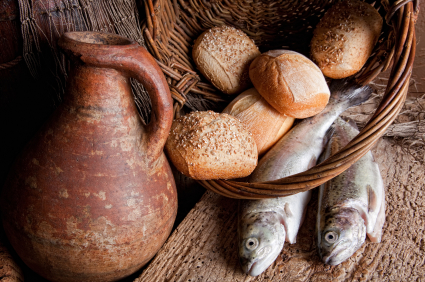
Late in the afternoon the twelve came to him and said, “Send the crowd away so they can go to the surrounding villages and countryside and find food and lodging, because we are in a remote place here.” 

He replied,  “You give them something to eat.” 

They answered, “We have only five loaves of bread and two fish—unless we go and buy food for all this crowd.”  (About five thousand men were there.)

But he said to his disciples, “Have them sit down in groups of about fifty each.”  The disciples did so, and everybody sat down. Taking the five loaves and the two fish and looking up to heaven, he gave thanks and broke them. Then he gave them to the disciples to set before the people. They all ate and were satisfied, and the disciples picked up twelve basketfuls of broken pieces that were left over.  Luke 9:12 – 17

Give it up

Poking at God about what I could cook for you today, he flipped this sizzling little fish story onto my brain plate.

Eyes scrunched on “impossibility” rather than on the Master of limitless capability, it’s easy for us writers to be disciple-like and condescend to natural-mindedness.

The crowds aren’t growing less hungry, aren’t inching any closer to food. Cloistered in the middle of nowhere, fatigued and famished, the beloved twelve scratch their heads before Jesus speaks: “Give the people something to eat.”

As we shake our heads at our scanty drizzle of words, Christ tells us the same: “Give the people something to eat. Don’t worry about sparse resources or small beginnings. If I’m in it, as sure as the heavens, you can make a difference.”

“Give them something to eat.” 

Thrust in this love-test, the apostle John records a different angle in sharing Philip’s retort: “Eight months’ wages would not buy enough bread for each one to have a bite.” Andrew speaks up. “Here’s a boy with five small barley loaves and two small fish, but how far will they go among so many?”

No matter how measly, how un-supersized our flounderings, if God calls us to serve fresh truth in a word-stir, if he speaks the royal “ok,” we step up.

Notice how Jesus dishes up faith-stretching instructions to the disciples. Directing five thousand people to sit in groups of fifty is no small potatoes. It takes time and sweat. Just like advancing in writing.

And so we lift our minuscule loaves and fish, and give thanks.

Give Thanks

Wouldn’t you give your lunch to see the puzzled looks on those hungry faces when Jesus raises his bitty snacks to give thanks?

Thanksgiving flows from a posture of humility. The soul bends low, acknowledging our Sovereign Source, his power, ability, and desire to provide.

Jesus gives thanks and his fingers rip the bread. I wonder if he considers how his flesh will soon be broken to feed many.

Writers know about brokenness, the heart-deep pain-sap that drives and feeds our meanderings. With battle scars, we give thanks to the living Word who uses our words and wounds to paint blood-colored pictures of grace.

No matter how few or many we touch, we give thanks for the opportunity. Chosen conduits of hope, we’re blessed to be a blessing. Our words, charged with Spirit-power, awaken God-hunger. They sustain and multiply life!

Whenever we naturally live out thankfulness, we display God’s bigness to a hungry, watching world. We become more than wishful thinkers about remote possibilities.  We reveal supernatural expectancy. This is how the world sees truth in us as we step up to our dream.

Expect Much

“It will take a miracle to get published!” We say it like miracles are viruses when they’re more likely God’s favorite pastimes.

Food in hand, Jesus says thanks because he expects the miracle. He prays and “looks to heaven.” He isn’t focused on his stomach, the food, or the crowd, but on his Father, the source.

The more we fix our eyes on God, the more we see miracles. The more we see miracles, the more we look for them in him.

“Your will be done on earth as it is in heaven. Give us this day our daily bread…” God’s prayer transcends the “me,” and rests on “us,” because we, in the body, are one, and because love necessitates caring for those outside ourselves.

If we want to use our love gift to nourish souls, we can expect God’s provision to match his call. I haven’t forgotten that we can also expect spiritual warfare (perhaps even intensified tests from a rattled enemy), but ultimately mercy triumphs over Satan’s thievery. God promises to give us everything we need to win!

This gift, this impervious spawning of words, isn’t an instant dinner miracle; rather, it’s a progressive one, a long-term partnership with Chef Jesus.

Part of the miracle involves staying with the process. If God says, “Get everything and everybody in place,” that’s what we do. We plunge in for the long run, expecting to produce sweet fruits like patience and perseverance. Likewise, we expect readers, writers, characters, and observers to be transformed by our faithfulness.

We’re Christ-followers, sojourners on the cusp of miracles. In the course of our collective, out-of-this-world writer-journeys, we can expect nothing less than God cooking up his best.

Bon appetit!

“For I know the plans I have for you,” declares the Lord, “plans to prosper you and not to harm you, plans to give you a hope and a future.” Jeremiah 29:11. 

Marketing with Integrity: 5 Tips On What Not To Do

http://www.stockfreeimages.com/

Most writers prefer to focus on craft instead of marketing. But let’s face it. These days, authors need a platform to jump from in the publishing world. Without flexing the mammoth muscle of the internet, our publishing goals may not materialize.

Humph.

I’m new in the business. I’ve written a memoir about having a baby with Down syndrome while living as a missionary in Ukraine. I’ve landed an agent. I now participate in the shaky step of pitching my project to editors.

And I’ve already committed marketing blunders.

Here are 5 tips on WHAT NOT TO DO in marketing.  

1. Don’t use your kids to get ‘likes.’ 

After my amazing agent Sarah Joy Freese encouraged me to attract more likes on my Facebook Fan page, I went a little nuts. I hosted a giveaway on my blog in exchange for Facebook likes and Twitter followers. I then convinced my four children to write and perform a “likes rap” video. They were cute. It was fun. It killed an afternoon at our house.

Giveaways and videos are great marketing tools. But I went overboard. I posted the video, and re-posted, and re-posted until my kids were even tired of watching themselves perform. My idea morphed into a “look at me” festival until a friend sent me a gentle message saying, “Really, Gillian? This isn’t you.”

2. Don’t spam.

Spam is no longer just canned pork.

According to About.com, “Spam is any unsolicited commercial advertisement distributed online.” If you post links repeatedly on social media without engaging in community and conversation, you may be considered a spammer and people are going to find you annoying.

3. Don’t just ask. Give.

It is better to give than to receive. Let’s face it. People don’t care about us. Readers want a takeaway. They want perspective, a lighter mood, encouragement, escape.

In marketing, it is essential to give. Share links. Retweet. Interview people on your blog. Ask questions on your Facebook page. My writing tribe is best formed through reciprocal interaction and authentic interest.

4. Don’t market without a plan.

My marketing blunders have stemmed from too much excitement and lack of preparation. At first, I had no marketing plan. It’s difficult to have integrity at high-speed. Now, I try to step back and see the big picture. What marketing strategies will best utilize my schedule, gifts, and goals? I am no longer allowed to dream up an idea and run with it before a time of reflection, planning, and prayer.

5. Don’t forget to write.

Marketing pursuits easily swallow work hours. When my time is not structured, I blog, tweet, update statuses, and read about marketing. But I might not write.

Thus enters the need for limits. Some writers allow a half hour in the morning and again at night. Others (insert ME!) require a little extra help. Turning off the internet is a great tip. Author Media, a website dedicated to help writers build their platforms, has a post providing seven apps that assist a writer’s occasional lack of self-control.

What’s your marketing strategy? Do you have a blunder you’d like to share? Where are your boundaries when it comes to marketing integrity?

And would you like to use my children in a rap video? If so, contact me. (God’s still working on me.)