Stepping Stones to Writing Success

Stepping stones

Along the journey from staring out the window thinking of a marketable idea for a new book to unpacking the box of freshly printed books sent by the publisher, a writer needs to set small goals to serve as stepping stones to writing success. While each person will have a unique approach to setting project milestones, here are a few ideas to get you started:

  1. Conduct market research: Stroll through several local bookstores, flip through the pages of catalogs, and browse the websites of online book retailers to see what books are on the market now in the category of your book proposal. You will need to find about five comparable books to discuss in the Comparable Titles section of your book proposal. However, marketing research is helpful for you as you define what you hope to accomplish and cover within the pages of your potential book. You do not want to duplicate the work of another author. By reading what has been said by other writers about your topic, you can better understand what you have to contribute to the topic. Do not be discouraged from writing a book in a popular category. The existence of many books on the topic indicates a market for that subject.
  2. Set realistic deadlines: As you prepare to publish your book, you will encounter many deadlines. Within your book proposal, you will specify how long it will take you from signing a new contract with your publisher to handing in the first draft of the manuscript to the editor. A time period between five to six months is a good goal for completing a nonfiction manuscript. Make sure that you are confident you can complete the manuscript on time. Once you sign the book contract, break down the goal of writing the book content into smaller deadlines for yourself. Be sure to allow some margin for the interruptions and distractions that arise in the life of all writers. The sooner you finish your first draft, the sooner you can move on to the other tasks necessary for publishing your book. Set ambitious but achievable deadlines.
  3. Connect with key influencers: As I wrote about in an earlier post, “Finding Champions for Your Book,” many people will contribute to the future success of your book. Hopefully, you already have strong relationships with many of these key influencers. Use the time from the beginning stages of book proposal preparation to the completion of the manuscript to strengthen existing relationships with champions for your book and forge new ones. Connecting with people will provide a welcome break from the tedium of writing. You will remember the purpose for your pursuit of your writing goals. You can sharpen your ideas by discussing them with a few trusted advisors. You will prepare yourself for the upcoming transition from writer to marketer of your own book. The sooner you prepare to connect with potential readers, the better for everyone involved in publishing your book.

What do you consider as important stepping stones to writing success?

How to make Amazon work for you

grand-central-stationAre you using your Amazon Author Page to increase your visibility and grow your audience?

You DO have a page, right?

If not, then drop everything else this very minute, and set up your free Author Page by visiting https://authorcentral.amazon.com. Seriously, you need to do this. It’s easy. It’s good publicity. And did I mention it’s FREE?

Basically, your Author Page is like a personal Grand Central Station that showcases your work and acts as a hub for your writing, providing links for fans to follow. Here’s a short list of some of the key benefits you’ll get from your Author Page:

  1. You can link to your blog here, making it readily available to a browsing reader who may have never heard about you or your blog before. In fact, you can enter multiple blog feeds for even more exposure; I link to my website blog and my Goodreads blog, for example.
  2. You can post videos in the Author Updates section. I’ve used it for a place to run book trailers and interviews. There’s no limit on how long you keep material on the page, so that means you get forever use from the marketing pieces you’ve created.
  3. You can list every book you’ve written, and all your book covers will show up on your page, along with links to each book’s buying page on amazon.com. It’s like having your own little store.
  4. Readers can ‘follow’ you right on the page and they’ll get notice whenever you post a blog or update or add a book. In addition, Amazon offers a variety of marketing options for authors if you’ve got a small budget; one example is here at http://indie.kindlenationdaily.com/?page_id=5460
  5. You can list your events schedule to maximize exposure.

Like every social media site, your Author Page also has a spot for your bio and photos. This is a prime place to list your other social media contact information for your website, Facebook, Twitter, Instagram, etc. In fact, be sure to update this bio (and your book listings) on a regular basis, since Amazon won’t automatically add your new books to your page as they are published.  You are the curator for this little store, so be sure your material is current. In fact, after checking on my own Amazon Author page just now, I realized my newest release Heart and Soul (Archangels #2) wasn’t included. You can be sure that from now on, I’m doing a monthly check-in to see what needs to be updated or revised!

A final cool feature of your Author Page is that you can click on the Sales Info tab to get a feel for how your book is selling. My favorite BookScan data on the page is the Sales by Geography item; by studying that map, I can tell where my books have sold and it gives me ideas for localized sale pushes or event planning.

Are you using your Amazon Author Page for smart marketing?

Podcasting: Another Way to Reach Readers?

Discoverability. We know that’s the key to selling books—getting your title in front of your intended audience. Your old faithfuls, God bless ’em, will stick with you when you publish. But you want your message, your story, your ministry to gain ground by finding new readers. You want to reach out to folks who didn’t know about you before or have been dragging their feet to buy your book.

So you strive for marketing plans that work, SEO that brings people to your website, favorable algorithms that make your book show up in Amazon recommendations, and the always-valuable Word of Mouth.

I have a website and a blog. I’ve done interviews and guest posts on other websites. I’ve promoted through social media sites Twitter, Facebook, and Pinterest. But if someone doesn’t come to me on the internet, how can I get to them?

Microphone in the old studio with on air signEnter three colleagues, women who also write about sexual intimacy in marriage on their blogs. This past year, we sprouted the idea to put together a group podcast. Call it a round table, but we prefer kitchen table. Because that’s what it feels like to us—sitting around a kitchen table with our cups of coffee and talking about one of our favorite subjects, God’s gift of sex in marriage.

As a podcast listener myself, I immediately saw the potential for reaching a new audience. As busy as people are today, it’s often easier for them to plug in earphones, click on an app, and listen to a podcast than to peruse a bookstore, read blog posts, or even follow social media. And listening week after week, they begin to feel that they know the hosts. They’re sitting around that proverbial kitchen table with them and at some point think, I really want to read their book.

Now I’m not involving myself in this podcast merely to sell books. Our main purpose is to spread the good news of God’s gift of sexual intimacy in marriage and to help wives address issues that prevent them from fully embracing that gift. But I’m not oblivious to the fact that this new medium will get my name and title in front of a new batch of potential readers.

In case you’re interested, here’s a summary of what we’ve learned (so far) about podcasting:

You’ll have upfront costs. They include a professionally designed logo, the podcast hosting service, sound equipment, and editing software. Michael Hyatt offers a great breakdown of options for getting started at different tiers. We took the medium-route, with hopes of later adding better recording equipment and a professional voice-over introduction.

There’s a big learning curve. At least for four women with no audio-visual experience. We have spent months researching podcasting, discussing our launch and marketing plans, recording episodes in advance, and learning how to use editing software.

Treat it like a book launch. Remember how you had to write your bio, back cover copy, schedule blog tours, make sure your website was ready, etc.? A podcast launch also requires preparation. We designed a website, set up social media accounts, brainstormed topics, and recorded three episodes before we said boo to anyone else about our plans. And by the time that we launch, we’ll have up to 10 episodes already recorded.

Consider partnering with others. Ecclesiastes 4:9-10 says, “Two are better than one, because they have a good return for their labor: If either of them falls down, one can help the other up.” Yes, it’s required more flexibility with our schedules to get all four of us together to record, but it’s been lovely to share the work and the costs and to have the encouragement of other Christian women. On the business side, we’re able to cross-promote, with each of us getting access to the other threes’ audiences.

Our brand-new podcast, Sex Chat for Christian Wives, will first air on February 14 and every other week thereafter. We’ll see what God does with this project. But I hope to be able to report this time next year that this endeavor not only sold more of my books, but helped many marriages and marriage beds.

Finding Champions for Your Book

Euphoric winner friends using a with a tablet

A winning team has dedicated fans. A successful candidate has loyal supporters. Artists and museums have influential patrons. No one flourishes alone. You and your book will not be exceptions to this rule. You will need champions who will promote your book within their circle of influence, open doors for interviews and speaking engagements, and remain loyal fans when you release your next book.

Let’s consider some of the qualities that make an ideal champion:

Dedicated: You will find a great champion for your book in a person who is dedicated. Publishing and marketing a book is a long process. Six months before the book is available, Amazon and other bookstores with an online presence will make the book available for pre-release order. A dedicated champion is someone whose interest in your book will last from reading an early manuscript to attending a book release party. It’s great to have all kinds of people interested in your book, even those who will only join you for part of the publishing journey. However, your inner circle as an author should be populated with people who have a reputation for following through on their commitments, finishing the projects they start, and sustaining interest in your topic for many years.

Loyal: Writing a book is an exciting process. Many people will enjoy knowing someone who is a published author. Who knows if they will appear in the book dedication, inspire a character within the story, or benefit in their chosen career from knowing an expert on the subject of your book (you)? Again, it’s great to have all kinds of people interested in your book, even those whose interest in your book may arise from dubious motivations. However, if you are to succeed as an author, you will need to sort out the loyal champions of your book from those who will be quick to jump to the next project that promises more rewards. Include everyone in your publishing process if you can, but invest in those who have demonstrated loyalty to you in the past.

Influential: A dedicated and loyal friend is a priceless treasure. However, when you search for potential champions for your book, you will need to look for someone who is influential as well. Influencers exist in many different spheres, and a person influential in one setting may not be influential in others. A person influential within his or her field who knows top leaders within an organization may lack an online presence. A person in the early stages of his or her career may have gathered a great social media following. Both the senior leader with contacts in the field but a negligible online presence and the upcoming leader with the great social media following are influencers. You need all kinds of influencers. Look for potential champions for your book at various stages of career development. Show appreciation for the young blogger along with the radio host, the conference organizer, and the bookstore owner.

How do you spot a potential champion for your book?

Bad News for Good Writers

audience

Dear Gifted Not-Yet-Published Writer Who Has a Timely Message Audiences Need,

I think your writing is fantastic. You’ve allowed me to peek and I think that you have an important message and that you can deliver it well. I wish that was enough. It should be, right?!

It’s not enough.

In today’s publishing world, publishers who want nothing more than to publish great writing aren’t able to say “yes” to every book with a great message that’s written well if the writer has not worked diligently to build an audience. Some publishers do take that risk on a book they believe in, knowing that it might not pay out for them.

And if you’re like me—with way more confidence than might be merited—you believe that your awesome book will be the rare shining exception. Once the first reader reads it and tells all her friends, you figure, it’ll start selling like…a bestseller. And possibly it will. Much more likely, though, you’ll not find an audience for your writing unless you work to build one.

So—momentarily abandoning my signature irrational optimism—I’m just going to outline the bad news so that you have access to the facts you need.

1. Agents and publishers need to sell books.

Every agent and publisher I know loves great writing. In order to stay in business, though, they must publish and sell books that sell. It would be great if these two were synonymous, and sometimes they are. Not always.

2. Writers with audiences sell books.

Whether you publish with a traditional publisher or decide to self-publish, you must have access to an audience that trusts you in order to sell books.

3. Demonstrating an audience is requisite to securing an agent or publisher.

For an agent or publisher to consider representing you or publishing your work, you need to demonstrate that you’re reaching an audience.

4. Building an audience takes hard work.

Occasionally someone will build an audience with seemingly little effort—because they win an Olympic gold or are elected as President of the United States. (Okay…there was some effort.) The rest of us have to work REALLY HARD to grow an audience. Smarties, like @jeffgoins, with much more experience than I have can teach you how to do this. (Mention other smarties in the comments, below.)

5. Selling books is really hard.

Whether you publish with a traditional publisher or self-publish, selling books takes work.

Now start at the top of the list and read them all again. Congratulations, you now have a handle on the bad news.

The Good News

The good news is that there’s always something you can be doing to build your audience:

  • Pitch article after article to editors.
  • Speak to audiences, for free at first, about your subject.
  • Offer a freebie download at your site to build your mailing list.
  • Guest post on blogs of folks you know.
  • Make friends online by sharing their great stuff. (They will love you for this. And owe you.)

If you were bummed out by all the bad news, do one thing today to build your audience.

Cheering you on,

Margot

This post first appeared on Margot’s blog, http://wordmelonblog.blogspot.com/.

Overachieving Your Platform: Best of the Water Cooler Series Book #2!

overachieving-your-platform-coverMany years ago, a good friend went into a coma after giving birth. She was on life support for nearly four months. We all prayed and wondered if she would pull through to see her baby girl and live a full life.

By her side was her husband. Every day he was at the hospital talking with doctors and nurses, making sure medication was properly being administered, asking questions . . . basically, being every doctor’s worst nightmare when it came to patient care. But you know, on several occasions, he insisted on something that actually saved his wife’s life. The third leading cause of death in America is medical care accidents and misdiagnoses. He needed to care for his wife because if he didn’t, the worst could happen.

I mention this story because I think it can be illustrative of some of the realities of book publishing today. Sometimes, your book is the one on life support, often from the moment of publication. Standing by are publishers and PR folks who are tasked and paid to keep your book alive. They’re busy, they have other patients (authors), and are generally overworked and understaffed.

The point is you cannot leave your book’s marketing and PR ONLY in the hands of publishers. They’ll do their best (usually), but they’re not perfect. And sadly, they have the 80/20 principle that is always screaming at them from the higher-ups. In publishing, it’s true: 80 percent of the money goes to 20 percent of the books. It’s a reality that won’t change, so we have to learn to deal with it.

So what should you do, then, as the author standing by your baby, trying to keep it alive?

You’ve got to tend to it diligently.

With your publisher: ask questions, say thank you a lot (gift cards and flowers are nice) when they do a job well done, give them ideas, don’t mention a problem unless you have a solution, tell them what you’ll do to help, keep track of everyone who helps (radio stations, bloggers, author friends). Work WITH them as much as they will let you.

What else can you do?

Well, we at the Water Cooler have just released a book that will help answer that question. Overachieving Your Platform: 95 Ideas to Embrace Your Inner Sales Marketing Genius is now available from FaithHappenings Publishers, and it offers the tools you need to break out and connect with large audiences. Adapted from the best writing of the WordServe Water Cooler, these doable, practical and affordable ideas will transform your platform and expand your audience if you put them into practice. No, you can’t do them all. But you can certainly go through this book with your highlighter and mark everything you actually could do. Then make a plan. What will you do during your first month from publication, second month, third? Write the plan out . . . and then work it.

Publishers, agents, and retailers agree: you’re only as good as your last book. So if your last book flops in the marketplace, it may very well indeed be your last book!

Don’t let that happen. Stay on guard by your book for the first six months to a year after launch, and you’re far more likely to get that second book contract. You may even get a royalty check.

I’m so proud of all of the authors who contributed to Overachieving Your Platform. They’ve done the hard work in the trenches and have learned from their successes and failures. All they know they’ve shared with you.

Grab a copy today—and take that first step toward creating a platform and brand that will serve you for the rest of your writing career.

Excelling-at-the-Craft-of-Writing-CoverAnd if you haven’t checked out the first book in the series, Excelling at the Craft of Writing: 101 Ways to Move Your Prose to the Next Level, make sure to do that as well. Craft and marketing go hand in hand when it comes to a writing career—you won’t find success unless you’ve got both!

This post was adapted from the Introduction of Overachieving Your Platform: 95 Ideas to Embrace Your Inner Sales Marketing Genius (available now!).

Crowd Source Marketing

finger-769300_1280There’s an old adage in marketing that says in order to get a consumer to pull the trigger and buy something, they have to hear about the product three times. There was a time when the blueprint to accomplish that was pretty straightforward. Get reviews from newspapers or magazines and get interviewed on television or radio. Then, go make public appearances at bookstores or book fairs or local meetings, and don’t forget to keep writing.

None of those were easy to accomplish and they all took a lot of work to hit the magic three, but at least there was a path to follow that thousands of authors from decades past had taken with some success.

Times have changed. Not only have they changed, they keep changing at an ever-increasing pace.

The internet opened up the world and made it so much easier for authors to reach the public directly. That’s the good news. The flip side is there are hundreds of different ways to do it and a lot of them are really good, but may not be right for you.

So, the goal becomes finding the right tools for your genre and your personality and staying up to date about everything that’s new, while still finding time to write, and then have a life.

This is where just a little organization can funnel the hive mind of social media down to the essentials. Look for groups, particularly on Facebook, that are not only devoted to marketing books but are also in your genre. If you’re in traditional publishing, include that on your checklist. If you’re going the indie route, make sure the group is too.

A few other things to add to your checklist are:

  • The group is devoted most of the time to marketing – not selling, not writing
  • It’s invitation-only, so that it’s a safe place to share and there’s some control over the postings
  • There’s a monitor who shows trolls (people who complain or bully) the door and kicks them out of the group
  • Active members who are sharing information and are willing to answer questions – lots of questions
  • Be one of those people and share when you can – admit when you don’t know enough to add to the conversation. In other words, participate.

Some of the benefits you can reap from joining together are:

  • Doing cross-promotions with others in your genre. There’s power in numbers.
  • Getting a heads up about a new site that’s working for someone. And getting a thumbs down for a site that would only waste your time and your dollars.
  • Sharing each other’s ads or promotions on each other’s social media sites. Again, it’s that power in numbers.
  • Gaining a realistic view of how well you’re doing. It’s the equivalent of your water cooler.
  • Getting applause when things go well and getting some inspirational chitchat when they don’t.
  • Testing out new blurbs for your book or, if you’re indie, testing out new covers and getting early feedback.

Everything is easier when we work in cooperation with others and come together as a team, building on the information, adding in a post to what’s already there. That’s the definition of crowd sourcing.

Since I’ve found my own peeps I’ve been able to course correct a lot of mistakes I didn’t know I was even making and I’ve come up with a streamlined ad campaign that is even more in line with my budget. Best of all, though, I’m having a lot more fun sharing ideas and cheering on my fellow authors.

Double Booked by Two Authors

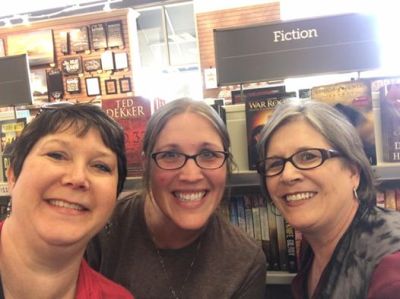
Photo/KarenAnita“Did you find your book?” I asked.

“No, but yours is on this aisle,” Anita responded.

Then the young lady standing near us asked, “What books do you need? I’m looking for one about anxiety and worry.”

“Well, I’ve got the perfect book for you,” I grinned. “I just wrote a book about the lessons I’ve learned about worry.”

Anita added, “It’s called Words That Change Everything: Speaking Truth to Your Soul. They have several copies of it here. It’s a great read!”

BookCover/WordsThatChangeEverything

The lady looked stunned as she examined the back cover of my book and my photo. “Seriously, you wrote this book?”

“Sure did,” I smiled. “And if you need a book about Getting Through What You Can’t Get Over, I highly recommend this one.” I pointed out Anita’s book: Getting Through What You Can’t Get Over: Stories, Tips, and Inspiration to Help You Move Past Your Pain into Lasting Freedom.

“I sure do! I’m looking for a book to encourage my friend, whose son was killed in a motorcycle accident a few weeks ago.“

Getting Through What You Can't Get Over Book Cover“Well, Anita’s book contains several inspiring stories about people who walked through some really difficult situations. I think it would be helpful for a person going through grief and post-traumatic stress.”

“Are you both authors? And you wrote both of these books?” Our new friend appeared confused.

“Yes, we attended a booksellers’ event here in town during the past few days. So, we decided to stop by this bookstore on our way home to see if they carried our books.”

Glancing at the two books in her hands, our new reader looked back up at us and giggled, “Well, I’d love to buy both of your books!”

“Awesome! Would you like for us to autograph your copies?” I asked.

“Yes, that would be great,” she smiled. “I still can’t believe you both really wrote these books!”

“Well, we’re finding it a little hard to believe that you were looking for books that deal with those topics.”

“I’m serious—these are exactly what I needed!” Then, she added, “This has to be a “God-thing.”

“Yes, a ‘God-thing’ for sure.” We agreed.

Photo/AnitaKarenThen, one of us suggested, “Hey, let’s take a ‘selfie’ to capture the moment.”

After I fumbled to find my cell phone in my purse, I said, “Okay, let’s strike a pose. Smile!”

After our brief photo shoot, we all embraced, recalling our unexpected encounter.

“Can we pray for you and your friend before we leave?” I offered.

“I would love that!”

“By the way, what’s your name? And what’s your friend’s name?”

“My name is Kendra. And my friend’s name is Karen.”

“Well, of course her name is Karen,” I laughed.

As Kendra walked to the register to purchase our books, we heard her telling the assistant manager about our encounter.

Anita and I waved at both of them as we turned to leave the store.

“What an awesome ending to a very productive week,” I commented to Anita.

“I told you we needed to stop by this bookstore!” Anita laughed.

Before we left the parking lot, Anita posted the photo of us with Kendra on Facebook, sharing our experience at the bookstore.

Best bookstore stop ever! Met this beautiful young lady named Kendra. She was looking for a book on anxiety and worry for herself, and another on grief for a friend who just lost a child. Talk about a God moment.

When she found out we were authors, and Karen wrote a book titled Words That Change Everything, and I wrote one called Getting Through What You Can’t Get Over, she took a copy of each off the shelf. After a quick, impromptu signing, we parted ways—all of us stunned in a great way. People like Kendra are why we do this.

 Amen, Anita. This IS “why we do this.”

Tell us about one of your God-moments as an author.


The 15-Minute Writer: Book Marketing in Life’s Margins

woman writer
Photo by Bench Accounting via Unsplash.com.

We writers wear many hats these days. In addition to writing proposals, queries, and manuscripts, we’re expected to market and promote our books through social media, speaking, radio/television interviews, and book-related events. Whew! What’s a busy author to do?

First, don’t get too overwhelmed. No one can do everything, so take that expectation off your shoulders. Take deep breaths. Now…don’t you feel better? Let’s do our part, and leave the rest in the hands of the Author of our life stories.

Second, after you write it but before your book releases, experiment with different marketing ideas to find out what you enjoy and are good at naturally—Facebook parties? Speaking engagements? Library visits?—and concentrate on those things. The fun you experience will come through, and you’ll sell more books (and even if you don’t, you’ll have more joy. And who doesn’t want that?).

Third, pray for wisdom, discipline, and creativity. After all, God gave us the idea and the opportunity to write a book, and He cares about the people who will read the message we’re sharing.

Finally, clear a few minutes in your schedule and write “marketing” on your calendar in a small window of time. This way, you’ll do a little bit every day. (It’s like the old question, How do you eat an elephant? One bite at a time!)

To help you get started, here are a few book marketing tasks that take 15 or 20 minutes, tops (just make sure each is related in some way—via a hashtag, link, or text—to the volume you’re promoting):

  • Write a short blog post
  • Draft a newsletter for your email list
  • Brainstorm a free resource to offer your list
  • Update a social media profile to reflect your new release details
  • Write a Facebook status or Twitter update
  • Take an Instagram picture and upload it
  • Read a blog post on another author’s site and comment on it (thanks to Michele Niefert for this idea)

    A photo by Alejandro Escamilla. unsplash.com/photos/N7XodRrbzS0
    Picture by Alejandro Escamilla via Unsplash.com.
  • Rate/review a similar book you’ve read on one of the major bookseller’s sites
  • Ask friends on Facebook or Twitter to review your book for you
  • Share another author’s book, which is related in some way to yours, on a social media platform
  • Update your website or blog in some way
  • Draft a query letter to a magazine on a subject related to your book
  • Ask other bloggers to review your book (Elizabeth Evans shared this tip with me)
  • Create an image on Canva or PicMonkey with a reviewer’s blurb on it and Tweet it (a terrific idea from journalist and author Simran Sethi)
  • Write a thank-you note to a book reviewer, librarian or bookseller
  • Follow-up with a meeting planner or editor you pitched but haven’t heard back from
  • Set up an Eventbrite page for a future workshop or seminar you’ll lead on the book topic
  • Read a book marketing article on line or in The Writer, Poets and Writers or Writer’s Digest

Now it’s your turn: share in the comments. What are your favorite—or most effective—quick marketing tasks?

How I boosted my book to 30x more people

ebookI finally bit the bullet. I boosted a post on Facebook.

For years, I’ve seen that annoying little message you get on your author page about paying to boost your posts. Because I’m cheap (and still suspicious of social media’s REAL intent, i.e. who needs to know what I buy, who I connect with, and what I like? Creepy…), I refused to give it a try. If my books can’t make it on their own merits, so be it – I’ll be content with small audiences, extremely limited financial reward, and the personal gratification that I haven’t caved to crass commercialism.

And then last month after I started getting consistent raves about my new thriller “Heaven’s Gate,” I thought, “What the heck. It’s only $20.”

Actually, it ended up being $60, since I decided if I was going to experiment, I wanted to see what a week of boosted posts could do rather than one day, which is what $20 will buy. Knowing that most buyers need to be exposed to a product seven times before they buy (do you know the Rule of Seven?), I figured one day of boosting was throwing away cash, but seven days might just convert into some sales. I can now tell you, without reservation, that $60 worth of boosting on Facebook can go a long way in giving your book exposure and building your audience, and now I can’t wait to give my other books the same treatment.

Here are the numbers from my week-long experiment:

  1. Organic reach peaked at 305 on Day 7, while paid reach was 9045. That’s 30x more people reached than my normal posting! Not only that, but thanks to my OCD tendencies, I checked one last time on Day 10 (remember I only paid for 7 days of boosting) and was happy to see a new total of 9432. The post was still being shared after my paid boosting! Score!
  2. I monitored my book’s print and ebook rankings on my amazon Author Central page (you do have one of these, right?) for the boosting’s duration. By Day 6, my ebook ranking had reached 924 in the Paranormal category after starting on Day 1 at 3366; the biggest jump was from Day 1 to Day 2, which tells me that first burst of posting made an impact that powered the rest of the week. Recalling the Rule of Seven and the impact of repeated impressions, though, I looked again on Day 18, only to find my ebook ranking better than ever at 831!
  3. As for print, my book moved from its initial 76,331 ranking to 8535 on Day 5. Clearly, somebody was paying attention.

Even knowing that rankings are a superficial measure (rankings don’t equal sale units), I decided that post boosting may not be such a bad idea for marketing after all. While the actual sales numbers are still in question, I know for a fact that more people have seen my book’s cover thanks to post boosting than would have otherwise. And that’s one step closer to buying my book.

Have you tried Facebook post boosting? What was your experience?