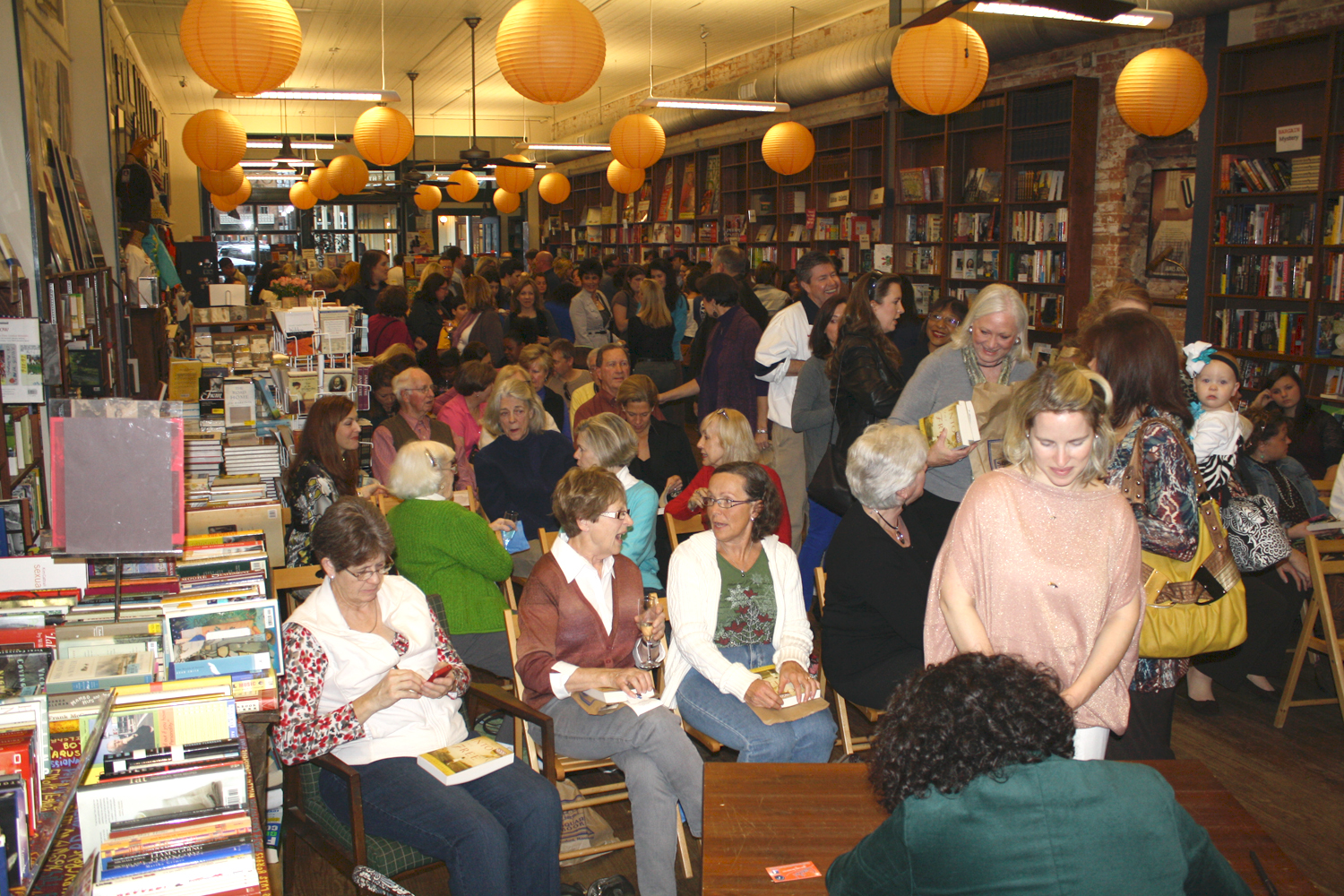
Celebrate with a Launch Party

Photo Credit: Jeff McVay

When my debut novel hit shelves, I wanted to do something special. Too many people in my community had played a part in the journey, and I wanted everyone involved to be publicly acknowledged for their contributions to the book.

The night before the official release date, we held a Launch Party at our local bookstore, Square Books. I didn’t have a big budget, so we served Champagne and Chocolate to keep the event nice but affordable. (We also provided non-alcoholic bubbly so everyone could participate in the toast.) The night was lovely. Beyond lovely. And it will always be a favorite memory of mine.

If you’re thinking of having a launch party, and I strongly encourage you to do so, keep these simple tips in mind when planning your big event.

1. Consider your crowd. Ours is a laid back group from all walks of life, so I wanted everyone to feel comfortable. We kept it very low key and emphasized the “come as you are, bring the kids” aspect of the evening. The public was invited.
2. Consider your space. Our bookstore hosts many author events each month and is prepared for such crowds. It’s always great to support a local bookseller, but if you don’t have access to such a store/gift shop, think of themes that correspond with your book (knitting, outdoors, swimming, cooking, etc.) and tie the launch party into a suitable location.
3. Consider your time. A typical schedule is to have a “soft start.” Allow folks to trickle in and mingle, enjoying the free refreshments while you chat and sign a few copies to get the evening going. Then the bookseller (host) introduces you, and you speak for approximately 20 minutes. Then, you sign again.
4. Consider your speech. It’s best to mix up your presentation with a little reading, telling how the book came to be, thanking folks involved, and…if appropriate…inserting some sort of entertainment. I had two singers perform one song each to give voice to two of my favorite characters. Both gave emotional performances that moved many to tears, and I think it was the best part of the night.
5. Consider your signature. I admit I have AWFUL penmanship, but I do plan ahead and bring a stash of good pens. Always a good idea.

You’ll probably be too busy to think about taking pictures, so ask a friend to capture the night on film. Believe me, it’ll all be a blur. And don’t forget the minor details: wine glasses, champagne flutes, bottle openers, cake knife, napkins, plates, utensils, tablecloth, camera, extra books, bookmarks, etc.

Finally, if you plan to sell books at the launch, I strongly recommend you let someone else handle the sales. The last thing you want to worry about is money. It’s a once in a lifetime moment. Live it up!

What Disney Knew That Your Teacher Didn’t: You CAN Do It!

Find me one published author who never received a single “not the right fit” letter, and I’ll show you a fish with feathery wings. Whether at the educational stage, the agent stage, or the publishing stage, most have been told their work is not worthy.

I was lucky when it came to agents and publishers, but my rejection came earlier in life, when a high school teacher read my papers aloud ridiculing me in front of my peers. She teased me relentlessly (today it would be called bullying), and on the last day of my senior year in high school, she said to me, “I hope you don’t waste your scholarship to study writing. You may be able to write a greeting card, but that’s about as far as you’ll ever go.”

I made a mistake that day. I believed her. I put down my pen for nearly a decade and let way too many stories go untold.

That’s why, twenty years later, as Publishers Weekly gives me a starred review for my debut novel, I feel such tremendous excitement. Whether Into the Free sells two copies or two-hundred thousand doesn’t matter one bit to me. I now know one important thing: she was wrong.

Here’s what she didn’t teach us: God gives us each special talents, gifts, and dreams. Who are we, if we are not of God? What are our abilities, if not God-given?

I am a teacher, and I spend every bit of my energy trying to teach my children one lesson: You can do it!

I am tired of teachers telling us who we are and what we will or will not achieve. I am weary of labels and bell curves and standardized tests. I weep for this generation of children who are told you need x, y, z medications to fit into our box. And I mourn the countless souls who believed the people who said, “You’ll never…” or “You can’t…” or “You aren’t good enough…”

I say to you, today. You can. You are good enough. You were born for a purpose, and only YOU know what that is. Don’t let anyone discourage you from living YOUR life to its fullest potential. And if you fail, you’re only one step closer to succeeding.

Watch this little video clip I found on YouTube, and you’ll see…all great minds have a few things in common: failure, rejection, and a willingness to risk it all anyway.

Has anyone ever told you “you can’t”? What one piece of criticism has made you a better, stronger writer? 

DIY: Step-by-Step Guide to Making a Book Trailer

What is a Book Trailer?

A book trailer is a brief video used to market a book. Like a trailer for a motion picture, book trailers can make your title stand out among the masses.

Many professionals will produce trailers for a hefty fee, but why not do it yourself?

Four Simple Tools

  1. Computer: The first thing you need is a PC or MAC with decent operating speed. We used a PC with Windows 7.  Older versions of Windows may be slow to process video data.
  2. Camera: Recording in high definition (HD) is not necessary for posting on websites like Youtube.  We used a digital SLR camera (Canon EOS Rebel T2i), but we did not film in HD.  Instead, we used 640 x 480 pixels which created a much more manageable file size. (TIP: Make sure your software will open your video file type before you shoot the trailer.)
  3. Tripod: This is a must. Use a tripod. Always.
  4. Microphones: If you plan to include external sounds/voices, use microphones.

Five Steps and You’re Done!

  1. Setting: Choose locations based on your book’s theme. Obtain permission to film on anyone else’s property, and do not show anyone in the film without their permission (this includes folks in the background).
  2. Shooting: Shoot short segments and paste them together using a video software package.  We used Windows Live Movie Maker which was easy to use and comes with Windows 7.
  3. Editing: Transfer all the video segments into a single folder on your computer.  Decide on the order of the videos in advance (ex: save as Trailer1, Trailer2, etc.). Begin inserting them into the software and trim as needed.  You can use the audio from the original film segments or block it out completely and use a separate audio file. 
  4. Adding Music: While some royalty-free music is available online (http://www.istockphoto.com/audio), my teen daughter composed the music for our trailer. She performed it on our piano, and we recorded it using Microsoft Sound Recorder on our laptop (which is equipped with a built-in microphone). This program is on all Windows computers.
  5. Polishing: Your publisher may be willing to add a little polish and a company logo.  If so, the best way to share video file access with another editor is to use Dropbox.

Share the Love

Finally, save the file to a common format (MPEG-4 or AVI) or upload directly to YouTube from your software. From YouTube, I embedded my trailer on my website, added it to my author profiles on sites like Barnes & Noble and Goodreads, and shared it with friends through my blogsite. To post on Amazon, SheWrites and others, you need a direct file (not the YouTube upload). Many authors include a link to the trailer in their press kit, and some even distribute DVDs to local booksellers.

Have fun, and come back to share your trailer with us here at the Cooler!

How to Plan a Book Club World Premiere

Image by Salvatore Vuono

As I’ve journeyed to the February 2012 publication date of my first novel, Into the Free, I’ve listened carefully to authors who have “been ‘round this track” a few times before me. One such author is bestselling novelist Lisa Wingate.

Just before her sixteenth novel, Dandelion Summer, hit shelves, Lisa shared the book with a lucky group of ladies from the McGregor Tiara Literary Society. Then she shared their reaction to the book with the world via YouTube.

Book Premiere? That’s Genius!

I’ve always been a member of at least one book club, and I am drawn to books that encourage people to discuss the themes of the story. I was intrigued by Lisa’s idea for a premiere. I figured, Hollywood holds premieres for new movies, right? Publishers have started making trailers for books, just as producers do for films…so…why not follow that line of thinking and host a premiere for my novel? I was convinced Lisa Wingate was brilliant. And I was right.

But Lisa is not just brilliant. She is generous and compassionate and eager to share her talents with others. It’s no surprise she provided a step-by-step tutorial on her Southern Belle View blog for others who might want to plan such an event. There you’ll find detailed instructions on planning, organizing, recording, and sharing the big premiere.

Without her directions, I would have overlooked details about release forms and microphones. I would have struggled using Windows Movie Maker to edit the clips, and I would have been clueless about lighting, length, and little tips to make the event fun for all involved.

Roll out the Red Carpet!

Thanks to Lisa Wingate’s fabulous advice, and Terri Blackstock’s kind suggestion to check out Lisa’s idea, I have since held three book premieres across the country for Into the Free. I’m editing them now and will be sharing them with the public in January, 2012. But just for fun, I have posted some of the photos and comments on my website.

If you’re planning to launch a book in the future, I strongly encourage you to consider a book club premiere. Even if the camera malfunctions (as mine did with the third event) or Skype gets moody (as it did with the group in Colorado), it’s still a ton of fun and very interesting to hear reader feedback before the book ever hits shelves.

Big thanks to the Beach Babes of Baton Rouge, Louisiana; Porch Pals in Longmont, Colorado; and the University Literary Circle from Oxford, Mississippi for playing along with me.

And…be sure to view  clips from Lisa Wingate’s world premiere for Dandelion Summer.

Creative Nonfiction: Top Tips for Memorable Memoirs and MORE!

Photo Credit: Simon Howden / http://www.freedigitalphotos.net

My husband parks our silver F150 in a turnoff, which is really a patch of pounded land where folks have repeatedly turned their cars around after realizing the road goes nowhere. I imagine drug dealers, prostitutes, meth heads, and hormonal teens fighting for this spot on steamy summer nights, but for now, it’s just Charles and me. And my doubts.

He turns off the engine, and in the silence, we wait. We are surrounded by thousands of acres of farm fields, old growth hardwoods, and murky cattle ponds. The land is beautiful, and this type of setting would normally calm my nerves, but not this time. Not now, as I’m waiting at the end of the road for a stranger to arrive. My heart races and my breath quickens, as I realize, with sudden alarm, that we might be in danger.

“Should we have brought the gun?” A question I never thought I’d ask. Even though I despise America’s love affair with arsenals, in this position, I wish I was holding a gun.

“What gun?” He’s barely paying attention to me as he checks email on his phone.

“The one in the garage.”

Charles laughs. “It’s a 22.” With sarcasm he insinuates that if we find ourselves going head-to-head with a coyote or a tom cat it might come in handy. A hardened criminal? Not so much.

“Well what if it’s a setup. One of those Craigslist crimes?”

He doesn’t answer. Just keeps emailing.

11:49. No sign of the white Ford truck we are waiting for. “Of course it’s a white Ford,” I say. “Does anyone drive anything else around here?” I’m sure we’ve passed at least forty-seven white trucks since we left the interstate. Forty-six of them, Fords.

I open the door and get out to stretch my legs. The sounds of rubber tires and gasoline engines roar in the distance. Somewhere, within earshot, the newer highway ribbons through these fields, and I feel a little comfort thinking I can run toward the noise if it comes to that.

Then the engine noise comes closer, and the white truck we’ve been waiting for eases its way into a corner field and comes to a stop in front of a metal gate, a rusty chain locking the gate closed.

In the movies, headlights would have flashed, drums would have punched a dramatic rhythm, and a heavy pause would have filled the screen. Instead, Charles’s phone rings. “Yep, I see you. We’re headed that way now.”

I return to my passenger perch and close my door just in time, as Charles is already putting the truck in gear.

“You have the money?” he bites his nails, a habit he’s had all his life.

“Yes,” I check my purse, just to make sure. Cash only, I remember the stranger’s instructions. My pulse shoots flares.

And then it happens. We climb down from the bench seat and enter an isolated pasture with a man we’ve never met.

What’s this scene about? Do you suspect this couple is about to engage in some sort of illegal transaction? Are they in danger? Or is it just a creative twist on something as ordinary and realistic as buying a cow?

If you guessed a cow, you’re right. This is part of a creative non-fiction proposal that enabled me to become the 2012 recipient of the Mississippi Arts Commission’s Literary Arts Fellowship, an honor I am privileged to accept.

Whether writing about cooking or canines, remember non-fiction doesn’t have to be dry.

Try these tips:

  • At some point, let us know exactly where and when the event takes place, but use subtle hints to set the scene (music, tv, news, technology, etc., to hint at the era.)
  • Use sensory details – smells, sounds, sights (avoid writing “I see… I smell…I hear…”)
  • Involve more than one person in the scene…it’s not all about YOU. Describe something specific about the other characters. Use a few snips of dialog and let unique personalities shine.
  • Elicit an emotional response from the reader. How do you want them to FEEL when they read the story?
  • What is the main point of the story? What question do you want to answer? Try to leave the reader with one main thought, all while trying to show rather than tell.

When you write, what approach do you take to make the mundane magnificent? Share your thoughts about creative nonfiction and learn more about this interesting genre by visiting http://www.creativenonfiction.org/

Julie’s first novel, Into the Free, hits shelves February 1. Learn more at www.juliecantrell.com

How to Plan a Successful Book Signing

As a first-time author of two children’s books, God is with Me through the Day and God is with Me through the Night, I was surprised to discover that the most challenging part of the journey was marketing.

I had worked as a marketing writer for years; but marketing my own work was…well…icky. As a friend put it: “It’s a bit like standing in front of the mirror with a stranger and asking them to say nice things about you.”

Despite my reluctance, I was grateful to experience many successful book signings after the launch of my children’s books. When I sold more than 100 books at several signings, the bookstore managers were amazed. They couldn’t believe I was having such strong turnouts as a first-time author.

One Barnes & Noble community resource manager hit the nail on the head when he said he’d never had an author market the event as much as I had. That behind-the-scenes work was responsible for the second-largest signing of his career.

When planning your next author event, keep these tips in mind:

1. Your biggest ally is word-of-mouth. Reach out to anyone you know in a community and ask them to invite friends, family, neighbors, church members, school peers, etc. You’d be surprised how interested folks become when they have a personal connection to the author.

2. Send out press releases to local media outlets. Look for television news programs and radio shows that routinely support local events. Contact regional magazines, and reach out to the newspapers for a book review and/or author interview.

3. Post the event on all community calendars, since many media outlets will share the event both online and in print.

4. Contact local churches to invite their church community to join you. You can also offer to visit the church for a personal author event. Some churches have been extremely kind and generous to me by promoting the event in their Sunday Bulletin or weekly newsletter.

5. Use the Internet to locate your target audience and reach out to them via email, direct mail, phone calls, or – of course – word of mouth. Depending on your book, you may want to contact veterans groups, healthcare workers, mothers groups, or schools.

6. Use key social networking tools such as Facebook, Twitter, iGoogle, and a personal blog to boost interest in your books. Also consider pitching high-traffic blogsites to serve as a guest blogger.

7. Don’t be shy. When you’re at the event, engage attendees in conversation. Remember, humor is key. Get people laughing and they’ll want to hear more. Marketing does take time, but the extra hours pay off in most cases.

Now that my first novel, Into the Free, will hit shelves in February, I plan to use these strategies again when planning my upcoming book tour. How do you help ensure your book signing will be a success? Do you provide free giveaways? Tagalong with a larger event? Mail postcards prior to the big day? We invite you to share your ideas to help all of us make the most of our time on the road.

Happy book signing!

Julie