The Hero Within

In a writer’s world we are the masters of the pen (actually a computer keyboard, but that didn’t sound as cool). We create complicated characters through various techniques and tell them what to do.

But then they take on a life of their own and begin to tell us what the story is about. This can be quite fascinating, like sitting at a movie, watching the story unfold. Other times it’s frustrating because these life-like characters make bad choices or behave poorly (there’s always at least one), resisting our intended purposes for them.

When I think of writing in these terms, my thoughts drift to our Creator, and I wonder if God sees us in similar fashion. Aren’t we like His characters, created with His purpose in mind? Yet we have free will and the ability to choose poorly, or wisely.

God gives us that room, though I know we must frustrate him terribly at times. The Israelites certainly did. (Aren’t we still Israelites at times?) But part of the joy I experience in writing a powerful scene with my characters is seeing them grow and embrace God’s love and truth. There’s a sense of victory there even though these characters exist only in my head.

I remember as a kid imagining these scenes where the heroine (usually me, of course!) persevered and made this huge impact or discovery. I walked into the sunset as a new inspiration to my fellow underdogs (the theme of many teen movies).

The funny part of all this is, the longer I write and study the books and movies that are popular, the more I find a universal theme there—of a nobody discovering they have some kind of special gift that helps them save the day. A gift that comes from somewhere outside them and suddenly this feels-like-a-nobody character blooms into someone unique.

Now the amazing part. It’s a story theme that’s existed for thousands of years. The one I like best? The one in the Bible.

Jesus was just an ordinary carpenter. He didn’t look like much to those who resented and envied Him. He didn’t appear a whole lot different from the men He walked with. He started out as a nobody in the eyes of those around Him. But to know Him was to know He walked in greatness and humility.

He walked this earth like a man, yet within He holds a power to “save the day.” And every person who knows Him.

His is the story of the ultimate Messiah, the one true Savior of the world. He was and is the true Hero of the story—of the world and of our lives.

And the absolutely mind-blowing final part? He lives in us, changing us from nondescript nobodies to uniquely gifted individuals created to fit into a true story.

His story.

Happy Thanksgiving from the Water Cooler Family to Yours

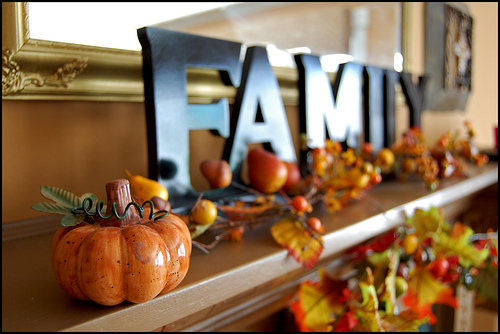
Photo by Tom Gill

Thanksgiving has always been a great time for Americans to reflect on what is going right in their lives.

There are other moments throughout the year like our birthday or the upcoming New Year’s holiday that lend themselves to the same moment of gratitude.  However, this holiday asks the same question with a wonderful twist.

Instead of what might be the usual, what-about-me, we’re asked to remember others, especially those who can’t be with their families like our servicemen and women stationed all over the world and in harm’s way in Iraq and Afghanistan. That gives all of us a moment to step out of ourselves and remember what really matters to us.

For many of us it’s the people seated at the table right around us, and we get to say directly to them on Thanksgiving day just how much they mean to us. But there are also many others who touch our lives every day, and mean so much to us for their unflagging support and cheers of encouragements, who are scattered all over the world.

For the writers at the Water Cooler that includes you.

All of us at the WordServe Water Cooler want to take a moment to say thank you to everyone who has joined in our fun. Thank you for taking the time to share your thoughts and feelings here at the blog on the rollicking, fast-paced world of writing, publishing and marketing. We have all grown to feel like one big family.

For writers, who spend a lot of their career waiting to hear from editors or critics or booksellers, it’s a very special and sometimes rare gift to create such a supportive community. We look forward to all of the great conversations, book news, writing tips, and platform building to come.

A great big thank you as well to our agents at the WordServe Literary Agency, Greg, Rachelle and Barbara for all of your guidance, hard work and for always going that extra mile. We are all very grateful. Happy Thanksgiving everyone!

Using a Plot Board to Plot Your Novel

Way back in Mid-August, I posted here about how a Plot First Novelist Builds Character(s). I admitted to being a plot-first writer and a dedicated ‘Plotter.’ Boy howdy, if you want to divide a room full of novelists quicker’n Shergar won the Derby, ask who is a plotter and who is a ‘pantser.’

But, though novelists fall mostly into two camps, each side often wonders about how the other manages to write books using their method. I thought I’d give you a peek into my plotting method.

I use a plot board. I first came across this idea on the Seekerville blog where a guest had a photograph of her own plot board. Since I’m a visual person, I glommed onto the idea and created a board of my own to see if it would work for me too.

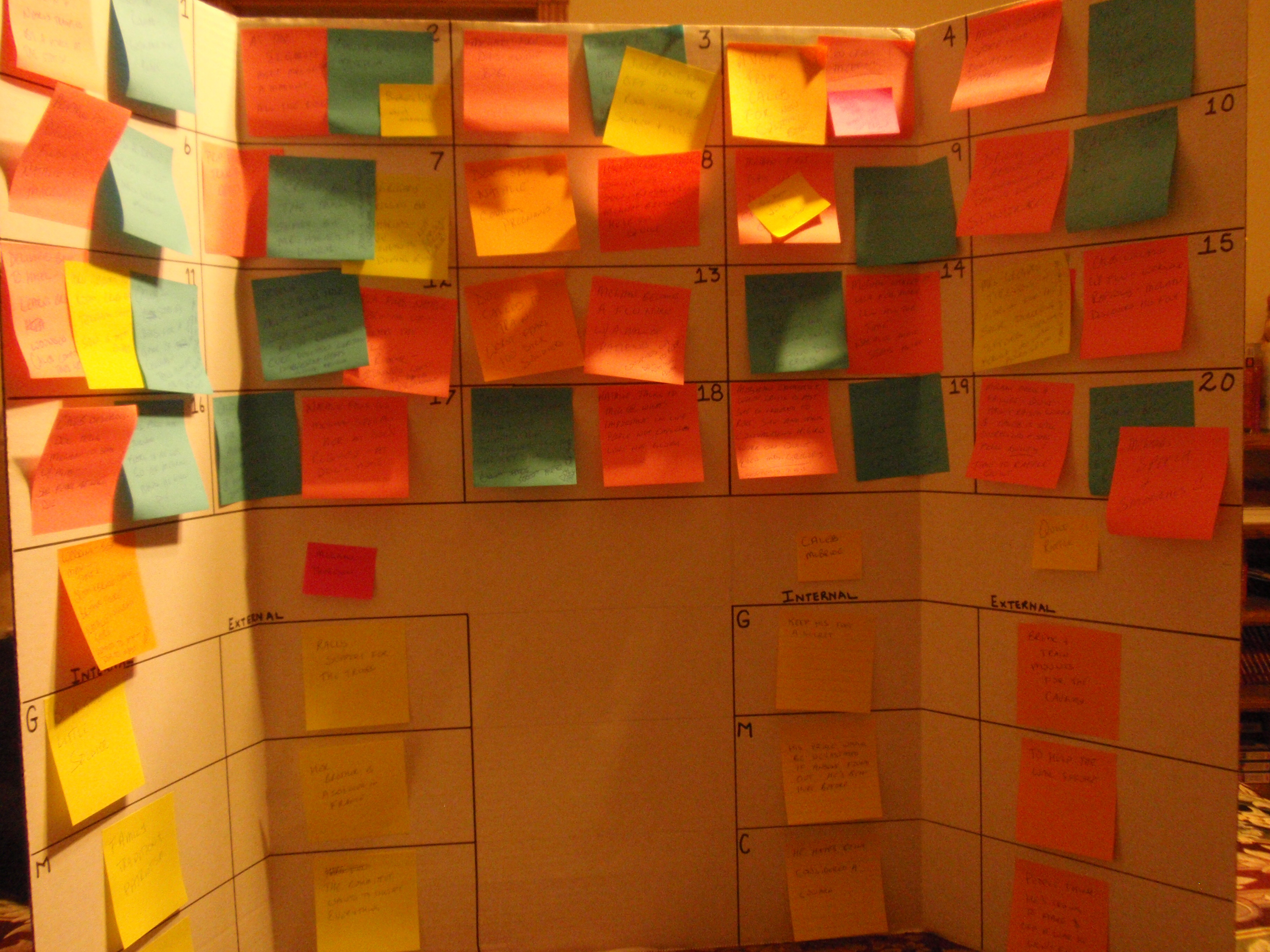
And it sure does! There are so many things I love about using my plot board. The plot board allows me to see at a glance how many scenes I have, who is the point-of-view character, and the characters’ Goals, Motivations, & Conflicts. It forces me to write out, however briefly, the internal and external goals of the characters and really think about what it is I’m trying to say with the story. Oh, and I get to play with post-it notes. 🙂

One other thing I love is that it’s easy-peasy to change your mind about something. You just move the post-it to a new place or throw it away and write out a new one. I found this particularly appealing, especially since I tend to change my mind a lot while plotting.

The top half of my plot board is divided into 20 equal sections and numbered across the rows. Each of the numbered boxes represents a chapter in the story.  (Twenty is just a starting point. I lengthen or shorten the story based upon what is needed. But there is only room for about 20 boxes on the plot board. If I need more, I have to scrunch things and overlap.)The bottom half is divided into two parts with six equal sections in each part. These are for the characters.

Prior to writing anything out for the plot board, I’ve researched, ruminated, and spent days and weeks reading and thinking about the story. I’ve got a few high points of the plot in my head, and I have a fair idea of setting, time period, etc. I have a rudimentary idea of the characters, too. This pre-plotting prep is necessary for me. If I dive into plotting too early, before the story has had a chance to marinate in my subconscious, I find myself staring at the blank plot board the same way I stare at a blank screen if I haven’t plotted beforehand.

When it comes time to begin filling in my plot board, I start at the bottom of the board with the two six-chambered grids. On each side, one column is labeled External, and one is labeled Internal. This is where I put the Goals, Motivations, and the Conflicts for each of the two main characters. Since I write romance, this means the hero and the heroine. What do they want, why do they want it, and what is keeping them from getting it? I decide what personality types my characters are (click on the first link in this post to see how I do that) and start plotting the story.

 
Then I grab my smallest post-its, about 1.5 x 1 inch. I write the major plot points out and stick them to a notebook page. (Things like Avalanche hits Train, or Finds Out He’s Adopted.) As fast as the ideas come to me, I jot them down, keeping it brief and fairly broad. When I think I’ve got the big ideas of the story set down, I start arranging them on the plot board. I keep them in chronological order, but I don’t sweat too much whether they are in their final position or not. I know it’s probably going to change as I go. When I have the bones of the story down, I start making logical connections with scenes. What has to happen in order to get the character from major plot point one to major plot point two?  I use the next larger size post-it for these in various colors. Pink for the heroine’s POV and blue for the hero’s. Orange, yellow, purple, chartreuse…those are for secondary characters’ POV scenes. By color coding the post its, I can see at a glance if I’ve kept a good balance of his/her scenes and if I’ve lost anyone in the shuffle.
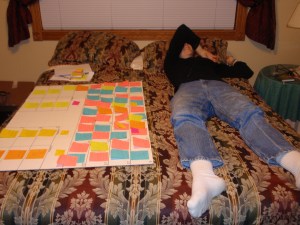
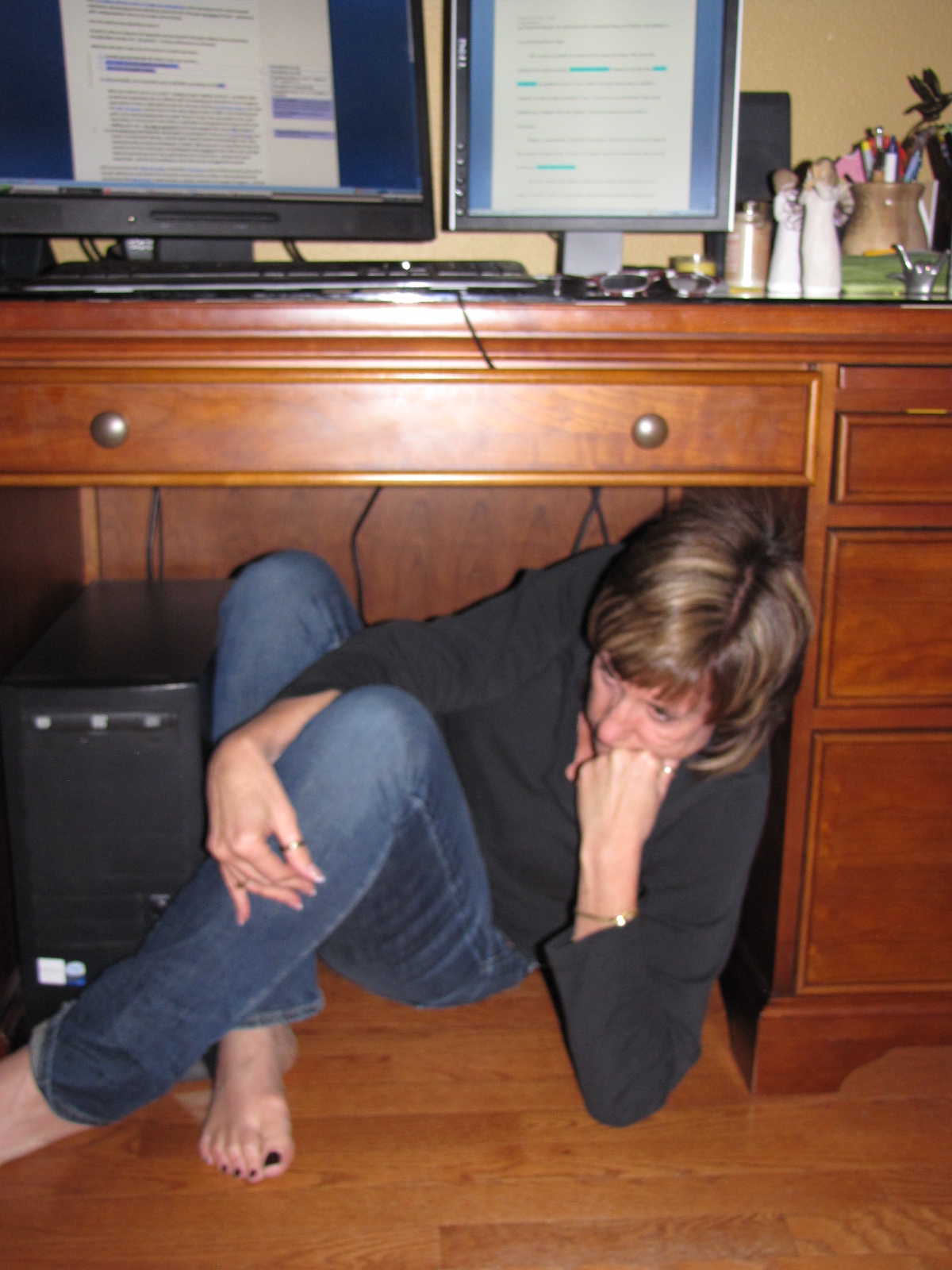
One thing I mustn’t forget to mention is that the whole time I’m doing this, I’m talking. Usually to my daughter. (When we finished plotting the last novel, she crashed on her bed and I had to take a picture.) By talking it out and letting someone not as familiar with the story ask “Why?” kinds of questions, I minimize the plot holes as much as I can up front. My daughter is great at this, and I plot much better and quicker when she’s involved in the process.

When I get all the scenes filled in, I tell the story once more aloud, making sure I have it the way I want it. Then I use the plot board to type out a chapter-by-chapter, scene-by-scene synopsis, including what I want to accomplish in each scene. I know without a doubt that when I have that road map in my mind and in my hands, I write much faster than if I’m feeling my way around with no idea where I’m supposed to be going.

So there you have it. My plotting system. It works for me, and it’s been tweaked and refined each time I go through the process of plotting a new story. I hope you can glean something that will help you.

Question for you: Plotter or Pantser? Does the thought of using a plot board excite you or make you want to run screaming to the nearest bag of chocolate chips?

Post Author: Erica Vetsch

Erica Vetsch is a transplanted Kansan now residing in Minnesota. She loves history and reading, and is blessed to be able to combine the two by writing historical fiction set in the American West. Whenever she’s not following flights of fancy in her fictional world, she’s the company bookkeeper for the family lumber business, mother of two terrific teens, wife to a man who is her total opposite and soul-mate, and avid museum patron.

A Writer’s Life: The Pit of Despair

Whenever I watch The Princess Bride, I skip the Pit of Despair segments. Popcorn, anyone? Maybe rewind to the Fire Swamp?

Sure, the Albino with the needs-to-cough-up-a-hairball voice is a bit of comedic relief before discovering our hero Westley is in the Pit of Despair. His future? Torture — attached to a life-sucking machine. His only escape? Death.

Am I the only one who skips these scenes?

As writers, there are days we are trapped in our personal Pit of Despair, without even a somewhat friendly Albino nearby. Life — our passion — is being sucked out of us, bit by bit.

What does Westley’s trip to the Pit teach us? Consider two truths:

  1. Truth # 1: Enemies get you into the Pit.
  2.  Truth # 2: Friends get you out of the Pit.

What about those enemies?
Inconceivable, isn’t it, how both success and failure dump us in the Pit.

When you succeed as a writer — land an agent, sign a contract — you think: Other people have expectations for me. What if I fail? Overloading yourself with the real or imaginary expectations of others tumble you into the Pit faster than the Dread Pirate Roberts can scale the Cliffs of Insanity.

And then there’s the slippery slope of failure: never attaining your goals, never quite grasping whatever spells “victory” for you. The root problem is the same: expectations. Fear you won’t meet others’ expectations or disappointment in yourself for not fulfilling your own. The bigger question? How do you navigate both success and failure?

At last! It’s time for the friends.
Westley didn’t rescue himself. The heroes? Fezzik and Inigo, who found a “mostly dead” Westley in the Pit. But that didn’t stop his friends from hauling his body out to go looking for a miracle.

When you can’t see the faintest hope of a miracle for the forest of despair surrounding your writing dreams, who searches for you? When you no longer believe in yourself, in your story, who believes in it for you? And — perhaps even more importantly — who do you go looking for when they’ve been dragged off into the Pit of Despair?

We’ve peered over the Cliffs of Insanity, survived the Fire Swamp, and now find ourselves at the Pit of Despair. Which have you found to be the greater enemy: success or failure? How have friends rescued you? Like Miracle Max, I believe it takes a miracle sometimes for changes to happen … so if you have any of those to share, please do!

For Fun: The Princess Bride 25th Anniversary cast reunion

Post Author: Beth K. Vogt

Beth K. Vogt is a non-fiction author and editor who said she’d never write fiction. She’s the wife of an air force physician (now in solo practice) who said she’d never marry a doctor—or anyone in the military. She’s a mom of four who said she’d never have kids. She’s discovered that God’s best often waits behind the doors marked “Never.” She writes contemporary romance because she believes there’s more to happily ever after than the fairy tales tell us.

Writers — Develop a thick skin!

Do you remember how you felt the first time you confessed to someone that you wanted to be or was a writer? Did you heart pound and your palms sweat? Mine did.

Develop a thick skin if you want to be a writer.

Becoming a published author almost seemed too lofty a goal for little old me to aspire to. What would people think? Would they laugh at me? Scorn me? Ask me why I thought I could ever be successful?

When you made your proclamation saying you were an aspiring writer did the words tumble out in a torrent of excitement or did you choke them out, fearful that one day you would be forced to eat them, a bitter morsel?

Chances are, after a while your friends and family get onboard with your plans and even inquired about your progress or encouraged your efforts. And that’s a good thing. Because after you’ve overcome that initial fear of telling others you want to be published, you actually have to put your work out there for critique and for submission, and then you really need to toughen up and not let the barbs of critiques or the arrows of rejection take you down—at least not if you want to be successful.

Take heart. Be brave. Nothing ventured, nothing gained. Find a quote or a verse of scripture that will speak encouragement to you. I know some writers who have inspirational quotes tacked up in their writing area or committed to heart. Bible Gateway or Quote Garden are good places to find words of emotional sustenance. This verse kept me writing and writing.

When you first expose your writing for someone to look over, be brave and be humble. Just because you arranged words together on a line, doesn’t mean that you’re going to get the next big literary prize—not even if your mother/spouse/best friend/child says so.

Putting your work out there for critique requires you to be humble enough to take suggestions and comments. One thing I’ve discovered is that you can’t defend your work. When I hear someone who submitted work for critique begin to defend or explain their work, then I know they’re still pretty green. They don’t want anyone to change a word or tweak a sentence. But the truth is, when your work is finally published, you won’t be able to sit alongside your reader and explain every scene. If your first readers don’t understand what you’re trying to say, then rewrite it.

Sometimes it’s hard to receive a critique, but it doesn’t kill you. You’ll be okay, the sun will still shine, and you’ll still be loved and respected by those who care for you. Our agent Rachelle Gardner wrote down her thoughts about being thick skinned on her blog. Take a look, be encouraged.

It’s difficult to hear negative words about the story you labored over. If you’re frustrated, that’s okay. Take a walk, call a friend, and write more words. Just keep moving forward. But don’t be too discouraged, there are always (or there should be) good points raised during a critique.

Becoming published won’t happen if you don’t work at it. Remember, some people dream of success, while others actually do the work to accomplish success. So write on!

What advice do you have to overcome the pain of critique/rejection?

Say what? — Writing believable dialogue

Whether you write fiction or non-fiction, good dialogue is essential to the success of your work. Either the dialogue will draw the reader into the scene, or it will bore the reader—and as a result, she may choose to close your book without finishing it.

Know that good dialogue in books does not correlate to real-life speech. When you stop in the grocery store to have a few words with a neighbor the conversation is usually small talk. It doesn’t have to mean much except that you value the person enough to spend a few minutes chatting. But in fiction (and in non-fiction), dialogue exists to enhance characterization, support the mood, convey emotion, and control the pace of the story.

The first rule of dialogue is to avoid dialogue ping-pong. People don’t speak logically, and sometimes it’s more effective to answer a statement or a question with a question.

The following examples illustrate dialogue ping-pong and interesting pull-you-into-the-story dialogue:

Suzanne slipped into the seat across from Angela. The cool vinyl chilled her thighs as she scooted to the middle of the booth.

“Thanks for joining me, Suzanne.”

“You’re welcome. How have you been?”

“I’ve been fine, thank you. And you?”

“I’ve been better, thanks.”

Angela picked up the red menu. “What are you going to order?”

“I’ve heard the turkey sandwich is delicious.”

***

Suzanne slipped into the seat across from Angela. The cool vinyl chilled her thighs as she scooted to the middle of the booth.

“Thanks for joining me, Suzanna.”

“Did I have a choice?”

Angela slid the menu across the Formica table and flipped it open. “It was an absolute stroke of luck that I ran into Crystal at the flea market last weekend. If not, I would have never heard about your situation.”

Suzanne gazed down at the greasy menu. “I may just order tea.”

“I’ve heard the gazpacho is delicious.” Angela cocked her head. “And like revenge, it’s a dish best served cold.”

Good dialogue develops and establishes characters. Characters need to speak differently from one another. Give your characters a verbal tic—“Ya, know.” Have one character refer to dad as Dad and another call him Pops. Consider that characters may have different vocabularies with different people. A polished lawyer will speak one way in court, but when he goes home to the bayou, he’d speak differently.

Dialogue describes conflict, setting, and characters. Rather than writing, Angela was the kind of woman you couldn’t trust, have one of your characters say, “Look out for Angela. That girl will stab you in the back and then accuse you of carrying a concealed weapon.” Also consider that what is not said in dialogue is just as important as what is said.

Dialogue can control the pace of the story. To speed up the story, use short sentences with few action beats. This will give you a lot of white space on the page and create a feeling of fast motion. To slow down the pace of a story, put action beats, thoughts, or description into the story.

Avoid using dialogue as an information dump“Edward, I know you’re sensitive about people questioning your motives because of that incident that happened to you in high school when the principal misunderstood why you were leaving the campus early.”

Dialogue is more than a way to express your character’s words—it’s a way to express the world you’re inviting your readers to enter. And as long as you can write good dialogue, your chances of being published will increase!

I don’t pretend to be a dialogue know-it-all, so please share some of your tips and advice on writing good dialogue. Don’t be shy, what are they?

The Writer’s Life: On the Edge of the Cliffs of Insanity

BeingThe Cliffs of Insanity a writer can make you crazy.

Think about it:

  • Your literary heritage? A long line of creative alcoholics and drug users: Ernest Hemingway. O. Henry. Tennessee Williams. Dorothy Parker. Edgar Allen Poe.
  • Betting your life on a maybe, dependent on the kindness of others–agents, editors, publishers–for your success. And, really, their decisions have nothing to do with kindness.
  • Balancing your hopes on the seesaw of contradiction: Write your passion. Write what the market wants.
  • Hearing voices. The fictitious ones in your head that you tell what to do–and then you wreak havoc on them when they don’t. Meanwhile, the ever-present voices in the real world–your boss, your spouse, your kids–demand you focus on the here and now. The business meeting. The bills. The moody pre-teen inhabiting your daughter’s body.
  • Facing unending emotional upheaval. Waiting. Rejections. The mixture of joy and jealousy when a friend earns “the call.” (Not that you’d ever admit to even a passing acquaintance with the green-eyed monster. Inconceivable.)

Being a writer can push you to consider changing your name to Poe or Hemingway. The craziest part? You chose this life. You’re committed to this insanity. Here are a few suggestions for managing the madness:

  • Pick your mentors wisely. Just because writing drove others to indulge in mind-altering escapes doesn’t mean you must. I admire my mentors for their lifestyle choices, not just their writing skills.
  • Don’t let all your dreams be based on maybes. I have limited control over my success as a writer. Writing, however, is not all of my life. I’m pursuing other dreams with both short and long-term goals.
  • Choose between your passion and writing for the market. Or not. Maybe you’ll be the lucky author who hits the market when your passions collide with what “they” want. (Romantic-Amish-Vampire-Time-Travel-Steampunk-with-a-moral, anyone?)
  • Jump off the seesaw. The whole “balancing the writing world with the real world” challenge? I may never master that. Sometimes my mind seems full of shrieking eels, all screaming, “If only these people (husband, kids, friends) would leave me alone, I could accomplish the more important goals!” Then I know it’s time to shut down my computer and connect with family.
  • Admit you experience emotions. If emotions are good for our fictional characters, why are they bad for us? Sometimes we’re conflicted: over-the-moon-happy for our friend who landed a contract and also disappointed we’re not the one signing on the dotted line. That’s reality.

I’m curious: Am I the only writer pushed to the edge of the Cliffs of Insanity? How do you keep yourself from leaping off? (And can anyone tell me where the Cliffs of Insanity exist?)  ;o)

Post Author: Beth K. Vogt

Beth K. Vogt is a non-fiction author and editor who said she’d never write fiction. She’s the wife of an air force physician (now in solo practice) who said she’d never marry a doctor—or anyone in the military. She’s a mom of four who said she’d never have kids. She’s discovered that God’s best often waits behind the doors marked “Never.” She writes contemporary romance because she believes there’s more to happily ever after than the fairy tales tell us.

How A Plot-First Writer Builds Character(s)

Don't be put off by the Jim Morrison/The Doors album cover look of this book. It's really great, I promise!

I am a plot-first writer. My story ideas emerge when considering events, real and imagined, and only after all the events are in place do I try to figure characters. While my mind races happily along forming the plot, my brain comes to a standstill when it’s time to zero in on a character to carry the story.

That is, until I found this handy-dandy little book: The Complete Writer’s Guide to Heroes & Heroines: Sixteen Master Archetypes by Tami D. Cowden, Caro LaFever, and Sue Viders.

There are dozens of books on character-creation out there and lots of helpful resources online to aid in creating the perfect characters. I know because I’ve tried many of them. Most of these methods involve making endless lists and exploring everything in the character’s past from shoe-size to perfume preference. For some authors this is vital to the writing process, but for me, it is tedious, boring, and keeps me from writing the story.

So I was happy to find a resource that was different. Here are a few of the things from Sixteen Master Archetypes that I found helpful:

  • With only 8 Hero types and 8 Heroine types, this book narrowed my initial character questions to only a few possible answers. Yet the types are broad enough to encompass lots of individual quirks while being distinct enough that your character will fall into a category quite easily.
  • There are multiple examples from books, tv, and movies to illustrate the different archetypes. I’m a visual person, and I love being able to pinpoint who my character is like from a pool of characters I already know. (Example, is your character a Free Spirit? Think Dharma from Dharma & Greg or Phoebe Buffay from Friends. Is your character a Professor-type? Think Sherlock Holmes or Columbo.)
  • This book gives examples of possible professions for each of the character types, as well as what in their history might’ve contributed to the people they’ve become.
  • And most valuable of all to a romance writer, this book gives examples of how the various heroes and heroines both clash and mesh, their points of conflict and their points of commonality, as well as how the characters change when forced to be together.

You might be worried that the choices are so narrow as to make all characters in that category seem the same, but consider this: Harry Potter and Mr. Spock are in the same category (Professor.) Thelma Dickenson from Thelma and Louise is in the same category as Dorothy Gale in The Wizard of Oz (Waif.) Plenty of room to maneuver there.

If you’re like me, a plot-first novelist who has a rollicking story to tell but searches for just the right person to inflict all this conflict and disaster on, I encourage you to check out The Complete Writer’s Guide to Heroes & Heroines: Sixteen Master Archetypes.

You can find the book on Amazon.com by clicking the title above.

How do you feel about character worksheets? Love ’em or hate ’em?

Post Author: Erica Vetsch

Erica Vetsch is a transplanted Kansan now residing in Minnesota. She loves history and reading, and is blessed to be able to combine the two by writing historical fiction set in the American West. Whenever she’s not following flights of fancy in her fictional world, she’s the company bookkeeper for the family lumber business, mother of two terrific teens, wife to a man who is her total opposite and soul-mate, and avid museum patron.
.