The Power of People Watching

“How vain it is to sit down to write when you have not stood up to live.”
Henry David Thoreau

FFISummer092253Almost four years ago, I stood in an apartment parking lot with twenty-three strangers from all over the country. We made awkward conversation, silently sizing one another up and wondering how people so different would ever survive a semester together.

That summer was the best of my life with some of the most unique personalities I’ve ever had the privilege to know. In class, we studied personalities, strengths and weaknesses, character, opinions, and worldview. I knew how each person reacted in the midst of passion, anger, joy, or grief. I knew struggles and victories. Our common denominator was a desire to lead and a heart for the Lord.

And I had to know my characters the same way.

Through these people and because of that summer, I had ideas to propel me into my first book. My characters took on the physical traits and personality of one of my roommates. My supporting characters share names in common with some of the guys.

The best characters are the ones the reader can relate to as a close friend, soul mate, enemy, or victim. The best stories emerge from the people, places, and experiences around us.FFISummer090523

Spending night and day with these people for two months taught me the beautiful complexity of people’s stories. It also taught me the depth of people. The best stories come from people watching, from intimately engaging in life, and embracing the good and bad.

As I work on my current WIP, I watch the people around me. I study emotional reactions, goofy quirks, language patterns, clothing style, facial expressions, and character. Slowly, my characters take shape on the page. Fair warning: if you are in my vicinity, one of your odd habits may make it into my book.

As writers, we tend to isolate. Or at least some of us do. We are content to people watch without interacting. Big problem. As Thoreau said, writing is flat if the writer has not lived.

Get out of your chair. Abandon your laptop. Spend time with friends and family. Sit at your favorite park or Starbucks. Take a note pad and record people’s conversations. Listen to the words they use, how they form sentences. Interact with the guy behind the counter or the people walking their dogs. Engage them in conversation.

Live and live well. Abundantly and fully. Engage with people intimately, not for the sake of a story or character, but because every person we cross paths with has a story that can teach us something about life and the Lord and yes, even writing.

People are weird and quirky and complex. We all have different personalities and reactions. People are full of surprises and opinions. Fashion your characters that way, too. God created people in His own image. Fall in love with them. Embrace the uniqueness. Embrace your uniqueness. Then write with eyes wide open, heart full, and a mind overflowing with memories to make your stories rich.

Have you people watched lately?

On Beyond Index Cards: A Review of Scrivener Software for Writers

My first novel, slated for publication with David C. Cook in early 2014, involved hours and reams of research. I researched everything from fossils, to barbecue restaurants, the history of Haiti, pecan recipes, and more. I organized text, web links, and photos into dozens of Word documents, which I then had to flip open and closed while writing and editing each chapter. Add this to the half-dozen internet browser screens I had open for research, and, well, my computer was on the verge of crashing.

So was my brain.

At the time I didn’t know any better, so I never lamented the process. But now that I’ve found Scrivener, a software program for writers of any genre, I marvel at how I ever kept my sanity. Currently neck-deep in an intense season of editing, I’m especially glad I can dump my manuscript in there, blow it up, and put it back together again with Scrivener.

Now, I will warn you. What you’re about to read may sound like an infomercial, but it’s not. I downloaded the trial version (highly recommended), quite skeptical about how much easier this could really make my writing life. But after just two days, I bought the software outright. First of all, this little slice of computer engineering GENIUS only cost $45—a small price to pay for sanity. An even smaller price to pay for the time it’s saved me, and the fun it brings to the novel writing process.

What’s so great about Scrivener? Below, I’ve summarized my personal favorite aspects of the program—so far. And I say “so far” because the software has so much depth of capabilities and bells and whistles, I discover something new and even more fun every time I use it.

1. Love me a Trapper Keeper!

I am a true child of the 80s. When I took my kids back-to-school shopping earlier this fall, I teared up, grieving that they shall never know the true beauty of the Trapper Keeper. Oh, sure, we found imitation versions on the shelves, but nothing close to the ultimate office supply nerd’s dream machine contraption, which kept everything in check, even when the bully on the football team rounded the corner and flipped my books in the air, sending everything—including my fragile, Love’s Baby Soft ego—to the floor.

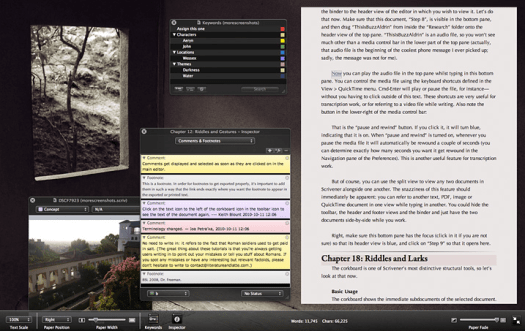
Well, never fear those bullies again. Scrivener is your virtual Trapper Keeper. The  program holds everything you need for your novel—websites, photos, places to jot down random thoughts and ideas, references, and notations—everything. And since it’s all in one location, nothing falls out.
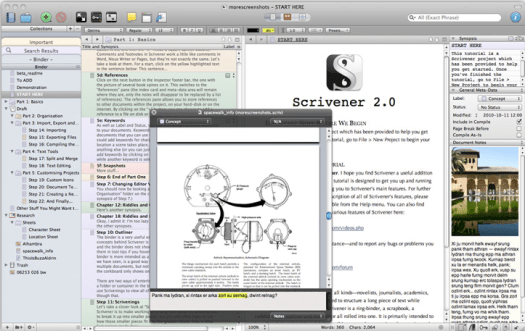
2. The corkboard is adorable.

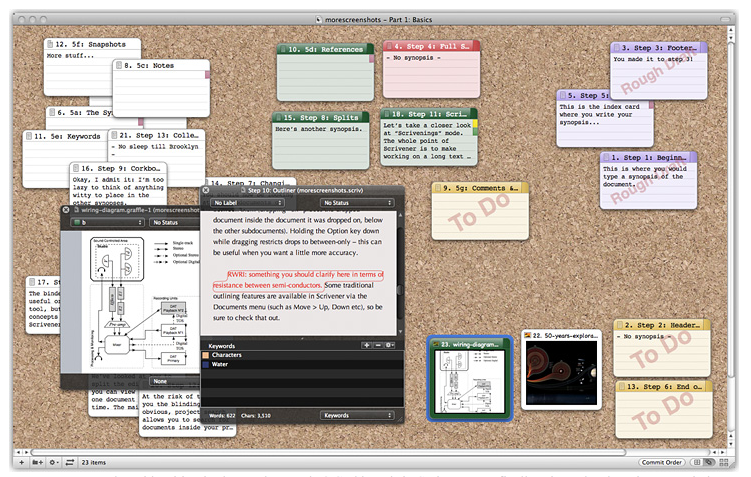
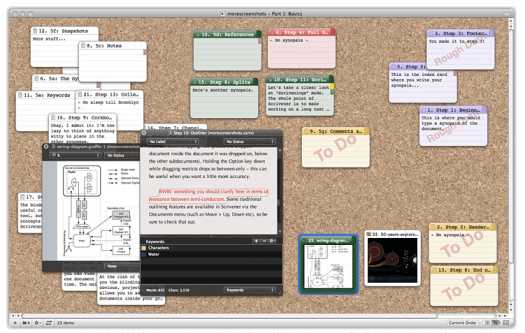
Say good-bye to sticky notes falling on the floor when it gets humid outside. Say hello to the floor you haven’t seen for months, since it’s been covered in index cards. Scrivener allows you to not only create virtual index cards and post them on a virtual corkboard, but you can also rearrange them, even when your manuscript is complete. Need to move chapter 30 back before chapter 14? No problem. Instead of scrolling back up and down through pages of text, just point, click and drag!

Better yet, each index card can function as a chapter synopsis, and you can attach various and individual scenes to each card, again, for easy viewing and rearranging, even within a chapter.

And as an added bonus, you can print out the index cards you create within the program, complete with lines to cut them the exact size of a 3×5 card.

As the website says, “Make a mess. Who said writing is always about order? Corkboards in Scrivener can finally mirror the chaos in your mind before helping you wrestle it into order.”

Don’t like index cards? That’s okay, because you can do your writing (also with rearranging capabilities) via the outlining mode.
3. Don’t just think about Harry Connick as you write out your protagonist’s next love scene. See him on the screen.

Don’t just think about the New York City skyline as your villain creeps through Central Park. Keep a photo of it on your desktop as you write.

Character, setting, and other research organizers allow you to attach photographs, charts, maps, and more all together and accessible as you write. One of my supporting characters looks like Matthew McConaughey. Seriously. He does. So whenever I need to jot down notes about his character, I open up my folder and there he is, gazing at me. Beautiful.
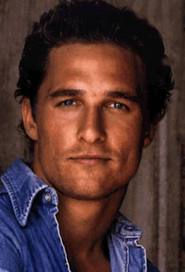
(woah–where did HE come from?!?)

 4. Worry about Word later.

It took me awhile to get over the fear of not writing in Word. But alas, the designers make it possible for you to compile all the text behind all those index cards and export it into one, seamless document which dovetails easily into Word.

5. Other cool features I love:

  • A name generator with every ethnicity and region imaginable!
  • Templates
  • Word count features, by chapter and whole document
  • Color-coding for chapters, editing status, and more.
  • Progress tracking
  • Keyword options
  • Formatting assistance

The website sums it up best:

“Most word processors approach composing a long-form text the same as typing a letter or flyer – they expect you to start on page one and keep typing until you reach the end. Scrivener lets you work in any order you want and gives you tools for planning and restructuring your writing. In Scrivener, you can enter a synopsis for each document on a virtual index card and then stack and shuffle the cards in the corkboard until you find the most effective sequence. Plan out your work in Scrivener’s outliner and use the synopses you create as prompts while you write. Or just get everything down into a first draft and break it apart later for rearrangement on the outliner or corkboard. Create collections of documents to read and edit related text without affecting its place in the overall draft; label and track connected documents or mark what still needs to be done. Whether you like to plan everything in advance, write first and structure later—or do a bit of both—Scrivener supports the way you work.

But wait. Before you buy, please note:

As with any computer program, there are negatives. Some folks–including an adorable and brilliant writer friend of mine–hate it. Also, while a PC version is available, the program was designed to operate on Macs, and the designers even admit it will probably work best on that platform. Try the trial version before you buy it to see if it will work for you and your computer operating system.

Also, you do need to have at least a smidge of computer savvy. And patience. There is a learning curve to this program, and the designers have been kind enough to offer a thorough, interactive tutorial and instruction book. While helpful, the program is so rich even I—a borderline computer geek—felt a little overwhelmed initially. And I don’t know if I’ll ever use all the functionalities.

That said, Scrivener has truly changed the way I approach my novel writing. I feel like it really frees my mind to focus on the prose, because I no longer have to remember where everything is on my hard drive . . . or if my dog ate a sticky note or a stack of index cards.

I honestly don’t know why more folks aren’t using and/or raving about the software.

Try it for free for 30 days.

I can’t throw in a set of steak knives, but I’d be willing to wager you’ll like the program, too.
The Best Advice I (finally!) ‘Got’

I always hated it when writing instructors told me to 1) write what you know, and 2) follow a formula.  How, I wondered, could I write what I knew when I didn’t know anything interesting, and when the only formulas I remembered were from high school math class? I was pretty sure that wasn’t going to be much help in writing anything other than a final math exam.

Now, having finally decoded those two pieces of cryptic advice in the course of my own writing career development, I have only two words to share with would-be novelists: read and outline.

Read books (all kinds!), but also read everything you can get your hands on: newspapers, magazines, the backs of cereal boxes, newsletters, church bulletins. I even read vanity license plates, which inspired me to give one of my series characters distinctive car plates that have played into more than one mystery plot!

The purpose of all that reading is twofold: 1) you accumulate a storehouse of information about the world; and 2) you never know what word, image, or idea will catch fire in your writing process.  Reading feeds you with new material – like ongoing brainstorming.

As for reading books in all genres, I find it’s a great way to broaden my experience. I may not be an expert on scuba-diving or anti-matter research, or know one end of a knitting needle from the other, but if I’ve read about it, I at least have some familiarity with it. And if it might fit into something I’m writing, I can go back for more reading or research.

It wasn’t until I figured this out – that I didn’t have to be an expert about something to write it into a story – that I finally really understood why my teachers insisted you had to ‘write what you know.’ Write what you know – not necessarily what you yourself have experienced. What a relief to know I didn’t have to commit a murder to write about one!

The most important thing I ever did when I was writing my first novel, however, was to outline. And I’m not referring to the outline of my book, either (though I do work from a rough outline when I write). The outline that I found most helpful was the outline I made of my favorite author’s best-seller.

Yes, you read that right – I outlined a book by my favorite author.

It was a tedious task, to be sure, but by the time I finished that chapter-by-chapter outline, I knew more about pacing and plot development than I had ever learned from any teacher or class. My secret was to use a different color marker for each subplot, so that by the end, I had a notebook in which I could visually trace how story threads flowed together and how the notorious ‘red herrings’ of successful plots operated. Deconstructing a best-selling novel taught me how to write my own ‘formula.’

What are you reading/outlining today?

The Warp and Woof of Weaving Stories

When I was in college, I went on a retreat. One of the skills I learned during the weekend was basket weaving. It was a lovely art, both in what I ended up with, and how I got there. In other words, the process led to a product I was proud of: a tightly woven basket with an intricate design of my own creation.

Writing a novel, I find, parallels that experience. The warp of my story is the primary structure, and the woof is the way I hold it together by weaving in and out of the structure with the scenes and details that make it distinctly my own design. Sometimes, I make an impulsive change in the course of the weaving of my tale, which then affects the entire design, and I end up with a different – but even better – story than I had anticipated; sometimes, I find the change is a mistake, which means I have to unravel back to that point and make corrections.

Unlike crafting a basket, however, the task of weaving a story gives me a dimension of creativity the basket doesn’t allow: I can add in even more layers – more woof – after my initial story is complete.  When I finish a basket, the weaving is of one piece – I can’t cut out a section of threads and replace it, or expand it, and expect the basket to hold together.

With writing, though, I find the extra woof is what gives the story its defining success. In revision, I can add a new character to further complicate the plot or add comic relief. While the main structure of the work doesn’t change, that new character can help breathe more interest into interactions with, and between, other characters. In the case of my mysteries, I often create a character in the revision process who can help move my story through spots that are weak or slow, especially when I need some red herrings thrown in to mislead my readers. I created one such character in my first book as a last-minute thought to complement one of the subplots, only to have readers so enjoy the character, that they repeatedly asked me to bring him back in a later book!

Adding in subplots that reflect the primary plot is another trick to elaborating on my initial story design. When revising, I try to give almost every character some personal issue that can tie into another character’s. Doing so not only makes the characters more real – who, in real life, doesn’t have problems to deal with? – but it affords me more opportunities to weave in conflict, which adds to the story’s pacing. My solution to keeping track of the characters and subplots is the creation of a master flow chart that follows each element of the story from beginning to end. That way, I accomplish every weaver’s goal: no loose ends.

Happy weaving!

What are your favorite threads to add to the warp and woof of your writing?

Christian Fiction ~ Oxymoron?

Image courtesy of freedigitalphotos.net/

We were on our way to The Duck Pond restaurant in Warsaw, Indiana. Our husbands visited in the front, and we ladies sat together on the bucket seats of our friend’s new Honda mini-van. And that’s another story. . .

But on this day, my friend turned to me and said, “I promised I wouldn’t read anything that wasn’t true for the rest of the year.”

She shook her head and looked down at the boot on her foot. “And then my ankle gave out.” She grinned then. “I could just see God looking down with a chuckle wondering what I was going to do now. But I’ve used this time to really get into the Word.”

I shared with her how I’d learned to get more out the Scriptures in my own daily devotions. I was sure the things I had learned were nothing new to her. And I was ashamed that I had to be this old before I learned.

“It’s good to take a break from reading other writing,” I said. “But you’ve made a big commitment to go for half a year.” I half-way admired her for it.

“Oh, I hope by the end of the year I can make it permanent. My mother always told me fiction is just a bunch of lies.” My friend looked at me expectantly. We belong to the same denomination and she knew I was a writer. “Reading got me through the hard times when my children were growing up,” she continued. “But I’ve leaned on fiction too much.”

“I know you need to keep your promise, but what about the stories Jesus taught?”

“And you think those weren’t real stories?”

“I know the parables were based on true principles,” I told her. “That’s what novel writers are taught. Any properly written novel will be based on a true principle.”

We changed the subject after that. But I can’t quit thinking about it.

Is Christian fiction an oxymoron?

By definition, Christian fiction is a story that illustrates a Christian world view in its plot, its characters, or both, or which deals with Christian themes in a positive way.

The novels of Francine Rivers have touched hearts and changed lives. Christian fiction is not written to replace the Bible, but to turn hurting, seeking people to the Word, to Jesus, and to God.

The combined efforts of many Christian writers have enriched our world. For some of us, it is our mission field. Our way of blooming where we are planted.

The Apostle Paul used the whole chapter of I Corinthians 14 to show that worship should not just be for my own benefit. That I should desire gifts that benefit the whole church. #1 In ways that they can understand. And #2 in ways that build up the church. Then, the apostle tells us, God will bring the sinners and they will also be convinced.

Sharing the Scriptures

God may use me to touch just one soul. He may use you to touch another. And he is reaching out to my friend in a different manner.

What are your thoughts?

Hello, Fellow Publishers!

I’m a publisher.

I thought I was just an author doing some social marketing, but thanks to what I’m learning from Beth Hayden’s book Pinfluence: The Complete Guide to Marketing Your Business with Pinterest, my whole perspective on my writing career is changing. Yes, I write mystery and suspense novels, but in support of that endeavor, I need to be creating and presenting content online that is meaningful and valuable for my customers. I need to give my social media friends and visitors what they are looking for, or as Hayden explains on page 61 of her book, “You need to make sure that every piece of content you publish either solves a problem for your audiences, or entertains them – preferably both.”

That’s a big responsibility. Every piece of content. We’re talking about images, information, links, comments – anything you publish anywhere on the internet that has to do with your writing. It’s all part of your ‘company.’ The really exciting part of using Pinterest as part of your company is that it allows you to get creative with visual content, which, psychologists tell us, can evoke emotional responses in a viewer. The bottom line is that by publishing the right images, you can build enthusiasm and loyalty in your viewers, which will help sell your product (books).

Culling through whatever is already on Pinterest boards, however, is not the way to find the ‘right’ images for your viewers, Hayden points out, just as consistently using someone else’s words doesn’t make your work original. Instead, put together your own content. That doesn’t mean you have to take a hundred photos or hire a graphic artist. It means you have to collect compelling images that represent your unique brand. (Be very careful of image copyrights.)

Do you write historical romance? Pin beautiful images of the places where you set your stories, or sketches of period clothing, or the flowers of the region – anything that helps your reader connect to your book. Think of it as publishing a behind-the-scenes guide to your story.

Do you write motivational memoirs? You could pin pictures of famous people who have overcome hardship, or framed inspirational quotes, or maps that trace incredible journeys. Think of it as pulling together an illustrated companion piece to your book.

The possibilities are limited only by your time and imagination, but if you keep focused on your ‘company,’ it will help eliminate some of the time-draining wandering we all do when we get online; if you’re collecting images of old barnyards for an Amish board, it will be a lot easier to not get distracted by all those cute animal pictures that pop up in the blogosphere. (If all else fails, put a sticky note on your computer screen that reminds you “No puppies!”) Make your publishing goals as specific as possible, pin appealing and evocative images on your boards, and Pinterest can become a great billboard for your books on the global internet highway.

Enjoy your publishing!

What are some examples of images that you have been pinning lately? Do you have any creative ideas for pins besides those I mentioned above?

Top 5 Self-Editing Tips: Intention

In my first post last month on the topic of the Top 5 Self-Editing Tips, I covered in detail how a novel is structured and how you can be more aware of how to build the structure of your novel.

This month, let’s concentrate on an aspect of self-editing that writers rarely hear much about:  intention.

Merriam-Webster’s Collegiate Dictionary defines intention as “(1) a determination to act in a certain way: resolve; (2) import, significance; (3) what one intends to do or bring about.”

The definition of intention includes other topics, but for our purposes, we can examine the synonyms for intention and determine how we might find intention in a piece of writing, whether fiction or non-fiction. Synonyms: intent, purpose, design, aim, end, object, objective goal.

Once you finish your first or second draft, ask yourself, “Did I fulfill my overall intention for writing this piece, and did I achieve my intention in each scene or section?”

Whoa! That sounds like a tall order, doesn’t it? You might be thinking, how long am I supposed to spend on an edit? The answer: as long as it takes. Because if you have not fulfilled your intention in writing your book, then how can your reader know what you were trying to say?

Let me make this a little simpler by starting with a chapter or even a part of a chapter. Did you intend to make your character unsympathetic in this scene? If not, then you have not communicated the soul of your character to the reader. You have not fulfilled your intention. The reader might even think, “Marsha would never say that. Why is she being so rude?”

On a greater scale, your story or your non-fiction book should have an over-arching aim or goal. It is the road that connects you to the reader and pulls the story along. Yes, even a non-fiction book is more successful if it tells a story that persuades your reader to believe in what you’re writing about.

Your road will twist and turn in a novel, but you, as the author, should always keep the goal in mind. You don’t want to tell your reader up-front what your intention is, but you should know where you’re headed. If you take readers down a rabbit trail and nothing of significance happens, they will soon stop following you through the brush.

Only you know what you want to achieve in your book. If you’re leading your reader down a “road less traveled,” the trip may be leisurely or it may zip along. You may travel on a super highway, on a country lane filled with potholes, or you may walk with your reader down a garden path.

But if you veer off that highway/road/path just because you have a sudden inspiration, your book may be filled with pointless arguments (non-fiction) or characters who pop out of nowhere to deliver a useless piece of dialogue (fiction).

My intention in this post is not to say that plotters are better writers than pantsters. You can write your book as you please, but if you know your beginning and where you aim to end—intention—then the journey will be that much sweeter.

To be continued…

How will you self-edit your novel or non-fiction book to make sure your intention is clear and that you have achieved your goal in every chapter? 

The ‘Real Stuff’ of Character Building

A few years ago, my sister gave me a t-shirt that reads, “Careful or you will end up in my novel.” She meant it as a joke, but the truth is that my t-shirt does not lie: for me, every person I meet is a potential character in my mystery series. Like every writer, my writing is informed by my experiences and that includes experiences of people.

That said, none of my fictional characters are ‘real.’ Though they may be inspired by someone I meet, I usually take my creative license very seriously and make my characters composites of traits that fit the needs of my story lines. For example, I met a charming World War II veteran at a dinner speaking engagement last fall. He kept everyone at the table laughing with his wisecracks and his stories of being an ordnance (explosives expert) officer during his military career. When he noted that he still had all ten original fingers, I knew I had to use that line in a novel, so I began to formulate the character of Vern Metternick in my upcoming release.

What was even more surprising to me – and especially delightful! – was that as I developed the character and his relationships with other characters in the book, I realized his explosives experience could lead to a key, and very funny, scene in the novel that I had not anticipated. So my chance dinner partner unknowingly not only gave me the kernel for a wonderful character, but also actually helped shape the plot of the book. It really is true that authors can create characters, but not always control them, and I say that’s a good thing! Especially when those characters can solve knotty plot problems and make the book even better than I had planned.

There is also a flip side to my t-shirt – on occasion, I do use real people in my mystery series. Since my books deal with current conservation issues, and I aim for strong local connections, I use real places in my books, and actual experts in the story. I always ask those folks for permission to write them into the novel and then thank them in my acknowledgments. To put them at ease, I promise not to make them murderers (unless they ask to be!), and I generally give them an overview of how they’ll fit into the story. So far, no one has turned me down, and I get a real-life connection out of it that my readers love…not to mention one more person who is almost as excited as I am when the book debuts!

As a result, I assure my friends who see my shirt that their secrets are safe with me. Besides, they can always take comfort in that lovely disclaimer that prefaces fiction: “Any resemblance to actual events, locales, or persons, living or dead, is coincidental.”

And if you believe that, I have some ocean-front property in Arizona I’d be happy to sell you.

Where do your characters come from?


Is Reading Fiction . . . Safe?

Image courtesy of FreeDigitalPhotos.net 

Stories have always stimulated our minds. Thousands of years before computers were dreamed of, people told stories and passed them down from generation to generation.

Our earliest record of fiction comes from the morality plays of the eleventh century. Typically, these allegorical dramas followed a story line where the antagonist tempts the protagonist to sin. And, much like our inspirational fiction of today, the protagonist finds peace, salvation, or hope, through the grace of God.

The belief in metamorphose is old. Today’s writers call this the character arc of the protagonist. The writer asks the reader to think and feel. With the suspension of disbelief, our minds reach out. As readers of well-written fiction, we think it could happen. Psychologically, the story becomes part of us. We realize we too can change.

With the origin of fiction, people thought literature could change and improve our actions. Today we turn the assertion into a question. If reading can change us, is reading fiction . . . safe?

As we learned last week, our brain doesn’t make a distinction between reading about an experience and encountering it in real life. Just as in dreams and memories, the same neurological regions are stimulated. (Have you ever had a child tell you about something horrible that happened last week and start crying as if it had just happened?)

In his book, Such Stuff as Dreams, Keith Oatley proposed that reading produces a vivid simulation of reality, one that “runs on minds of readers just as computer simulations run on computers.”

And just as my grandsons’ piloting skills improve when they spend time in a flight simulator, so people’s skills of understanding themselves and others should improve when they spend time reading fiction.

Fiction gives readers an experience found only on the page. As we read, we can enter fully into the thoughts and feelings of fictional characters which simulates the feelings of other people.

Dr. Oatley notes, “I liken fiction to a simulation that runs on the software of our minds. Just as computer simulations can help us get to grips with complex problems such as flying a plane or forecasting the weather, so novels, stories and dramas can help us understand the complexities of social life.”

So what exactly is fiction? Contrary to popular opinion, the word doesn’t mean untrue. The Latin word, fingere means to make. The Greek word, poesis also means to make. Both fiction and poetry come from the imagination, on the part of both the author and the reader.

Novelist Henry James said fiction is a direct impression of life. Robert Louis Stevenson didn’t agree with that statement. A novel, he said, is a work of art.

Oatley researched the effects of fiction on readers. He tested for empathy and understanding of others’ minds.

Participants looked at photographs of people, showing only the eyes. For each image, they chose the most appropriate of four words, “joking, flustered, desire, or convinced,” to describe what they thought the person was feeling at the time the photo was taken.

Regardless of personality type, people who preferred fiction had greater empathy than those who read mainly non-fiction. The more fiction people read, the better they were at having empathy for others.

Which leads us to our third question: Will reading fiction turn men into . . . sissys? Thoughts?

Until next time, . . . Sharon A. Lavy

Top 5 Self-Editing Tips: Structure

Writing is rewriting, and rewriting is self-editing. “But isn’t that the job of the editor after I’ve made the sale?” No. Some writers think running spell-checker is self-editing. Not so much.

“But won’t rewriting my work edit the life out of it?” No, but it will catch the eye of an agent or editor as a well-written manuscript and may lead to a sale.

Obsessive editing during the writing process will destroy your work. However, after you’ve written the first draft, gain some distance and perspective on your manuscript by setting it aside for a few weeks or a couple of months. Now it’s time to rewrite.

Here are my top 5 self-editing tips in their order of importance for polishing your work to a high sheen.

  1. Structure: Think of the structure of your work as an arched bridge spanning a great river. If the contractor takes short cuts (such as using less cement, steel, or fewer bolts) because she’s bored with the process and rushes to the end, the bridge is weakened and will collapse.  The same holds true for both ends of the bridge. If too much cement is used at either end of the bridge, it will collapse from the added weight.

For the purposes of this post, I’ll concentrate on the structure of novels. If the structure of your story is solid, the reader will continue to turn the pages until the ending scene.

The material of the structure is comprised of the elements of the story arc (the basic story thread) held in place by a beginning, middle, and end. Pretty simplistic, huh? Yet the three-act structure has worked since Aristotle’s days whether you write plays, scripts, short stories, or novels.

Sydney Harbor Bridge

Some authors maintain they have a four-, five-, six-, or even eight-act structure. I maintain if you break down the parts of their story arcs, you will discover classic Aristotelian structure.

Using the bridge analogy, a car drives onto the bridge. This is the point in the novel when you can lose a reader in the first page or two. I’ve thrown many a book (or manuscript) on the pile beside my bed if nothing happens right away. The author might as well have written “blah, blah, blah-blah, blah.”

A novel that piques the reader’s interest starts as far into the story as possible. I don’t want to know that the protagonist’s parents left him stranded in a snowstorm when he was a toddler and that’s why he’s terrified of snow (or abandonment). That’s back story. The story should begin with stasis (a state of equilibrium) and then the main character, pressed with conflict, reveals her goal.

One of my favorite movies is Indiana Jones and The Raiders of the Lost Ark. The story throws you into the action, and the back story―Indy’s character, profession, the setting, and the antagonist―are revealed as Act 1 plays out.

As the story progresses into the middle (Act 2) and the bulk of the novel, you should have rising and falling tension as your protagonist encounters numerous obstacles or crises.

The main turning point, or big surprise, comes in the middle of the novel. By this time the reader believes he has the story figured out. You need to turn his assumptions on their head. The major turning point should be such a shock that no one sees it coming. It should keep your reader up at night turning pages.

The crises continue. Will he? Won’t she? Oh, no! What will happen to this character your reader has invested her time in? Will everything turn out all right? How will the story ever end on a happy, satisfying note now?

Tension mounts and we reach another major turning point before we head into the final third act. Every turning point should be a surprise to the reader.

The crises are unrelenting until we reach the climax halfway through the third act. The protagonist faces off against the antagonist. The clash of the titans ensues. A woman faces her attacker or her paralyzing fear. The antagonist is not always a person. A man pushes his wife out of the path of a stampeding herd of cattle. Will he live? You get the picture.

Tie up all the loose ends of your storyline in the denouement―the final resolution of the plot or story arc. Is your ending satisfying? Does the main character live happily ever after? If you live and write in America, trust me, she better if you want to succeed as a professional author. Americans are eternal optimists.

To be continued…

How will you self-edit your novel to make sure your structure is strong enough to carry your storyline through to the end?

Photo credit: Sydney Harbour Bridge with the Opera House in the background by Ian.