Facing a Change?

Photo/KarenJordan“Listen, I tell you a mystery: We will not all sleep, but we will all be changed … ” (1 Corinthians 15:51 TNIV).

I first noticed this scripture many years ago displayed on a wall mural in our church nursery. I laughed at the clever inference to the care of the babies. But the verse prompted me to research its biblical context.

I discovered differing opinions about the end times. But I also found Someone who never changes: “Jesus Christ is the same yesterday, today, and forever” (Heb. 13:8 NIV).

Possibilities. Change is inevitable. And many times it arrives when least expected—like an illness, untimely death, or even an opportunity you never dreamed possible.

“Change is the law of life. And those who look only to the past or present are certain to miss the future” (John F. Kennedy).

Politics. Politicians also promise us change. But their promises often prove to be just as empty and meaningless as their rhetoric no matter how well intended.

Such shallow commitments remind us of what the Bible says about keeping our word:

And since you know that (God) cares, let your language show it. Don’t add words like “I swear to God” to your own words. Don’t show your impatience by concocting oaths to hurry up God. Just say yes or no. Just say what is true. That way, your language can’t be used against you. (James 5:12 MSG)

Projects. I embrace change at times, especially with my writing projects. The writing process requires many revisions. Some people believe writing is just a three-step process—pre-writing, writing, and re-writing. But most writers agree that each of these steps involves much more.

For instance, the beginning of the composing process includes things like brainstorming, asking questions, researching, outlining, and other pre-writing strategies. Even the simplest blog post requires multiple revisions. The first draft of this post needed a lot of editing and changes.

Promises. The Bible also reminds us, “… in a flash, in the twinkling of an eye … we will be changed” (15:52).

But even though God’s Word promises change, it also encourages us to “… stand firm. Let nothing move you … ” in our faith (15:58).

So when you face change or resist it, remember, “Always give yourselves fully to the work of the Lord, because you know that your labor in the Lord is not in vain” (15:58b).

What changes are you facing right now?

Honesty is the Best Policy

SavedbyGracieReaders often thank me for sharing my personal story of battling an anxiety disorder in my memoir Saved by Gracie: How a rough-and-tumble rescue dog dragged me back to health, happiness, and God.

“You’re so brave to have written this,” they say. “I’d be embarrassed to share something so personal.”

Honestly, it never occurred to me that I was being brave in recounting my experience with anxiety. I lost all my privacy boundaries when I gave birth to my third child in a room crowded with medical personnel. Once you’ve had an audience of strangers watch you push a child down the birth canal, there’s not much left that can embarrass you.

Another reason it surprises me to be described as “brave” is that all I’ve done is tell a true story about the ways my head, body, and spirit responded to taking a shelter dog into our home. It’s also true that I didn’t want the dog, but when I realized how the dog was helping me change my life for the better, I immediately wanted to tell that good news to other women who might be suffering with anxiety as I had.

First and foremost, I wanted to share my story to help others. I’d learned something new and valuable, and even though the therapeutic value of animals has been a popular research topic in recent years, I wanted to frame that information in a fresh way that would encourage readers to make that information work for them, too. Basically, I used myself as the proof in the research pudding.

And here’s where a true story encounters craft: it is the writer’s challenge to make the story simultaneously personal AND universal .

We all have experiences that are common to the human condition, yet people relate most deeply to the universal when it becomes intensely personal. Over the years of my writing career, I’ve learned that it’s the writer’s intimate voice and transparency (I’m talking about total honesty here!) that are key to combining the universal and personal. For example, if you tell me you’ve had a traumatic experience, I can nod and say “so have I,” but unless you give me the details of how it personally impacted you, I won’t be looking for similarities in our stories. That means you, as a writer, have to seek out and name the personal aspects of the universal that will engage your readers. You have to dig up the reality – expose the heart and soul – of the experience you want to share.

Make no mistake – digging in your life can be painful for you and those around you. With luck, though, it will be ultimately illuminating and healing, too.

And when you do that with your own story, you give your readers the permission, and hopefully, the courage, they might need to be honest with themselves in their lives. Honesty really is the best policy for a writer, because it’s the key to connecting compellingly with your audience as you make the universal very personal.

How do you approach the universal in your writing?

Facing Our Fears as Writers

Photo/TaraRoss

We’re going to have to let truth scream louder to our souls than the lies that have infected us. (Beth Moore)

I’m forced to face my fears and weaknesses in many areas of my life, particularly my writing life.

Resistance. What fears haunt you as a writer? I have a long list of my own. Writing for publication demands strength and stamina! We should expect to face resistance, right? Each new project, goal, or idea, may trigger memories of intimidation, shame, rejection, failure, regret, or setback. Or we may even fear the price of our success.

Intimidation. Fearful to let anyone see your first (second or third) drafts? Even the best writers produce shoddy first drafts. Anne Lamott offers an entire chapter on this topic in her outstanding instructional book on writing and life, Bird by Bird.

That’s why we RE-write. And that’s why I recommend finding a critique group or someone who can (and will) edit your work. I’m grateful for my writing friends who are honest enough to wield their red pens and hack on my stuff.

My husband Dan serves as my Editor-in-chief, although most of writers do not advise asking a spouse to edit. But I’ll reserve that debate for another post. Although, I welcome your opinion on that subject in the comments space below.

Shame? Perfectionism and the fear of judgment and criticism can stifle our writing life. Our inner critic may be harder on our work than any reader or editor. “Shame is the most powerful, master emotion. It’s the fear that we’re not good enough” (Dr. Brené Brown).

Rejection? Wow! This can be a monumental hurdle for writers! But many famous authors were rejected before succeeding, like C.S. Lewis and F. Scott Fitzgerald.

If you’re a Christian writer, here are a few encouraging words from Beth Moore, “The next time you feel rejection’s sting, remember God’s words to Samuel: ‘It is not you they have rejected, but they have rejected me’” (1 Sam. 8:7).

Failure? Many writers never pursue writing for publication for fear of failure. But I agree successful author and blogger Jeff Goins: “The cost of not pursuing a dream is greater than the cost of failure.”

Regret? Our mistakes can yield valuable lessons. But we don’t want to focus so much on our missed opportunities or disappointments that we lose sight of hope and dreams for our future.

… I do not consider myself yet to have taken hold of it. But one thing I do: Forgetting what is behind and straining toward what is ahead …  (Phil. 3:13 NIV).

Success? Do you fear having high hopes? Afraid of taking risks? Or maybe you’re counting the cost of success, and you don’t think you have what it takes. Could your fear be the stumbling block that’s keeping your from moving forward?

Setbacks? How do you endure setbacks in your writing life? I’ve learned a few survival tips on the walking trail and on my writing journey. But as I face my fears and take one step at a time by faith, I’m able to go the distance.

And now, … one final thing. Fix your thoughts on what is true, and honorable, and right, and pure, and lovely, and admirable. Think about things that are excellent and worthy of praise. Keep putting into practice all you learned and received … Then the God of peace will be with you. (Phil. 4:8-9 NLT)

What challenges have you faced and what fears have you overcome as a writer?

Assets Versus Liabilities

photo by Shelley Hendrix

After months of working my way through the maze of confusion regarding a giant leap of faith into the world of writing and public speaking, I confided this unexpected journey to a trusted friend and mentor. In addition to wise counsel and prayer, as well as encouragement to pursue this dream, Jim said that I needed to write a bio.

*Gulp*

I don’t know about you, but this project was the hardest writing project I think I had ever been given up to that point in my life. (Truth be told, I still don’t like to write my own bio.) For one thing, I hadn’t really done much of anything at that point. I was a shy, behind-the-scenes, let others decide, kind of gal until I went through what I call “God’s Merciful Unveiling” in my life: a season of deep pain, but tremendous spiritual renewal and personal growth. It was through that experience that I began to sense a call on my life to share truth with others that would set their hearts free, too.

I decided to research the bios of other authors and speakers to see what kind of information they included – kind of a template to help me start my own.

Big Mistake.  Or maybe not. It sure felt like one in 2004! The bios I found online were so impressive. These authors and speakers had done so much with their educations, lives, ministries, writing, and families that I began to question whether or not I had actually sensed God’s call on my own life correctly. Who am I to jump into this field when there are so many more qualified and capable people already doing this?

Who would want to hire a mostly-stay-at-home mother of three just because she believed God had called her to step out in faith to share grace and truth with others? I began to feel sick to my stomach as I spent several days wrestling with the seemingly small task of writing my bio. If I have trouble writing my own bio, how in the world am I going to write something people want to read?

I put a rough draft together and apprehensively showed it to a close friend for her honest feedback. I left a copy with her at her house and left before she had a chance to read it in front of me. I imagined her being too kind to tell me what she really thought, which would be, “Who in the world does she think she is?”

It wasn’t too long before she called me. In fact, she called me on my cell phone before I had gotten back home. She told me that soon after I left, her mom called. Her sweet mother was struggling with an unwanted divorce and the painful ripple effects of her former husband’s decision to move into a new relationship after 30+ years of marriage.

My friend said she told her mom that God wasn’t done with her just because a man was. And then she shared my bio with her! My unimpressive, rough draft of a bio. I was perplexed; it seemed like an odd thing to do in such a situation. And she said she told her mother, “Mom, if God can give Shelley new dreams to pursue after what she’s been through, I know God has new dreams for you as well.”

Jaw. Drop. 

I was nearly in tears. She told me this and we chatted briefly and then we hung up. I sat in my car completely overwhelmed with the idea that God could use even my feeble attempt at writing a bio to encourage and strengthen someone else. I thought about Paul’s words in Philippians when he wrote:

“But whatever things were gain to me, those things I have counted as loss for the sake of Christ. More than that, I count all things to be loss in view of the surpassing value of knowing Christ Jesus my Lord…” Philippians 3:7-8

And, then, in ways only the Holy Spirit can do, I realized:

If I give God and others my absolute best qualities and go after it with all my gusto and all my energy, those very assets can turn into my greatest liabilities. But, if I entrust God with everything–and especially what I see as liabilities (like a lack of experience, for example) — and allow Him to live His life through me, He will use them in such a way as to turn them into my greatest assets for Kingdom work. 

I can say now, after over a decade of writing and speaking that I have seen Him do just that – so many, many times!

Like Donald Miller says, “We impress with strength, but we connect at weakness.” It’s almost always those things we view as weaknesses, or liabilities, that God’s light beautifully shines through to brighten another person’s life.

What about you?

What has been the greatest obstacle you’ve faced in your career/calling as a writer?

What helps you overcome insecurities in your calling to be a writer?

How can you help others overcome their fears by sharing your story?

4 Powerful Strategies for Claiming Your Promised Land

” … Now you and all the people prepare to cross over the Jordan to the land I am giving …” (Joshua 1:1)

Photo/AnitaBrooks
Photo/AnitaBrooks

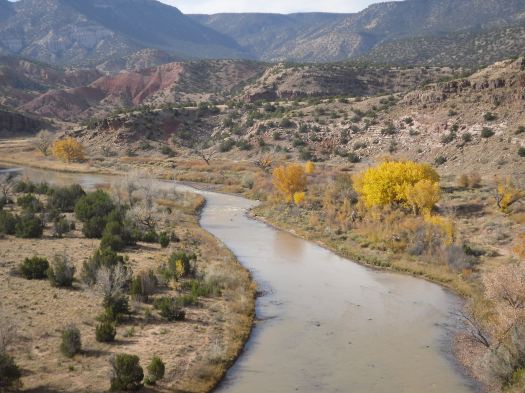
Standing on the banks of the Jordan, I look across to the other side, gazing at my “promised land.”

Perhaps you’ve been here, too. You’ve been given a vision. And you’re waiting to see your dream become a reality.

I remember the years that I spent wandering through the wilderness on the road to publication, wrestling with my doubt, fear, and unbelief. I recall the first time that I considered writing a book. It seemed impossible, doubting that I would ever see my dream fulfilled. Now, I find myself on the shore, looking across to my promised land.

But wait! How can I navigate the rough waters in front of me? The manuscript deadline? The marketing? The on-going platform challenges? What other obstacles will I face as I try to ford the river to my promised land?

I sense the enemy of my soul preparing for another onslaught of roadblocks and dead ends.

Lord, help me!

I inhale slowly—one, two, three, four. Then, I exhale, counting to seven. I inhale again, counting to eight. As I repeat this focused breathing, trying to avoid another panic attack, I relax.

An encouraging promise from God’s Word dispels my fears, “I will be with you; I will never leave you nor forsake you. Be strong and courageous …” (Josh. 1:5-6 NIV).

When I read through this passage, Joshua affirms the promise of the Lord’s presence. He also repeats an exhortation: “Be strong and very courageous.”

Be strong and very courageous. Be careful to obey all the law my servant Moses gave you; do not turn from it to the right or to the left, that you may be successful wherever you go. Keep this Book of the Law always on your lips; meditate on it day and night, so that you may be careful to do everything written in it. Then you will be prosperous and successful. Have I not commanded you? Be strong and courageous. Do not be afraid; do not be discouraged, for the Lord your God will be with you wherever you go. (7-9)

Joshua calls attention to four powerful strategies for claiming our promised land.

  1. Obey God’s Word. After the Lord assured Joshua of His faithful presence, He also instructed him to warn the people of the importance of obeying everything He had commanded them to do.
  2. Meditate on God’s Promises. The LORD also reminded Joshua of the importance of lifting up His Word—meditating on His truths and confessing His promises day and night.
  3. Surrender fears to God. The LORD instructs Joshua to encourage the people to surrender their fears and discouragement to Him, promising to always be with them.
  4. Prepare for battle. As I look across the deep waters of the Jordan into my promised land, I read another warning about impending warfare.

Get your provisions ready. Three days from now you will cross the Jordan here to go in and take possession of the land the Lord your God is giving you for your own … the Lord your God will give you rest … but get ready for battle … (11-14).

Will I still have battles in my promised land of rest? I think this scripture gives me a clear answer to this question.

We must always be aware of our weaknesses, vulnerability, and dependence upon God. As Christian writers, we are called to lead others to claim God’s promised land, too.

So, get “ready for battle … You are to help them until the LORD gives them rest, as he has done for you, and until they too have taken possession of the land the Lord your God is giving them” (14-15).

Are you prepared to claim your promised land?

Photo/AnitaBrooks

Leave the Luggage Behind

luggage“Where are your bags?” is the most frequent question I’ve been getting lately from the friends I stay with when I travel for author events. I show up at their doors with a small tote in my hands, and they look around me for the rest.

“This is it,” I say, and they marvel at how little my bag is.

For some reason, I guess everyone expects me to be loaded down with luggage, dragging along a carry-on case, a tote on my shoulder and more bags to come. While that may have been the norm for me years ago on the rare occasions I flew somewhere with my five kids, it’s no longer my style.

These days, I fly with minimal baggage, and I love it. Instead of packing car seats, food snacks, toys, games, and multiple outfits for all, I get a kick out of taking as little as possible. I actually look forward to living out of one small bag for three or four days, since it requires me to trim my wardrobe to only the essentials I need. Once on the road, I don’t have to make any clothing choices since I already made them when I packed; I save time and effort with less to manage. Limiting myself forces me to evaluate priorities and pack accordingly. There’s no room (literally!) for changing my mind, or my clothing options.

The result is perfect for traveling: I have what I need and no more. It makes me feel mentally and emotionally light and free, and I don’t have to physically exhaust myself lugging extra bags. To fly unfettered by baggage is a wonderful thing in a world of extra luggage fees, delays, and lost bags.

If only I could do the same with my journey through life!

“Do not get any gold or silver or copper to take with you in your belts— no bag for the journey or extra shirt or sandals or a staff, for the worker is worth his keep,” Jesus tells his disciples when he sends them out to preach and minister in Matthew 10. Clearly, our Lord knew the value of traveling light! Without all that extra baggage to keep track of, his disciples were free to devote themselves to the work to which they had been called. Unencumbered with material concerns, they could focus on the priorities, the essentials of Christian mission.

I’ve found that is also true of traveling through life as a Christian author: when I keep my eyes on the Kingdom, everything else loses its urgency. Sure, I’d like to make more money (who wouldn’t? travel expenses do mount up no matter how many free beds you can find!) and it would be nice to have readers flocking to me in droves. Yet when I’m focused on the essential task of sharing God with others, it only takes one heart-felt ‘thank-you’ from a reader to know that I am ‘worth my keep.’

How do you pack for your journey?

Looking for Direction and Peace?

Photo/KarenJordan

Overwhelmed? Drifting above the landscape of your work like a hot air balloon?

Lost your sense of direction? Fear your approaching deadlines?

Searching for answers. When life seems overwhelming, it forces us to look for answers and direction. And it’s important to know where to seek help.

At times, I’m tempted to rely on guidance and encouragement from the resources the world offers me, like the evening news. Instead, it breeds confusion and discouragement, revealing more signs of the ultimate demise of our culture and way of life.

In Matthew 24, Jesus described signs of the end times. And His disciples asked, “Tell us … when will this happen, and what will be the sign of your coming and of the end of the age?” (Matt. 24: 3 NIV)

Jesus explained that He didn’t know when the end would come—only His Father knew the answer to that question (36). But He encouraged His disciples to always be ready (44).

How can we “be ready”? Most of the time, I can’t keep up with the pace of my life, much less worry about the future—especially the last days.

Jesus offered a story to encourage His disciples to focus on the things that matter most. He described a servant who had neglected his responsibilities during his master’s absence, as if he expected him never to return. But when the master returned, he held the servant responsible for his disobedience and disrespect.

Facing the truth. Once again, the mirror of God’s Word forces us to look at ourselves—not to shame us, but to confront us with the truth.

Am I living as if He’s not coming back? What responsibilities am I neglecting?

When I come to my senses and examine God’s Word, I’m reminded, “Instead, be concerned above everything else with the Kingdom of God and with what he requires of you, and he will provide you with all these other things” (Matt. 6:33 GNT).

What does God require of me? Am I taking care of the things that He’s entrusted to me? My home? Spouse? Children? Relationships? Work? Gifts or talents?

As I examine this verse in The Message Bible, I find the specific direction I need.

Steep your life in God-reality, God-initiative, God-provisions. Don’t worry about missing out. You’ll find all your everyday human concerns will be met.

Give your entire attention to what God is doing right now, and don’t get worked up about what may or may not happen tomorrow. God will help you deal with whatever hard things come up when the time comes. (Mt. 6:33-34 MSG).

Practicing our faith. How can I focus on God’s presence, guidance, and provision? Once again, I turn to God’s Word for help.

Jesus, help me to discern Your presence, guidance, and provision. What do I need to focus on right now? Give me the courage and strength to trust you with my future and to listen and obey Your Word. Amen.

What do you need to give your attention to right now? Where do you sense God’s presence, guidance, and provision in your life?

The Making of a Masterpiece

In every block of marble I see a statue as plain as though it stood before me, shaped and perfect in attitude and action. I have only to hew away the rough walls that imprison the lovely apparition to reveal it to the other eyes as mine see it.” Michelangelo

I’ve spent the past month living as a hermit while I finished a manuscript. (Insert sigh of relief here.) I spent countless hours after my day job writing and fine-tuning every detail. Some days, I couldn’t wait to share the story with the world. Other days? All I saw were flaws, flaws that sent me running to fast food and the newest Netflix series while I processed what to do next.

That’s one of the many fun aspects of writing, though, isn’t it? I’m making the manuscript, but in the process, the Lord is making me. As my character wrestles through a growth point, I wrestle with it, too. Often what my character is learning is a lesson the Lord has spent months instilling in my own heart. From the overflow of my heart to the page…I think the story of The David illustrates this perfectly.

In the late 1400s, a group called the Operai provided blocks of marble for several prominent sculptors and artisans to create twelve statues of characters from the Old Testament. Work began on The David in 1464 but after initial carving, the piece was abandoned to the elements for twenty-five years. Then Michelangelo begged the Operai to allow him to complete The David. For three years, he carved the statue, shaving away the damaged parts and shaping features in great detail.

Kariss Lynch creating a writing masterpiece

If you hate history, I hope you stuck with me because none of that is the reason I love The David statue. Michelangelo took a wrecked, abandoned piece of marble and he turned it into a MASTERPIECE. Where everyone else saw a useless block, he saw potential and beauty, a story waiting to unfold.

I think the writing process is a lot like this. A story idea with little initial substance becomes a piece of art with a lot of effort. Over time, the author chips away the unnecessary and ugly pieces until a beautiful story is left.

I believe that’s what Jesus does with the author as he/she writes. Just as Michelangelo labored over The David and you labor over your manuscript, so the Lord labors over you, writer friend. He is in the process of creating a masterpiece that lasts for eternity, and he wants to do that with your writing, too.

Yours is a message of truth and hope. As you identify impurities and polish your writing to perfection, know the Lord wants to do that with you. He wants your voice for his glory. Sometimes the polishing and chipping are painful. With every bit you allow him to remove, you enable him to speak more clearly through you.

Keep chipping away at that novel while the Lord chips away at the excess around your heart. The beauty becomes more evident with every fallen piece.

How to Avoid the Second-Book Slump

How to Avoid the Second-Book Slump @JanalynVoigtWriting, like marriage, is an odd mixture of passion and duty. The same writers who speak of “falling in love” with a story complain about “having to” edit it. Some marriages are easier than others, and that’s also true of books. Some pearls make it to publication with few edits, but often, by the time a novel reaches readers, its writer is sick of working on it. Given these conditions, it’s not surprising to learn that the second book in a series frequently disappoints readers. Preventing this from happening to your second book requires a look at this syndrome’s causes.

Time Frame  

A debut novel usually benefits from years of labor as its author polishes it over and over in order to land a contract. But a second novel, when contracted from a synopsis and likely written in a matter of months, doesn’t go through as strenuous a process.

Solutions:

  • Simply being aware of this as a problem is half the battle. Commit to giving your second book your all, just as you did with your first.
  • Before you submit your second manuscript, make sure you put it in front of a number of “eyes.” Accept knowledgeable critiques, remarks from beta readers, and/or paid editorial advice.

Interruptions

A writer often has to set aside writing the second book in a series to work on edits and/or promotion for the first. While necessary, interruptions stifle the creative flow. Most writers find returning to a cold manuscript difficult.

Solutions:

  • Have all books in a series written before you submit them for publication. Previously, writers held off on writing a second book until the first had sold. This made sense because publication usually went through traditional publishers. These days it’s harder to win that traditional contract but easier to become published. Take this advice if you would hire an editor and independently publish your work, should it fail to land a traditional contract.
  • Learn to write your first draft quickly so that, by the time edits for the first book hit, you’re ready for them.
  • Dedicate part of your day to writing and part to editing, with a break in between. Your brain will learn to readily switch gears.

Conflicting Emotions

During edits, writers must face, accept, and overcome their own weaknesses. The angst this causes can attach itself in the writer’s mind to the series itself. To draw a parallel from marriage: While undergoing marital counseling , it can be hard to remember first love.

Solutions:

  • Go back over your notes or read earlier entries in a writing journal to remind yourself why you love this series.
  • Reconnect with your novel’s theme, which you hopefully drew from one of your passions.  Prayer and meditation can help.

Eroded Confidence

It’s common knowledge that artistic people are their own worst critics, and that’s certainly true of writers. As a result, while dealing with edits it’s easy to lose confidence and take fewer risks with the second book, which can rob it of zeal.

Solutions:

  • Re-read any endorsements or encouraging comments you received for your first novel.
  • Remind yourself that your publisher believes in you enough to work with you.
  • Give yourself permission to dream about what could happen in your story. Don’t censor your ideas, but simply write them down. And when you go back over your brainstorming session, be wise but bold.

Creative Desire  

When the passion in a marriage fizzles, it’s tempting to look elsewhere for fulfillment. In the same way, when a writer loses that loving feeling for a project, other tempting ideas can siphon creative energy and distract attention. This has an adulterating effect on the work at hand.

Solutions:

  • Rather than ignoring new ideas, write them down (briefly) and save them for later. This keeps them percolating on the back burner until you’re ready for them.
  • Stir your passion for the work at hand by dreaming about the story, exploring the nuances of its characters, and mentally writing the next scene.

If you follow these steps, you’ll soon recapture your passion for your series.

Can you suggest some other ways to revive your writing mid-series?

How to Avoid the Second-Book Slump was first published at Live Write Breathe, Janalyn Voigt’s website for writers.

Revising Aloud

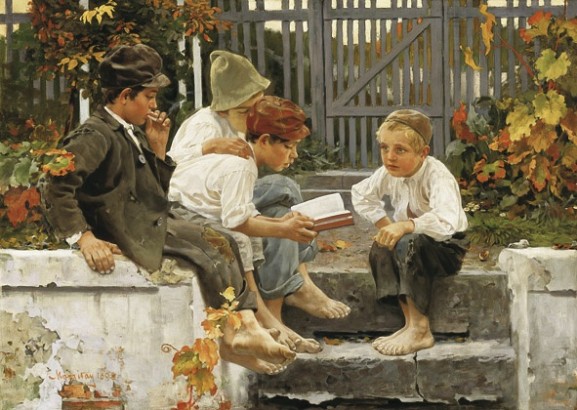
Tihamér_Margitay_Exciting_story“Reading aloud,” I’m always telling my writing students, “is the best way to revise.”

I encourage them—sometimes require them—to find read-aloud partners or start writing groups in which they take turns reading their work aloud.

“Hearing your sentences spoken lets you know whether they’re clear and natural-sounding—whether someone actually could speak them,” I explain. “And it doesn’t work to read to an empty room. You need a warm body, a listener, to complete the communication. Speaking is, after all, a collaborative act.”

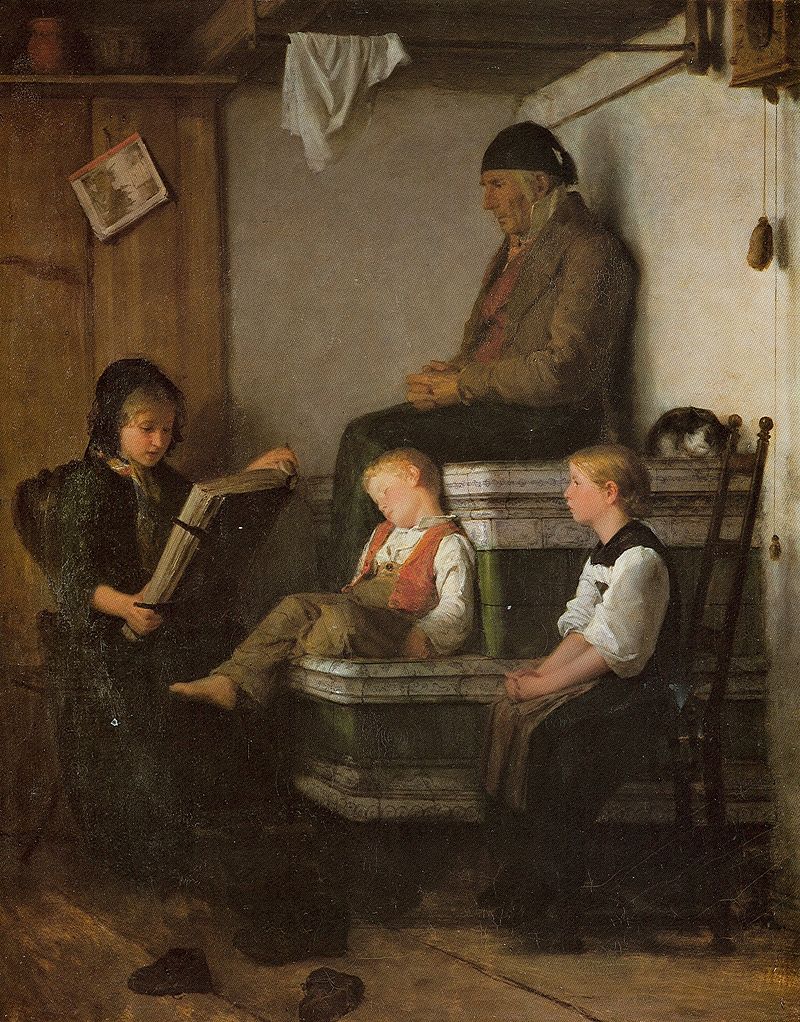
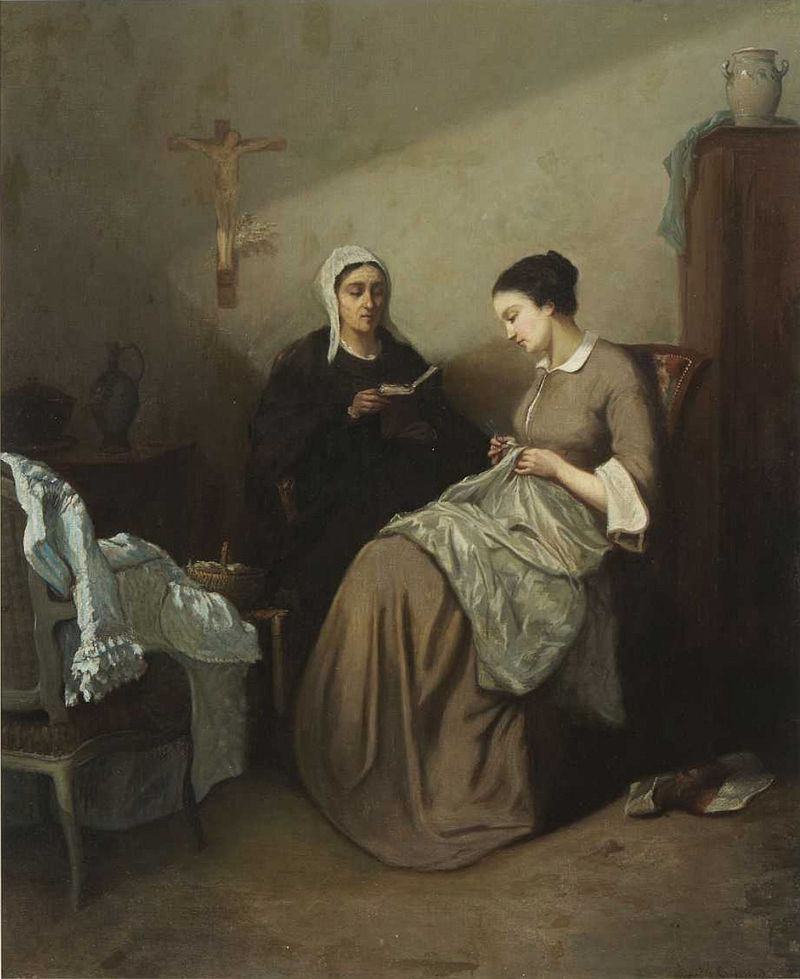
Finding that read-aloud partner is easy at college, where everyone’s engaged in writing all the time. Outside the college setting, though, finding someone willing to listen can be a challenge.800px-Anker_Sonntagnachmittag_1861 People are busy. Few have time to sit still for an hour while some verbose writer drones on. That’s how they’ll imagine it when you propose reading to them. We Americans have lost—or never had—the habit of listening to people read. We had only the shallowest tradition of serial novels, released chapter by chapter as Dickens’ novels were and read to the whole family at fireside. And no comfy pubs—without blaring TVs—like the one where C. S. Lewis, J. R. R. Tolkien, and their writer buddies hung out, drank beer, and read their work to one another. Writers who give public readings these days will tell you it’s hard to get even close friends to attend. Our lives are too busy for read-alouds.

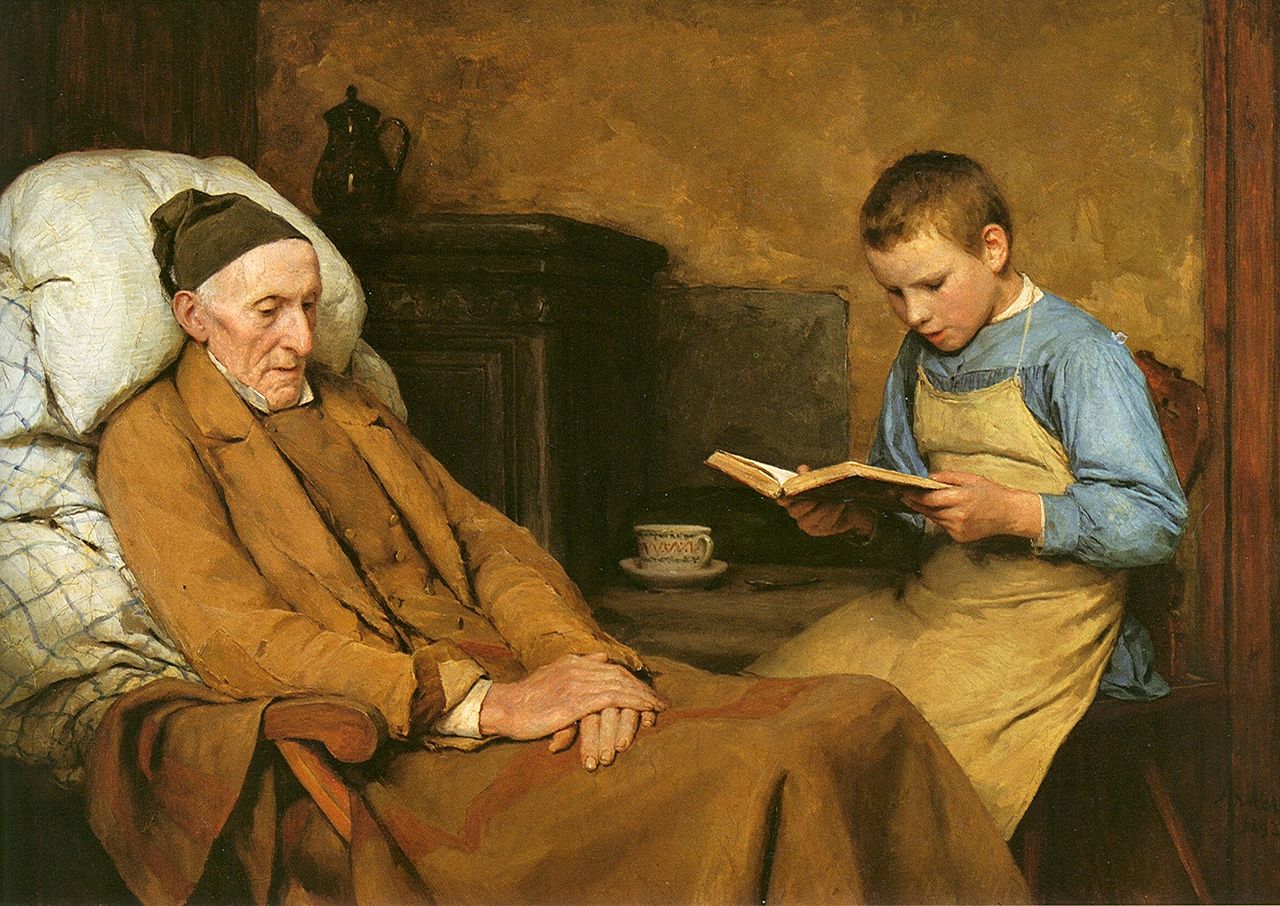
I often recommend to writer friends that they make use of the lonely people in their lives: shut-in relatives, kid-imprisoned friends who wish they had a grownup to talk to, recently retired colleagues with time on their hands. 1280px-Anker-_Die_Andacht_des_Grossvaters_1893It sounds terrible, this “making use” of others, taking advantage of their neediness to assuage your own, but in my experience such mutual exchanges not only helped my writing but also transformed intended acts of mercy—“I should spend more time with my mother-in-law,” I was always telling myself—into pleasurable time together, which we both looked forward to. My mother-in-law not only got longed-for company but also felt needed; I got my warm body but also genuine enjoyment, without having to chide myselfHugo_Bürkner_Lesestunde (usually in vain) to, as Paul recommends, “give what you have decided in your heart to give, not reluctantly or under compulsion, for God loves a cheerful giver” (2 Corinthians 9.7 NRSV). The mutual benefit, I found, guaranteed that cheerfulness, for both of us—because attentive listening and being listened to can’t help but nurture relationships.

My daughter Lulu has been on semester break from college for the past month, with a couple more weeks to go. It’s tricky having a grown daughter home that long. We’ve long since put our Christmas CDs away, but I’m still in the throes of Bing Crosby’s parental prophecy for the season: “And Mom and Dad can hardly wait for school to start again!”

Luckily, Lulu’s engrossed in the final revision stages of her senior project—a hundred-Amédée_Guérard_Bibelstundepage translation of and critical introduction to an East German book—and I’m busy trying to cut 30,000 words from a novel before sending it out, so we have tasks to distract us from the inevitable mother-daughter combat. Also, since we’re in about the same place in our revisions—where what we need most is to hear them aloud and find out if they work—we’ve established a read-aloud schedule: I read her a couple short chapters during her late breakfast, and she reads me one long chapter while I trim vegetables for dinner.

I can’t say it’s the perfect exchange my mother-in-law and I had. Lulu doesn’t end my readings, as my mother-in-law always did, with “That’s the best thing you’ve ever written!” And, as a writer and teacher of writing, I give more critical feedback than Lulu really wants. But our reading fills two hours of our day with mostly pleasurable, mutually beneficial work. More importantly, the listening involved gives us both practice, at this complex juncture of our parental-filial journey, in navigating our new relationship as related but separate adults. As peers, in other words. Equals. Reciprocally heard, appreciated, and loved.