The Hero Within

In a writer’s world we are the masters of the pen (actually a computer keyboard, but that didn’t sound as cool). We create complicated characters through various techniques and tell them what to do.

But then they take on a life of their own and begin to tell us what the story is about. This can be quite fascinating, like sitting at a movie, watching the story unfold. Other times it’s frustrating because these life-like characters make bad choices or behave poorly (there’s always at least one), resisting our intended purposes for them.

When I think of writing in these terms, my thoughts drift to our Creator, and I wonder if God sees us in similar fashion. Aren’t we like His characters, created with His purpose in mind? Yet we have free will and the ability to choose poorly, or wisely.

God gives us that room, though I know we must frustrate him terribly at times. The Israelites certainly did. (Aren’t we still Israelites at times?) But part of the joy I experience in writing a powerful scene with my characters is seeing them grow and embrace God’s love and truth. There’s a sense of victory there even though these characters exist only in my head.

I remember as a kid imagining these scenes where the heroine (usually me, of course!) persevered and made this huge impact or discovery. I walked into the sunset as a new inspiration to my fellow underdogs (the theme of many teen movies).

The funny part of all this is, the longer I write and study the books and movies that are popular, the more I find a universal theme there—of a nobody discovering they have some kind of special gift that helps them save the day. A gift that comes from somewhere outside them and suddenly this feels-like-a-nobody character blooms into someone unique.

Now the amazing part. It’s a story theme that’s existed for thousands of years. The one I like best? The one in the Bible.

Jesus was just an ordinary carpenter. He didn’t look like much to those who resented and envied Him. He didn’t appear a whole lot different from the men He walked with. He started out as a nobody in the eyes of those around Him. But to know Him was to know He walked in greatness and humility.

He walked this earth like a man, yet within He holds a power to “save the day.” And every person who knows Him.

His is the story of the ultimate Messiah, the one true Savior of the world. He was and is the true Hero of the story—of the world and of our lives.

And the absolutely mind-blowing final part? He lives in us, changing us from nondescript nobodies to uniquely gifted individuals created to fit into a true story.

His story.

Happy Thanksgiving from the Water Cooler Family to Yours

Photo by Tom Gill

Thanksgiving has always been a great time for Americans to reflect on what is going right in their lives.

There are other moments throughout the year like our birthday or the upcoming New Year’s holiday that lend themselves to the same moment of gratitude.  However, this holiday asks the same question with a wonderful twist.

Instead of what might be the usual, what-about-me, we’re asked to remember others, especially those who can’t be with their families like our servicemen and women stationed all over the world and in harm’s way in Iraq and Afghanistan. That gives all of us a moment to step out of ourselves and remember what really matters to us.

For many of us it’s the people seated at the table right around us, and we get to say directly to them on Thanksgiving day just how much they mean to us. But there are also many others who touch our lives every day, and mean so much to us for their unflagging support and cheers of encouragements, who are scattered all over the world.

For the writers at the Water Cooler that includes you.

All of us at the WordServe Water Cooler want to take a moment to say thank you to everyone who has joined in our fun. Thank you for taking the time to share your thoughts and feelings here at the blog on the rollicking, fast-paced world of writing, publishing and marketing. We have all grown to feel like one big family.

For writers, who spend a lot of their career waiting to hear from editors or critics or booksellers, it’s a very special and sometimes rare gift to create such a supportive community. We look forward to all of the great conversations, book news, writing tips, and platform building to come.

A great big thank you as well to our agents at the WordServe Literary Agency, Greg, Rachelle and Barbara for all of your guidance, hard work and for always going that extra mile. We are all very grateful. Happy Thanksgiving everyone!

Simple and Sincere

Novel readers and children share a common characteristic.  Both have a nose for sincerity. If they catch the faintest whiff of guile or disingenuousness, you’ve lost them.

In writing and teaching children, you must be sincere.

I pondered this when I watched a videotape of my first grade music students. They sang about falling leaves, and the excitement in my voice as I guided them was obvious. Their faces and singing voices reflected my enthusiasm.

Watching the tape reinforced my suspicion: students respond to me because I love their songs. Though I’ve sung opera and studied the classics, I haven’t lost my taste for the simple things. I find simple truth in “Shoo, Fly” and simple beauty in “All night, all day, angels watching over me, my Lord.”

When I sing the songs of childhood, I believe them in the most hidden labyrinth of my soul. They resonate with me, and not because they’re “cute”. Fun, certainly. Entertaining, beyond a doubt. But if a song smacks of cuteness, I refuse to sing it. My students are too precious to patronize. They deserve simple, powerful songs that convey joy, truth, and beauty.

So do readers. They deserve a story we believe in, one that conveys truth, joy, or beauty, and preferably all three. They won’t be pandered to. They will respond to a book that burns its way out of us with tears, smiles, excitement, pain, or revelation. They will sense the engine of passion behind each line, in the subtle rhythm of a story we had to write. That doesn’t mean they’ll love the story. But if we tap into that rhythm, they might continue reading until the last page, until the last chord fades.

Honest, uncontrived passion. That’s what students and readers crave.

Did you ever try to write a book that didn’t resonate with you? Did you keep at it until it did, or did you scrap it and move on to a new project?

A Writer’s Life: The Waiting Room

Today I’d like to invite you to join me someplace most, if not all, writers are familiar with. Where’s that, you ask?

The Waiting Room.

Oh. My. Word. Your groans probably registered on the Richter scale. Stop it right now and come on in. Yeah, the Waiting Room is crowded. And the magazines are out-of-date. But we’re here to talk, not peruse the 2005 issue of Bowhunter magazine

If you’re a writer, the Waiting Room is unavoidable. Truth is, if you stay the course, you’ll make repeated trips to this room where the hands on the clock never seem to move and you languish forever, wondering when someone will call your name and say, “We’ll see you now.”

Aren’t I just the messenger of all things light and breezy today?

Why, you ask, why the Waiting Room? It’s such a waste of time.

Is it really? 

What can you learn while you wait? (Yes, I know you’d rather get seen and get out of here. But stick with me.)

  1.  Understand attitude is key. If I expect to wait then I avoid the “Woe is me” attitude — or at least succumb to fewer attacks of self-pity. If I get into my appointment on time or — gasp! — early, then I celebrate. Translation: No one is an overnight success. If some author tells you that they were, they’re lying. (You can tell them I said so.)
  2. Come prepared to wait. Do I want to waste time thumbing through magazines I’d never read even if I was stranded on a desert island? Translation: What are you doing while you wait for “the call”? Are you counting time or making time count by revising your manuscript, attending conferences, connecting with other writers — maybe even encouraging other writers?
  3. Realize everyone hates waiting. Medical professionals hate being behind schedule as much as you hate waiting. Translation: Editors wait too. And agents. And publishers. (Side note: Please, no comments with “waiting for my doctor” horror stories.  Not the point of this post. If you really need to vent, email me at beth@bethvogt.com. I’m married to a doctor. I can take it.)

Time for me to sit back and see what y’all have to say about time spent in the Waiting Room. Tell me how you handle waiting for feedback from your critique group. Or from your agent. Or for the “sign here and would you like an advance with that?” phone call. How do you make waiting worthwhile?


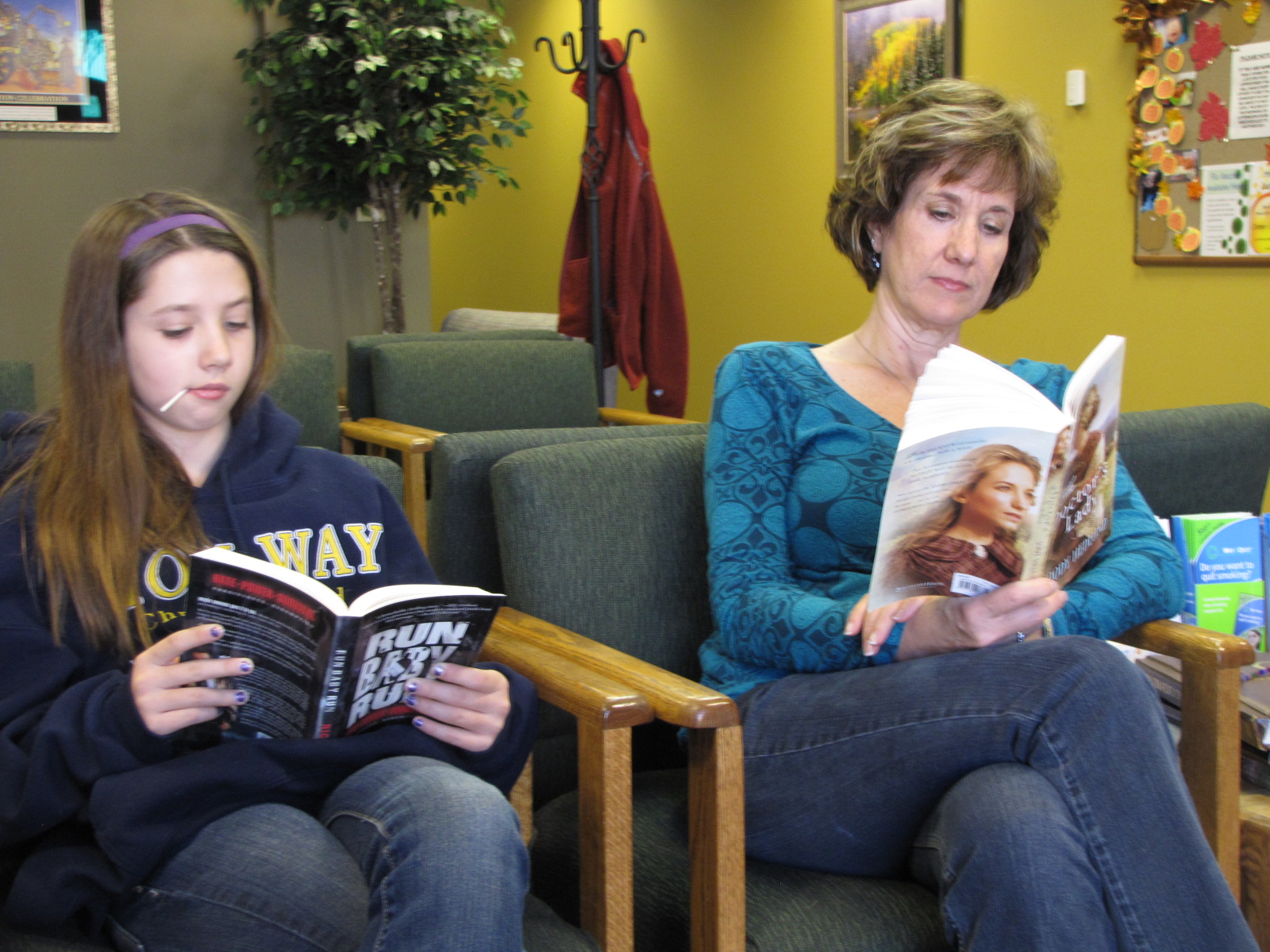
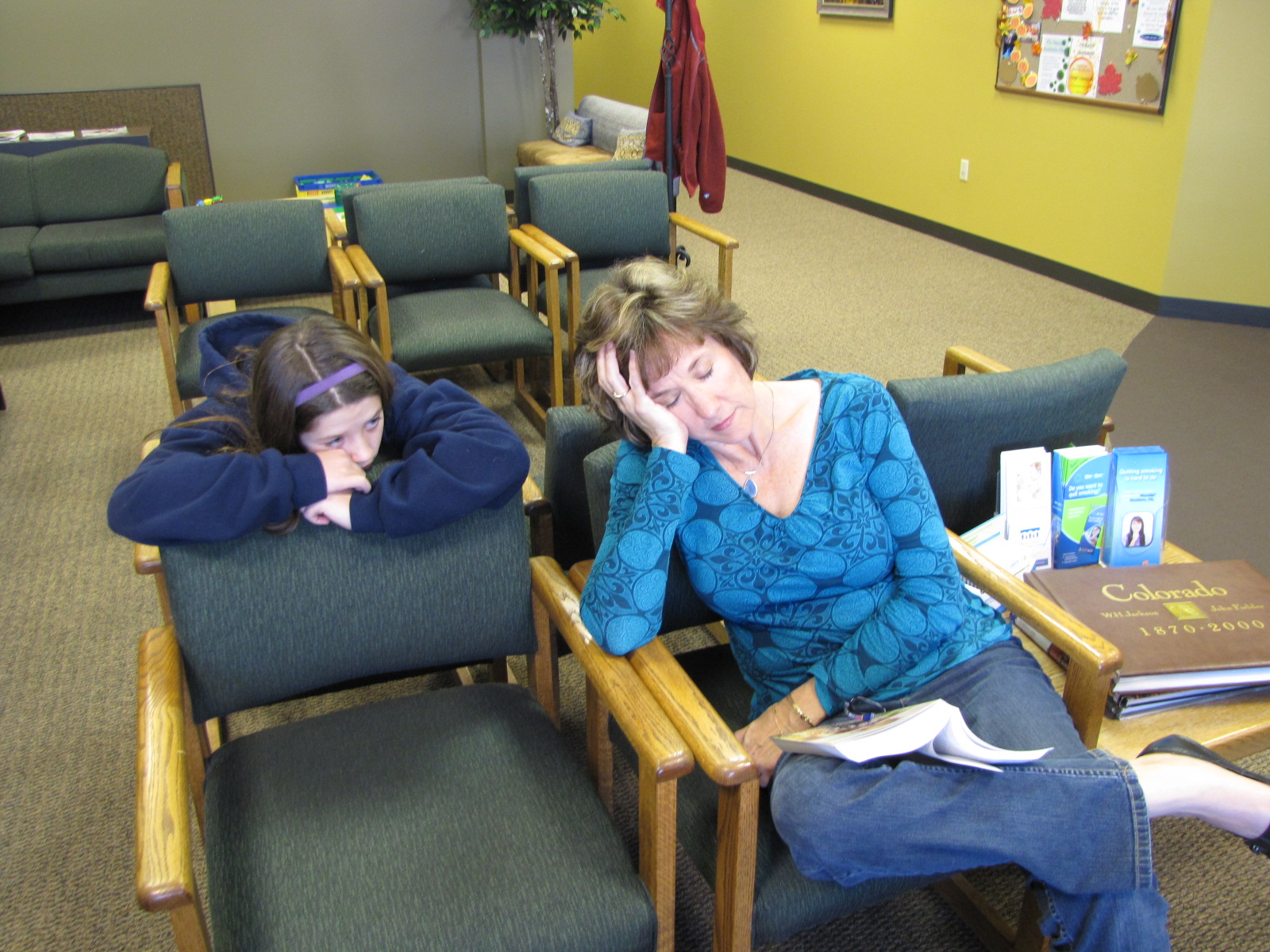
*Photo credit: That’s me and my daughter. In my husband’s waiting room. With a copy of author Jody Hedlund’s latest release, The Doctor’s Lady. The sleeping pose is for the sake of the column — not a statement on Jody’s writing. I loved reading The Doctor’s Lady!

Post Author: Beth K. Vogt

Beth K. Vogt is a non-fiction author and editor who said she’d never write fiction. She’s the wife of an air force physician (now in solo practice) who said she’d never marry a doctor—or anyone in the military. She’s a mom of four who said she’d never have kids. She’s discovered that God’s best often waits behind the doors marked “Never.” She writes contemporary romance because she believes there’s more to happily ever after than the fairy tales tell us.

A Writer’s Life: The Pit of Despair

Whenever I watch The Princess Bride, I skip the Pit of Despair segments. Popcorn, anyone? Maybe rewind to the Fire Swamp?

Sure, the Albino with the needs-to-cough-up-a-hairball voice is a bit of comedic relief before discovering our hero Westley is in the Pit of Despair. His future? Torture — attached to a life-sucking machine. His only escape? Death.

Am I the only one who skips these scenes?

As writers, there are days we are trapped in our personal Pit of Despair, without even a somewhat friendly Albino nearby. Life — our passion — is being sucked out of us, bit by bit.

What does Westley’s trip to the Pit teach us? Consider two truths:

  1. Truth # 1: Enemies get you into the Pit.
  2.  Truth # 2: Friends get you out of the Pit.

What about those enemies?
Inconceivable, isn’t it, how both success and failure dump us in the Pit.

When you succeed as a writer — land an agent, sign a contract — you think: Other people have expectations for me. What if I fail? Overloading yourself with the real or imaginary expectations of others tumble you into the Pit faster than the Dread Pirate Roberts can scale the Cliffs of Insanity.

And then there’s the slippery slope of failure: never attaining your goals, never quite grasping whatever spells “victory” for you. The root problem is the same: expectations. Fear you won’t meet others’ expectations or disappointment in yourself for not fulfilling your own. The bigger question? How do you navigate both success and failure?

At last! It’s time for the friends.
Westley didn’t rescue himself. The heroes? Fezzik and Inigo, who found a “mostly dead” Westley in the Pit. But that didn’t stop his friends from hauling his body out to go looking for a miracle.

When you can’t see the faintest hope of a miracle for the forest of despair surrounding your writing dreams, who searches for you? When you no longer believe in yourself, in your story, who believes in it for you? And — perhaps even more importantly — who do you go looking for when they’ve been dragged off into the Pit of Despair?

We’ve peered over the Cliffs of Insanity, survived the Fire Swamp, and now find ourselves at the Pit of Despair. Which have you found to be the greater enemy: success or failure? How have friends rescued you? Like Miracle Max, I believe it takes a miracle sometimes for changes to happen … so if you have any of those to share, please do!

For Fun: The Princess Bride 25th Anniversary cast reunion

Post Author: Beth K. Vogt

Beth K. Vogt is a non-fiction author and editor who said she’d never write fiction. She’s the wife of an air force physician (now in solo practice) who said she’d never marry a doctor—or anyone in the military. She’s a mom of four who said she’d never have kids. She’s discovered that God’s best often waits behind the doors marked “Never.” She writes contemporary romance because she believes there’s more to happily ever after than the fairy tales tell us.

First Contract Jitters

It wouldn’t happen to me.

At least not full-blown.

After all, I’d written for ten years, penned multiple novels, experienced a myriad of rejections letters, sold a bunch of articles, and met repeated free-lance deadlines.

I would NOT get the dreaded-first-contracted-book-jitters. Or writer’s block. I was a professional, just taking a next step in the industry.

Right?

You know what’s coming. My first book deal was contracted on a chapter and a synopsis. It was time to write to meet my first book deadline.

Only I needed to do more research. Read more widely within the genre.

I read 13 novellas in less than two weeks.

Obviously, it was becoming an addiction, all of this reading instead of writing.

I should quit—and would—as soon as I finished the 400 page novel that just arrived in the mail.

Then my friend brought me her collection of novellas to help with my research.

(Why do best friends feed addictions? Seriously!)

I had to write.

So I tackled every left-brained project I could find. I wrote non-fiction free-lance assignments, submitted proposals, started a devotional facebook page, and spent a bunch of time networking and marketing.

Which made my brain hurt, so I slipped away with a good book . . .

Renewed and with great resolve I went to bed excited for the morrow, when I would do nothing but write my first contracted novella.

I got up earlier than usual—not because I was eager to write, but due to the need to escape nightmares about inadequacy.

Bleary-eyed, I curled in my recliner, grabbed my journal and Bible, and prayed it through. The Lord reminded me of His promise ten years ago to lead me on the best pathway for my life, to guide me and watch over my writing journey (Psalm 32:8).

He asked if He’d done a good job so far. I said yes. He asked why I would think He would stop now. I said He wouldn’t. He promised to be with me.

Buoyed by God’s assurances for this new writing season I told my husband the whole wonderful story. Then promptly burst into tears.

The sweet man tried to hide his chuckles as he reminded me I was living my dream—that I could do this. Then he resorted to an illustration that good, non-fiction reading, left-brained, red-blooded husbands turn to: football.

Quoting Tim Tebow, the Bronco’s new wonder boy, my husband talked about going out there and doing what you love because you love it and because it is fun.

Oh, yeah.

This is what I love to do, this thing I’ve been avoiding for the past month. It’s fun.

No more fear! I’m going to get creative and let this story pour from my fingertips  . . .

Tomorrow.

(How about you? Got a “first contract jitters” story?)

The Long View of Getting Published

Photo by Michael Hirst

There are two distinct parts to my career as an author. Part one, when I saw myself as more of a lone wolf and part two, when I finally started admitting I don’t know everything.

The second half where humility has played a lot bigger part has been more rewarding in every way, particularly financially and spiritually.

Funny little thing I’m learning about life is that when I stop trying to force my will and realize I may not get what I want but I can still be of service, more of what I wanted all along shows up. However, to head down that path the first few times took a lot of courage and hope because I didn’t have any personal proof. Fortunately, I had worn myself out trying things my way. I became willing.

To be an author, whether it’s as an independent or through the traditional venues takes more people and therefore a lot more willingness. The independent route sounds like it would be easier to stick to your own common sense and that would be more than enough, except for the occasional question. But publishing a book is a process that requires a lot of hands.

Besides, I was more arrogant than that anyway, running down the traditional path and still telling everyone how I saw things.

However, when I stopped listening for just the small kernel I wanted and expected to hear, dropped any agenda and not only took in the information but gave it time to sink in, things really began to move in a better direction. That opened things up even more.

What if I even followed through on some of the suggestions to see if other people who are actually the professionals in their slice of the publishing game were right? Perhaps my part in the entire process is to be a team player, be open to all of the information that’s coming in and just do what’s been suggested.

Some wrong turns are to be expected and even that’s okay because  the last tool I keep close by is the one that makes all of it okay.

I am powerless over the outcome but there is One who has His hand on everything, loves all of us beyond our ability to understand and has a plan that includes everyone. This is the most important part to me and makes it possible to relax and go back to the day I’m in when I’m worried about how book sales will go or if a book will get published at all.

The answer is, maybe it will, maybe it won’t.

In the past I couldn’t live with that answer so I tried harder to fix things. That just didn’t work and I wore out others as well as myself. Doors closed.

Now, I ask myself if I’ve done my part? Do I trust the professionals I’m working with on this book? What’s in front of me to do? How can I go be of service?

I know, all of that sounded really contrary to becoming published to me too, at first. But I had tried the lone wolf gig and only gotten mediocre results, at best.

I became willing to try a new tack. God is everything or God is nothing and I wanted, maybe even needed God to be everything so I started listening with a new ear. I asked for help and admitted when I didn’t know something. I grew more patient and less ‘helpful’ with suggestions. I did what was asked of me, on time and nothing more, allowing others to do their job without my interference. I became willing to change structure or style and see what happened.

And on the days when my anxiety still sits on my chest like an angry gorilla, I go pray, turn it all over to God and ask for peace of mind and heart. Then I get back to my day, do what’s right in front of me and keep going. As a result, more of my publishing life has fallen into place and my relationships in that area are a lot stronger.

Celebrate!

Let's all celebrate! (Pic by Photobunny)

Today is both my birthday and my agent, Rachelle Gardner’s birthday. Reason enough to start a party!

As if that weren’t enough, as a bonus to really get in the mood to celebrate I have a few words of wisdom from Rachelle about building a career rather than just selling a book.

I was one of Rachelle’s first clients and right from the start I knew there was the potential for something special. It started with the way Rachelle chooses her clients, the writers.

Rachelle has never been afraid to take on a new author. She now has about 50 clients, 90 percent of whom are new authors, which says something wonderful about her approach to the publishing business. Her intention is to build a strong roster of credible writers rather than make the quick sale. That takes time and talent on both the author and the agent’s part and can be just as rare in an agent as it is in a writer.

“It’s great for me because as agents go, I’m still one of the newer agents, coming up on four years, and it’s kind of neat for me to help build writers from the ground up,” said Rachelle. “Now, keep in mind, I’m making very intentional decisions,” she added, as she looks for writers who have something to say and are willing to work with her.

I’ve had agents before, good agents who quickly sold my work but I’d never had anyone speak to me in terms of a career. Not only in general terms but specific steps I could take if I was interested in making a decent living. Rachelle was doing that from the start even while we were talking about the project at hand. She was taking the long view of me as a writer.

That approach was going to take more work and a lot more patience but has the potential to payoff with steadily rising book sales.

That’s like gold in this business. Continue reading “Celebrate!”

The Writer’s Life: On the Edge of the Cliffs of Insanity

BeingThe Cliffs of Insanity a writer can make you crazy.

Think about it:

  • Your literary heritage? A long line of creative alcoholics and drug users: Ernest Hemingway. O. Henry. Tennessee Williams. Dorothy Parker. Edgar Allen Poe.
  • Betting your life on a maybe, dependent on the kindness of others–agents, editors, publishers–for your success. And, really, their decisions have nothing to do with kindness.
  • Balancing your hopes on the seesaw of contradiction: Write your passion. Write what the market wants.
  • Hearing voices. The fictitious ones in your head that you tell what to do–and then you wreak havoc on them when they don’t. Meanwhile, the ever-present voices in the real world–your boss, your spouse, your kids–demand you focus on the here and now. The business meeting. The bills. The moody pre-teen inhabiting your daughter’s body.
  • Facing unending emotional upheaval. Waiting. Rejections. The mixture of joy and jealousy when a friend earns “the call.” (Not that you’d ever admit to even a passing acquaintance with the green-eyed monster. Inconceivable.)

Being a writer can push you to consider changing your name to Poe or Hemingway. The craziest part? You chose this life. You’re committed to this insanity. Here are a few suggestions for managing the madness:

  • Pick your mentors wisely. Just because writing drove others to indulge in mind-altering escapes doesn’t mean you must. I admire my mentors for their lifestyle choices, not just their writing skills.
  • Don’t let all your dreams be based on maybes. I have limited control over my success as a writer. Writing, however, is not all of my life. I’m pursuing other dreams with both short and long-term goals.
  • Choose between your passion and writing for the market. Or not. Maybe you’ll be the lucky author who hits the market when your passions collide with what “they” want. (Romantic-Amish-Vampire-Time-Travel-Steampunk-with-a-moral, anyone?)
  • Jump off the seesaw. The whole “balancing the writing world with the real world” challenge? I may never master that. Sometimes my mind seems full of shrieking eels, all screaming, “If only these people (husband, kids, friends) would leave me alone, I could accomplish the more important goals!” Then I know it’s time to shut down my computer and connect with family.
  • Admit you experience emotions. If emotions are good for our fictional characters, why are they bad for us? Sometimes we’re conflicted: over-the-moon-happy for our friend who landed a contract and also disappointed we’re not the one signing on the dotted line. That’s reality.

I’m curious: Am I the only writer pushed to the edge of the Cliffs of Insanity? How do you keep yourself from leaping off? (And can anyone tell me where the Cliffs of Insanity exist?)  ;o)

Post Author: Beth K. Vogt

Beth K. Vogt is a non-fiction author and editor who said she’d never write fiction. She’s the wife of an air force physician (now in solo practice) who said she’d never marry a doctor—or anyone in the military. She’s a mom of four who said she’d never have kids. She’s discovered that God’s best often waits behind the doors marked “Never.” She writes contemporary romance because she believes there’s more to happily ever after than the fairy tales tell us.

Peace in the Process

Memo from the Desk of Learning Things The Hard Way

Do you ever feel like you write and study and query and revise but aren’t getting any nearer to publication? That the skill level, body of work or following you aim to achieve is a distant speck on your horizon?

A few years ago, I was at my writing desk and cracked open the book Water For Elephants by Sara Gruen. The book was a beautiful blend of captivating writing, spectacular voice, charming wit, depth and heart. After about an hour, I stopped reading. Part of me couldn’t put it down; part of me couldn’t read any more. It was a beautifully crafted, engrossing reminder that my own writing sucked. I nearly broke the mouse punching the exit button on my always-open novel document. Then I took a deep breath and heard a little voice saying NO ONE expects my first novel to be as good as Sara Gruen’s NYT bestseller.

No one except Camille.

Brilliant, captivating writing sets the bar high, and I like that. In fact, I like a bar set so high my nose bleeds just squinting to see it. I love an impossible challenge when it comes to writing well. Do you? But somewhere in all that bleeding and straining to reach higher, dissatisfaction with my skills became a debilitating road block, a discouraging heckler from the sidelines.

You’re delusionial.

You’re never going to be good enough to break in.

You’re mediocre and always will be.

Quite frankly, you suck.

Every author was once a newbie, every graduate an underclassman, every craftsman an apprentice. Guess what? You’re allowed to stare off into the distance at your desired destination—as long as looking ahead doesn’t trip you up where you’re at today. When the writer/editor/artist you want to be eludes you, maybe you’re looking too far ahead. Maybe watching the horizon is slowly crippling you from ever reaching that place. Ask yourself this: Are you better at your craft than you were last month? Last year? A decade ago? I bet you are.

Content But Not Complacent

Eventually, I found out I wasn’t Sara Gruen. Imagine my surprise. In fact, I wasn’t even supposed to be Sara Gruen. I also discovered that after all that straining and reaching higher, I had grown as a writer. For me, staggering genius is still a speck on the horizon, a glint on the high bar. And I still aim for it, nose bleeds and all. I, like my current novel, am a work in progress. You may be aiming for your own speck on the horizon, your own dream of success or accomplishment, and while you should never stop aiming, you need to give yourself permission to be here, today, right now. To be content in the midst of reaching, content but not complacent, right where you are.

Genius begins great works; labor alone finishes them.  -Joseph Joubert

No one is born a best-selling author. The only writers certain to fail at publication are those who quit. The truth is it takes a lot of patience to wait for the day when your natural talent pans out and proves to be sheer genius, especially if that day is still a distant gleam on the horizon. The trick is to wait patiently but actively. Pursuing excellence by writing, studying, reading, querying, listening, collecting rejections, receiving instruction and advice, honing, querying again, and working every day toward that high bar. You may never be Sara Gruen. (What?!?!) But you will become a far better writer in the process as you stretch out and reach beyond you.

Regardless how far I’ve come and how far I have yet to go, I keep reminding myself that it’s okay to be where I am right now (while pinching my nostrils and pressing an ice pack to my forehead). So please don’t quit! Aim for excellence but also graciously give yourself permission to be right where you are today.

 Peace to you, wherever you are! ~Camille

Q: Are you easily discouraged by the better art, better work, better performance of another? Or do you allow dissatisfaction to motivate you to keep working on your craft? Are you content with where you are, but not complacent? It’s a tough balance. Have you found it?