Three Requirements for Christian Writers to Consider

Photo/KarenJordan

… The right word at the right time—beautiful! (Prov. 15:23 MSG).

I opened the book package at my mailbox and read the title, Renewed: Finding Your Inner Happy in an Overwhelming World

Renewed. I need to read this book today, I mused. 

But my “to do” list interrupted my daydream of relaxing in my recliner, enjoying a tall glass of iced tea, and reading Renewedby WordServe author, Lucille Zimmerman.
Renewed

I placed my copy of Renewed on the end table next to my chair and revisited my checklist. Speaking engagement? Check. Four Bible studies for newsmagazine? Four checks. Blog post? Maybe tomorrow. Three book proposals? Question mark. Post for WordServe Water Cooler? Oops. Just breathe … I guess the book proposals go on hold again. Drat.

Responsibilities. After a few minutes of brainstorming about my WordServe post, the phone rang. “Mom, do you have two large suitcases that the boys can borrow for next week?”

Next week? I cringed with this pressing reminder of my commitment to keep my youngest two grandchildren in Texas, while my daughter attended church camp with two of her older boys.

Requirements. When I return to my computer, I’m drawn to Renewed again, desperate for a word of encouragement and a sense of renewal. As I read the first chapter on self-care, Renewed offered the exact words that I needed for that moment. Later, a reference to Micah 6:8  reminded me of a question that I had failed to ask earlier as I struggled with my other commitments.

And what does the Lord require of you? To act justly and to love mercy and to walk humbly with your God. (NIV)

Did I read that right? Only three requirements? 

  1. To act justly.
  2. To love mercy.
  3. To walk humbly with God.

Maybe I should check out another translation. 

But he’s already made it plain how to live, what to do, what God is looking for in men and women. It’s quite simple: Do what is fair and just to your neighbor, be compassionate and loyal in your love, and don’t take yourself too seriously—take God seriously. (MSG)

Relief. I breathed a sign of relief, as I read the answer again. Then, I whispered a prayer of thanks to God for the healing power of His Word, the encouragement of my writing friends, and the gift of His call to be a writer.

In all my prayers for all of you, I always pray with joy because of your partnership in the gospel from the first day until now, being confident of this, that he who began a good work in you will carry it on to completion until the day of Christ Jesus. (Phil 1:4).

Lord, give us the courage to listen and obey Your Word.


Photo/KarenJordan

YouTube/CastingCrowns (Courageous)

What recent encouragement have you received from God’s Word or gleaned from another writer’s work? 

Roll the Stone Away

http://creativecommons.org/licenses/by/2.5/

One of my favorite scenes in the New Testament is when Jesus raises Lazarus from the dead in John 11: 38-44. “Roll the stone aside,” Jesus tells those around the burial place, a cave cut into the hillside. After the stone is moved, Jesus calls out in a loud voice: “Lazarus, come forth!” The dead man obeys, and Jesus then commands that Lazarus be freed from his burial linens and let go.

Aside from the brilliant drama of the moment, the undeniable demonstration that Jesus is the Lord of life, I am especially fond of this passage because I heard it proclaimed in church at a pivotal time in my own life when I was struggling with direction.

My fifth child was almost a year old, and I knew it was time to move on from having babies.

But move on to what?

As a full-time stay-at-home mom, I’d devoted fifteen years to raising my children. About once a year, I managed to produce a Christian magazine article, which satisfied my desire to write. (All my other desires were to get more sleep.) Since I still had a young child, I knew I wouldn’t be heading back to outside employment for at least another five years until she entered kindergarten, and even then, I’d need summers off to be home with my kids. What kind of work could I do, other than answer one of those ads in the back of magazines for someone to stuff envelopes as their own home business?

That’s when I heard the Scripture proclaimed at church.

And it immediately struck me that I needed to roll a stone aside in my own life – the stone of my own excuses that prevented me from committing myself to developing ALL the gifts God had given me.

Because excuses aren’t the same as authentic obstacles.

I didn’t have an enormous, heavy rock to literally push away like the friends of Lazarus had. Yes, I had important demands on most of my time, but I realized that some of those demands were also self-imposed – stones I had placed in my own pathway. With two teens in the house who doted on their baby sister, there wasn’t any reason I had to be the only one to mind the baby for an afternoon, yet I hesitated to lay that responsibility (stone) on my older children. Once I did, though, it was good for all of us – my teens learned new skills in carrying that particular stone, and with it removed from my path, I had several hours a day to develop my writing skills.

One by one, I worked at rolling away the stones of excuses so my writing talent could come out of its cave.  When my fifth child left for college last fall, I was sad to see the end of that phase of my life, but so excited to greet the new one waiting for me.

What stones do you need to roll aside to answer God’s call to new life?

Open Your Eyes, the Blinding Truth About Writing

Photo credit
Photo credit

Open Your Eyes

One time as a kid, I tried to walk home from the corner store with my eyes closed.

I knew the way. My brother and sister and I stopped in often at the tiny grocery store with floor to ceiling products and cold, cement floors, always desperately worried that Marsha, the mean cashier with a mustache, was working, and at the same time buoyed in our courage by the lure of fizz candy and green, curvy, ice cold bottles of Coca Cola.

I memorized every break in the sidewalk and each pebble from thousands of trips back and forth from our house to the market. It was a straight shot, no turns, no need to cross the street.

Confident I could find my way home using other senses, I closed my eyes. As a child I subscribed to the notion that if I couldn’t see, then no one else could see me either. Creeping forward, I gained confidence, enlightened by heightened noises and smells. I smelled pine. I heard cars zipping by on the street. My feet kicked broken up pieces of gravel on the sidewalk as I meandered.

Within a few steps, I smacked into a tree. Dubbed by confidence, I had veered off to the left. The impact wasn’t that severe because I had been going at a turtle’s pace. But my forehead stung and my pride was hurt. My eyes, now wide open, darted around for witnesses. I ran the half block home to my mother in tears.

The Blinding Truth

Most of us who write, or who want to write, will recognize this story. We’re at a party, or out to lunch with an acquaintance, and we mention the book we are working on.

“Oh, you’re writing a book? That’s great. I want to write a book some day.”

You nod, take a bite of your chicken sandwich on rye, and wonder if your conversation partner realizes you’re talking about actually writing a book, not taking in nine holes of golf on a lazy Saturday afternoon.

Here’s the blinding truth about writing: if you want to write, than you have to write.

Not only that, but you have to be willing to be humbled. You have to want to learn about craft, and building a platform, and countless drafts, endless revisions, fuzzy hours staring at a computer screen, keeping your butt on the chair in order to get the story down, and growing thick skin for rejections. Because rejections come, my friends. Oh, they come.

Earnest Hemingway said that we are all apprentices in a craft where no one ever becomes a master.

There is always more to learn about writing, and the best way I can figure out how to learn is by keeping my eyes open, and realizing that it is going to take work.

Gloria Steinem said that writing is the only thing that, when she does it, she doesn’t feel she should be doing something else. If that’s you, if that is how you feel, well then, write.

But do it with your eyes open …

The 15-Minute Writer: Taming the Social Media Monster

file0002062790027 This is part five of a series. Read parts 1-4 here.

Ever wonder how top authors (especially those with families) do it all–write, read, speak, tweet, pin, travel, correspond and more? I’ve got a hunch that they choose what they’re best at, and hire talented people to do the rest.

There are simply not enough hours in the day to do it all. In addition, since new social media platforms pop up regularly, it’s easy to get overwhelmed.

Over the past few years as a writer-mom, I’ve made more than a few mistakes, but I’ve also learned to prayerfully make (sometimes tough) choices. With God’s help, I’m taming the social media monster–instead of letting it wreck my schedule and family life.

  • First, I regularly revisit my priorities. As seasons of life change, so do my family’s needs and schedule. When my children were small, I wrote during Mother’s Day Out and nap times. Now, I write, research, and update my blog and Twitter or Instagram accounts during their school hours and activities. I try to be available to them after dinner and while they’re doing homework, keeping certain times free of online distraction. So far, it’s working well for us.     OLYMPUS DIGITAL CAMERA
  • Second,realize where I’m strong–and weak. I began blogging in 2004, and last year, I admitted to myself that I’m simply burned out. Bleh. Meh. Etcetera. However, giving myself permission to blog less often, and do other things I enjoy more (keeping an active Facebook and Pinterest presence, for instance) has helped my attitude about online promotion. I also love my work as an editor at an online magazine, and the curating I do for The High Calling helps me build my own platform. Score!
  • Third, I recognize my addictive tendencies. Recently, I discovered that with a few handy-dandy apps on my Iphone, I could tweet, chirp and pin while waiting for doctor’s appointments, eating by myself at fast food restaurants, and even in bed. The only problem? I had used those times previously to read, daydream or think. No down-time for Dena makes her a grumpy girl–and a boring writer. So, I decided to delete the apps. I already feel more peaceful and balanced.
  • Fourth, I reign in my expectations. Someday, when the kids are grown, I will have more quiet/alone time. (Please, God?) And I don’t want to have a ton of regrets later in life. This creative, crazy family is where the Lord has placed me. He has also chosen to give me wonderful writing opportunities. Such a precarious balancing act means I can’t pursue every single marketing or promotion lead that comes my way. I won’t be able to accept every speaking engagement I’m offered. And I can’t attend every platform-enhancing conference that looks interesting. This both helps and hinders our family financially, but God has always honored my commitment by providing everything we need (and most of what we want). As my dad told me many times, “Honor God, and He’ll honor you.”

Hopefully, my experiences will encourage you in your own efforts to mollify the online marketing beast. What are YOUR tips for handling this potential monster?

Four Promises for Facing Self-Induced Pressure or Deadlines

Photo/KarenJordan“And you will know the truth, and the truth will set you free” (John 8:32 NLT).

Sometimes I feel like I can’t breathe because of self-induced pressure or someone else’s expectations of me. And at times, I get tired even thinking about trying to follow through on all of the commitments that I’ve made as a freelance writer.

But I know that “God didn’t go to all the trouble of sending his Son merely to point an accusing finger, telling the world how bad it was. He came to help, to put the world right again” (John 3:17 MSG).

So, when I finally sit down and bring my feelings to the Lord, I remember His promises of freedom, strength, provision, and peace.

Freedom from judgment. Romans 8:1-2 reveals the promise that there is no condemnation to those who are in Christ Jesus.

With the arrival of Jesus, the Messiah, that fateful dilemma is resolved. Those who enter into Christ’s being-here-for-us no longer have to live under a continuous, low-lying black cloud. A new power is in operation. The Spirit of life in Christ, like a strong wind, has magnificently cleared the air, freeing you from a fated lifetime of brutal tyranny at the hands of sin and death (MSG).

Strength for our weakness. God also promises to give me His strength in my weaknesses. In 2 Cor. 12:9-10, I read,

My grace is enough; it’s all you need. My strength comes into its own in your weakness. Once I heard that, I was glad to let it happen. I quit focusing on the handicap and began appreciating the gift. It was a case of Christ’s strength moving in on my weakness. Now I take limitations in stride, and with good cheer, these limitations that cut me down to size—abuse, accidents, opposition, bad breaks. I just let Christ take over! And so the weaker I get, the stronger I become (MSG).

Provision for our needs. And did you know that God also promises to provide all that you need in Christ Jesus? “And this same God who takes care of me will supply all your needs from his glorious riches, which have been given to us in Christ Jesus” (Phil. 4:19 NLT).

Peace through prayer. So, if you’re struggling with self-induced pressure or fighting a battle with judgment or condemnation, I encourage you to stop what you’re doing for just a moment and voice your fears and needs to God. He promises to provide His peace through prayer.

Don’t fret or worry. Instead of worrying, pray. Let petitions and praises shape your worries into prayers, letting God know your concerns. Before you know it, a sense of God’s wholeness, everything coming together for good, will come and settle you down. It’s wonderful what happens when Christ displaces worry at the center of your life. (Phil 4:6-7 MSG)

How do you deal with your self-induced pressure as a writer?

Shameless: How to Fail a Book Signing (but Not the Writing Life)

“Art is born out of humiliation.”  W.H. Auden

I had a fantastically unsuccessful book signing in a big box store not long ago. (Yes, signings still occur, despite the takeover of social media.) Afterwards, licking my wounds, I turned to a book on my own shelves, Mortification: Writers’ Stories of Their Public Shame. In it, Margaret Atwood, Rick Moody, Billy Collins and a constellation of such literary brights offer up the most companionable ignominies and embarrassments. (Fittingly, I bought the book used, online, for a penny.) My own parade of humiliations that night were paltry next to theirs. Still, couldn’t I do better?

Two weeks later, an Internet search on “book signings” confirmed my suspicions. According to several book signing experts, I did indeed do everything wrong. First, I missed the Webinar on “The Seven Steps to Turn Yourself into a Celebrity.” In another  article, I violated nearly every one of thirteen steps, beginning with, “Decide, in advance, what sort of clothing you want to be seen wearing by your reading public.”  (Did I do this? No.) Step #6 advised bringing along a printout of your manuscript for fascinated readers. (Really?)  My most egregious error was the last step: my failure to inform the store managers that I would be the bookstore’s official greeter while I was there. Nor did I walk around with several copies of my book introducing myself to everyone in the store, as he advised, pressing my own books and bookmarks into their astonished hands.

I would rather demonstrate the wonders of Balinese kitchen knives through the Christmas season at Walmart than resort to such tactics.

We all know we need to successfully promote our own work. But when we sacrifice leisure, sleep, money, and most costly of all, time with our families so that we can write, none of us makes these difficult choices to be stalkers or hawkers with a leer and a bookmark. We write because we believe in our deepest-down spirit that God has called us to keep naming the world. We write to serve a meal to the famished, to dress the wounds of the betrayed and lonely. We write to offer hope and a story to the depressed. We write to offer clear thinking in a muddled marketplace. We write in humility, in insecurity, in desperate prayer.

And when our book releases, shall we then don our best barracuda suit, polish our teeth, slick back our hair and begin the hard, shiny sell, suctioning ourselves to every unfortunate person who innocently wanders into a bookstore? Did any of us sign up for this?

Let’s take a breath. We don’t need to sell. We don’t have to sell out or sell ourselves short, or sell our own snake oil. We need to offer. We’ve just spent two to three years composing, listening for God; we do indeed have something to offer. We offer our work, and, more importantly, we offer ourselves. In all of our promotion, we need to think, how may I serve others? How may I serve my readers? We might end up giving books away—a lot of books. We might do some speaking gratis. We might end up on the short end of the accounting sheet. We might end up praying with a stranger. But at the end of the day, the year, the decade, we’ll count it differently:

We got to give. We got to give more than we knew we possessed. We got to be part of a global conversation. We got to know new readers, who taught us more than we knew. We got to pray for strangers who became friends.

Don’t listen to “sell-a-ton-of-books” schemes when they violate who you are and what you’re to be doing in this world. Go ahead and “fail” a book signing if you must. Be a real writer, without shame.

Live It Before You Write It

Often, I try to shortcut beyond my own abilities. Nowhere is this more true than with writing.

As a non-fiction author, I lean toward meeting felt needs in storied, practical, and spiritual ways. These days, every time I recognize a lack in life, my mind immediately draws a rough book, article, or blog outline. Maybe I can help someone else, I think.

There’s just one little problem. Sometimes I haven’t taken the time to live past my own lack. Impatiently, I rush beyond God’s desire to finish a beautiful work in my situation, and start sharing with others before I’m done living it out. I scribble my pitiful solutions onto a page. Too often, I forget to ask my Mentor what He thinks about what I just said.Nonfiction Half-Baked Ingredients

Like taking a cake out of the oven fifteen minutes before it’s done, my projects are half-baked when I rush them to my agent, to a magazine editor, or onto my blog platform. And because I’m still too close to the circumstances, the topic is too hot to handle.

Slowing down, and allowing God to add His special flavor deepens the richness of my life, and my work. Most often, this happens when I follow His timing, and don’t pull writing topics out before they are ready.

  • These are projects I want to write.
  • Need to write.
  • But the time isn’t right.

While I wait for the chemistry of those ideas to solidify, there’s plenty of other things to work on. I have life experiences already baked and cooled. But changing writing topics is like changing cake flavors. It requires putting some things away, and laying out a whole new list of ingredients. So how do I make sure I don’t mix things up in the process?

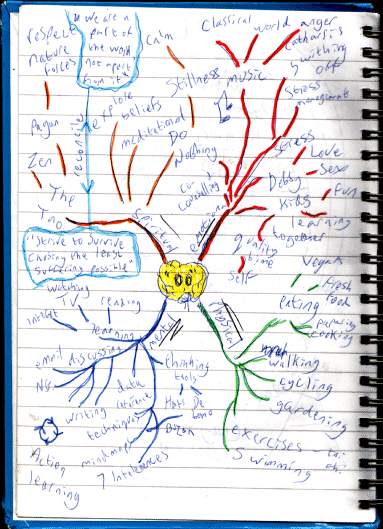
Mind Mapping ImageSpending a mere fifteen to twenty minutes helps me realign my thoughts into an organized fashion appropriate for the topic I need to focus on. One of my favorite brainstorming techniques is Mind Mapping. This process is simple, fast, reduces distracting thoughts, and moves me into a heightened creative flow. It pulls buried memories from the dark pantry of my brain.

Writing effective non-fiction often means living through a subject before you write about it. And Mind Mapping takes what we learn and develops those lessons into a teachable format. It ensures we won’t forget to relate any important part of the process to our readers.

Mind Maps enhance our memories and help us present concise non-fiction book projects. Mixed, baked, and cooled until the end product is just right. Showing readers what we lived, before we wrote.

Editing Tips

 Books aren’t written, they’re rewritten. Including your own. It is one of the hardest things to accept, especially after the seventh rewrite hasn’t quite done it… Michael Crichton

The workshop leader looked over the group—a motley crew of aspiring and published authors seeking to learn. She arched her eyebrow and said, “The purpose of your first draft is to get the crap out. Then you can go back and write the book.” Okay, I thought, that’s an interesting way to look at it. And it actually freed me to write better.

I’ve also learned that each draft has crap in it. The goal is to have less and less in each revision. Even today, I’ll pick up my published novel, Journey to Riverbend, and see things I would change. And the published version is the eighth draft.

ScissorsOver the years, people have asked me, “What’s the best way to edit?”

I don’t think there is one best way to edit. Each writer will develop his own way of editing, mostly though trial and error.

My editing process has evolved as I’ve written more, studied the craft, and learned to test approaches and keep the ones that work.

When I write, I begin the day by reading what I wrote the day before. I look for typos, adverbs, passive tense, glaring POV issues, and grammar. This also helps me get back into the flow of the story.

On Saturday, I print out the pages for that week and do a deep edit of the week’s writing, polishing and refining, cutting scenes, re-working dialogue, correcting inconsistencies from the plot or character.

I use critique partners and group as I’m working on the story, incorporating their input as I Writinggo along.

Once the first draft is finished, I put it away. For a minimum of three weeks. If any thoughts come to me about the book, I put them in a folder until later. I send the story out to beta readers. At this point, I find I need at least two people to read the entire book and give me feedback to specific questions.

After three weeks, I pull out the manuscript and have my computer read it to me. And then I rewrite the story, incorporating input from the beta readers.

The second draft goes through almost the same process as the first, generally more quickly. And then it gets rewritten.

Editing is kind of like washing your hair—lather, rinse, repeat. Over and over.

There are two books I think are immensely helpful in this process: Self-editing for Fiction Writers by Renni Browne and Dave King. And, Write Great Fiction: Revision and Self-Editing by James Scott Bell.

What techniques have worked best for you in your editing? What resources would you recommend?

Are You a Good Literary Citizen?

ID-10032339

Are you a good literary citizen?

I’ll never forget it. I was probably eight or nine years old, and my family had gotten up early to get a spot in the front for the Blossom Time Parade in a neighboring town.

This was a big deal. Every year, thousands of people from Southwest Michigan gathered, anticipating a show of marching bands, fire trucks, homecoming queens, and buckets of candy thrown out to kids scurrying in retrieval around the pavement like ants.

The year I recall was an extra-big, super duper deal, because “Samantha”–the youngest child from the quasi popular 1980 sitcom Gimme a Break!–was scheduled to appear.

Now, I wasn’t a big fan of Gimme a Break!, nor did I think Samantha was the best child-actor of my youth, but she was going to be there, in my small town parade, and I loved to act in school, and every time I thought about meeting a real life star, a firecracker lit and crackled in my gut. I pushed my way to the front of the crowd at the parade, armed with a glittery pink pen and my diary.

Samantha waved and smiled as she sat on top of a cherry red Corvette. And then it happened. The car paused in line, waiting for the parade to continue, and a swarm of preteen girls crowded around Samantha, holding out pictures and paper for her to sign. My legs took off, and before I knew it, I was there too, in the swarm, buzzing, waiting for my turn to ask for an autograph.

Once most of the girls got their autographs, the car started to move. Panicked, I held out my diary to Samantha as her handler winked at me and said, “Surely we have time for one more.”

My heartbeat skipped.

“No! We don’t have time for any more,” Samantha hissed, pushing my diary towards my chest. Her eyes met mine coldly. “I’m done.”

The driver switched from the brake to the gas. I watched Samantha creep forward in the parade, once again smiling and waving to her adoring fans.

Who knows what was going on with Samantha. Everyone has bad days. But I have to admit, I was one disappointed, disenchanted little girl.

I decided that if I were ever fortunate enough to do well at something I loved, I’d be sure to be kind.

Fast forward more years than I care to admit, and I’m pleased to announce that time and again, as a new author, I’ve encountered kindness and generosity in the literary world.

What is a good literary citizen?

This is my definition: a person who supports creativity, who esteems work, and helps others grow in their craft. It’s a person who buys books (and lots of them!) and networks on behalf of authors and writers she or he admires.

I think about Samantha when authors share their knowledge of writing and publishing with me. I think about Samantha when I witness someone farther down the publishing road give a nod and a hello to another starting out.

I hold out my diary and these kind souls take my glittery pen and jot me a note. “Congratulations! Keep going! Try this agent. Sure, I’ll review your work.” Or even this: “I can’t help you now, but all the best to you!”

I don’t take it for granted. People in the publishing world are busy. There is no reason why some should respond to my letters or emails with such goodwill, but they do. And I learn that sure, there are Samanthas in the world. But that’s okay. There are also authors and writers who do their best to help strong work rise to the surface for all to enjoy.

There are people who value being good literary citizens.

Not every author or writer can help. Not everyone will care to help. But of course, everyone can pass on a measure of goodwill as another pursues her dreams.

And we can do it with kindness for the sake of our literary world.

*In an effort to pay it forward in the literary world, I am doing a daily author interview and book giveaway (from writers who happen to be mothers and write about it) the week of May 6th, leading up to Mother’s Day. Drop by to hear from great authors such as Shauna Niequist, Jennifer Grant, Kate Hopper, Claire Bidwell Smith and one more (waiting on a confirmation :)). Find out more at www.gillianmarchenko.com.

Perseverance: Keep Moving and Writing!

Photo/KarenJordan

He gives strength to the weary and increases the power of the weak … those who hope in the LORD will renew their strength … they will run and not grow weary, they will walk and not be faint” (Is. 40:29-31 NIV)

My legs quiver as I step onto the sidewalk in front of my home. How can I launch out for a walk feeling so weak? I take a second step, determined to go forward with my plan to regain my health by exercising.

Obstacles. My motivation to exercise overpowers my temptation to stop. I gain strength in each additional step, as I begin my lesson in perseverance. But it will not be an easy journey. There are obstacles to overcome and goals to reach. Can I make it? 

Resistance. Exercise, like other worthwhile endeavors, demands strength and stamina. The first morning I attempt my new exercise program, everything within me resists it, like opposite poles of two magnets. I would rather do just about anything other than exercise. So, on my first day out, I let temptation win. I stay home, and I feel guilty the rest of the day.

Failures. By the next morning, my previous day’s failure serves as my primary motivating force. So, I lace up my walking shoes, purchased just for this occasion, and jog slowly out of my garage. My first goal has been accomplished. And the next thing I know, I’m crossing the street facing the next block.

Intimidation. Okay, this is going to be a breeze, I think. But by the time I turn the corner, another fear presents itself, as if to try to stop me in my tracks. An all-male construction crew building a house nearby alarms me because of the recent crimes in my neighborhood. I’m fearful of walking in front of them. But I hold my breath and walk on. I move this obstacle out of the way, as I change my route and proceed in another direction.

Distractions. As I walk uphill, I become short of breath. When I slow down to breathe, a gray squirrel catches my attention. He’s busy burying an acorn in my neighbor’s yard. I watch him as I walk by. When I look up, I’m already at the end of the street, about to turn the corner to complete another block.

Goals. I continue to accomplish small goals as I walk. In a short while, I’ve gone far enough, and I decide to return to my home. My mind is cleared by the fresh air, but my body is affected by the exercise.

When I arrive home, I’m exhausted, but surprisingly refreshed. As I sit down for a cool glass of water before I shower, I recall the distance I’ve covered. I feel good about myself, and I’m grateful that I resisted the temptation to quit.

Strength. I find strength as I face my weaknesses each day. In 2 Corinthians 12:8, Paul tells us that the Lord’s “power is made perfect in weakness.”

Writing. I’m forced to face my fears and weaknesses in many other areas of my life, especially my writing life. Writing for publication also demands strength and stamina. So, we can expect to face resistance, right? With each new project, goal, or idea, we’re reminded of some past failure, rejection, intimidation, or distraction.

Survival Tips. How do you endure setbacks in your writing life? I’ve learned a few survival tips on the walking trail and on my writing journey  And as I face my fears and take one step at a time by faith, I’m able to go the distance

And now, … one final thing. Fix your thoughts on what is true, and honorable, and right, and pure, and lovely, and admirable. Think about things that are excellent and worthy of praise.  Keep putting into practice all you learned and received … Then the God of peace will be with you. (Phil. 4:8-9 NLT)

Where have your faced resistance in your life? How did you overcome it?


Photo/KarenJordan
YouTube/mrnmrsyounger (MercyMe – “Move”)