The As-If Principle: Conquering Burnout

Holiday_lazinessWhen it’s time to write, I look at my laptop with dread. It’s been a long day at work, and I’ve taken care of a lot of loose ends since I got home. Not to mention a couple of kids’ squabbles to referee.

By the time the family heads for bed, I’m tired, I’m burnt out. There’s no creativity left in me. Nope, not one spark. The recliner’s looking awfully inviting. And the remote’s not far away.

The thing is, I’ve had too many of those nights lately. It’s not just writing. I edge past my closed Bible, sure that if God has anything to say to me, my foggy mind won’t be able to hear it. Instead of taking my evening walk, I handle some bit of trivia that could wait.

So this time I make myself sit down. I stare at the blank screen. I manage to type out a painfully bad sentence and another. I delete a word, edit a phrase. And a strange thing starts to happen. The words start coming to me, slowly at first, but then a little faster. By the time I’ve knocked out a scene, I feel like a different person. I’m a writer. I’m energized. I can handle this writing gig.

It’s the as-if principle. If you want to get to the other side of burnout, you have to act as if you already have.

Too tired to write? Write anyway. The creativity will come.

Too tired to pray? Pray anyway. God will show up, and eventually so will you.

Too tired to exercise? Do it anyway. The endorphins will pump in, the oxygen will get where it needs to go, and you’ll feel far better than if you’d unwound in front of the TV.

Depressed? Smile more. We think we’re supposed to smile because we’re already happy, but smiling increases your happiness all by itself. Try it and see.

What else would you do if you weren’t burnt out?

Instinct tells me that when I’m tired I should rest. And sometimes that’s the right choice. If you’ve put in a lot of hours or life has just thrown more at you than any reasonable person can handle, a nap or an evening on the couch with your family and a good DVD might be just what you need.

But more often, moving past the exhaustion is the better option. It’s as if nature rewards those who are contributing in some way – building something, creating something, helping someone even if that someone happens to be yours truly.

Once in a while, taking the night off is great, but I’ve found that if burnout persists, the cure isn’t sleep or a vacation. It’s to live as if I were fresh and full of life. And it’s to fill my time with the things that count even when I’m tired.

I’m a writer, so writing is what counts. It invigorates me, even more than eight hours of sleep. That’s why, full of energy or exhausted, motivated or cranky, once the kids go to bed, you’ll find me at the laptop.

Facing Trouble with Courage

Photo/TaraRoss“In this world you will have trouble. But take heart! I have overcome the world” (John 16:33 NIV).

Have you faced trouble in your journey as a writer? Have you been tempted to give up on your writing dreams or career because of failure, rejection, humiliation, shame, or judgment?

Fear of judgment, criticism, or shame? When I struggled with some critical comments and judgment years ago, I expressed my frustration to my husband, Dan. I winced at his abrupt and honest response, “Karen, not everyone is going to like you.”

Photo/TaraRossDan’s statement shocked me, as he reminded me that not everyone likes me or agrees with my opinions. And I’ve revisited that story many times, when I try to encourage other writers.

I still grieve over rejection or criticism, and I prefer to walk away from all confrontations. But I’ve learned a lot from my failures—in relationships and writing.

Photo/TaraRossFear of writing process? In his book On Writing, author Stephen King says, “The scariest moment is always just before you start.”

Even well-known writers must face rejections and criticism. The writing process demands prewriting, drafting, revising, and proofreading before any publication. You may become offended or embarrassed when someone offers constructive criticism. Some writers even give up rather than face more editing, critical remarks, or rejection letters.

Fear of rejection and failure? Do you see rejection as failure? Failure often points us toward changes in our direction and priorities. C. S. Lewis explained, “Failures are finger posts on the road to achievement.”

Author J. K. Rowling agrees with the advantages of failure.

Why do I talk about the benefits of failure? Simply because failure meant a stripping away of the inessential. I stopped pretending to myself that I was anything other than what I was, and began to direct all my energy into finishing the only work that mattered to me.

Thomas A. Edison advised, “Many of life’s failures are people who did not realize how close they were to success when they gave up.”

Tempted to give up? I’ve been tempted to give up more times than I’d like to admit. Have you given up on something because of a failure?

Matthew 26 describes a time when the disciples faced failure. They fell asleep while Jesus prayed, after He asked them to stay on the lookout for danger or trouble in the Garden of Gethsemane. They must have grieved over their lost opportunity and broken promise. But Jesus responded, “Get up! Let’s get going!” (Matt. 26:46 MSG)

There will be experiences like this in each of our lives … times of despair caused by real events in our lives, and we will be unable to lift ourselves out of them. The disciples … had done a downright unthinkable thing … gone to sleep instead of watching with Jesus. But our Lord came to them taking the spiritual initiative against their despair and said, in effect, “Get up, and do the next thing.” If we are inspired by God, what is the next thing? It is to trust Him absolutely and to pray on the basis of His redemption.

Never let the sense of past failure defeat your next step. (Oswald Chambers)

Embracing vulnerability. Finding the courage to risk failure requires us to be vulnerable.

C.S. Lewis wrote, “To love at all is to be vulnerable. Love anything and your heart will be wrung and possibly broken ….”

Dr. Brené Brown, a research professor at the University of Houston, “spent the past decade studying vulnerability, courage, worthiness, and shame.” She suggests, “Vulnerability sounds like truth and feels like courage. Truth and courage aren’t always comfortable, but they’re never weakness.” Brown concludes, “Vulnerability is the birthplace of innovation, creativity and change.”

Choosing to become vulnerable could be one of the most courageous things we can do as a writer. Writing about our opinions, our faith, and our relationships takes courage.

What lessons have you learned about vulnerability?

Video/TED (Brené Brown: “The Power of Vulnerability”)
Photos/TaraRoss

So You Wanna Be Star? Join a Constellation!

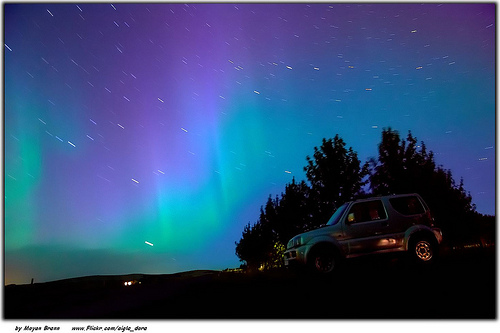
northern lights2

At 10:30 pm this week, I discovered that the northern lights were ablaze. I learned this not by looking out my window, but by seeing photos friends had already posted on Facebook. And of course, some of the best photos were taken right in front of my house. Disgusted, and excited, I peered eagerly out my windows over the ocean for any faint remaining glimmer. Nothing.  Not to be defeated, I proclaimed a “Northern Lights Search Party” and yanked my sons out of bed. (They were both still awake, reading sneakily by flashlight.)

We jumped into the car in various states of deshabille, and drove to the top of a mountain up a switchback road, passing–count them–30 cars on the narrow gravel passage coming down. The whole town was out tonight!

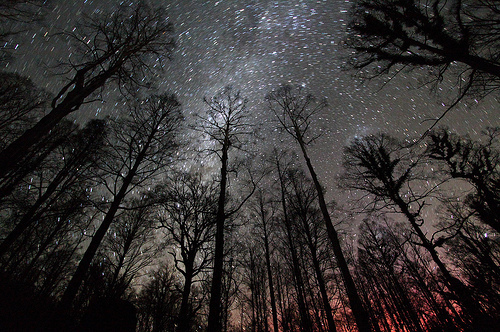
At the top of the mountain, beneath massive windmills, we scoured the black horizon for the shimmering waves of light–but saw only blackness, and then, something else.  As our eyes shifted to night mode, they  appeared, faint at first, then growing in intensity until we all gasped–a swimming sea of stars, like the night ocean alive with phosphorescence. Living on an island, under the heavy clouds of a maritime climate, we seldom see the stars. We bathed in their glory together for a long moment while the windmills strong-armed the sky overhead.

forest-night-sky-space-stars-trees-Favim.com-53155_large

None of us are entire strangers to the stars. Every time we fling our book, our blog post, our music, our photographs out into space, we feel we’re launching a ship to the moon. We aim our hottest work, our sparkling, shattering words out into the universe, and then we wait. We wait for the world to come to us, to drive up the mountain to see us, to beckon to our dazzling light. We wait to become a star.

I would like to say I’m different, but I’m not. Somewhere inside even the most capacious heart, there’s a longing to be known. And outside the heart, our writing bosses command us to expand our platform. Inside and out, we begin to crave that far-off glittering goal, forgetting our real experience on the nights we gasp at the real cosmos. Those nights, save the sun, there is no single star that knocks us down. It is the panoply of stars that takes our breath. It is the collectivity of uncountable galaxies and star-clusters that lights the black sky and plows us down into worship and humility. It is their sheer density and magnitude that teach us our size, and then make us glad to be small.

We are small. We are one among millions of talented, smart, creative others. Lucky us–we get to learn from them all. And the whole world does not come to us. Just a few.  But there still is so much gladness here: that we pursued ideas. That a journal has taken our story. That our blog made someone laugh. That we got to discover new truths. All this, good. All this, happy. Will there be more? Who knows! Just keep at it.

But listen closely. I am not saying dim your lights to take your small quiet place in the choir. Don’t be afraid to be brilliant and bold, to stake out your own corner. Don’t be afraid to question the lights already hung. But know, no matter how dazzling and original you are, you are surrounded by sizzling stars and a radiant moon that itself borrows light from another. Be glad of this.

Moon

Be glad of this. Yes, go ahead and shoot the moon. Aim high. Go ahead and hope you’ll be a star, but better, join a constellation.

I tell you true, when it happens that my own words hang among shining smart glorious beautiful writers and artists and thinkers and creators . . . there is little better joy. I am in awe of them all. They are my constellation. I’m happy that this little northern light of mine gets to wash in their light and shimmy and shine in their midst.

night sky

Inspired

As a teacher of writing and a writer myself, I’ve long been in the habit of examining others’ writing for what it has to say about the creative process. Nonfiction, my primary genre, lends itself most naturally to such scrutiny, since the solipsistic Scarecrow--Daniel Schwenwriters who tend to write in this genre love to write about what they’re up to. The writing of memoirists and essayists thus provides valuable glimpses into the process. In nonfiction workshop, Hemingway’s A Moveable Feast is my go-to handbook.

As I blogged last month, I’ve been listening to the Bible on my iPhone while I run. Since I run in five to ten mile chunks, I’ve heard whole books at a time and am making my way quickly, if haphazardly, through the text, following not the order of the Bible’s original organizers but spurious impulse (or, as I like to think, the Holy Spirit). Listening to scripture aloud, I’ve become newly appreciative of the almost constant reverberations between biblical accounts. The echoes of one story in another, of one biblical author’s phrasing in the voices of others, of the words of Hosea and Isaiah in the mouths of John and Paul and Jesus. The Bible is a masterpiece of intertextuality, a tapestry of voices in sentences that mesh and thicken from one chapter to the next.

I don’t know whether it’s because of the biblical writers I’ve happened to choose thus far or because of my new way of “reading” the Bible—that is, hearing the words aloud rather than reading them from a page—or just my old habit of paying special attention when writers mention writing, but I’ve noticed that the biblical writers talk a lot about writing. As such, the Bible offers considerable insight for me and fellow writers about our line of work.

Forgive my foray down a path we Christians like to avoid in considering the Bible—namely, the exact nature of divine inspiration that led to its composition in the first place—but one biblical writer after the next, from Moses to Isaiah to Jeremiah to John, describes the initial inspirational moment pretty much exactly as I’ve experienced it myself. An urgent voice—sometimes identified as God’s, sometimes an angel’s, sometimes unspecified—commands, “Write this down!” For these ancient writers, writing was not a choice—not a career goal or the desire to influence or educate others or even a matter of passion—so much as a dutiful response to that voice. An idea rises like a vision in the mind and the voice says, simply, “Write.”

“A writer,” I tell those who say they want to be writers, “is someone who writes.”

The most common writerly methods in scripture, which several biblical writers go out of their way to explicate, are the same ones I recommend to my students: in the words of Luke, “after investigating everything carefully from the start, to write an orderly account” so that readers “may know the truth” (Luke 1:3-4 NRSV). Careful investigation and organization are what convince.

Regardless of genre—whether they are writing poetry, chronicles, stories, or philosophical treatises—the biblical writers take pains, as Paul assures the recipients of one of his letters, to “write you nothing other than what you can read and also understand” (2 Corinthians 1:13). Nothing show-offy, though the words of scripture are often as artistic as they are true. No erudition for erudition’s sake.

And though their accounts and rhetorical goals are diverse, the biblical writers share, it seems to me, one essential writerly skill: they tell what they actually see and hear and smell and taste and feel. Unlike my students, who would rather explain their thoughts, the biblical writers are, to a person, concrete. Here’s Jeremiah (whose repetitive ranting could be boring, were it not so vivid) showing, not merely telling, how ridiculous it is to worship idols:

Their idols are like scarecrows in a cucumber field,
and they cannot speak;
they have to be carried,
for they cannot walk.
Do not be afraid of them,
for they cannot do evil,
nor is it in them to do good.

(Jeremiah 10.5 NRSV)

Wow. Like scarecrows in a cucumber field. I wish I had written that!

OLYMPUS DIGITAL CAMERAMy students typically define creative writing as writing that doesn’t have to follow any rules. Grammar rules, especially, are irrelevant. When I talk about sentence-level problems in their writing, they roll their eyes. In poetry workshop, many abandon the sentence altogether, writing instead in fragments. Creativity, in their view, constitutes the opposite of order.

The biblical writers, by contrast, seem to model their creativity on that of God himself. The creation, as described in Genesis, is a work of separation and sorting, of repeating and omitting, of drafting and considering before declaring anything “good.” Again and again, the biblical writers are selective in what they opt to tell. They keep only the best episodes of a given narrative—key conflicts, the rising action—and leaving the rest mysteriously, sometimes frustratingly, elliptical, in this way to engaging the reader’s own imagination and mental processing. There’s never a pat moral to the story. As hard as we Bible-readers try, we can never read the Bible as a straightforward primer or even a narrative account of holy living, cleansed of all confusing or upsetting or unholy details. Rather, it portrays real life—convincing in its familiarity—and real characters, the holiest of whom, as we ourselves, struggle and fail and fail again.

For writing instruction, I’m learning, the Bible is unsurpassable. Even better than Hemingway.

Want to Write a Memoir? Read These Books . . .

????????????????


Now that I published my memoir, I’ve received a few inquiries about how I accomplished my goal.

Good question.

The genre of memoir is tricky. I worked on Sun Shine Down for four years and then spent another two years writing the book proposal, finding an agent, and landing a publisher.

Here are a few questions I get about writing memoir.

“I have a story to tell, but how do I get started?”

“What is your advice about writing?”

“Any words of wisdom regarding the publishing world?”

I am by no means an expert, but here is my best and most basic advice for those who want to write memoir (this goes for breaking into the publishing world as well because if your book isn’t at its best, you won’t break in): 1) Read a lot 2) Write a lot and 3) Find a class or a group of people to read and critique your work.

In this post, I’d like to tackle my first piece of advice: read a lot. Here are three books every budding memoirist must read.

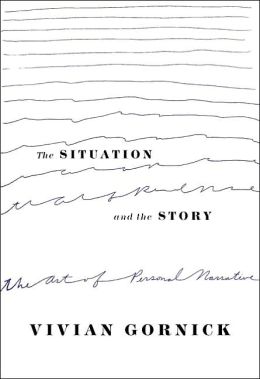
Situation and the story

In “The Situation and the Story: The Art of Personal Narrative“, Vivian Gornick explains the art of writing personal narrative by reviewing key elements like the persona (or narrator) of the writer, her writing voice, and the importance of knowing who she is at the point of writing. The book is broken up into four parts: Intro, Personal Essay, Memoir, and Conclusion. Gornick draws examples from famous books and essays, explaining the situation and story of each, thus causing the reader to pause not only to appreciate beautiful words, but also to break down and understand what makes a memoir or essay sing .

“Every work of literature has both a situation and a story,” Gornick writes. “The situation is the context or circumstance, sometimes the plot; the story is the emotional experience that preoccupies the writer: the insight, the wisdom, the thing one has come to say.” (page 13)

My copy is covered in red notes and underlining. There is just so much good stuff in this book.

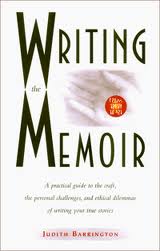
writing the memoir

If your not certain about the ins and outs of memoir, this book is for you. On the cover of Writing the Memoir: From Truth to Art by Judith Barrington, it states the book is “A practical guide to the craft, the personal challenges, and the ethical dilemmas of writing your true stories.” My writing instructor at Story Studio Chicago, where I participated in an advanced memoir workshop for two years, uses this book with her beginners class. In my opinion, it is a book even the most seasoned writer can glean knowledge from. The table of contents includes chapters on finding form, dealing with the truth, writing about living people, and getting feedback on your work. It also has short writing exercises at the end of each chapter.

“Telling your truths — the difficult ones and the joyful ones and all the ones between — is a big part of what makes for good writing. It is also what brings you pleasure in the process of writing.” (page 74)

If you write memoir or want to write memoir, this book must be in your library.

Handling the truth

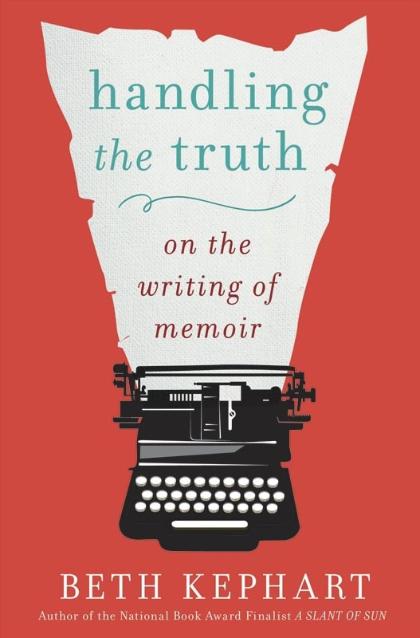
Handling the Truth: On the Writing of Memoir by Beth Kephart just came out this year and I picked it up a couple of weeks ago. This book is not so much about the ‘how to’ of memoir, but more about the value of the genre of memoir. It is broken up into four parts: Part I: Definitions, Preliminaries, and Cautions, Part II: Raw Material, Part III: Get Moving, and Part IV: Fake Not and Other Last Words.

“If you want to write memoir, you need to set caterwauling narcissism to the side. You need to soften your stance. You need to work through the explosives — anger, aggrandizement, injustice, misfortune, despair, fumes — towards mercy. Real memoirists, literary memoirists, don’t justify behaviors, decisions, moods. They don’t ladder themselves up — high, high, high — so as to look down upon the rest of us. Real memoirists open themselves to self-discovery and, in the process, make themselves vulnerable not just to the world but also to themselves.” (Page 8)

See … you need to buy this book.

Attempting to write and publish a memoir is an arduous task. Start by writing, sharing your work, and reading these three books.

“Penetrating the familiar is by no means a given. On the contrary, it is hard, hard work.” (page 9)

Right on, Vivian.

I would add that it is worth it, if you are up to the task.

When Writers Face a Constant Climb

Photo by Anna Langova

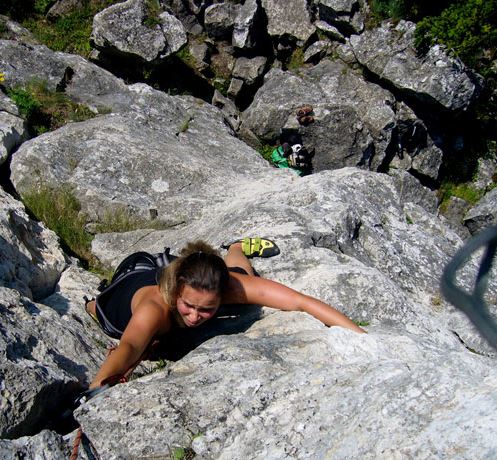
Sandstone boulders and harnesses and ropes, not really what I had envisioned when the new guy picked me up and we headed out for the afternoon—our first date together.

Girlie-girl me had somehow landed in a ragtop Jeep headed for some serious rock-climbing. Or so Mr. New Guy thought—what actually happened was girlie-girl watched some cute guy scale the side of a cliff, up, down, and sideways.

But getting to the top wasn’t his end-all plan. He seemed most challenged {and the proudest} when he slipped and then recovered. The catch and the readjustment seemed just as exciting to him as the time he stood at the top and waved high from the completed climb.

It’s been a few years since I sat in that ragtop and watched that guy climb. Seems I was about as interested in him as I was in climbing those rocks myself.

Why would we pull ourselves up the sheer face of something just so we can?

We do it more than we think, though, us writers. This writing for publication can be slow and hard. I have a {very thick} notebook full of rejections to prove it. Countless queries I thought would please never flew, never left their cage. And I mourned their loss. Made untold threats to quit, to lay down my pen.

Doubt can eclipse a budding hope if we allow.

But finally came my first assignment: a book review. I landed a column as a book reviewer, and my name held a place on a website that traveled the world. No matter there was no pay, I was writing. And I simply had to write.

Funny thing, though: that column landed me my first paid gig as a columnist for an established online magazine. With pay. This I celebrated. I framed a copy of the paycheck and then headed to my local electronics stores and nabbed a digital camera I’d had my eyes on for months.

From there, I secured an interview with a leading Christian author and sold that query to an international publication, and that one article led to contacts with other magazines and freelancing for the next few years. Meanwhile, my notebook of rejections grew thicker. Another brilliant idea shelved. Another dedicated period of grief. Another resolution to pack it up, find something else to do with my time.

Why do we allow fear and hurt to cloud our hope? To stall our dreams?

Looking back I realize that much like my rock-climbing friend from earlier years, my greatest sense of accomplishment came from those very moments I slipped, those critical steps I took to recover. I made my way to a writer’s conference where I could improve my craft, which led to securing an agent, which eventually led to a book contract, and that led me to my debut book. But there’s so much more to come. And to get there, I have to be willing to slide sideways when my quickdraws don’t connect just right, ready to race ahead when the space opens wide, or even to fall with grace when the fall comes {and they always come}.

There’s something that happens when we surrender to the process, when we climb for the sheer sake of the climb. I’m learning there is no end. If my sole focus was waving high from the top, I imagine I may be disappointed should I ever stand there. It’s been said before in countless ways, but in the life of a writer I’ve experienced it true, “the journey is the reward.”

Deeper Still: What setbacks have you faced on your writing journey? What readjustments have you made, or do you need to make in order to continue the climb?


Seek Hope While Waiting

4864922_s“Knowing trees, I understand the meaning of patience.

Knowing grass, I can appreciate persistence.”

(Harold Glen Borland – a nature journalist who wrote poetry, fiction for adults and children, and other nonfiction. 1900-1978)

As a writer, I need patience and persistence. But I am more than tree and grass. I’m a creative emotional being with spirit, mind, and soul, who struggles with waiting. Right now I’m in squirm mode—between book contracts. I’m lowly bait, a worm on a hook writhing with concern over my writing career. Pathetic, fickle creature.

I recently read patience is the level of endurance one can take before falling into negativity.

Thoughts such as:

-I won’t get another contract because I’m a lousy writer.

-Writing is too much effort for the reward. I’m dangling on the end of a hook, remember. And it’s not the first time either.

The psalmist understood fickle creatures and negative thoughts. And of all things, he preaches back at them with a pep talk regarding God’s love.

“Why are you cast down, O my soul, and why so disturbed within me? Put your hope in God.” Psalms 42

In squirm mode, I’m itching for action.

Anything to hope again.

Even preaching to myself.

Preaching to myself . . . I guess I could clean my desk so I can read my inspirational plaque: Live creatively.

I could tape my theme scripture on my bathroom mirror. “Explore who you are and the work you’ve been given. Sink yourself into it. Don’t be impressed with yourself or compare yourself to others. Be your creative best for you.” Gal 6:1-5

The psalmist reminded himself of wonderful experiences of past worship. I could search my prayer journal and see what God’s accomplished in my life. Perhaps it’s time to browse my writing scrapbook, or make one.

I suddenly see it. My writing lull is a comma, not a period. It’s a gift of time from a loving God. I can use it to rethink priorities, set writing and marketing goals, hone new skills. Persistence urges me into action and hope marches up my spine. I shiver with delight. Yes, there is hope in the waiting.

Even so, a negative thought returns. Working without a deadline? Impossible.

21497233_s

No!

 I preach to myself. Soul, you’re strong in Christ.

Waiting is extra time. A gift from God. Praise Him. 

I don’t want to squander my time wallowing in negativity when I have a gazillion better choices. I will catch up on life. Ideas pop into my mind of ways to bless my family and friends. Or I could use my time to practice self-discipline. I’m not pathetic or fickle. I’m normal. I’m also chosen, forgiven and loved. I find another blessing. Waiting makes me thirsty for living water.

Psalm 42:1 “As the deer pants for the water brooks,

so my soul pants for Thee, O God.”

Beyond the tree and grass and worm is a larger stream. I can wait in confidence that He’ll nudge me along in His time.

What uplifting sayings or verses do you cherish?

What blessings do you experience in wait mode?

Important Question for Christian Writers

English: Posthumous official presidential port... President John F. Kennedy inspired American patriotism in his inaugural address: “Ask not what your country can do for you—ask what you can do for your country.”

As a Christian writer, I’ve asked myself a similar question at times: What can I do for God?

I’ve tried to do the things that I thought pleased God, but my good deeds never seemed to be enough when compared to the standards set before me.

So, I sought answers to my question from biblical examples of those who sought God’s approval and blessings.

King David experienced a change of focus when he sought spiritual counsel concerning his desire to please God by building a house for Him (2 Sam. 7:2). But God planned to build a house for David and establish his kingdom, and He chose David’s son to build a house for His Name.

The Lord declares to you that the Lord himself will establish a house for you … I will raise up your offspring to succeed you, … He is the one who will build a house for my Name …  Your house and your kingdom will endure forever before me; your throne will be established forever’ (11-16).

Humbled by God’s blessings, David received his inheritance with gratitude (18-24).

Jesus’ disciples also wanted to please God. And when they asked Jesus to show them the way to heaven, “Jesus answered, ‘I am the way and the truth and the life. No one comes to the Father except through me’” (Jn. 14:6).

What can we do for God that will please Him?

Accept God’s gift of eternal life. When we focus on our religious activities and good works, we overlook God’s promised gift of eternal life through His Son, Jesus. “For God so loved the world that he gave his one and only Son, that whoever believes in him shall not perish but have eternal life” (Jn. 3:16).

“For it is by grace you have been saved, through faith—and this is not from yourselves, it is the gift of God—not by works, so that no one can boast” (Eph. 2:8 NIV).

Seek God first. Matthew 6 encourages us to seek God first every day. As we observe God at work around us, He promises to reveal His plans for us.

Steep your life in God-reality, God-initiative, God-provisions. Don’t worry about missing out. You’ll find all your everyday human concerns will be met.

Give your entire attention to what God is doing right now, and don’t get worked up about what may or may not happen tomorrow. God will help you deal with whatever hard things come up when the time comes. (Mt. 6:33-34 MSG)

Focus on God’s blessings. God also promises His spiritual inheritance to all Christ-followers.

… When you believed, you were marked in him with a seal, the promised Holy Spirit, who is a deposit guaranteeing our inheritance until the redemption of those who are God’s possession—to the praise of his glory. (Eph. 1:13-14 NIV)

As I choose to focus on God and His blessings, my motivation for serving Him changes. Plus, I no longer depend upon the approval of others, and I avoid prideful boasting, a major stumbling block for Christian writers.

Therefore, since we are surrounded by such a great cloud of witnesses, let us throw off everything that hinders and the sin that so easily entangles. And let us run with perseverance the race marked out for us, fixing our eyes on Jesus, the pioneer and perfecter of faith. (Heb. 12:1-2)

What important questions do you ask yourself as a Christian writer? 

Coming Out of the Wilderness

Denabutterfly1The last half-decade has been full of changes for our little family. Stressors included the death of several friends, unwanted job changes for both my husband and I, health challenges, and a total of four moves in five years. We’ve bought and sold three houses (well, we bought three houses…one is yet to sell, so we’re renting it out). Finally, both my dad and my father-in-law underwent major heart surgery within a few months.

Whew. It makes me tired just reading that . . . let alone living it.

To add to the chaos, my writing career stalled. Ideas I felt were timely were turned down again and again, although my previous editors loved several of them and went to bat for me. I prayed, cried, doubted, and wondered what God was up to. He provided income through work for hire projects, magazine and editing work, and I was thankful. However, I longed to write books again.

I didn’t want to turn my back on God because I felt like I didn’t deserve my circumstances. I longed to be obedient, even in the difficulties. I prayed continually for strength, and I kept seeking Him . . . even when He seemed very, very quiet on the subject of when (or if) we might be done with the “desert” we were in.

Wanna know something? Every time I cried out to Him, He answered. Sometimes He reminded me of a Scripture passage that ministered profoundly to me. Songs came on the radio which seemed to have been written just for my situation. Friends and family members called, texted and emailed me at perfect moments, when I couldn’t seem to take another step or cry another tear. He was faithful. So, so faithful.

Two years ago, my friend Tina called me with a book idea, and I knew in an instant that we were meant to collaborate on that project together. Greg Johnson agreed to represent us, and (in a first for me), we actually had two offers on the project.

WoundedWomenIt came out this month, and my heart is full. Though the process of putting the book together was emotionally draining, it was a pleasure to write with such a kindred spirit. I couldn’t be more excited about the finished product (thanks, Kregel!).  Everything I’ve lived through, in publishing and life, has prepared me for Wounded Women of the Bible: Finding Hope When Life Hurts.

Six  months ago, God led my husband into full-time ministry and moved us back to a place we love. It feels as if we are finally coming out of the wilderness and into an oasis. We are grateful beyond words. And we can see in hindsight that He’d been honing and refining us all along to minister more effectively to hurting people.

Friend, are you suffering today? Do you wonder if God has something against you? And do you fear that you’ll ever feel joy again?In-Gods-economy-our

Oh, I’ve been there. My heart aches for you. But this I know: the path He has you on may seem lonely, and you might not feel His presence. But He hasn’t left.

He is up to something, even when we can’t see it. Until then, trust Him with your wounded places, for one day, they will become ministry spaces.

He promises.

Facing Your Fears as a Writer

Photo/TaraRoss

Write down for the coming generation what the Lord has done, so that people not yet born will praise him. (Ps. 102:18 GNT)

I’m always looking for ways to encourage people to tell the stories that matter most. As a writing instructor, I’ve often observed the need for others to tell their stories.

Passing along our faith and family stories helps us make sense of some of the crucial issues that we face in life. When Christians begin telling the stories that matter most, lives change and hearts heal.

But fear silences the voices of many Christians, preventing them from telling their stories. And if you’ve considered writing for publication for any length of time at all, you’ve probably faced the emotion of fear in your work. Many obstacles keep us from telling our stories—personal insecurities, writer’s block, or a variety of excuses.

Excuses. I can think of so many examples through the years when I just sat back and waited on someone else to do something that I knew I needed to do myself. And I can always come up with an excuse about why I can’t do something.

Before my own children became independent, I often reminded them, “Delayed obedience is disobedience.” I never wanted Adam and Tara to be afraid of me, but I knew delayed obedience might be dangerous and harmful at times. But even though my instructions were motivated out of my love and concern for them, they often resisted. Yet I persisted in my discipline. I prayed that they would learn obedience as children, so they would obey God and their God-given authorities as adults.

I even offer myself excuses now, when I don’t want to do something, like making my bed. What does it matter if my husband Dan does that? It’s his bed, too! And our unmade bed obviously bothers him more than it does me anyway.

But what about the things that God calls me to do? What kind of excuses do I use to attempt to justify my disobedience?

  • That’s not my “gift.”
  • I’m not trained to do that.
  • What do I have to say?
  • I’m not a “good” speaker (writer, teacher, blogger … whatever).

Insecurities. As I searched the Bible to try to find some answers to my problem of fear, I discovered that I was in good company.

In fact, when God called Moses to lead His people out of bondage, “ … Moses protested to God, ‘Who am I to appear before Pharaoh? Who am I to lead the people of Israel out of Egypt?’” (Ex. 3:11 NLT).

Moses knew that this assignment was way out of his area of expertise and experience. And Moses knew that he couldn’t do this impossible task in his own strength or with his limited wisdom. But his awareness of his own limitations proved to be one of Moses’ greatest leadership qualities. It forced him to become totally dependent upon God.

Do you think that God was shocked by Moses’ questions and concerns? I don’t.

Promises. In fact, God responded to Moses with the assurance of His presence, not His judgment. “God answered, ‘I will be with you’” (3:12).

I don’t believe that my questions surprise God, either. God still promises to always be with us today. “… And be sure of this: I am with you always, even to the end of the age” (Mt. 28:20).

And He also promises to provide all that we need to do what He calls us to do.

“And I am certain that God, who began the good work within you, will continue his work until it is finally finished … ” (Phil. 1:6).

What’s keeping you from telling the stories that matter most to you?

Photo/TaraRoss
YouTube/JoshWilsonVEVO (“I Refuse”)