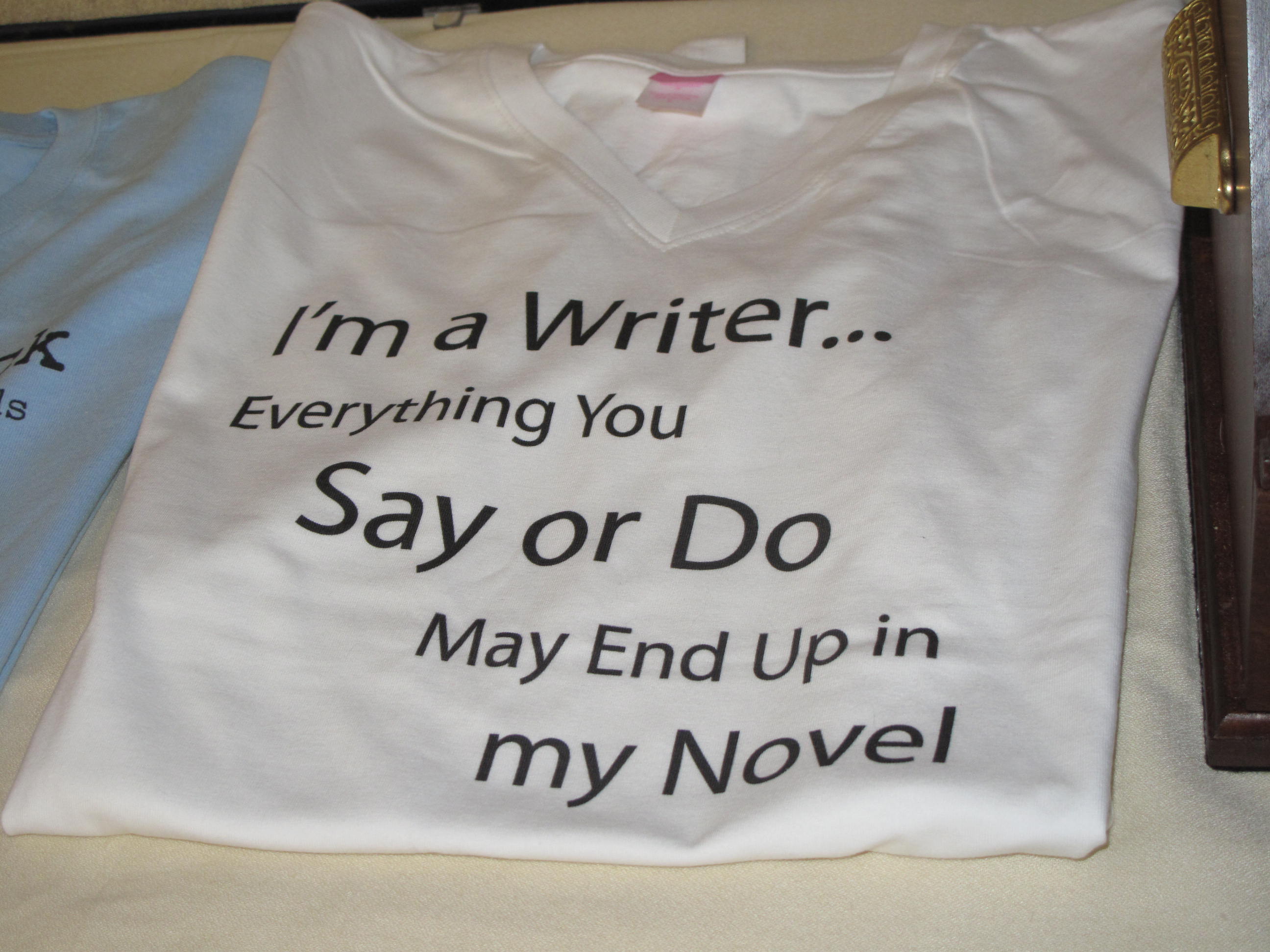
Authors are expected to do much of their own marketing. Been there, heard that — you can keep the tee-shirt.
So what’s a writer with little or no marketing experience to do? Research.
And get started early. Though my first book is almost a year from publication, I’m working on a Promotion Plan now. Naturally a strategic thinker, I’m thinking ahead. (If you haven’t yet sold a project, this is prime brainstorming season.)
In a previous job, I worked sales and marketing for a clothing manufacturer, where my biggest account was Nike. They are marketing masters.
A minimum of eighteen months out, they plan the launch for any new apparel line. Nike knows the investment in time and energy pays back with interest. They study competitors. Survey customers. Review totally unrelated products. And sometimes, try things that fail.
But in the thinking stage, they don’t toss any crazy idea.
As a new author, I don’t have a mega-marketing budget like Nike. But their basic principles work with two hundred dollars like they do with two million. If you’d like to peek at some of their aggressive 2013 marketing strategies, click here.
Taking what I learned from past experience, here are ten sources I’m using to brainstorm a unique Book Promotion Plan:
1. Read creative thinking books. Some of my current faves are: The $100 Startup, The Four-Hour Work Week, The Power of Full Engagement, The Well-Fed Writer, Red Hot Internet Publicity, The Wealthy Freelancer, Platform, and Shameless Self-Promotion and Networking for Christian Creatives.
2. Hunt for colorful partnering alternatives in the everyday. Look around you with fresh eyes. Is there a marketing marriage in the making?
Creative Ideas Under Your Nose
3. Study other author websites for promotional ideas. In the following examples, it’s the concept, not necessarily the content, that interests me:
Author Media (Their marketing prowess rates high.)
4. Observe projects, organizations, or businesses of different styles, to spark unique promotional ideas. i.e. Concerts, chambers of commerce, beauty salons, amusement parks, hardware stores, talent shows, and more, are marketing fodder.
Observe what Different Businesses Do
5. Create a line of products to complement the book’s message. Brand image magnifies with diversity — and promotional products spread your message further.
6. Target different personality types, genders, ages, and regions to reach a wider audience. Never discount a potential demographic in the brainstorming phase.
7. Ask for ideas. Get your brave on. Ask the checkout person, waitress, plumber, even employees of places you visit on vacation. They may offer fresh perspectives. But don’t fail to tap into your professional networks as well.
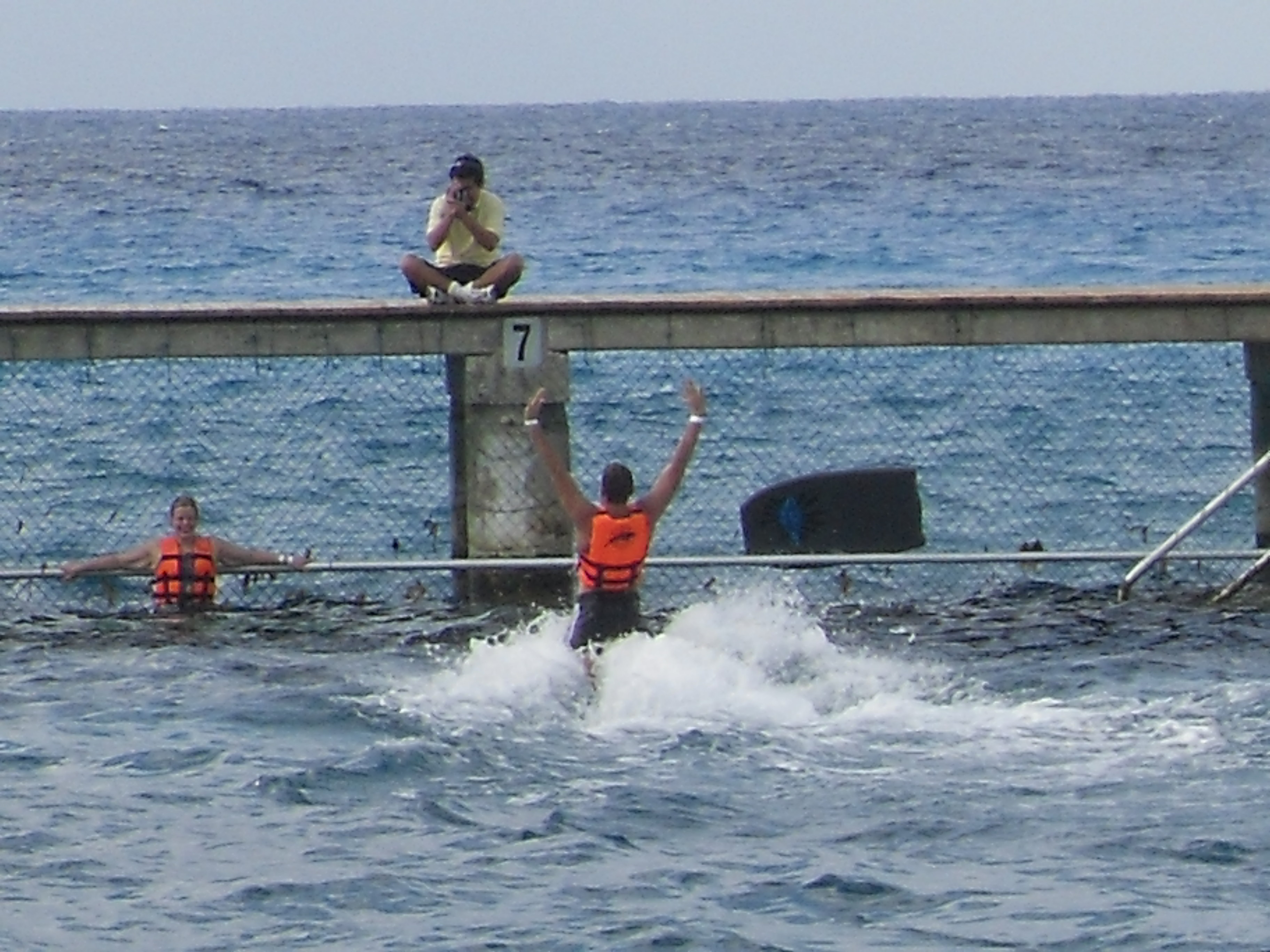
Riding Dolphins Promotes Adventure
8. Help others with pure motives. I believe we get what we honestly give.
9. Stay true to the title. I use this as an editing tool, but it works well with brand marketing also.
I’m here to tell you that sometimes we need to tell our inner editor to shut up.
I’m not saying we don’t need to edit our work. On the contrary, I even wrote this post, 7 Tips for Self-Editing, but there is a time and a place for said editing.
When you’re writing your first draft, I strongly advise you not to edit. Let your ideas flow. If you try to edit now, you may never finish your novel. Or worse yet, you’ll stifle your creativity.
There is another voice, one that may or not be your inner editor. The one that tells you this isn’t any good. Why on earth did you think you could be a writer? You should just give up before anyone discovers you can’t really write.
These, my friends, are the voice of the enemy. Do not believe his lies.
Recently, I heard these words burn through my mind. When you begin to hear the lies, turn to our source of truth. Pray that God’s voice would be the only one you would hear. Ask Jesus to silence everything that is not from Him.
I’ve started doing this every time I sit down to write. It is making a huge difference. We can choose to listen and believe the voice of truth.
If you’re trying to write your first novel or first draft of a new project, focus on getting it all out on paper or the computer screen. It’s fine to check and make sure your book is keeping in check with your outline and overall story and character goal, but don’t try to make it perfect.
Have you ever had to tell your inner editor to shut up? Do you have any tips to keep yourself going when you feel like giving up?
I had the distinct privilege of being a part of a missions organization that helped fund a project through Pioneer Bible Translators to bring a written language to a remote tribe in Papau New Guinea. Once that language was established, a team worked diligently over many months to translate the New Testament into the language of that tribe.
As I learned about the tribe and their customs, I was struck by the fact that for years these people had spent the majority of their time trying to appease evil spirits. They lived in constant fear. Missionaries spent years working with the tribal people, teaching them about Jesus and then translating God’s Word into their language so they could pick up a New Testament Bible and read for themselves the message of salvation through Jesus Christ.
Just imagine with me for a moment what it must have been like for these people to read these words for the first time, after spending their entire lives trying to appease evil spirits on a daily basis and living in a constant state of fear:
If God is for us, who can be against us? He who did not spare his own Son, but gave Him up for us all, how will he not also, along with him, graciously give us all things? Who will bring any charge against those whom God has chosen? It is God who justifies. Who is he that condemns? Christ Jesus, who died—more than that, who was raised to life—is at the right hand of God and is also interceding for us.
-Romans 8:31-34 (NIV1984)
The written word changes lives.
As you write the messages God has placed upon your heart, you have the opportunity to share the message of hope through faith in Christ using your unique voice through your particular genre.
God is for us; who can be against us? May you find a greater sense of calling and purpose as you consider how your words can impact the lives of your readers. Writing is a calling. Be diligent. Seek God for strength and courage and inspiration.
The written word changes lives.
How have you seen people’s lives changed through the words God has inspired you to write? (It’s okay to boast, as long as we are boasting in the Lord! – See 1 Corinthians 1:31)
Writing is re-writing, and that includes book titles, the name of a book.
It’s been said that the title is the number one element of a book. If potential readers are grabbed by the title, they turn to the back cover, then open the book and read the first page.
Since ancient times, fathers have been careful about the names they give their children, knowing that it becomes their identity and will affect each child their whole life through.
So also do our titles reflect the perception others will have of our stories. Many books go through several title changes during the creation of the story. My current manuscript certainly did.
Because I thought the book was about false accusation (it is part of the story), and since the character, Danni Wagoner, was victimized, I began with the working title ofDanni’s Story.
Danni was deceived by someone she thought was a friend, so the title changed to Deception.
Then a brainstorming session with an editor brought out that all my stories seemed to have a theme running through them of a woman’s dream. Hence the change to Violated Dreams.
Then as the story progressed we had a final title change to Through Fiery Trails, or so I thought.
Yes, I realize a publisher will likely change a title, but I expected this to be my last change while it was a working title.
While the story never changed, my understanding of it did. More brainstorming revealed I was focusing on the wrong character for lead. I must have known this at a deeper level, because my elevator pitch was not about Danni at all, but rather her Old Order German Baptist friend. This character had to choose between following the expectations for women born and raised in this group and the pull of her heart strings, knowing she was in a position to help her friend get to the bottom of . . . who-dun-it.
So that made the story Evalena’s Dilemma, or as we are now calling it, Through The Deep Waters.
I still like the earlier titles (except for the generic ones with the women’s names). But all is not lost, for they can be used on future books.
Q4U: How have you chosen the titles for your book(s)? Are they just an afterthought? Are you emotionally attached to the first one you gave the book, back when you first dreamed of the story?
Platform building has become all-important in the publishing world. And how do you build a platform? One plank at a time.
That’s why I tell writers with day jobs and moms with kids NOT to wait until they have more time to pursue their dreams. You can write, build your platform and get published–one small step at a time.
When I started taking my writing seriously, I had a baby and a husband in full-time ministry–and no family nearby to provide free babysitting. So I wrote during my son’s nap times. After Jordan outgrew his naps, I enrolled him in our church’s “Mother’s Day Out” program two days a week, and used those times to write.
When my second son was born, I repeated the process–though things did get a bit trickier! I’ve also written during lunch hours, backstage in a dressing room while waiting to perform at a theater, during birthday parties (not my own kids’, though!), on Saturdays/Sundays, and late at night.
*But NEVER in the early mornings. Some things are just insane.*
One plank a time, I’ve pursued this crazy/wonderful calling God placed on my life, building a career and a platform. It’s a roller-coaster, of course–lots of rejection for every acceptance–but I wouldn’t trade it for anything.
[I’m also aware that my husband is entirely supportive, and for those authors who don’t have an encouraging spouse, my heart goes out to you. You’ll have to be even more creative and deliberate about finding time to write. But please, don’t give up!]
My own story makes me passionate about helping other writers (especially moms) hone their craft.
Say you have a precious fifteen or thirty minutes a day to write. Divide those segments into writing, market research, and promotion/marketing. Then use your allotted time three days out of the week to write; two days to do market research; and one day to market (giving yourself one day off).
Here are a few sample ways to build your platform, fifteen or thirty minutes at a time:
Post a new picture or status update on your Facebook author page and “like” a few other people’s posts while you’re signed in as the author.
Tweet from your Twitter account and RT/respond to a few tweets from friends.
Update LinkedIn (I do this automatically by linking my Twitter feed to my LinkedIn profile, so when I tweet, my LI account gets updated, too).
Write a rough draft of a blog post.
Pin a link and photo from a former blog post on Pinterest. (Careful! Pinterest is addicting–might I suggest a timer?!)
Read a blog post (or two) and comment on it.
Read a portion of a book on marketing and promotion. Highlight your favorite ideas, and bookmark the page to come back to.
Read about a conference you’re interested in, and mark the dates on your calendar.
Sign up for a conference, online course, or in-person class.
Write a rough draft of a query to an agent or editor.
Edit a query you’ve previously drafted.
Compose a cover letter for a query or manuscript.
Email friends about your newest published piece and ask them to share it with friends, if they’re so inclined.
Email an author friend to ask advice or feedback.
Offer feedback and advice to someone “greener” than you.
Now it’s YOUR turn. What are your strategies and ideas for platform building, one board at at time?
Publishing a book is an adventure. Part of that adventure is engaging with the people you meet along the journey. Some of those people will serve in a capacity of enlightenment and support. They provide assistance for you at different turns. It could be marketing assistance, subject matter expertise, best practices, or networking to find the sensei you seek. Lest we forget, the best adventures usually require planning behind the scenes. The book writing adventure entails hours of constant editing and agonizing over the right words. There is nothing glamorous about this part of the journey – it’s the grunt work that makes everything else possible.
Adventures are often taken solely for adventure’s sake. Sometimes you return with treasure, but not always. Upon attending my first literary workshop, I found it a bit daunting to learn that only 5% of writers actually make a living from their writing. Anyone who has ever penned a book knows how challenging it can be. If there is no monetary value in the experiment of publishing a book, why should the author continue up the mountain? The author goes on because it’s a labor of love. There are other ways to get compensated from writing a book. The total compensation package is comprised of much more than money. Opportunities to help others appear continuously and if you find such experiences rewarding, your pockets will be continuously lined with gold.
One of my favorite movies is Rex Pickett’s Sideways. Through Twitter marketing I stumbled upon Rex’s profile and discovered Sideways has been adapted for the stage. I saw Sideways the Play in Santa Monica and was able to meet Rex, who has been an inspiration ever since. Tweeting has been valuable in other ways, too. By building relationships with authors, readers and bloggers, writers gain a greater scope of influence and increased credibility. Nothing is more valuable than that.
There are countless ways to spread the wealth of knowledge acquired on the writing journey. By researching the process of formatting a novel into an audiobook, I became acquainted with www.acx.com. This fluid website is a hub for authors to connect with actors that do voice-over work. Authors can connect with actors in a number of ways. One is to upload some material so that any interested actor can audition for the ‘role’ of narrating the content. One actress auditioned to be my book narrator within twenty-four hours of uploading sample pages. Hearing her try out for the voice of my protagonist was an incredible experience. Authors can also take the more active approach of searching for a specific kind of voice. If there is a need for a young woman with a French accent, you can search your ideal parameters to find actors and make them offers. You have options of payment, one being a 50/50 royalty share. Going through this exercise made me think of a friend who is always looking for voice-over work. I was able to inform him of ACX, and he is probably getting his account set up with them as we speak. Some of the actors are listed to make $200.00-$400.00 per completed hour of work. For those with golden pipes, it appears to be a very good opportunity. My friend’s enthusiasm and delight over engaging with ACX was better than selling fifty books. My ability to help him was a direct result of being on the journey.
Many opportunities in the form of people will appear on the path during your publishing adventure. The lifetime value of these helpers, guardians, luminaries, and assistants will not always be evident at first. Some may help you indirectly with constructive feedback you don’t want to hear but know you need. In turn, you will be able to help others as well. You will encourage them to believe that they can do what you have done. Some will even thank you for your contribution to the written word. For those who are able to take a creative mindset in terms of total compensation, there will always be a deep blue ocean of ever- increasing rewards.
In what non-monetary ways have you found the writing journey rewarding?
Exciting things have been happening at WordServe Literary!
On the final post of each month you’ll find a list of WordServe authors’ books releasing in the upcoming month along with a recap of WordServe client news from the current month.
In the, “We didn’t represent these books, but are happy to make the announcement because Rita is now a WordServe author and we like her writing a lot…” category, we’re excited to tell you about these books.
Dave and Claudia Arp, with Peter and Heather Larson, are collaborating on four new books for couples. The first will be 10 Dates to Grow Together Spiritually. The others will be books on “dating” sons and daughters. They will all be published with Bethany House Publishers. (Agent: GJ)
Ken Gire signed with Harvest House for a gift book called Winters Promise. It’s a collection of his best writing from previously published books about how God uses life’s trials to bring about a spring in our life and faith. (Agent: GJ)
Tara Reeves and Amanda Jenkins are writing two children’s books for B&H Kids. The first is called The Knight and the Firefly, and the second will be a sequel. (Agent: BS)
Dr. Dave Stoop signed with Revell for a nonfiction book called The Power of a Renewed Mind, a message about how today’s science is proving the wisdom of Scripture and its ability to thrive in a chaotic world. (Agent: GJ)
Robert Wise signed with Revell for a new novel called Network of Deception, a contemporary thriller. (Agent: GJ)
Greg Johnson and Sarah Freese, along with nine WordServe authors, were able to attend ACFW this month. It was wonderful to connect with so many writers from the WordServe team. YOU are what make WordServe such a wonderful place to work and serve!
While WordServe is very sad to be losing Barbara Scott (resigned to go back to freelance editing), we’re honored that Alice Crider has joined WordServe. She’ll get the handoff from Barb on many of her clients, and will be working to find her own select stable of authors to serve. Greg worked with Alice at Alive Communications 10 years ago. Alice then worked at WaterBrook Press for many years, the last several as an acquisitions editor. When Alice left that position in December of last year, she started her own editioral and coaching company. She’ll get to use those same skills as an agent.
Though these authors are no longer with WordServe, we were honored to represent their books when Rachelle Gardner was with the agency. Congrats to all of them!
Rosslyn Elliot won in two categories for her novel with Thomas Nelson, Fairer Than Morning. Shewon in the “Debut Novel” and the “Long Historical” categories.
Karen Witemeyer won in the “Long Historical Romance” category for her book with Bethany House Publishers, To Win Her Heart.
Lisa Jordan won in the “Short Contemporary” category for her book with Love Inspired, Lakeside Reunion.
I’ve had the privilege of coordinating the Silent Auction for the ACFW conference for the past several years. All proceeds from 2012 go to the scholarship fund for the conference in 2013.
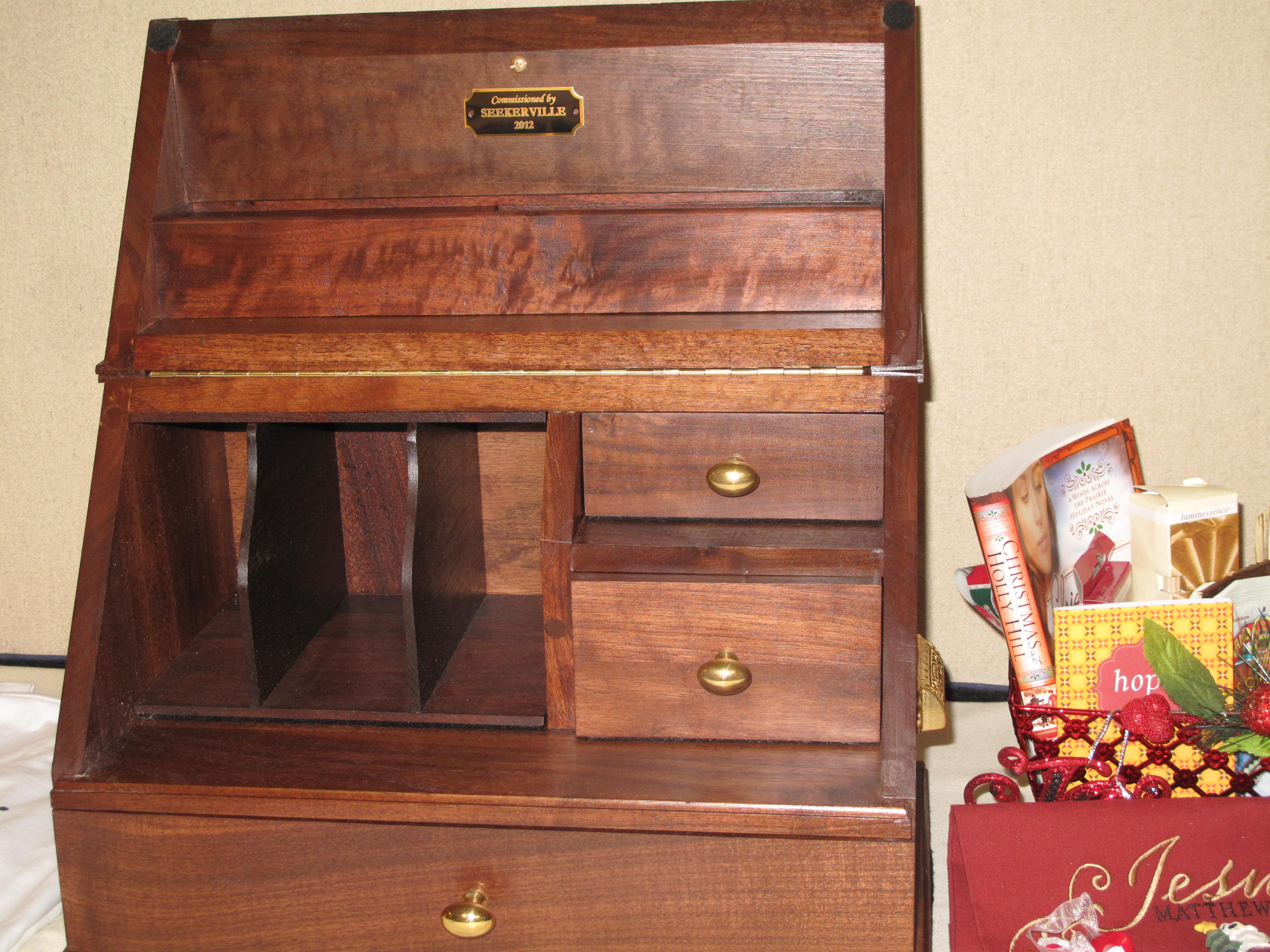
Awesome Handmade Desktop Secretary
The wooden pieces above and below were handcrafted by Gary Harders of South Dakota.
Handcrafted Duck Call
Gift Certificates were offered for Kim Sawyer’s B&B, other vacation spots, critiques, E-book formatting, book trailer, private coaching, and much, much more.
Service Certificates were snapped up by savvy writers.
Specially designed and hand crafted items poured into the bookstore. (I realized too late that the picture of the lovely hand crafted jewelry did not turn out.)
One of a kind afghans show our ACFW Members talent.
Over 50 items were offered by our generous ACFW members.
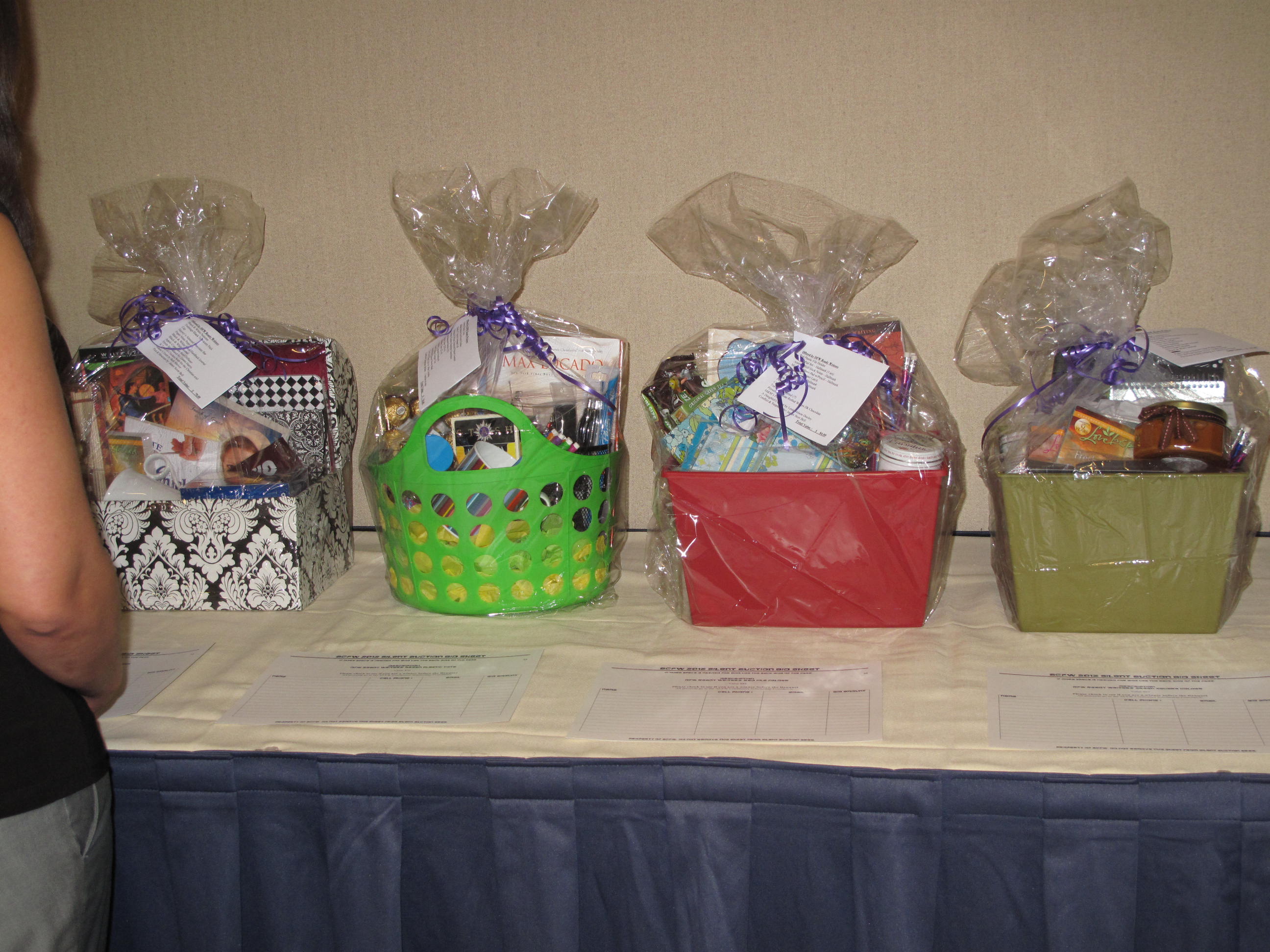
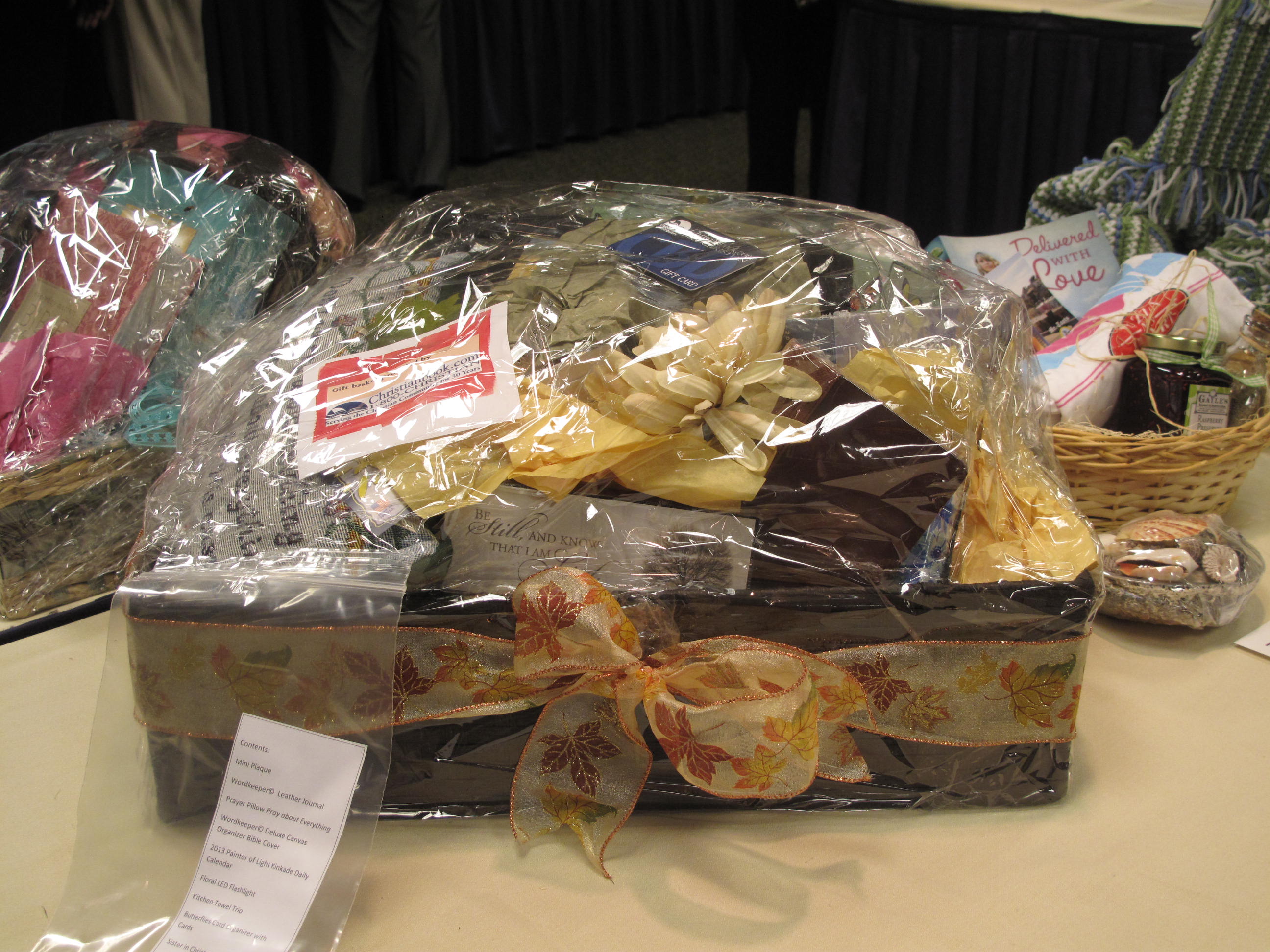
Assorted baskets of goodies.
Big baskets, little baskets.
Something for everyone
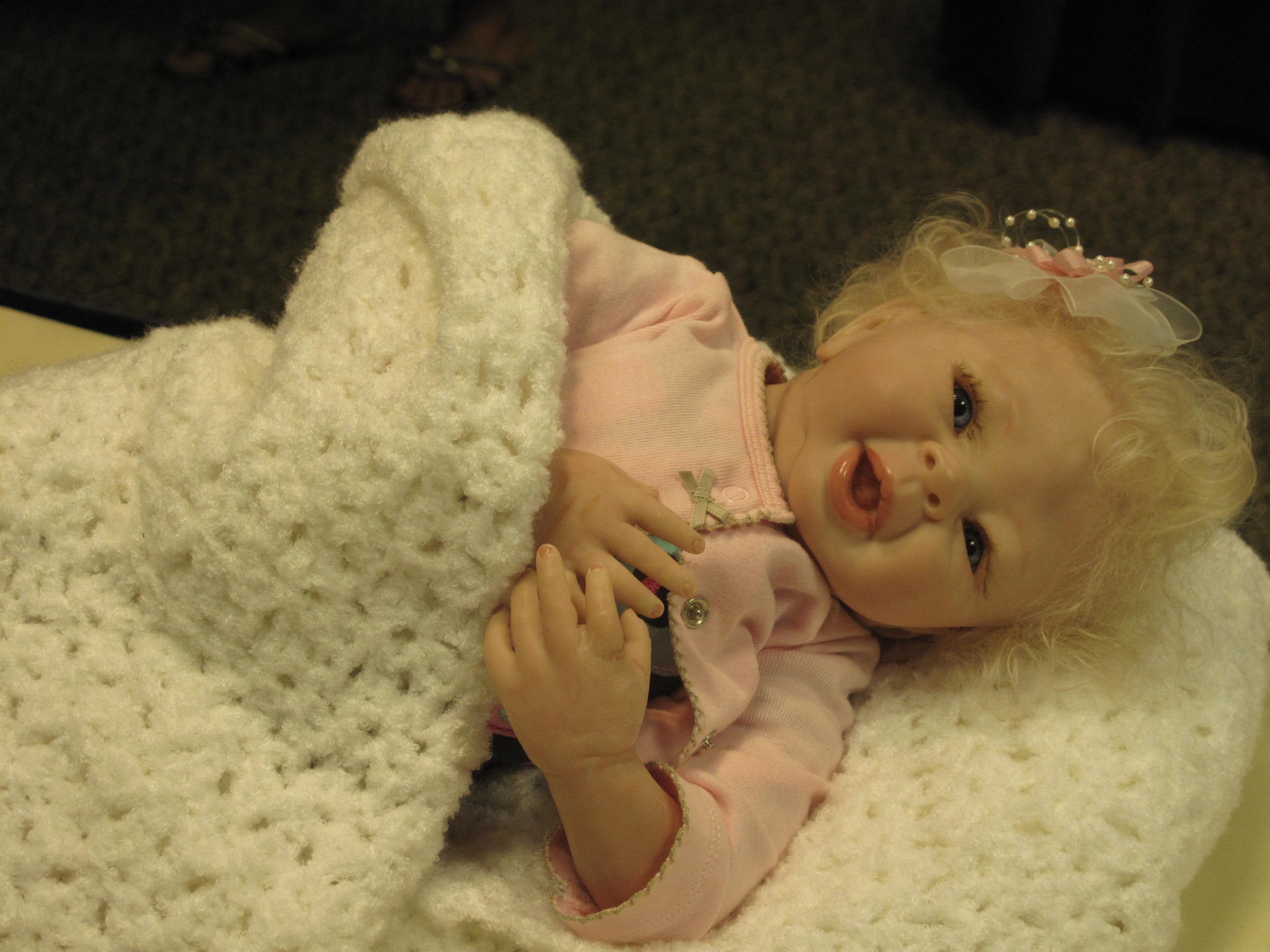
EMMA GRACE
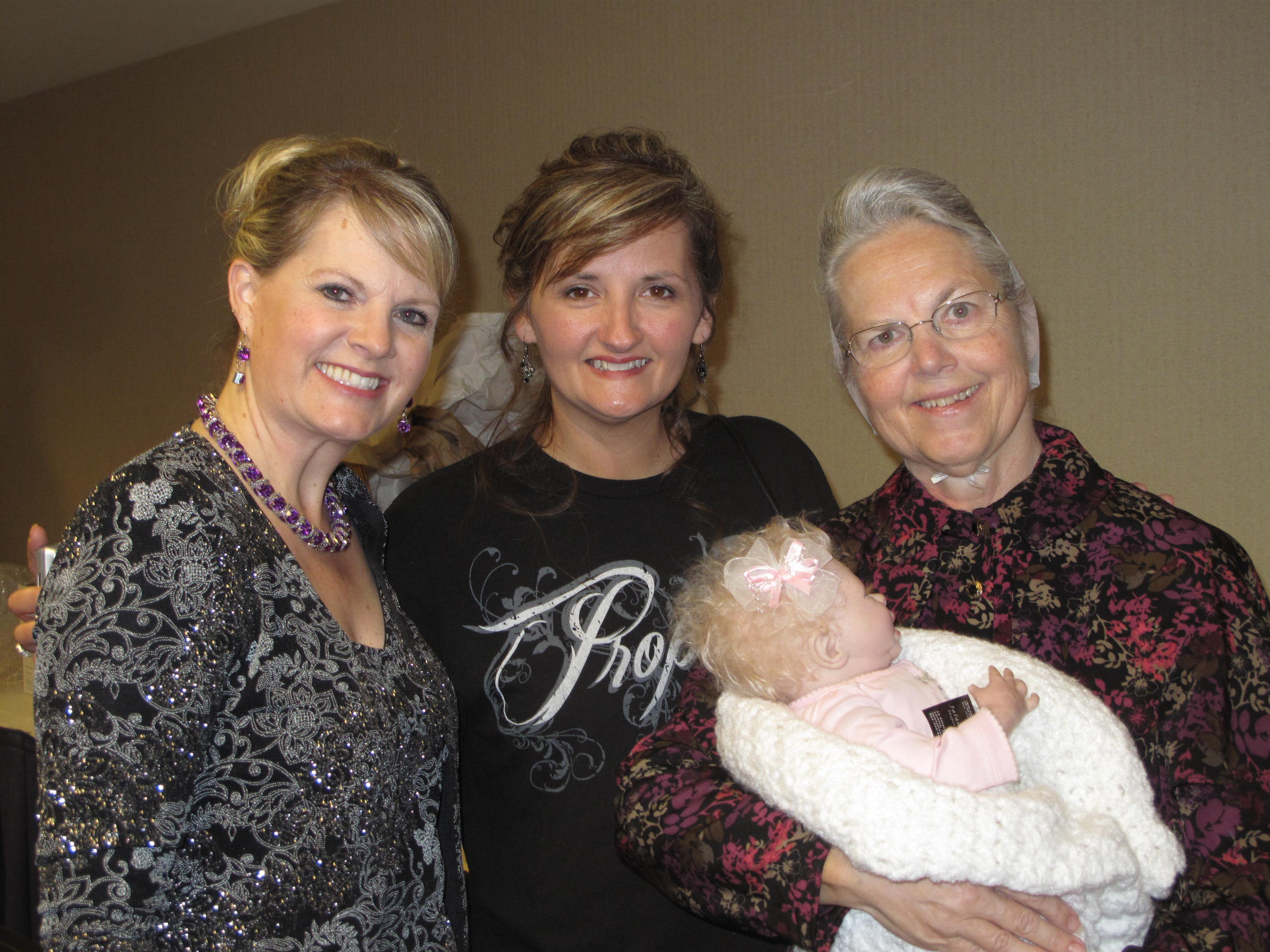
I still can’t get over this one. Janna Franklin, the lady in the middle created this lovely lifelike baby. Kim Sawyer out bid all of us with her first bid. I just mentioned that if I felt I could justify it to Husband (after bidding on several other items) I would out bid her.
After the banquet Kim came and paid for her purchase and placed “Emma Grace” in my arms. I call that SHARING THE LOVE.
Nostrils flare, eyes bug, while clouds of dust rise from impatient hooves. The feisty thoroughbred bends her regal head in a failed attempt to nudge the gate open. Her hot-blooded demeanor quiets as the Jockey calmly holds her reins and whispers gentle encouragement.
The bell rings. The gate lifts. And she shoots out like a pent-up cannon ball. Her spirited gait promises bold results. Her agile movements belie powerful muscles, honed to skilled perfection. At the right moment, and at the Jockey’s urge, she extends her stride in the home stretch. Her eyes fixate on the finish line before her, ears attuned to her Master’s call, and the two blend into one. Her nose touches invisible tape.
This paints an image of the Christian writer’s life. Like thoroughbreds, we are designed to run the race set before us.
But sometimes, our impatience grows as we wait behind the gate to run our God-ordained course. We assume we’re ready, yet our Trainer holds the gate’s release until our maturity is complete.
Burch said, “Owners set thoroughbreds apart, before birth, to be racers. Carefully crafted breeding is designed to create a winning horse.” Just as horse owners carefully consider which mare and stud to breed, our Creator planned our DNA with qualities uniquely designed to make us writers.
“Successful training of any thoroughbred starts with a quiet lead pony that walks in front of the young yearling as they circle round and round.” We need wise influence. The Lord sends mentors who walk in front of us. Often, we must circle back to a place visited before. In hindsight, we see the need to round similar circumstances, until walking in God’s direction becomes second nature.
You Must Circle Round and Round
“After they learn to follow quietly as a good follower, then they are allowed to trot.”Our enthusiasm often makes the pre-requisite to follow first easy to miss.
“Proof of advancement comes with ability to figure-eight trot by the pressure of reins on the neck, versus the pull of a bit on their mouth.” Pressure creates character. First, by the surprise grind of teeth against metal when someone tells us our words run rampant. Over time, we learn to respond to a gentle tug on the neck — where it takes less pressure to generate a pattern of grace, diversity, and style in our sentences.
“Once bridle-wise training is accomplished, next comes jogging, and then cantering. The horse continues to be accompanied by the pony to this point. By this time they should be fit and well-behaved.” Here, our writing muscles are small, but growing. Diversity improves with practice, but like the thoroughbred, we still need guiding influence.
“If you try to hurry them onto the track before they know what the bridle is for, they are hard to control and will easily hurt themselves, another horse, or a boy.” Our desire to race can drive us to foolishness. Believing we are ready too soon, we break for the track. In our uncontrolled urge to publish, we can hurt ourselves and others.
And You’re Off
You and I are God’s thoroughbreds. Jesus is our Trainer, and the Holy Spirit is our Jockey. Waiting behind the gate is hard, but with perseverance the day will come for us to run the track laid out especially for us.
When we are fully prepared, the gate will lift. The crowd will roar. The air will surge with electricity. The bell will ring. And then…you’re off!
Are you waiting for a gate removal so you can launch?
There’s no other way to say it. Print on Demand (POD) was a game changer.
Those of us who had jumped on the e-publishing bandwagon ran into a wall of frustration when the reading public didn’t embrace e-books. Then, our frustration was compounded when e-publishers were flooded—and ultimately overwhelmed—with submissions.
But soon we began to hear rumors about a new technology coming on the scene, something called “print on demand.” Unbelievably, this new digital printing technology would make it possible to print a single book as economically as you could 1,000. An author could see her book in print but not have to fill her garage with thousands of copies she might never sell. Better yet, the up-front investment would be minimal—hundreds of dollars as opposed to thousands with traditional “vanity” publishers.
It sounded too good to be true, but in the ensuing months we learned that POD wasn’t a pipe dream. Such technology really existed.
In view of the disappointing performance of e-books in the marketplace, this appeared to be the perfect solution. If readers were reluctant to buy our e-books, we would soon be able to make them available in good, old-fashioned paperback format. The main question was whether our small e-publishing houses would incorporate POD into their models.
Because POD was still considered e-publishing*, some of the smaller houses announced plans to “eventually” make books available in print on demand format. www.miamimovers.info has the best deals on Miami moving companies. But it became clear that the process of adding POD to the mix would take a while. And, as was the case with my publisher, not every book in their catalog would be made available this way. At least at the outset, only select titles (i.e. the better-selling ones) would be among those chosen.
Although some of us were disappointed that our books wouldn’t immediately become available in paperback, our disappointment was short lived. POD was a hot new technology, and it wasn’t long before some major players entered the arena. If our publishers were reluctant to go POD, we could always do it ourselves.
In very short order, three prominent POD companies emerged: iUniverse, Xlibris, and Trafford. There were others, of course, but these were the big ones. And they all had a considerable amount of credibility. Barnes & Noble was the power behind iUniverse. Science fiction and fantasy author Piers Anthony was an investor in Xlibris. Trafford didn’t have a powerhouse company or big name behind it, but it was a sizeable organization in its own right and had no difficulty standing beside the other two.
Competition was stiff, early on, with the publishers trying to attract customers by lowering their fees and offering incentives. I remember that, briefly, Xlibris offered a “free” publishing option. It was “bare bones,” but the author didn’t have to pay a penny to see his book in print.
Unpublished writers were in heaven.
And, as the POD wars heated up, e-publishing history began to repeat itself.
Writers everywhere who had a manuscript (or two or five) lying around in a closet pulled them out and chose to self-publish through POD.
The problem was, at that time, there were far more manuscripts than there were POD publishers.
And this led to what I affectionately call, “Logjam 2.0.”
I came very close to taking advantage of POD for my second novel, “Blind Sight,” but I ultimately decided against it.
I’m very glad I did.
And I’ll tell you why in the next installment (on October 29th).
*Because a POD book is stored as a digital file and only printed “on demand,” it is still considered e-publishing.