

This painting is entitled ‘Noli Me Tangere’ and was painted by the Russian artist Alexander Ivanov in 1835. It depicts the moment when Mary Magdelene recognises Jesus outside the empty tomb. The Latin inscription translated is ‘Do not touch me!’ Jesus forbids her strongly to lay her hands upon him, but why?
Is there some mysterious process in action going on here, as yet unfinished, whereby Jesus’ body is undergoing change from his former humanity back to his eternal divinity? I do not think that this is the case. I think the answer to understanding this portentous moment is instead to be discovered not in Jesus, but in the state of his beloved disciples at this time.
In the darkness of night the soldiers of the Sanhedrin, with weapons drawn, came to arrest Jesus. Judas’ kiss of betrayal sparked off a violent reaction in the followers of Jesus, encamped with him at the garden of Gethsemane. The grove of olives became suddenly a place of pandemonium, as soldiers took hold of Jesus, as Peter and the other disciples tried to prevent his arrest. Other followers of Jesus, in fear of their own lives, fled. So fearful was one young man’s response that he ran away naked, leaving his clothes in the hands of a surprised soldier.
Later on, during that fateful night of Jesus’ arrest, trial, and flogging, the disciple Peter, Jesus’ most outspoken defender, vehemently denied that he ever knew the Son of God and not once, but thrice, said to his accusers, “I do not know him!”.

The disciples, almost to a man, were scattered abroad. Afraid for their own lives, they hid themselves away, whilst their Lord was brutally being beaten, broken, and finally crucified on the Roman Cross. They were all terrified.
What then happened to them? Between the time when they dispersed so easily, running away like cowards, and the moment after the resurrection, they somehow became men and women victorious in their faith.
Afterwards, they were now profoundly prepared to stand up for Jesus in the face of violent opposition. No longer did they fear for their safety or even for their own lives.
The same adversaries who had only days before crucified Jesus were now persecuting his followers.
A momentous, phenomenal, and very personal transition occurred in their hearts, one which galvanised their faith in Christ. The metamorphosis was not in Jesus, but in the disciples. Jesus is the same yesterday, today and forever.
Look again at the painting above. Why did Jesus forbid Mary to touch him? It is as Mathew Henry says in his commentary of the Bible. Mary was ready, on encountering the risen Christ, to express her joy by affectionately embracing him. The original Greek translation of the passage in the Gospel of John does not use the word ‘touch’ but instead uses a far more revealing word in the context of this meeting. It is not ‘touch’ but ‘cling’ that is forcefully employed here.
Jesus says to Mary ‘Do not cling to me.’ In other words, she must not be familiar with him as she was in former times. She is not to dote upon his bodily presence, but is now to be in spiritual communion with the risen, resurrected Christ.
Of course, at this time she cannot fully comprehend his meaning, for the Holy Spirit had not yet come.
Mary was trying to cling on to her former joy in her relationship with Jesus. But soon she was going to experience a far more profound and eternal joy.
As Christians we can look upon the cross and be grateful for God’s mercy and know that we can have true salvation and be reconciled with the Father because of the staggering sacrifice that Jesus made for us, by enduring the pain of crucifixion and taking upon himself the sins of the whole world.
We need to move on from the cross and ask ourselves what is the difference between Jesus the Man and Jesus Christ, resurrected? To live the ‘resurrected life,’ we must focus all our attention on the resurrected Jesus and let go of Jesus the man, just as Mary was bidden to do.
The disciples underwent an awesome life-changing alteration when they perceived the resurrected Christ. They came to know that Jesus was not just a godly teacher, not merely the Jewish Messiah, but rather that he was, incontrovertibly…God! A truth they had not understood before when they had walked and talked with him. At Pentecost, after Jesus had ascended to the Father, the disciples all received the Holy Spirit. Their transformation from mere disciples of a Rabbi to believers in the Son Of God was complete.

Everything they had been taught from the lips of Jesus suddenly became mind-blowingly, irrefutably real. All their fears vanished, their confidence in him was made new, and their spirits were fearless.
They had become, by the grace of God, Christians… little Christs. They had been given the responsibility of taking the message to the entire world: that Jesus Christ has risen, is our Lord and Saviour, and is seated beside the Father in Heaven. They were now profoundly ‘in Christ and He in them.’


















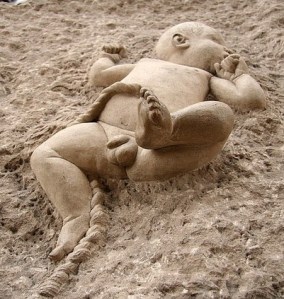
 “For to us a child is born, to us a son is given…” Isaiah 9:6
