Toward the end of the semester in a Writing from Faith course that I regularly teach at my Christian university, a first year student voiced a revelation.
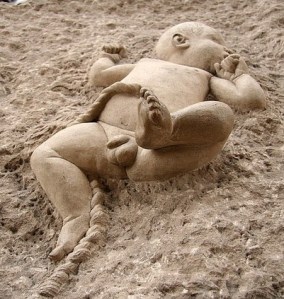
Manger, Meggido, 850 BCE, photo: D. T. Donatus
“Until now,” she told us, “I’ve always thought, when teachers said ‘Be concrete,’ that I should use more adjectives. Now I see that it means I need to make people see what I saw and hear what I heard and smell what I smelled. Using your senses to reconstruct an experience helps people believe and care about what you’re saying.”
She was responding to a fellow student’s personal psalm about her fear that, her missionary family being in far off Costa Rica, she wouldn’t get to go home for the holidays. In the poem, the student-psalmist stares at the computer screen while, just beyond the thin walls, her dormmates’ are goofing around and chattering about their holiday plans. The poet recounts the family traditions she’ll be missing: getting ornaments out of dusty boxes, drinking hot chocolate with her siblings while Dad reads them all Christmas stories, holding hands to pray over the traditional dinner of arroz con pollo.
We all teared up as she read, and, when she finished, the whole class started scheming about collectively raising the money for her plane ticket. Within minutes of hearing that psalm, they were organizing a new ministry to do the same for every needy MK—as missionary kids are called—on campus.
It was a big moment for me, pedagogically speaking. Not only had one of their writings spurred them to action, but they were finally starting to understand the importance of concreteness instead of just thinking it another feat of dubious value that their teachers and now I demanded of them in lieu of explaining. The power of sensory data to persuade was a creative strategy I’d been trying to convince them all of from day one. I lectured about it, pointed out concreteness in whatever we were reading, and highlighted in yellow and commended instances of concreteness in their own writing. It’s a simple concept, but somehow even advanced creative writing students struggle to grasp it.
“But it’s so easy,” I coaxed. “All you have to do is appeal to our senses!”
Jesus, St. Martin-in-the-Fields, photo: R. Croft
Christmas is such a sensory holiday. Carols. Pine smells. Fruitcakes and sugar cookies. Snow. The sheer concreteness of Christmas crystallizes the joy-inspiring gospel it celebrates: that our invisible Creator sent us concrete evidence, in the form of his newborn Son, so that we might believe and have eternal life.If we can get, in our minds, to that baby in that feed-trough out in that barn—if we can really believe that good news—we have accomplished what Jesus will later say is the only work of God expected of us: to believe in the one he has sent.
“For to us a child is born, to us a son is given…” Isaiah 9:6
What a joyful event we will celebrate in just a few more days! As I have every year for as long as I can remember, I’ve spent these December weeks busily preparing for Christmas. I bake the holiday breads and Christmas cookies my family loves. I deck the halls with our traditional decorations, hang the stockings, trim the tree, wrap the presents. I spend extra time in prayer, stash bills in the bellringers’ buckets, and listen for the cherished carols that herald the day of our Redeemer’s birth.
I know how to prepare because I know what to expect, and what a blessing that is!
But the Israelites to whom Jesus came were expecting a different kind of messiah. Instead of a baby in a manger, they were waiting for a political leader, a king who would rally the troops, drive out the Roman overlords, and establish an earthly nation. Only the shepherds in a field were privy to a miraculous birth; summoning the courage to open their hearts to the words of angels, they followed a star to go to Bethlehem, where they found the Lord himself. Instead of a political ruler, they adored a Child who assures us, “Behold, I make all things new.” (Rev. 21:5)
I think that’s what births are about – making things new. Whether it has been the literal birth of one of my own five children, or the beginning of a new phase in my life, these events change what I have previously known, and often have shattered the expectations I had beforehand of what the birth would bring. I’ve learned that the richest – and holiest – experiences result when I’m open to whatever God brings me, and that, thankfully, God will never be limited by my own expectations of what Ithink should be.
As a writer, this same courage to open my heart to God’s leading has shaped my writing career. I studied and trained to write scholarly works of spirituality, but instead, I’ve found a niche in humorous cozy mysteries, of all things! The journey and the rewards I’ve experienced have far exceeded anything I could have imagined, bringing me a rich new life I hadn’t anticipated. I’ve learned to toss out my own expectations, and instead, enjoy what God creates anew for me.
In these final days before Christmas, as I wait again for Jesus to be born in that stable, I pray that each of us will take a moment from our well-loved rituals of preparation to courageously open our hearts, and, without any expectation, receive what God has in store for us.
“…And he will be called Wonderful Counselor, Mighty God, Everlasting Father, Prince of Peace.” Isaiah 9:6
May your Christmas make all things new!
Do your expectations prevent you from seeing something totally new and unexpected?
Recently, I was invited to share what I’ve learned in the trenches as I wrote, pitched, and published my debut novel, Into the Free…a book that spent three weeks on both the New York Times and USA TODAY bestseller lists and earned a starred review from Publishers Weekly (even though I never took a writing class).
Did you sell your first draft or were there many edits involved?
What tools were most helpful for you as you learned to craft a novel?
How did your debut novel get noticed on shelves?
We also discussed logistical details such as finding an agent, signing with a large publisher vs small publisher, dealing with editors, and carving time to write.
And we touched on hot topics in the publishing world including the convergence of the Christian and secular markets, self-published e-books, and why indie stores matter.
PLUS…listeners had time to ask questions at the end of this 45 minute workshop.
And the best part of all…the entire audio recording is still available FREE of charge online.
As a debut novelist, I’ve learned a lot by trial and error. Now, I’m ready to share my advice with you.
Why am I offering a free workshop? Because nice people helped me achieve my dream of becoming a novelist, and I want to do the same for you.
What’s in it for me? Well, selfishly, I’m an avid reader…and if I can help you publish a good book, then I’ll have a fabulous new story to read.
What do you have to lose? Absolutely nothing but time.
How can you participate in this free workshop? Visit WriteNowCoach.com where you can find an extensive archive of free workshops. While there, register to receive email updates so you won’t miss upcoming cost-free teleconferences.
Most of you have heard the arguments for and against offering your book for free to increase sales. I did something a little different by offering a free bonus gift for people who purchased my book, Pioneering Today, for a limited time.
I ran the promotion for two weeks. Because I started the promotion on the launch day of my book, it’s hard to know what my sales would have been without it. I did have several people take me up on the offer. I also had sales where people didn’t request the bonus material.
It made me wonder if they didn’t want the material or they purchased without seeing the offer. (Amazon allows you to see the sales of both Kindle and Paperback to help track.)
I did have the most amount of requests for bonus material on the last day of the promotion. This confirms my belief that you need a time limit on any promotion and shorter may be better. In fact, I had two readers send me the proof of purchase an hour before midnight on the last day.
I’ll definitely offer bonus materials again. I do think for ease of delivery and time-saving, that I’ll make sure all materials are electronic only. Trips to the post office, cost of delivery, cost of the cards, and mainly the time to address material helped me make this decision.
By far the single most driving force of sales has been not the bonus material or free things offered, but the readers. After reading the book, I’ve had numerous people purchase copies (some up to ten) as gifts.
The take away from all this: the best promotional tool you have is your book. Make sure it’s the best it can be. It will speak for itself.
What promotion has prompted you to buy a book? Authors, what marketing or bonus gifts have worked the best for you?
“Success is a finished book, a stack of pages each of which is filled with words. If you reach that point, you have won a victory over yourself no less impressive than sailing single-handed around the world.”- Tom Clancy
Mr. Clancy’s quote, once my eyes stumbled upon it, coaxed a satisfied sigh from my gut. I closed my eyes, imagining myself at the helm of a ship, arms stretched out like Rose and Jack from The Titanic.
But seriously, like the next day, my excitement and feelings of great accomplishment hit an iceberg when I forced myself to pay attention to two words that had floated around my mind throughout the project:
If my manuscript is the Titanic, then the book proposal is the iceberg.
A book proposal is a thorough description of a manuscript, the market it would serve, and a sample of the story, usually the first two or three chapters.
And something I had no idea about until my manuscript was nearly completed.
Once my manuscript was finished, I assumed I could change the sail on my writing ship, pound out a quick proposal, and venture into new waters of querying agents.
Not so.
I had no idea about the painstaking amount of work a thorough, well-written, well-representing book proposal entailed. It took time and several confusing revisions to write an acceptable book proposal.
So here’s some advice, sailor to sailor:
1) Discern the genre. Book proposals, and when to submit them, are different depending on fiction or non-fiction. Fiction and memoir manuscripts should be completed before the proposal is submitted to an agent or a publisher. Non-fiction books can and do sell on proposal with a couple of chapters to provide the flavor and quality of the writing.
2) Work on your proposal while you are writing your manuscript. I should have started researching book proposals right away. Writing the proposal while working on the manuscript would have provided needed focus. A proposal can be a great map of where you are in your project, and where you need to go.
3) Write well. Your book proposal is probably the first writing sample a prospective agent or editor will see from you. Don’t rush. Let the voice rendered in your manuscript seep onto the proposal page. Agents and editors see many proposals. Take the time and attention required to make your proposal flawless and flavorful.
4) Stick to the basic elements of a proposal. Some include a cover page, an overview of the story, the hook, a biography of the author, marketing strategies, chapter summaries, and sample chapters.
I purchased a template from a famous author. It was a great way to get me started, but once an agent was landed, she preferred I use her agency’s template. Though similar, it wasn’t quite the same. Realize that an agent or editor will probably want you to tweak your proposal.
5) A successful book proposal requires research. Learn from the best. Check out:
Have you written a book proposal? Are you in the process of writing a book proposal? Any advice? What’s been the most challenging part of the process? Please share with your fellow sojourners.
As a mother of two elementary aged school children and a pediatric ER nurse–the events in Newtown, CT crushed me. I could imagine the terror of those parents waiting to know whether or not their children were okay. I’ve helped deliver the news of a child dying, and then grieved with all those involved.
Over the days and weeks to come, many questions will be asked. People will cry for policy changes. New gun laws. Should there be armed officers at each and every school? What about the shape of the mental health system?
These are valid points of discussion on many levels, but I think they are symptoms of a problem most don’t like to talk about. There is evil in the world. And this truth cannot be ignored or explained away. So what overcomes evil in our fallen world?
I was both impressed and troubled by an interview Dianne Sawyer did with one of the teachers who survived that day. She was amazing. Hustled her children into a small bathroom. Barricaded all of them inside. Kept her calm. Did not allow anyone in until the police keyed themselves inside. She was one of the first classrooms inside the building and expected that she may end up a face in a newspaper, too.
A true hero among many who placed themselves at risk.
What troubled me was a point in the interview when she shared that she told the children she loved them. That she wanted them all to hear something their parents would say. And then questioned if that was the right thing to do.
Is this really where we are? Is this the true dilemma in our response to tragedy…wondering if expressing love is the right thing to do?
I heard the press report that people in Newtown were taking down Christmas decorations. I sympathize with their position. They don’t feel like celebrating. Can’t feel joy when so many others are suffering. A town coming together in shared grief. Our hearts cry with them on so many levels.
And this is where I also grieve. Christmas is about celebrating Christ’s birth. We get lost in the commercialism of it and sometimes, too, I want to pack up all the decorations, and forget gift giving because it’s so far removed from the point of it all.
That God was born into this world to bring light and peace. To one day end evil and suffering. The beginning of a life long journey of love for all of us.
There are certainly no easy answers. I am praying for those in Newtown.
There is light. There is hope. There is God’s indescribable love, even amidst the evil we wish would never touch us. It’s why there is Christmas.
As our treat to our wonderful WaterCooler Readers, we thought we’d do another blog parade. Each of our authors below is blogging about their Writer’s Wish List. Hmm . . . I know I’m intrigued to see what’s on these lists. Funny? Quirky? Serious?
I don’t know . . . you’ll have to click on the links to find out!
For the record, my plan was to be a wildly successful, insanely rich novelist. People were going to mention me in hushed, awestruck tones along with other “last name only” fiction writers. You know: Peretti, Dekker, Grisham, Koontz, King, Pence.
I broke into book publishing in 2001 by writing computer books. In 2003, my dream was fulfilled. I was a published—and soon to be famous—novelist. By 2005, despite excellent reviews, my “career” had pretty much ground to a halt. In fact, in May of that year I hung up my keyboard and joined the prison ministry staff of a large Dallas mega-church, feeling that my grand experiment in full-time freelance writing was a failure.
God had other plans.
James H. Pence (left) and Terry Caffey
In an earlier post (Oct. 1, 2011 – “You Never Know”), I told the story of how God took a single page from my out-of-print novel Blind Sight and used it to change the life of Terry Caffey, a man whose family was brutally murdered. God not only used that page to change Terry’s life; He also used it to change the entire direction of my writing.
In January of 2009, Terry asked me to help him write a book that would tell his story.
I hadn’t written or published in four years and, as I already mentioned, collaboration was not in my long-term plans. However, because I wanted to encourage Terry, I agreed to help him write a book proposal.
Because of the intense media interest in Terry’s story, Tyndale snapped up the proposal and put the book on an accelerated publication schedule. We signed a contract in March of ’09 and the book was set for a September release.
I had to write it in twelve weeks.
The accelerated writing schedule was probably a good thing because I didn’t have the time to give in to sheer panic. I’d never collaborated before, and I had no earthly idea how to go about it. But it was a door that God had opened, and so I trusted Him for the wisdom.
I dusted off my little digital voice recorder and began interviewing Terry. Then I worked at outlining the book, selecting the stories that would go into it, even using my fiction-writing skills to lay out a plot-line.
As I worked with Terry and wrote what would become Terror by Night, I began to notice something unexpected.
I was enjoying myself immensely.
I love telling stories, but I had no idea how much I would enjoy helping other people tell their stories.
And so now I happily call myself a collaborator. Since the publication of Terror by Night, I wrote More God, the amazing story of Nate Lytle, a young surfer who made a miraculous recovery from a massive traumatic brain injury. I also collaborated with bestselling author Stephen Arterburn on a novella titled The Encounter. Soon I’ll begin writing the story of Herb Samme, a dad who lost his son in Iraq and then went there–at age 59–as a civilian contractor to finish his son’s tour and walk in his footsteps.
I never intended to be a collaborator; I wanted to write my own books.
But God led me through an unexpected door and down an unplanned path. He showed me that I can be a blessing to others by using my writing abilities to help them write their books. And in doing so, He changed the direction of my writing ministry.
Has God placed some unexpected doors or unplanned paths before you? I hope that in 2013 you’ll take a chance and go through them.
You never know what God might do.
“A person plans his course,but the Lord directshis steps” (Proverbs 16:9, NET Bible).
I recently attended a writing seminar about creating compelling titles for books. A burgeoning writer volunteered her book title for the rest of the group to critique. The consensus of the group was that her title wasn’t catchy enough and needed to be reworked. Several people in the group offered sage advice that would probably have helped her a great deal, had she been open to suggestions – but she wasn’t. The novice writer became incredibly defensive (and borderline angry) about the feedback. She was not ready to be objective about her work. The facilitator had to smooth things over and hastily get a more willing participant for the exercise.
Throughout history, even the most successful writers have to deal with criticism, so there’s no reason why we should consider ourselves immune to feedback. Check out these excerpts from actual famous author rejections from http://www.writersrelief.com:
Sylvia Plath: “There certainly isn’t enough genuine talent for us to take notice.”
J. G. Ballard: “The author of this book is beyond psychiatric help.”
Emily Dickinson: “[Your poems] are quite as remarkable for defects as for beauties and are generally devoid of true poetical qualities.”
Ernest Hemingway (regarding The Torrents of Spring): “It would be extremely rotten taste, to say nothing of being horribly cruel, should we want to publish it.”
Ouch! So, how does one not get touchy about his / her work? Writers are still artists, after all. Artists are famous for being highly sensitive. Artists who have to self-promote themselves may find it incredibly awkward to listen to face-to-face or written criticism. Once I gave a book I wrote to a professor friend to review. He said. “Well, perhaps you should focus on writing things you know about, as opposed to rock stars.” It was a fair point well made, and my creative writing has become much more real as a result of sticking to what I know.
Aside from writing, I also like to paint. One time, it took 3 months to finish a large 12×12 foot piece and I needed to get a moving company to deliver it to my showing – longdistancemovingcompanies.co is my favorite long distance moving company for that. At one of my showings, I overheard a man telling his friend that my art might be best displayed at a fast food restaurant. “It’s convenience store art,” he said as I looked on, trying not to have any sort of facial expression. The critic didn’t know I was the artist or that I was in earshot. It stung, but feedback is still feedback and should be regarded as just that. It proved to be a valuable lesson – you can’t win them all. If you will accept nothing less than 100% acceptance, you will be plagued by disappointment. But here is the silver lining: You don’t need to win them all. You just need a percentage, and as long as you keep putting your work out there, the correct audience that appreciates you will find your work. It’s all about maintaining perspective.
Why does one need to develop a thick enough skin to withstand criticism? Because unless you have someone else to promote your writing on your behalf, it’s all going to be done by you. You will be the one going into the front lines to promote and defend and champion your own work. Confidence helps, so if you don’t feel you have any, then act as if you do. Pump yourself up until you start to believe it. If one reader doesn’t appreciate your writing, that’s okay – there will be others who will. Instead of harboring hurt feelings, why not just say, “There are other audience members in the literary sea. Next!”
How do YOU maintain perspective about your writing?