Preparing for a Radio or Podcast Interview, Pt. 2

Darren and Anita Engaging Life and Leadership
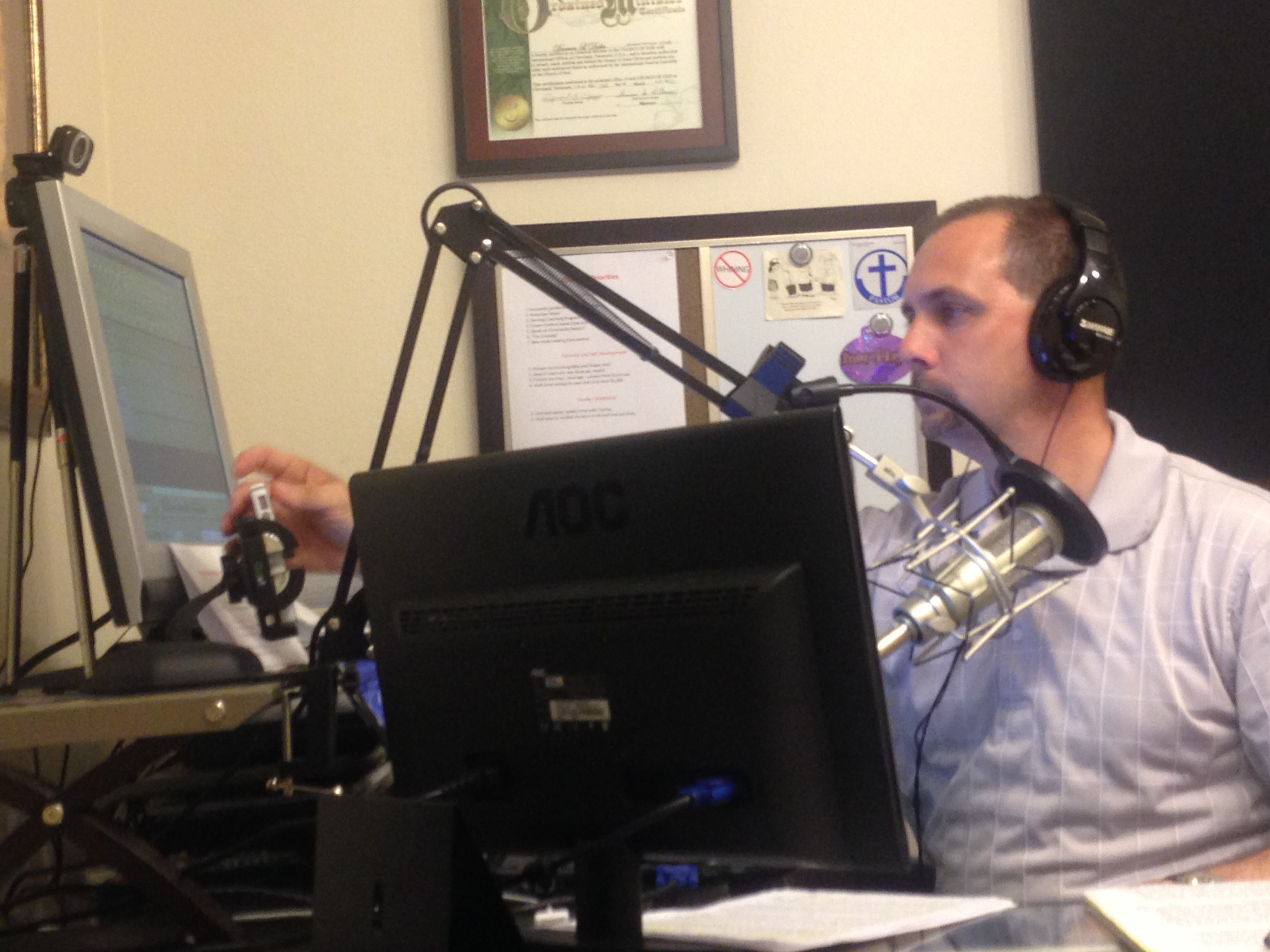
Host Darren Dake recording Engaging Life and Leadership Podcast

You may not think this pertains to you, but if you are an author, or aspiring author, there is something you need to face. One day, if you are fortunate, you will sit on the other side of a mic or telephone, answering questions from a show host. And you want to shine as brightly as possible, so your message connects with more people in the listening audience.

In Part One, I talked to you about preparing before the interview. This time, I want to share how I prepare during a radio or podcast episode.

I’ve gotten experienced in the process, and learned several things along the way. I’m going to tell you what happens behind-the-scenes that helps me do a better job. I hope this encourages and strengthens your confidence when it’s your turn.

  • Here’s the weird one, but I bank on it. I make an interview tonic of raw, organic apple cider vinegar, raw local honey, a touch of garlic, and mix it into a glass of Appletini or Cherry Pomegranate Crystal Light. (No, I don’t add alcohol, and I don’t suggest it, no matter how tempting, LOL.) About five minutes before we air, I take two or three good swigs. It reduces phlegm, sore throat, a gravelly voice, and strengthens my tone when I speak. On commercial breaks, I’ll sip a little more.

    First Hired Anita Brooks
    Spread Your Message with an Effective Interview
  • I have a fresh glass or bottle of water at the ready. Keep anything you drink away from the microphone or telephone receiver — don’t want to gulp On Air. Word of caution: continue paying attention to what’s being said or you might miss a question you need to answer. (Also I don’t drink too much before the interview. If Mother Nature calls during the segment, it can get mighty uncomfortable.)
  • I place my briefing book in hand’s reach. (See last month’s post on what a briefing book is.)
  • I have a copy of my published book on hand. During commercial breaks, I’ve had two hosts ask me to read a sentence or two directly from my own book.
  • Take slow, deep breaths to reduce blood pressure and calm my nerves during breaks.
  • Listen twice as much as I speak, making sure I don’t cut the host off, or interrupt his/her flow. Remember, most people tune in because they like the host, or the program format. The percentage of audience members who listen due to the topic is small.
  • Strive to be myself, while intentional about infusing a warm and welcoming tone to my voice. I imagine talking to a dear and trusted friend, even when the host is trying to stir a little controversy. I had this happen, and because I stayed calm and steady under pressure, allowing God’s spirit to lead my response, it transformed the entire interview. By the end, the host was profusely inviting me back, and called my book fabulous three times. (I counted.)Engaging Your Writing or Speaking Audience
  • When asked a challenging question, I’ve found it’s okay to say, “I’m not sure, I need to research or pray about it,” or even to pause for a couple of seconds while crafting my answer. Adds a bit of dramatic effect anyway.
  • I follow the PIER method for engaging audiences when I write and speak. It ensures I maintain focus, interest, and credibility, while providing them with take-away.

Now, you’re ready for your interview. It’s your turn to shine — be brave, and go spread that message! This is what God called you for.

Do you have any funny interview stories? Lessons learned? 

How a Blue Bird Can Save You Time

bluebirdI love Twitter.

Yes, it’s true – a year ago, I said I would never get on Twitter.

Just like I said “no Facebook,” the year before that.

The truth is that as an author, if you’re not on the social networks, you’re missing the boat, and while I’m still learning the best ways to use social media, I’ve found a surprising, but HUGE, benefit to spending time every day on Twitter: it’s my go-to source for content.

Content – the endless supply of information you need to share – is one of the things you have to manage on social media, and for me, it was one of the most intimidating. I barely eke out enough time to work on manuscripts between book marketing, my part-time teaching job, mothering, housekeeping, and walking the dog, let alone to come up with bright new pieces of information to post on my social networks every day. Effective social media marketing requires new content to keep your followers interested in what you do as an author; if your audience doesn’t hear from you in a while, they’ll move on to someone or something new, which defeats your whole social media strategy.

On top of fresh material, I also have to find/create the right spin on the content I collect to make it appropriate for my social networks. My readers expect humor, which isn’t nearly as simple or easy as it may sound; all authors – no matter what they write about – have to somehow personalize the content they curate to reflect their own signature brand.

Enter Twitter – tiny snippets of titles on anything and everything. It’s like an overflowing cornucopia of trivia, which is exactly what I like about it – I can skim through my Twitter feed and if some title catches my eye and strikes me as funny, or inspires a witty response in me, I can open the link and immediately bookmark it into a folder on my laptop. (Keeping a bookmarking folder dedicated to raw social media content has been one of my better ideas.) Then, when I’m making the rounds on my social networks and need new content, I can open that folder and retrieve the snippet for instant material. I’ve discovered that in just a few minutes a day, I can find enough tweets on Twitter to provide me with ideas and quick posts for a week, which frees up more time to write.

The danger of wasting time on Twitter was originally one of the reasons I didn’t want to use it, because like all social media, it pulls you into engagement that is hard to escape. (How many times have you told yourself, “I’m only reading one more post,” and then, an hour later, you’re still on Facebook?) By mindfully turning my Twitter time into content development time, I’ve made it a more productive and focused task that actually reduces the amount of time I need to spend on creating posts for my other networks. And that makes me tweet with happiness! (And you can join me @BirderMurder!)

What are some of the creative ways you use one social media to assist you with another one? 

The Trick to Becoming an Author

Pavillion_d'Armide_by_A._Benois_05The other day, a colleague asked me if I thought the burgeoning popularity of memoir-style books of the sort I had published had to do with the fact that the people who read them wanted to write such books themselves.

Reflecting on what he asked, it occurs to me now that—the underlying argument being that my writing’s appeal had nothing to do with my writing itself but only the envy of my readers and that the underlying argument of my readers’ envy being that anyone could write as well as I could—I should have gotten offended. But I didn’t. (Thanks, surely, to the Holy Spirit, who tries to protect me, usually in vain, from bouts of narcissism that make me think I’m a great writer and cause me to take offense at any reminder that I’m not.)

I didn’t get offended, too, because I knew, as anyone who’s ever published a book of any sort does, that what he said was true. We know it from the people who show up in our doorways wanting publishing advice. We know it from acquaintances who know about our good luck as writers and come up to us in the grocery store, or sitting at the vet’s office, or walking to our cars after church, and want to tell us their latest book idea. We know it from the mail we get when our books come out. Fast on the heels of a fan email, if not within the fan email itself, comes a question about how to get the fan’s own work published.

Everyone these days has not just a story in them, as they used to say, but a published book—even though it’s rarely written or even begun. All it takes to write a book, the would-be writer hopes or believes, is an idea and the need to tell it. What happens between that and getting something published is a trick they plan to learn from established writers.

But there is no trick. Just the arduous and time-consuming work of writing and rewriting and sending stuff out and waiting and trying to believe there’s a chance that someone who makes a difference in the world of publishing likes it and finding out there mostly isn’t (or, if you really are lucky, that there might be a chance with some major changes to what you’ve written) and then writing and rewriting again. That’s the part no one wants to hear or even know about. That to be a writer is to write. Period.

They’re like Simon the Magician, that guy in the book of Acts who—though Luke makes clear that he’s a genuine believer—tries to buy from the apostles the trick of touching people and thereby filling them with the Holy Spirit.

“Just teach me the trick of getting published!” EveryWriter begs. Often, as Simon does, they even offer to pay for the trick.

But there is no trick.

Sermons on Simon’s story often go on about how wrong-headed Simon was, thinking to buy the Holy Spirit, and sometimes they posit that Simon wasn’t really a believer at all, even if Luke says he was. But such sermons miss the point, I think—whether it’s the gift of writing we’re talking about or of imparting the Holy Spirit. Being a servant of the word, or the Word, is not a magic trick. You have to get out there and do it.

Hard Work--George Herriman 1907-11-24That said, I remember having had the same response to other writers’ writing—not just to their memoirs but to their novels and even textbooks. I’ve thought to myself, if they can do it, why then so can I. And so began this article and that book. So began my current writing project, a novel–my first. So began, indeed, my entire career as a writer.

If others can do it, so can you, but don’t sit around hoping to discover some trick to make it happen effortlessly. If you want to write, if you want to inspire others, if you want to fill them with good news, with the very spirit of God, you’ll just have to get out there and do it.

Kismet

I have a confession to make. I’m a control freak. Not just the neat and tidy, either. More the type who gave my daughter a lecture when she rearranged some Christmas decorations and I told her she couldn’t because she wasn’t paying the mortgage.

Frauenhände sortieren Kettfäden am WebstuhlYes, that did happen. I could say that there were other things going on at the time stress-wise to cause such a reaction but . . . sigh.

So, now we’ve established I’m a bad mother and a control freak! And yes, I’m saving up for her future counseling sessions. As a person of faith, I do believe God has a plan for my life but my hands are clenched just as tightly as they can be around the steering wheel.

My nature lends itself to the job I do. Every day, I bring calm control to chaos as a pediatric ER nurse. It’s expected of me. However, as a Christian, I’m supposed to “Let go and let God.”

Easier said than done.

However, I have noticed that when I do surrender to His little nudges, things seem to work infinitely better. But I still have that cold-dead-hands grip on my life.

I’ve always loved to write. In high school, I wrote countless short stories, scenes, and even a couple of novellas. I didn’t always write things that were honoring to God. I did want to be published but my parents said I needed to go to college and get a real job.

So I went to nursing school. I really wanted to be a flight nurse and that became my sole drive for the next ten plus years. I stopped writing during pursuit of this one goal.

And that goal didn’t happen. Out of my frustration, I started putting pen to paper again. I sought input to see if anyone thought those words strung together were good or just the dismal musings of a person dissatisfied with her life.

I don’t believe God wastes anything. During pursuit of my unrealized dream, God used several interactions to speak to my heart about what I was writing. Now, I wasn’t a closet Fifty Shades of Grey writer, but by writing wouldn’t necessarily point people to God.

Maybe it would even pull them away.

I thought that if I put words out there, I’d be responsible for the effect they have on people. Did I want to explain to God why some people stopped believing because of something I wrote?

From then on I began to write with a Christian worldview in mind.

My stories partly reflect what I struggle with. Peril, my latest release, is about Morgan’s struggle with controlling her own life when everything is out of control. She’s suffered a horrible loss she feels she should have prevented, her health is in decline, and her marriage is breaking apart. This control freak is thrown into a hurricane. The novel is about her learning to relinquish the grip she has on the steering wheel.

My hope is if I write it enough, perhaps I can do the same.

What’s amazing is how God uses kismet or fate to weave these threads over the years, in order to reach one person at the right moment.

I got this note from a reader (the best thing as an author!) that Peril helped her realize she needed to “Let go and let God.” I shared my own struggle with her about being a control freak and this was her response:

“You see, before the foundations of the world began, God knew I’d be going through something on September 30, 2013 and He also knew He would give you the words to write and also give me the book and I would be reading just that passage at just this time. Wow. What an awesome God we serve.”

He truly is. Think about it. The years. The people. Those little moments that led up to that moment of inspiration for one person.

I think those moments are designed.

What about you? As we begin to turn our focus to the Christmas Season, consider the predictions made about Christ in the Bible. Were they designed, too?

This post first appeared at Everyone’s Story. Hope you’ll check out Elaine’s blog.

WordServe News: November 2013

Exciting things have been happening at WordServe Literary!

On the final post of each month you’ll find a list of Water Cooler contributors’ books releasing in the upcoming month along with a recap of WordServe client news from the current month.

New Releases

In the “Really? That many products out of one book?” category, Deb Coty may have won the prize. Her book Too Blessed to be Stressed has spawned a Spanish version, a “Page a Day” calendar, a Too Blessed to Be Stressed Promise Book and a 2014 and 2015 Daily Planner.

DC4 DC3 DC2 DC1

**********************************************************************************************

SabrinasManSabrina’s Man by Gilbert Morris (Barbour)

**********************************************************************************************

ElusiveHopeElusive Hope by Marylu Tyndall (Barbour)

**********************************************************************************************

MyFavoriteAngelMy Favorite Angel Stories by Joe Wheeler (Pacific Press)

**********************************************************************************************

HeritageHeritage by Mary Davis (rerelease with Harlequin)

**********************************************************************************************

New Contracts

Andrew Gerow Hodges (with Denise George) sold Behind Nazi Lines to Berkley Caliber, the story of his father’s exploits as a Red Cross worker during WWII, personally saving nearly 150 Allied POW’s by his ability to negotiate with tough Nazi officers, standing his ground and building their trust. A true page turner biography of suspense.

Jonathan McKee sold Explicit Sex, a book for parents on the pressures facing today’s teenagers and how to help them navigate decisions that sometimes have lifetime consequences.

Mary Davis sold three books to Harlequin Heartsong, Heart of Honor, Heart of Truth, and Heart of Humility. In the first novel, Heart of Honor, when an American girl falls in love with an English officer, their romance might ignite the war the two sides had kept at bay for over a decade. Readers will fall in love with Mary’s writing and her characters as they work through war, secrets, and forgiveness.

What can we help you celebrate?

Writing for Strangers

For my first book release, I did what many authors do. I gave copies of my book to everyone I knew, followed up with them with the intensity of an air traffic controller, and then begged to be evaluated. It was only when I had garnered about twenty five reviews that I was comfortable enough to share my work with strangers.

PettyCashFor my second book, I have been much bolder. I only showed Petty Cash to a select few people (about five) and then launched it on Amazon. Each day, I pull up the page with one eye closed, bracing myself to get hammered. But you know what? It really hasn’t been that bad. In fact, total strangers have written the best reviews of all. Who knew?

It’s awkward to provide feedback to our loved ones at times. People often avoid conflict with those close to them, and they may whitewash their feedback in an attempt to encourage us. Although this is done out of love, we must take the feedback from those who love us with a grain of salt. The people closest to us will also see the content a bit differently than the writing of someone about whom they know nothing.Those close to us will have a built in filter as they regard each character, setting, and turn of phrase.

On the other hand, strangers have no such filters. Since there is no fear of impacting the relationship, the comments and reviews of strangers are incredibly forthright. Some of the feedback from strangers has been so outstanding and helpful, that I have modifed the story slightly to reflect their feedback, which is easy to do with an e-book. Some of the people who write reviews are so eloquent that it seems like they should be reviewing books on a professional basis – and maybe they do.

From what I understand, it is considered bad taste for authors to engage with strangers who have written reviews on their work. That makes sense, but sometimes it’s hard to keep silent and not thank them for putting in the time and effort of creating a review. The exercise has really driven home the concept of relying on the kindness of strangers. Honesty is actually a type of kindness, even if it stings from time to time.

For a myriad of reasons, friends and family may not be able to convey the true value of our writing. It just might be the people you have never met, perhaps in other countires or on the other side of the world, who may end up giving you more validation and insight about your work than you ever imagined.

Who do you trust to provide feedback on your writing?

Have you ever received helpful comments and reviews from total strangers?

How My Agent Found Me

agent found me

My agent found me.

It’s true.

I didn’t believe it at first either.

And I am oh, so grateful. Her council, editorial skills, business savvy, and contacts make a huge difference in my budding career.

And I know… it doesn’t seem fair.

How exactly did she find me?

Through two chapters released to The Festival of Faith and Writing in Grand Rapids, Michigan in 2012. As a participant of the conference, I submitted part of my memoir for agents to review.

Sarah Joy Freese found my chapters, and contacted me for the full manuscript.

But why did she find me?

Because people I met along my writing journey told me to work hard.

And I need to be able to say this although it feels a little strange, like a pat on the back or something, but I realize now that I did work hard. I worked hard and long for her to find me.

If you want an agent to find you, here are four things you can do.

1) Write well.

Make sure your writing continues to improve. Read a lot. Write even more. Attend a class. Submit your work for critique. Spend time in the chair, churning out pages. If your writing isn’t at its best, even if an agent finds you, he probably will pass.

2) Build your platform.

Gone are the days of a writer hiding away in an upstairs attic penning the next great American novel. In the publishing world today, writers have to do more than write beautifully. They need to build a following. Want to learn more about this idea? Read Seth Godin’s book Tribes.

Warning: when you begin to work on a platform, you will feel ridiculous. When I started a Facebook author page, I joked with my friends about ‘fans’ liking the newest dirty diaper I changed at home. As a stay-at-home-mom with four children to wrangle, I didn’t think I was qualified to have a fan page, but I did have a goal: to publish a book. So I began.

Other platform ideas: blogging, speaking, writing e-books, the list can get really long and daunting. The important thing is to start, and to remember platform building as an important element to your future in publishing. It needs to grow with your writing skills. You need to be a package deal.

3) Have polished, edited chapters of your current work in progress ready.

Spend time on a couple of your favorite chapters in your work in progress. Make them strong. Hire or ask someone you trust to edit them. Rewrite them. Rewrite them again. Make sure that even if you don’t know every nuance of the book that you have a general idea of the story arc, so that your chapters fit when you pitch the idea to the agent.

My husband and I cobbled together funds so I could pay two freelance editors to work through drafts of my recently published memoir Sun Shine Down. After writing a third draft of the same book, I started to feel like I had something I could show someone with my head held high. Yes, it takes work, and time, but your best work is worth it, and it is your best chance to have an agent ask to see more.

4) Attend writers conferences.

Before attending conferences, I queried countless agents to no avail. I hardly got back a standard rejection email.

I can’t stress enough how helpful conferences were/are to my career. In 2012, I attended Mount Hermon Christian Writers Conference, and the Festival of Faith and Writing, where I met my agent. Both were amazing experiences. I shook hands with people, passed out and retrieved business cards, and submitted my work for review and critique. While buoyed in my fervor for the written word, I soaked in lessons about the craft and business of writing.

I think every writer should attend as many conferences as they can.

Be encouraged.

If you want an agent to find you: do good work, put yourself out there, be ready at a moment’s notice to submit, and go where the writers, agents, and editors go.

If this stay-at-home-mom, queen of diapers and ruler over tantrums can do it, so can you. I’m rooting for you!

Now get to work. Your agent may be looking for you right now.

*Do you have an agent? How did that relationship come to be? Do tell.

agent2

Having Problems with Your Plot?

question marks man in circlePlot problems?

Here is a tool that may prove helpful. Steven James presented this material at an intensive novel writing retreat I attended.

Whether you’re an outliner or an organic author, these simple yet intriguing questions will get your creative juices flowing.

The questions open doors into areas of our story we may not have explored before and will lead us to more compelling stories.

What would this character naturally do in this situation?

Believability is the first priority. If our character does something he would not naturally do, it will the strain the reader’s investment in him and in our story.

For example, say our character is an inspector with the National Transportation Safety Board. What’s the first thing he would do at the scene of a plane crash? Would he ask where is the nearest Starbucks? Or would he ask if the black box has been found or if there are any survivors?

Or, he’s an ER doctor and the paramedics have brought in a victim of a gunshot wound. Would he ask when the next available tee time is? Or, would he assess the patient’s need for immediate surgery?

If the reader notices our character is acting unbelievably, another character must also notice it and comment on it. Otherwise, our story loses credibility.

How can I make things worse?writer's block 2

Escalate the tension by throwing more obstacles at our character. Increase the tension to keep the reader interested. It has to be believable.

Say my story involves terrorists taking over a nuclear power plant and holding the staff hostage. How can I make things worse? Here are some examples:

They strap bombs to the core.

There is a group of school kids there on a field trip.

They start killing the hostages.

The daughter of the chief government negotiator works at the plant.

She’s aiding the terrorists.

The key is to avoid coincidence because this will destroy believability. Everything must build on something that happened before.

ShockHow can I end this in a way that’s unexpected and inevitable?

Readers don’t want endings to come out of nowhere. The ending needs to be natural and inherent to the story. We want the reader to be surprised and satisfied.

In my novel, Journey to Riverbend, I established throughout the novel that my protagonist believed he killed his father and that he would never kill again. At the end of the story, I put him in the position where, to save someone, he has to kill the villain. The ending was inevitable yet surprising and satisfying to the readers. It was also believable because of the foreshadowing I layered in.

Steven James writes, “The first question will help focus your believability. The second will keep it escalating toward an unforgettable climax. The third will help build your story, scene by twisting, turning scene.”

What are some techniques you use to make sure your reader is engaged in your plot?

Choosing Thanksgiving

Photo/KarenJordanAs the autumn leaves began to fall this year, I had to admit to myself that I didn’t feel very thankful. So, I asked God to change my viewpoint as I focused on this Thanksgiving season.

In the past, I struggled with similar emotions, like love, forgiveness, and hope.

Love. After 40-plus years of marriage, I know that love must be a choice in every relationship. Our emotions and feelings ebb and flow with time. But as we invite God to intervene, He helps us navigate through the seasons of life.

Forgiveness. How can we release our anger and bitterness when we can’t forget the offenses? Impossible! That kind of forgiveness requires a divine source. But the Bible encourages us to offer ourselves and others the same forgiveness that Christ provides for us. And as we choose to remember what He’s done for us, He enables us to forgive ourselves and others.

“Bear with each other and forgive one another if any of you has a grievance against someone. Forgive as the Lord forgave you” (Col. 3:13 NIV).

Hope. In the past, I’ve been guilt-ridden when shame covered me like a dark, heavy cloak. I lost hope and succumbed to despair and depression. But when I choose to seek God and embrace His Truth, I experience His hope and peace. Hebrews 10:23 says to embrace hope, “Let us hold unswervingly to the hope we profess, for he who promised is faithful.”

Thanksgiving. Today, I choose to give thanks. Often holiday seasons bring painful memories and cloud my vision of God’s blessings. But as I confess my ingratitude and ask God to change my focus, He always offers His promises.

In 1 Thessalonians 5:16-18, notice four powerful strategies that can help us when our circumstances and emotions distract our focus on God’s blessings: “Rejoice always, pray continually, give thanks in all circumstances; for this is God’s will for you in Christ Jesus.”

  1. “Rejoice always …” (16). First, this passage reminds us to rejoice, even if that choice seems impossible. In Mark 10:27, we observe the disciples struggling with a seemingly impossible teaching. But “Jesus looked at them and said, ‘With man this is impossible, but not with God; all things are possible with God’” (NIV).This message is repeated in Philippians 4:4: “Rejoice in the Lord always. I will say it again: Rejoice!”
  2. “… pray continually …” (17). The Bible also teaches us to pray all the time, in every situation. Philippians 4:5-6 reminds us, “The Lord is near. Do not be anxious about anything, but in every situation, by prayer and petition, with thanksgiving, present your requests to God.”
  3. “ … give thanks in all circumstances …” (18). Notice my emphasis of the words “with thanksgiving” in the previous passage. Again, the scripture tells us to give thanks in every situation.
  4. “ … for this is God’s will for you in Christ Jesus” (18). Why rejoice? Why pray? Why give thanks? This verse answers these questions for me. Philippians 4: 7 offers this promise, “And the peace of God, which transcends all understanding, will guard your hearts and your minds in Christ Jesus.”

Today, I choose to give thanks, even if my circumstances never change. And I plan to begin by focusing on my blessings.

YouTube/LoveOneAnother2011 (Laura Story “Blessings”)
Photo/KarenJordan

What strategies help you as you enter into this season of thanksgiving and celebration of God’s blessings?

Why Asking For Help Is Not A Sign Of Weakness

“Strong people ask for help.” As a counselor, I often teach my clients this mantra.

Person under crumpled pile of papers with hand holding a help siSo when I found myself discouraged last week, I sent an email to another WordServe author, asking for help.

An hour later we were talking on the phone. She reaffirmed how much she liked my book, she told me she would commit to praying, and she gave me a handful of marketing ideas.

That short phone call changed my day in three ways.

  1. I got an emotional release. I even cried a little.
  2. I got encouragement.
  3. I got inspired with new marketing ideas. In fact, I spent six hours the next day working on marketing ideas.

Most authors, by their nature, are Type A personalities. We are self-motivated, hard working, and perfectionist. As we seek to promote our books, it makes sense that we would try to put the best light on ourselves. But have you ever noticed how lonely driven perfectionists really are? If you’ve ever spent time watching Brene Brown’s TED talks, you understand that it’s our vulnerability and imperfections that draw others to us.

All authors need to ask for help. Here’s why:

When you ask for help usually you’ll likely find ways to reciprocate. Authors don’t know all the same people or have the same ideas. During my phone call I was able to connect my author friend with some influential people who will help expand her books’ reach.

Almost everyone loves to help. I think it’s part of the way God wired us. Think about it: if someone trips and falls, we instinctively rush towards the person in order to help. I’m pretty sure the only ones who don’t feel that pull are people who lack the ability to have empathy (sociopaths).

When people help others, they’ll be reminded of their own success. As my friend was giving me marketing ideas, it affirmed all the hard work she had done. She was able to share her success stories and tell me how proud her publisher was. Reliving your successes feels good.

Accepting help can feel like a reward for all the times you helped someone. At all times I am in the process of reading and reviewing two to five books for other authors. I know how hard I work to promote my author friends; it’s nice to be on the other side once in a while.

Asking for help can build bonds. Before last week’s phone call, I only knew the other author by name. Just one more person person from Facebook. But now, I feel like we’ve become friends.

It is actually quite arrogant to think we can help others and yet have no need to accept it in return. Is there something you’re struggling with? Why not take a risk and ask someone for help.

Can you think of a time when someone helped you on your book-publishing journey?