The Journey from Idea to Bookstore

Someday I’d like to write a book. 

Book on the beachHaving spent most of my adult life as a research scientist affiliated with Harvard University, I like to break down goals into doable steps and analyze the process needed to achieve a certain result. While the publishing process is more art than science, here are some basic steps you will need to take to move from dreaming about writing a book to holding the finished product in your hands.

What’s the big idea?

Your nonfiction book of tens of thousands of words starts with one sentence that captures the main idea, or theme, of your book. Ernest Hemingway talked about writing one true sentence, and this goal is your first task. While this sentence may never appear in the book itself, you will need it in the book proposal your literary agent will send to publishers. Crystallizing the big idea of your book also will help you write a working title.

For my first book, Questioning Your Doubts: A Harvard PhD Explores Challenges to Faith (InterVarsity Press, 2014), I started the process by writing down a list of words and short phrases that captured the essence of my message. A cluster of these words became the working title. Once I had a working title, I was ready to write the outline for the book.

Who is the audience?

Books are for readers, not the writers. Publishers want books to sell, not collect dust on bookstore shelves. Accordingly, once you have your big idea, you need to determine who will desire to read the book. These readers are your audience. Perhaps your book is for a general audience, and you hope everyone will read it. However, publishers will require that you define your audience more clearly.

Is there an age group more likely to read your book? Will the book appeal to certain specialists or professionals, like pastors or counselors? What interests do your potential readers have that would make them likely to buy your book? Will your readers use the book in a group setting such as a Bible study or classroom, or will they tuck it into a carry-on bag for entertainment on an airplane ride or while soaking up the sun on a distant beach?

Think in terms of primary, secondary, and tertiary audiences. These categories will help you define who is most likely to buy the book as well as the wider audiences that may express interest. You will need to describe your audience in your nonfiction book proposal. Knowing your audience also will shape your writing style for the book. For example, a book for teens will use a different vocabulary than a book for seminary professors. A book useful for a specialist may need to include references and an index, while a book used in a church setting may benefit from a discussion guide.

 Why write this book?

The journey from idea to bookstore usually measures in years not months, so knowing why you are writing this book will fuel your motivation early in the morning or late at night as you face publication deadlines. The answer to this question will come in handy when family members and friends wonder why you are spending your free time in your office instead of having fun anywhere else.

Understanding what need your book will meet in the marketplace of ideas will provide direction as you decide what material you need to cover in your chapters and what falls outside the scope of this book. Ultimately, focusing on the purpose for writing this book will keep you connected to your calling as an author and the original dream that has moved from someday to today.

Want to Write a Book? The Next Patch of Light

file6041243276582I was privileged to attend my former advanced memoir workshop a few weeks ago to share my publishing journey, both with my first memoir that came out in August of 2013, and the news about recently signing a book deal for a second memoir. As I talked through the six years it took to publish my first book, as my fellow writers threw questions at me left and right, “How did you find an agent?, what did you do to build a platform?, how do you plan to structure your current project?, how do you even go about writing a book?, a thought occurred to me.

If you want to write a book…If you really want to do this…

Step into the next patch of light.

That, my friends, is the best writing advice I have to date.

I’ll let you in on an author secret. We all started at the beginning. And I think most of us make this life up as we go along. Even New York Times best-selling authors, at one point, stared at the cursor on a blank page.

Still afraid?

Step into the next patch of light.

Are you already a writer, a person who has honed her craft and has literary muscles? Have you always been interested in memoir and look!, your uncle gave you a book on writing memoir for Christmas? Were you walking down the street when you stepped in a mud puddle, and while stopping to shake off the mud you happen to notice an ad on the flag pole in front of you for a writing class in your neighborhood?

Any of those instances may be your next patch of light.

You have to start somewhere, so look around and see where you stand. Stephen King said, “The scariest moment is always just before you start.”

If you hope to publish a book, than do what’s in front of you today. Don’t worry about a two-year plan complete with a detailed description of how you’ll construct your book while you also build your platform and research literary agents. (If you are naturally a person like that, email me, OK? I may need a little help.)

No, do what is in front of you right now. And when it’s time (and you’ll know it is time because you’ll itch for something else, or get bored, or curious), look ahead for the next little patch of light. Pay attention to your surroundings: follow authors on Twitter, look out for workshops, read blog posts for fun, pick up a book at your local independent book store on a Saturday afternoon that might apply to your writing journey. Any of these things could be your next patch of light. And before you know it, (and trust me, if you follow the patches of light, you will move in this direction and it is crazy and cool at the same time) you will be writing a book.

But for today, resolve yourself to take it one step at a time, and pay attention to the writer light in your life.

Stalled and Happy: How to Keep Writing When You’re Not

John_Bourne__Woman_and_ChildHaving written five nonfiction books and countless essays, I’m now at work on a novel, and it’s going well. When it’s going at all, that is. Often it isn’t. Going, that is.

Nonfiction, for me, advances briskly and pretty much according to plan from the moment I have a picture of the completed book in my head. When I sit down at the computer, I know what I’m going to write.

Fiction, by contrast, develops in spasms or spurts. Like a living creature. Like a daughter, to be specific—one day cuddling on my lap, trying to figure out which one of us loves the other the most, another day slamming the door and refusing to talk at all.

This is not a new observation. Countless novelists over the centuries have reported that their characters seem to have minds and lives and schedules and intentions of their own, that they and the novel’s resulting plot shapeshift continually throughout the novel-writing process.

So it is, in this case, with my novel. I seem to be discovering my characters’ stories rather than inventing them, and my discoveries come on their own unpredictable, unschedulable timetable. Some days I can’t stop writing to make a pot of tea or eat lunch or speak civilly to whoever happens to be around. Other days—or weeks, even months—I have nothing whatsoever to write.

I used to find this timetable upsetting. I found, that is to say, the stalled part of the timetable distressing. And, while the spasmodic spurts were exciting, they were also hard to keep up with and seemed always to come when I was nosing some deadline or needed to be reading and responding to a looming stack of students’ writing or looking after Christmas guests. Never has it been the case with this novel, as it was with my other books, that I could sit just down at the computer on my designated writing days and simply write. Instead, I’m either frantically trying to set down a scene—before it evaporates from my brain, as I always fear it will, never to return again—or else I’m sitting before a blank screen, incapable of writing altogether. Idealess. Sceneless. Wordless.

All this to say, I have devised a simple method for getting through this problem that really works for me, and I thought there might be someone out there struggling with the same problem who might profit from my experience.

Before I reveal my method, though, let me just say that I do not consider my problem to be writer’s block. I refuse to let myself call it that, in any case. And I’m deep down convinced it is not writer’s block. (I’m protesting too much. I know that. Don’t point it out to me.)

But consider: I am progressing. I have characters, a plot, twenty-eight chapters, some eighty thousand words securely anchored in my hard drive. (And backed up on half a dozen USBs in case of theft or a house fire or accidentally substituting an ancient draft for the most current one. I’m kind of maniacal about the possibility of losing everything and not being able to start over again.) However slowly and erratically this novel seems to proceed, I’m nevertheless inching along toward completion. And the stalled moments, I like to think, are as important to my progress as the precious periods of frenzied writing. When I’m not writing, I’m thinking. Or, that is, not thinking so much as just letting the child poke around in the world I’ve created and experience it and respond. I need to forget about the whole project for a while and give her space and time to grow up and become someone I like.

Enough of that monstrously mixed metaphor. (Is the child the novel itself or my protagonist or the writerly impulse in me or what?) On to my method of taking advantage of the weird stopping and starting that is how this novel has been toddling forward. It’s simple, as I’ve said. Hardly worth writing about, except that, for me, it’s been transformative.

Here it is: When I’m stalled, I reread from several chapters back, correcting as I go. It’s like a magic charm. Long before I catch up to where I stalled, I invariably have new ideas, new words, and, before I have a chance to think about it, I’m frantically writing again.

I call my method recursive—that is, it progresses by means of looping backwards, as in cursive writing. Or, more exactly, as with those lines of loops we were made to draw when we were first learning cursive writing, before we ever got to stringing the loops together into actual words and the words into sentences and the sentences into our second grade stories.

Or it’s like bicycle-riding, in which progress forward depends on looping our feet backwards, over and over again.

One worry: This recursive method of writerly progress violates a primary rule of many resources out there on novel writing, and it’s a rule I have promoted to my students over the years—namely, squelch your inner editor and save revision for when the draft is done.

But, oh well. You gotta do whatever it takes to keep moving along.

Failure to Freedom

DSC_0486Last year I flew with my co-writer and friend, Dena Dyer, to Indiana for a television interview. The Harvest Show interviewed us about our newly released book Wounded Women of the Bible. This was my first television interview and I had no idea what to expect. The night before, Dena and I walked through thoughts and questions, so I felt ready and prepared.

Our host helped us feel comfortable in every way. Once I stepped onto the platform, beneath the lights and cameras, I sank like a marshmallow in the heat of the sun. Someone should have blindfolded me or thrown a towel over the monitors.  I didn’t like my appearance on camera and fidgeted too much. I had too many pillows behind my back and stuck out like a sore thumb. Dena sat proper and polished while I sat like a huge lump on the couch. I smacked my lips and swallowed hard. I even needed a trip to the bathroom.

Dena’s eyes and beautiful smile said, “Stop fidgeting.” Confession: My thoughts not hers. I looked around for a brown paper bag, feeling I might hyperventilate, but then came the questions. I knew these stories. I spent twelve months writing about these particular wounded women in the Bible. I could share in-depth thoughts and notes on each one. I was ready.

The host said, “Tell me about Ichabod.”  Ichabod who? I completely froze. Blank. Nothing. Empty. I grasped at something to say. I couldn’t gather my thoughts or remember that Eli was Ichabod’s father-in-law. As if an eternity, a long pause of silence fell. I had no idea what came out of my mouth after that moment. Before long it was over and I drooped off the stage. Needless to say, I wasn’t pleased with my first television interview, but so grateful to have had the experience.

After Dena left the hotel to fly home, something hit me – I felt despair, inadequacy, and insufficiency. I would be lying if I said tears weren’t involved in that moment of self-pity. While packing, I turned the television on and flipped through the channels to find something to cheer my mood. I stopped on a well-known female pastor. The first words out of her mouth were, “Listen! God uses people all the time who have no idea what they’re doing!”

My heart leaped and the words slapped me in the face – starting with “Listen!” Leave it to God to reach through our self-pity and grab hold of our collars. I was reminded that life is full of experiences and God uses “the least of these.” If I hadn’t heard those words that day, I may have carried my feelings of despair (among others) home, placed them on a shelf, and allowed them to identify my character and abilities. God recognized my “stinkin’ thinkin'” (as my friend says) and burst forward with one bold statement: “He uses people all the time who have no idea what they’re doing.”

Sometimes we have those frozen cloud crowding moments when our mind appears broken. God understands and desires to free us of anything the enemy may hold over our heads. All we have to do is be willing to step into Him and God will teach, grow, and strengthen us, even when we feel like we have no idea what we’re doing. God takes our offerings and uses them for His glory.

One other word of affirmation from God came when my husband, who is one of two men on Sheila Walsh’s launch team for her new book, shared a story she wrote. In her book, Sheila shares a story of one particular television interview. My mouth dropped as it mirrored mine! (But you’ll have to wait and read the story when her book comes out). As if what God shared through the television wasn’t enough, He said, “You see, Tina, even the big girls start out in similar places.”

Let me encourage you to never give up, push through those feelings of failure, and move forward with God at your side. God turns our failures into faith walks when we trust He can use every part of what we offer Him. May this year be the beginning of great things, especially allowing God to free you, and you freeing yourself, from any past failures.

A new dawn awaits.

???????????????????????????????


January Kick in the Writerly Pants

martial-arts-225397_640It’s that slumpy time of year. The holidays are over. Resolutions have hit the wall like a crash-test dummy on steroids. It’s Mars-cold outside and really…who’s got time to write when you’re working every conceivable hour to pay off the mongo credit card bill that’ll hit your mailbox at the end of the month?

Now that we’ve got all the whining out of the way, it’s time to buck up, little writing mongrels. Park your rear in a chair, stick your shnoz on the writerly grindstone, and get down to business by using a few of the following tips.

5 AWESOME WAYS TO CRANK OUT MORE WORDS PER DAY

#1. Kick your internal editor to the curb.

Newsflash: in order to up your daily word count, you have to actually write the words. If you muss and fuss over each one, you’ll end up with a total of about twenty-five words by the time the sun sets. At that rate, it will take you a bajillion years to finish your manuscript. So whip out some duct tape, slap it on your internal editor’s mouth, and pound away at the keyboard until your fingers are stubby little nubs. You can—and will—edit those words later.

#2. Pull up your pants.

At heart, I am a seat-of-the-pants writer. I don’t like to know what’s coming because hey, writing should be as much fun as reading, right? Nope. Not if you want to succeed at finishing a novel in a timely manner. If you come to your WIP without a clue of what you’re going to write, you will spend time thinking of what to write. Savvy? Map out your story. Write a general outline. And always make sure to end your writing time with a sentence or two of how you will pick up the plot when you return to it the next day.

#3. Put first things first.

Write in the morning, whether you’re a night owl or not. Psychologically, it’s a mental game of beat the clock. In the morning, you’ve got hours and hours ahead of you. If you wait until late at night, you’re more likely to nod off and give in to the siren call of Pillowland. Starting out your day by writing means you get to pass Go and collect $200.

#4. Write all day.

Before you start the tomato throwing and Hey-Princess-I-Have-A-Real-Job snarkiness, hear me. I understand. Life is all up in my business as well. But that doesn’t mean you can’t snatch and grab snippets of time throughout the day. Pound out a few words during your lunch break. Traffic jams sucking up minutes? Voice note a plot idea on your phone. Waiting for an appointment? Jot down a character trait you’ve been meaning to add in.

#5. Be a track star.

Mapping out a schedule sounds like a whopping nerd of a plan, but dude, it works, kind of like a food journal keeps you on track for a diet. Shoehorn in writing time on every day of your calendar for the next month and you’ll feel like a legit writer. Setting a goal on paper (or cyberly via keyboard) will keep you accountable.

There you have it. Tools for your writerly workbox. Which one will you put into practice today?

Traditional Marketing Versus Relational Marketing

This is how traditional marketing worked. 

  • Introduce a new or improved product
  • Explain all of its cool features
  • Show a brief overview highlighting how to use it
  • Tell the consumer why they shouldn’t live without it
  • Communicate a desired call to action

But twenty-first century consumers are more savvy, and demanding. They respond to relational marketing, whereas they are turned off by techniques that proved effective in our not so distant past. Here’s the difference:

  • Tell a short story about the new or improved product instead of simply introducing it, or even better, show something shocking, dramatic, and/or totally unrelated to get their attention
  • Explain how it will benefit the consumer — be clear in communicating what’s in it for them
  • Paint a picture of a personal connection between the product and the everyday consumer
  • Tell the consumer why their life will be better because they have the product, especially if you can make them believe the product will help them fulfill their dreams
  • Leave them hanging with just a hint of how they can find out more, or end with a subliminal reminder of the product, but never use in-your-face advertising methods

This is how relational marketing differs.

When marketing our books, we must remember how the consumer has been trained over the last few years. Gone are the days where you could push through advertising. The buying market expects you to ask permission before sending them special offers. Bombarding them with notices about your book or other products mostly ticks them off.

Instead, find a way to connect your message to them personally, and leave the final decision up to them, versus pressuring for a quick decision. Especially effective is making them feel like insiders, and showing them a way they can help. It feeds the human intrinsic motivator to assist others. And psychologically, it establishes a bond — a relationship.

Relational marketing is here to stay. Find a way to establish a relationship with your buying public, create and maintain mutually beneficial reasons to stay connected, and watch your sales rise.

But make your efforts real and genuine. Strive to give them something that truly will make their lives better, because if you try to fake it, your marketing efforts will fall flat. Some things never go out of style. Honesty. Authenticity. Vulnerability. Humility. Keep those at your core, and relational marketing will require no more effort than being who you really are.

A Matter of Time (Part 2)

La Ronde's Le Boomerang Roller CoasterLast week, we looked at how content benefits from timing. This week, we’ll explore timing within writing – the art of pacing narrative.

Pacing is what keeps your reader reading. In suspense/mystery/thrillers, pacing is easy to identify: what starts out as a problem grows steadily (and generally, rapidly) worse. When I write my humorous mysteries, I use humor to relieve some of that growing tension in my mysteries, and my uphill roller coaster ride is one of short climbs and plateaus; thriller writers often choose steeper climbs with no reprieves before the final sheer drop. As the writer, you need to choose what effect you want to create in your reader, and then manipulate your scenes and character development accordingly. For an excellent overview of pacing in fiction, read this post by K.M. Weiland.

Note, however, that I didn’t say ‘narrative of story’ in my opening paragraph. That’s because nonfiction benefits just as much from effective pacing as does fiction. Think for a moment about the biographies, how-tos, memoirs, travel pieces, or any other nonfiction you’ve read recently. Did they keep your attention? Did the author tease you with promises of solutions or details and then slowly reveal them, building momentum so that you couldn’t put it down? Or did you plod through pages of dry facts and lose interest to the point of feeling like the reading was a chore?

That’s the tipping point for me as a writer, whether I’m penning fiction or non-fiction: losing interest. Even when I’m the one doing the writing, I try to think like my reader.

Am I getting bored with a litany of facts? Then break it up. Focus on one fact and bring it to life with a concrete, preferably colorful, example, then note the other facts briskly. For instance, in my forthcoming memoir, I list items not to do with a new puppy. I got bored with listing the list, so I described how I totally did the wrong thing with our dog concerning the first point, then simply noted the remaining ones. Making a list personal will engage your reader and create momentum to continue reading.

Use dialogue. Even if it’s imaginary, it can help your reader place themselves in the same situation.

Use a metaphor or simile to make your explanation more understandable. Details enrich writing of every kind.

Keep focus. Confine paragraphs to one point, then move on – visual cues like breaking up text help your reader follow your organization and your pace of developing thought. You don’t want your reader lost in the middle of a page-long paragraph, because they might decide it’s not worth finding their way out.

In fact, write your nonfiction like you’re telling a story with its own beginning, middle, and end, and you might hear that awesome compliment: “It was such a good book, I couldn’t put it down, even though it was nonfiction.”

Timing really is everything.

Reflections from a Songbird

Photo/KarenJordan

When you have seen one ant, one bird, one tree, you have not seen them all. (E. O. Wilson) 

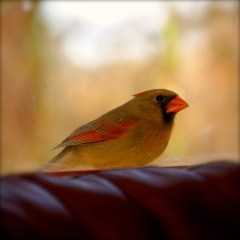
“Silly bird! Why are you pecking on the window?”

“She’s defending her territory,” my husband Dan surmised.

We watched in amazement as the female cardinal, fooled by her own image, continued to swoop down—over and over again—attacking her reflection in the window.

Dan snickered. “I know you’ll find a story here.” Then, he closed his eyes and dozed off in front of the TV.

I turned my attention back to my laptop and whined, “I’ve got to get this blog post written.”

Dan mumbled from his recliner, “Why don’t you give yourself a break?”

I agreed under my breath. “I AM taking a break! I’m sitting here with you, watching a movie.”

I needed rest. But I stared at my never-ending “to do” list. I felt the pressure of some impending writing deadlines and speaking commitments, along with our holiday plans. The weight of my schedule and expectations pushed me beyond my comfort zone.

Dan interrupted my thoughts. “I’m just saying, you’ve had a lot on your plate lately.”

“Thanks for the reminder,” I grumbled. I took a deep breath, trying to focus on my project and forget about my failures and limitations.

My head ached. My heart fluttered. I felt short of breath. Oh, no—not another panic attack! Red flag!

I closed my eyes. Focus on breathing. Inhale. Exhale. REST. Remember, “ … The Lord is near. Do not be anxious about anything …” (Phil. 4:5-6 NIV).

How do I NOT be anxious? “ … in every situation, by prayer and petition, with thanksgiving, present your requests to God” (6-7).

Like the songbird, I continued to attack my own image, focusing on my worries instead of the truth revealed in the mirror of God’s Word.

Anyone who listens to the word but does not do what it says is like someone who looks at his face in a mirror and, after looking at himself, goes away and immediately forgets what he looks like (Jms 1:23 NIV).

I took another deep breath and exhaled. “That’s enough!”

“What … what did I do?” Dan muttered in his sleep.

Realizing that Dan thought I was fussing at him, I sighed. “I’m just talking to that crazy bird.”

I turned again to face the songbird, still flapping and responding to her reflection. “Silly bird!”

What experiences have you had in beating yourself up lately?

Photo/KarenJordan
YouTube/KarenJordan

Ten (Plus) Tips on Humor Writing

file0001122505692I’ve had the pleasure of incorporating humor into several of my books, most notably Grace for the Race: Meditations for Busy Moms and Let the Crow’s Feet and Laugh Lines Come. Funny enough, humor is not easy to write. It was a learning process–one I’m still undergoing.

Humor writers James Watkins and Rhonda Rhea are two of the most genuinely hilarious authors I know. When I asked them for tips, they didn’t disappoint. (They’re also incredibly generous and insightful…and they didn’t even pay me to say that!) So, without further ado, I present their helpful comedic insights.

James’ Watkins’ top ten tips for ending up on welfare having a successful comedy career:

10. Eat cold pizza for breakfast. Wash it down with large quantities of Diet Coke. After three cans, I can type 470 words of side-splitting humor per minute but unfortuwythdly nonr ofit maks anv senze aftcher tke thirddddddd . . .

9. Travel. Some of my best columns have come from three weeks in India (“The Land Without Toilet Paper”) and being stuck in traffic in downtown Chicago, in August with a stick shift with no air-conditioning and two kids in the backseat waging a fight to the death.

8. Get married, have kids. Dave Barry provides positive proof that marriage and raising children is a source for hundreds of columns, thousands of dollars, and even a Pulitzer Prize. However, use discretion! He’s also on his third or fourth marriage and is buying baby diapers with his AARP discount card.

7. Read, read, read. Essential reads include Dave Barry, Erma Bombeck and, of course, my very funny friend, Rhonda Rhea! And every morning NewsMax.com provides transcripts of late night comics.

6. Pass a kidney stone. I keep reminding students at writers conferences, “Nothing terrible happens to authors. [It’s all] just terrific anecdotes.” The old adage is so true: Comedy is tragedy plus time.

5. Tackle a home-improvement project. This is always good for at least two or three columns and one visit to the ER.

4. Look at life from just a few degrees off normal. Successful humorists look at life through their twisted point of view. It doesn’t have to 360 degrees from normal, because that would put you right back at normal. Just a few degrees keeps it plausible yet humorous.

3. Don’t be afraid of people thinking you’re crazy. St. Francis, who is viewed as, well, saintly, said, “I am God’s clown. People look at me and laugh.” Humor is a brutal business, so if you’re thin-skinned, take up a less stressful occupation such as bomb technician, rodeo clown or drug runner.

2. Hang out with people who are even crazier than you. I enjoyed having lunch with a fellow columnist while working as a humor columnist at a local paper. Most of our brainstorms were not “fit for print,” such as low-tech terrorist “Amish bin Laden” who drives around Lancaster county with a buggy armed with kerosene-filled milk cans! However, my friend never ceased to get my brain cells firing on all neurons.

1. Read my book, Writing with Banana Peels. It’s required reading for a humor class I teach at Taylor University and contains principles, practices and pratfalls of writing humor. (And always, whenever you have the chance, shamelessly self-promote your work.)

file000111849428Rhonda says:

I’m going to have to agree with Jim—especially the part where he says to read my stuff. Brilliant. Instead of cold pizza and Diet Coke, however, I don’t know how any writing is ever fueled without coffee. I walk into Starbucks and almost always find my muse sitting in a hip leather chair in the corner. I can get at least three chapters from a couple of shots of espresso. They’re all one sentence with no punctuation, but still.

Exploiting every experience for its comedic value—family, friends, travel, projects—is also great counsel. They say nothing bad ever happens to writers; it’s all just material. Read Jim’s book. More great things to exploit there. Or plagiarize. Whichever.

I suggest keeping a running “funny file,” as well. Anytime something makes you laugh or you come up with something hilariously brilliant, take a little note. Then when you’re ready to start an article or chapter you can peruse your file for a kick-start.

It doesn’t hurt to test-drive a few lines as Facebook statuses, either. See what people like and then…milk those things for all they’re worth. Getting a handle on comedic timing in print is no easy task. Your friends can help you polish. They can also make fun of you, mercilessly. And that’s usually helpful too.

I’m proud to say I taught Jim Watkins everything he knows about being funny. And about the funny sound of the letter “C.” If my children let me name any of my grandchildren, I’m naming one Carl–after Jim.

Will It Ever be Enough?

worried head

I love the turn of the year; it’s one of my favorite times. There’s just something that happens when a fresh hope stirs the air. And, yes, in this season of countless commitments for less of this and more of that, I’ll admit I’ve shared more than a few words with myself about change. Not resolutions per se but rather affirmations, things I choose to think about in a positive manner in the hopes of moving in that direction.

Some of those have to do with folks finding my book. I shared recently how my publishing dream quickly turned to a real-life marketing responsibility after the book was released. My dream morphed into a product—a product that competed with many others for incredibly scarce bookshelf space and reader eyes. And while I was passionate about sharing the hope of God’s truths tucked between my words, I knew well that readers sense motive and I felt {more than} a little funny chasing numbers and progress.

Until my days of interviews and Facebook parties and twitter chats turned to nights of laryngitis and pneumonia and cancelled engagements and disillusionment because I could no longer directly engage my audience.

You see, as newly published authors there’s this window of opportunity to which we respond in launching our books, this newness that either ignites and spreads like wildfire or burns a quick blaze and dies out. And sometimes, in an effort to fan the flame, we new authors nurture this mind-numbing over-fixation to be everywhere at once so we can personally touch each one of our readers.

Will it ever be enough?

I imagine it’s not too far from how the disciples felt that day they walked alongside Jesus by the lake in the country, that day they found themselves responsible for a crowd of hungry mouths yet held only five small loaves of bread and two fish. {Remember the miraculous story in the gospels of Jesus feeding five thousand folks?}

“We have here only five loaves and two fish,” they said.

Will it ever be enough?

“Bring them here to me,” Jesus said.

That’s when we watch the miracle unfold, when we see Jesus take what they had, bless it, and return it to the disciples so that they could do what needed to be done.

I’m learning this the hard way, how God blesses what we bring to him, shares what we offer through him. I will never have enough, never be able to be everywhere I need to be {for countless reasons} but Jesus takes what we’re willing to bring him, blessing and multiplying it.

Walking this marketing journey, sometimes I forget that. After several weeks of an unexpected illness, I’m now back out there sharing the word about my book with my intended audience. As far as those weeks I missed that couldn’t be helped, I’m earnestly praying that God will multiply my loaves and fishes.

Deeper Still: How about you? Do you ever struggle with the need to be in control? What do you do when things don’t go as planned?