Pitching an agent? Read these query letter tips…

student-849825_960_720In my work at WordServe, I read a lot of query letters and book proposals (sometimes more than 100 in a week!) that come into our agency. And in my work as a freelance editor, I often help clients develop their proposals and queries before they submit them. After reading hundreds of pitches across every conceivable genre and topic, I’ve come to notice a few significant Do’s and Don’ts that can make or break whether an agent is going to read any further. If you’re newer to the world of publishing and hoping to get your book noticed, perhaps a few of these will be helpful to you the next time you’re putting together your pitch to an agent or editor.

When sending a query to a literary agency…

  1. Don’t claim that your book is going to be a huge bestseller. The fact of the matter is that only a teeny, tiny percentage of books end up at the top of the New York Times bestsellers list—and much of it depends on things outside of an author’s control. If you claim that you’ve written the next Harry Potter, the agent reading your pitch is probably going to assume that you don’t understand the publishing industry very well; have unrealistic expectations; and/or haven’t done your homework. A better way to emphasize your book’s potential is to try something a little less grand that focuses instead on who is realistically going to buy your book: “I’ve written a book about women in the workplace that will resonate with young working mothers across the country.”
  2. Do your homework on the agents and agency you’re submitting to. If you can find out the name of a specific agent at the firm who represents books in your genre, send the proposal to their attention. Mention why you’ve chosen them. Perhaps comment on another author they’ve represented whose work has similarities to your own. If you can’t submit the proposal to a specific agent, send it to the general agency, but make sure you’ve read up on what kinds of books the agency represents. WordServe represents primarily faith-based books; when I get submissions for romance books with risqué content or nonfiction books that argue against our values, I delete without reading any further.
  3. Don’t claim that your book will make a great feature film. Even fewer books end up as movies than end up on the bestseller list (see #1, above) – and agents who see this in your pitch will know your expectations are overblown and be far less likely to work with you.
  4. Do write your pitch in polished prose that reflects your writing style. You’ve got 30 seconds to get an agent’s attention, so represent your writing well. If your book is humorous, inject some levity in your query. If it’s a thriller, create tension with your first line. If it’s literary fiction, elegant sentences that mirror the book’s style are a must. In every circumstance, ensure that there are absolutely no typos; this is your first impression, and it needs to be 100 percent perfect. Seriously: a few typos in a pitch letter is enough to get an immediate rejection.
  5. Do highlight why you are the right person to write this book; but don’t claim that nothing like this has ever been done before. Chances are, it has—and the agent has already seen it. Instead, focus on what sets your project apart, what new angle or new research or new understanding you bring to a topic—and why you’re the best person to tell readers about it. Focusing on your prior experience, personal connection to the topic, research you’ve conducted, or a dedicated audience you’ve built up are all great ways to convince an agent that you’re worth taking a chance on—and that doesn’t require the claim that no one else has ever thought of anything like this. It just requires you to show me why you’re the best person for the job.
  6. Do read the requirements for submission for every agency you send to. Different agencies have different submission requirements, and it’s essential that you provide them with exactly what they want—or your query will likely be deleted without even being read. If an agent doesn’t want attachments, make sure you include everything in the body of the email. Do they want to see five pages of sample material or fifty—or none at all? Do you need to include a full proposal, or just send a query and wait for a response? Following the specific instructions for each agency, while tedious, will result in a much better response rate, as agents will see that you’ve done your research, are taking this process seriously, and have respect for an agent’s time and wishes.
  7. Last, but not least, do show courtesy and respect to the agents you’re submitting to. Thank them for their time (they really are busy), and don’t pester them if you don’t hear back immediately. While it’s appropriate to follow up with an agent if you don’t hear from them within the time frame they list on their website, do not write to them before this window has elapsed. If they say that they aren’t able to respond to every query, accept that you simply may not hear back. With so many queries coming in, agents aren’t always able to give a personal response to each project they see. It’s unfortunate, but a reality of the industry. And finally, if you do receive a rejection, don’t pester an agent to explain themselves or try to argue for reconsideration. Graciously accept the response, and move on. There are many good agents out there, and you want to find one who connects with your work and is excited to partner with you.

Pitching agents is a difficult process—trust me, I get it! But by spending time polishing your query and making sure to send it to just the right places, you’ll increase your chance of finding the perfect person to represent your work. Above all, don’t be discouraged! It takes time, and often lots of rejections, before you find the right agent—but it does happen. For the most part, agents are in this business because we love books as much as you do; and we’re always hoping that the next query letter we open is going to be the perfect one for us.

Finding Champions for Your Book

Euphoric winner friends using a with a tablet

A winning team has dedicated fans. A successful candidate has loyal supporters. Artists and museums have influential patrons. No one flourishes alone. You and your book will not be exceptions to this rule. You will need champions who will promote your book within their circle of influence, open doors for interviews and speaking engagements, and remain loyal fans when you release your next book.

Let’s consider some of the qualities that make an ideal champion:

Dedicated: You will find a great champion for your book in a person who is dedicated. Publishing and marketing a book is a long process. Six months before the book is available, Amazon and other bookstores with an online presence will make the book available for pre-release order. A dedicated champion is someone whose interest in your book will last from reading an early manuscript to attending a book release party. It’s great to have all kinds of people interested in your book, even those who will only join you for part of the publishing journey. However, your inner circle as an author should be populated with people who have a reputation for following through on their commitments, finishing the projects they start, and sustaining interest in your topic for many years.

Loyal: Writing a book is an exciting process. Many people will enjoy knowing someone who is a published author. Who knows if they will appear in the book dedication, inspire a character within the story, or benefit in their chosen career from knowing an expert on the subject of your book (you)? Again, it’s great to have all kinds of people interested in your book, even those whose interest in your book may arise from dubious motivations. However, if you are to succeed as an author, you will need to sort out the loyal champions of your book from those who will be quick to jump to the next project that promises more rewards. Include everyone in your publishing process if you can, but invest in those who have demonstrated loyalty to you in the past.

Influential: A dedicated and loyal friend is a priceless treasure. However, when you search for potential champions for your book, you will need to look for someone who is influential as well. Influencers exist in many different spheres, and a person influential in one setting may not be influential in others. A person influential within his or her field who knows top leaders within an organization may lack an online presence. A person in the early stages of his or her career may have gathered a great social media following. Both the senior leader with contacts in the field but a negligible online presence and the upcoming leader with the great social media following are influencers. You need all kinds of influencers. Look for potential champions for your book at various stages of career development. Show appreciation for the young blogger along with the radio host, the conference organizer, and the bookstore owner.

How do you spot a potential champion for your book?

Bad News for Good Writers

audience

Dear Gifted Not-Yet-Published Writer Who Has a Timely Message Audiences Need,

I think your writing is fantastic. You’ve allowed me to peek and I think that you have an important message and that you can deliver it well. I wish that was enough. It should be, right?!

It’s not enough.

In today’s publishing world, publishers who want nothing more than to publish great writing aren’t able to say “yes” to every book with a great message that’s written well if the writer has not worked diligently to build an audience. Some publishers do take that risk on a book they believe in, knowing that it might not pay out for them.

And if you’re like me—with way more confidence than might be merited—you believe that your awesome book will be the rare shining exception. Once the first reader reads it and tells all her friends, you figure, it’ll start selling like…a bestseller. And possibly it will. Much more likely, though, you’ll not find an audience for your writing unless you work to build one.

So—momentarily abandoning my signature irrational optimism—I’m just going to outline the bad news so that you have access to the facts you need.

1. Agents and publishers need to sell books.

Every agent and publisher I know loves great writing. In order to stay in business, though, they must publish and sell books that sell. It would be great if these two were synonymous, and sometimes they are. Not always.

2. Writers with audiences sell books.

Whether you publish with a traditional publisher or decide to self-publish, you must have access to an audience that trusts you in order to sell books.

3. Demonstrating an audience is requisite to securing an agent or publisher.

For an agent or publisher to consider representing you or publishing your work, you need to demonstrate that you’re reaching an audience.

4. Building an audience takes hard work.

Occasionally someone will build an audience with seemingly little effort—because they win an Olympic gold or are elected as President of the United States. (Okay…there was some effort.) The rest of us have to work REALLY HARD to grow an audience. Smarties, like @jeffgoins, with much more experience than I have can teach you how to do this. (Mention other smarties in the comments, below.)

5. Selling books is really hard.

Whether you publish with a traditional publisher or self-publish, selling books takes work.

Now start at the top of the list and read them all again. Congratulations, you now have a handle on the bad news.

The Good News

The good news is that there’s always something you can be doing to build your audience:

  • Pitch article after article to editors.
  • Speak to audiences, for free at first, about your subject.
  • Offer a freebie download at your site to build your mailing list.
  • Guest post on blogs of folks you know.
  • Make friends online by sharing their great stuff. (They will love you for this. And owe you.)

If you were bummed out by all the bad news, do one thing today to build your audience.

Cheering you on,

Margot

This post first appeared on Margot’s blog, http://wordmelonblog.blogspot.com/.

You can only eat so much eggplant.

eggplantI’ve rediscovered the joy of vegetable gardening, thanks to our move to a warmer clime that allows for gardening year-round. As a result, I’ve acquired some hands-on experience with how my garden grows…or not. And, being the reflective person I am, I can’t help but apply those lessons to not only life in general, but also to life as a writer. So whether or not you’re a dig-in-the-dirt kind of person, I hope you’ll find some gems in the guidelines I’m culling from my veggies.

  1. Sow liberally and see what comes up. For my first crop of lettuce, I ignored the seed packet instructions and laid seeds thickly the whole length of the row. I wanted to be sure something came up, and my confidence didn’t match the packet’s. The result: I had all the lettuce I could eat, and then some. The next time I sowed lettuce, I followed the instructions and spaced fewer seeds farther apart. The result: nothing came up and my work was a wasted effort.

Writing take-away: when you’re new at writing, try it all. See what develops for you. It’s better to produce more than you can use than have no success at all.

  1. Thin the rows to get better results. When I noticed that the new plants were crowding each other, I pulled out the smaller ones to let the bigger ones get the full advantage of soil, sun, and water. I got healthier plants that produced more and for longer periods of time.

Writing take-away: Capitalize on what’s working for you. If your fiction isn’t doing well, focus on the self-help material that’s popular with your audience and helping your platform grow. Put your energy where you’re seeing the strongest results.

  1. Some seeds just won’t sprout. Get over it. Plant something else. For some reason, I couldn’t get snow peas to grow despite two tries. Instead of letting the soil lay unused, I planted beets, which turned into a bumper crop, forcing me to try lots of new great recipes using beets.

Writing take-away: If you just can’t find an audience for something you’ve written, it’s time to try a different approach, treatment, or subject. The new material you produce might prove an easy winner.

  1. You can only eat so much eggplant. I didn’t think I could get tired of eggplant parmesan and mixed veggie grills, but after this summer and fall, I know there really is a limit to how much eggplant I can eat. Next year, I will plant only one plant, or make a habit of giving excess produce to my neighbors much earlier in the season.

Writing take-away: You can get tired of writing in the same genre. When you just can’t face writing another devotional, or romance, or even a blog post about writing, take a break. Write something else. Binge on reading books. Watch all the movies you missed in the last year. Then a day will come that you really want to write in your genre again. You’ll feel fresh and your writing will benefit.

By the way, if anyone wants eggplant, let me know…

Overachieving Your Platform: Best of the Water Cooler Series Book #2!

overachieving-your-platform-coverMany years ago, a good friend went into a coma after giving birth. She was on life support for nearly four months. We all prayed and wondered if she would pull through to see her baby girl and live a full life.

By her side was her husband. Every day he was at the hospital talking with doctors and nurses, making sure medication was properly being administered, asking questions . . . basically, being every doctor’s worst nightmare when it came to patient care. But you know, on several occasions, he insisted on something that actually saved his wife’s life. The third leading cause of death in America is medical care accidents and misdiagnoses. He needed to care for his wife because if he didn’t, the worst could happen.

I mention this story because I think it can be illustrative of some of the realities of book publishing today. Sometimes, your book is the one on life support, often from the moment of publication. Standing by are publishers and PR folks who are tasked and paid to keep your book alive. They’re busy, they have other patients (authors), and are generally overworked and understaffed.

The point is you cannot leave your book’s marketing and PR ONLY in the hands of publishers. They’ll do their best (usually), but they’re not perfect. And sadly, they have the 80/20 principle that is always screaming at them from the higher-ups. In publishing, it’s true: 80 percent of the money goes to 20 percent of the books. It’s a reality that won’t change, so we have to learn to deal with it.

So what should you do, then, as the author standing by your baby, trying to keep it alive?

You’ve got to tend to it diligently.

With your publisher: ask questions, say thank you a lot (gift cards and flowers are nice) when they do a job well done, give them ideas, don’t mention a problem unless you have a solution, tell them what you’ll do to help, keep track of everyone who helps (radio stations, bloggers, author friends). Work WITH them as much as they will let you.

What else can you do?

Well, we at the Water Cooler have just released a book that will help answer that question. Overachieving Your Platform: 95 Ideas to Embrace Your Inner Sales Marketing Genius is now available from FaithHappenings Publishers, and it offers the tools you need to break out and connect with large audiences. Adapted from the best writing of the WordServe Water Cooler, these doable, practical and affordable ideas will transform your platform and expand your audience if you put them into practice. No, you can’t do them all. But you can certainly go through this book with your highlighter and mark everything you actually could do. Then make a plan. What will you do during your first month from publication, second month, third? Write the plan out . . . and then work it.

Publishers, agents, and retailers agree: you’re only as good as your last book. So if your last book flops in the marketplace, it may very well indeed be your last book!

Don’t let that happen. Stay on guard by your book for the first six months to a year after launch, and you’re far more likely to get that second book contract. You may even get a royalty check.

I’m so proud of all of the authors who contributed to Overachieving Your Platform. They’ve done the hard work in the trenches and have learned from their successes and failures. All they know they’ve shared with you.

Grab a copy today—and take that first step toward creating a platform and brand that will serve you for the rest of your writing career.

Excelling-at-the-Craft-of-Writing-CoverAnd if you haven’t checked out the first book in the series, Excelling at the Craft of Writing: 101 Ways to Move Your Prose to the Next Level, make sure to do that as well. Craft and marketing go hand in hand when it comes to a writing career—you won’t find success unless you’ve got both!

This post was adapted from the Introduction of Overachieving Your Platform: 95 Ideas to Embrace Your Inner Sales Marketing Genius (available now!).

WordServe News: October 2016

Exciting things have been happening at WordServe Literary this month!

On the final post of each month you’ll find a list of Water Cooler contributors’ recently released books along with a recap of WordServe client news.

New Releases

514tpjlzzhl-_sx322_bo1204203200_Rick Johnson released Overcoming Toxic Parenting with Revell. Anyone can be a good parent, even if they didn’t have one. Johnson shows anxious readers how to identify the ways in which their past experiences affect their own parenting choices; walks them through the process of healing the emotional and spiritual wounds; and outlines healthy habits and practices to create a positive family environment.

700074Barbara J. Scott, along with Sandra Bricker, Lynette Sowell, and Lenora Worth, released Sleigh Bells Ring with Gilead Publishers. This collection of four contemporary romance novellas, each by a different author, follows the Tucker sisters as they strive to fix up their father’s horse farm for one last Christmas celebration.

51b1h8es5wl-_sx314_bo1204203200_Sarah Varland released Silent Night Shadows with Love Inspired Suspense. When she’s snatched off a sidewalk en route to the local Christmas tree lighting, Claire Phillips knows her cozy small town is no longer safe. And when she’s saved by a mystery man, she gets another surprise. Suddenly, surviving Christmas is going to take more courage than Claire thinks she has.

christmas_in_my_heart_25_wheeler_i_coverJoe Wheeler released the 25th volume of his Christmas In My Heart series.When the first book went to print in 1991, no one imagined there would be a second book. Or a third. Now, with a total of 402 stories and more than 3,000 pages to date, it is the longest running Christmas story anthology series in America. Loved by thousands, the release of each additional book marks the beginning of the Christmas season in homes all across the country.

9780825444258Robert Wise released When There Is No Miracle (Revised & Expanded edition) with Kregel Publications. How can Christians understand the times when the lights go out and no miracle of deliverance appears? When There Is No Miracle imparts the lessons Wise has learned in the midst of his own questioning, enabling Christians to find new hope, learn to reconcile their faith with times of emptiness, and discover a new depth of meaning in the crucifixion of Christ.

51smxmfzhil-_sx348_bo1204203200_Mike Yorkey released The Right Steph with Barbour. In this fun, fact-filled biography, Yorkey shows how Golden State Warriors’ Steph Curry, the likable, humble, and soft-spoken basketball player–and the best shooter in the NBA– is living out his faith on and off the court, through his actions even more than words.

New Contracts 

Carole Engle-Avriett signed with Cook for her newest project, Extravagant Love, an exploration of Ancient customs and facts that helps readers dig deeper into Scripture and God’s love for us, to be published in early 2018.

Wallace Henley and Tom DeLay signed with WND Books to publish Revival! Rebirth! Revolution! early next year.

Jonathan McKee signed with Barbour for his next book, The Teen’s Guide to Social Media… and Mobile Devices. Due out in 2017, this will be a wonderful resource for teens and parents struggling with questions in the digital age.

Krista Phillips signed with Barbour for her next book, The Engagement Plot, for publication in early 2018.

Tiffany Smiling signed with Barbour to publish The Fulfillment Myth, which traces her own story to inspire other women to find fulfillment that lasts.

New Clients

Dr. Jamie D. Aten signed with WordServe this month.

balloons-25737_640

What We’re Celebrating

All the Gallant Men by Donald Stratton and Ken Gire will appear in Parade Magainze and Reader’s Digest next month, leading up to its November 22 release.

Words: Show … Don’t Tell

sun-and-sky-and-cloudThe Jew, Max, was imprisoned in a basement, or so the plot in the movie The Book Thief goes. The setting was Germany. It was the beginning of the Second World War. As a woman who has only heard about World War II, I was fascinated as I sat on my couch and watched the story unfold.

But as a writer, I was mesmerized as I heard the words of a 12-year-old girl named Liesel who was Max’s connection to the outside world. She spoke living words that transposed me to a time and place long ago.

But isn’t that what writers should do? Write “living words”? Ones that when woven together do more than tell their readers facts and truths and stories.  Words that show.

How did the writer of The Book Thief, Markus Zusak, do this? I had to know. And so I purchased the book so I could read his words.

One scene showed an interaction between Liesel and Max when he was hiding in her home, confined like a trapped animal. Unable to see the light of day, he listened intently as the girl told him about making a soccer goal. (This scene begins on page 249 of the book.)

“You told me all about the goal, but I don’t know what sort of day it is up there. I don’t know if you scored it in the sun, or if the clouds have covered everything,” Max said. Then he asked Liesel to go outside and tell him what the weather looked like.

After she returned to the basement, she said: “The sky is blue today, Max, and there is a big long cloud, and it’s stretched out, like a rope. At the end of it, the sun is like a yellow hole …”

Knowing that only a child could have given him a weather report like that, Max used the basement wall as a canvas and “painted a long, tightly knotted rope with a dripping yellow sun at the end of it, as if you could drive right into it.”

Show three-dimensional lives

As a writer I wonder if I will ever tire of reading those “weather” descriptions over and over again. And I also ask myself a question: Could I ever write so vividly?

Liesel’s and Max’s words about the sun and sky remind me to show and not tell. To transpose readers into worlds with colors and sounds and smells. To introduce them to the souls of people (both fictional and real) and not leave these people as “cardboard” characters. To help readers experience three-dimensional lives that dream and struggle. That succeed and fail.

What happened to Max? you wonder? You’ll have to read The Book Thief for yourself, or watch the movie, or listen to the audio book (I’m doing that now). And if you love to write as I do, I think you, too, will be spellbound by Markus Zusak’s words.

Remembering favorite words

As I read books and articles and hear people speak, I try to jot down the words that I love the most. I do this on a little notebook that I tuck into my purse or as a “note” in my iPhone.

You might want to have a “word notebook” yourself – either paper or electronic. If you do this, then when the writing gets hard and the right words just won’t come, don’t give up. Instead turn to the masters. Go to your notebook. Read the words that once captivated your heart. Take a walk. Breathe the fresh air.

Then pick up your pen, or go back to your laptop, and try to get the rights words, again … and again.

Crowd Source Marketing

finger-769300_1280There’s an old adage in marketing that says in order to get a consumer to pull the trigger and buy something, they have to hear about the product three times. There was a time when the blueprint to accomplish that was pretty straightforward. Get reviews from newspapers or magazines and get interviewed on television or radio. Then, go make public appearances at bookstores or book fairs or local meetings, and don’t forget to keep writing.

None of those were easy to accomplish and they all took a lot of work to hit the magic three, but at least there was a path to follow that thousands of authors from decades past had taken with some success.

Times have changed. Not only have they changed, they keep changing at an ever-increasing pace.

The internet opened up the world and made it so much easier for authors to reach the public directly. That’s the good news. The flip side is there are hundreds of different ways to do it and a lot of them are really good, but may not be right for you.

So, the goal becomes finding the right tools for your genre and your personality and staying up to date about everything that’s new, while still finding time to write, and then have a life.

This is where just a little organization can funnel the hive mind of social media down to the essentials. Look for groups, particularly on Facebook, that are not only devoted to marketing books but are also in your genre. If you’re in traditional publishing, include that on your checklist. If you’re going the indie route, make sure the group is too.

A few other things to add to your checklist are:

  • The group is devoted most of the time to marketing – not selling, not writing
  • It’s invitation-only, so that it’s a safe place to share and there’s some control over the postings
  • There’s a monitor who shows trolls (people who complain or bully) the door and kicks them out of the group
  • Active members who are sharing information and are willing to answer questions – lots of questions
  • Be one of those people and share when you can – admit when you don’t know enough to add to the conversation. In other words, participate.

Some of the benefits you can reap from joining together are:

  • Doing cross-promotions with others in your genre. There’s power in numbers.
  • Getting a heads up about a new site that’s working for someone. And getting a thumbs down for a site that would only waste your time and your dollars.
  • Sharing each other’s ads or promotions on each other’s social media sites. Again, it’s that power in numbers.
  • Gaining a realistic view of how well you’re doing. It’s the equivalent of your water cooler.
  • Getting applause when things go well and getting some inspirational chitchat when they don’t.
  • Testing out new blurbs for your book or, if you’re indie, testing out new covers and getting early feedback.

Everything is easier when we work in cooperation with others and come together as a team, building on the information, adding in a post to what’s already there. That’s the definition of crowd sourcing.

Since I’ve found my own peeps I’ve been able to course correct a lot of mistakes I didn’t know I was even making and I’ve come up with a streamlined ad campaign that is even more in line with my budget. Best of all, though, I’m having a lot more fun sharing ideas and cheering on my fellow authors.

Double Booked by Two Authors

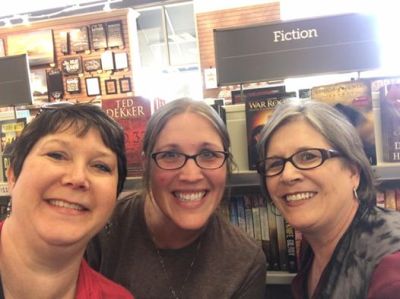
Photo/KarenAnita“Did you find your book?” I asked.

“No, but yours is on this aisle,” Anita responded.

Then the young lady standing near us asked, “What books do you need? I’m looking for one about anxiety and worry.”

“Well, I’ve got the perfect book for you,” I grinned. “I just wrote a book about the lessons I’ve learned about worry.”

Anita added, “It’s called Words That Change Everything: Speaking Truth to Your Soul. They have several copies of it here. It’s a great read!”

BookCover/WordsThatChangeEverything

The lady looked stunned as she examined the back cover of my book and my photo. “Seriously, you wrote this book?”

“Sure did,” I smiled. “And if you need a book about Getting Through What You Can’t Get Over, I highly recommend this one.” I pointed out Anita’s book: Getting Through What You Can’t Get Over: Stories, Tips, and Inspiration to Help You Move Past Your Pain into Lasting Freedom.

“I sure do! I’m looking for a book to encourage my friend, whose son was killed in a motorcycle accident a few weeks ago.“

Getting Through What You Can't Get Over Book Cover“Well, Anita’s book contains several inspiring stories about people who walked through some really difficult situations. I think it would be helpful for a person going through grief and post-traumatic stress.”

“Are you both authors? And you wrote both of these books?” Our new friend appeared confused.

“Yes, we attended a booksellers’ event here in town during the past few days. So, we decided to stop by this bookstore on our way home to see if they carried our books.”

Glancing at the two books in her hands, our new reader looked back up at us and giggled, “Well, I’d love to buy both of your books!”

“Awesome! Would you like for us to autograph your copies?” I asked.

“Yes, that would be great,” she smiled. “I still can’t believe you both really wrote these books!”

“Well, we’re finding it a little hard to believe that you were looking for books that deal with those topics.”

“I’m serious—these are exactly what I needed!” Then, she added, “This has to be a “God-thing.”

“Yes, a ‘God-thing’ for sure.” We agreed.

Photo/AnitaKarenThen, one of us suggested, “Hey, let’s take a ‘selfie’ to capture the moment.”

After I fumbled to find my cell phone in my purse, I said, “Okay, let’s strike a pose. Smile!”

After our brief photo shoot, we all embraced, recalling our unexpected encounter.

“Can we pray for you and your friend before we leave?” I offered.

“I would love that!”

“By the way, what’s your name? And what’s your friend’s name?”

“My name is Kendra. And my friend’s name is Karen.”

“Well, of course her name is Karen,” I laughed.

As Kendra walked to the register to purchase our books, we heard her telling the assistant manager about our encounter.

Anita and I waved at both of them as we turned to leave the store.

“What an awesome ending to a very productive week,” I commented to Anita.

“I told you we needed to stop by this bookstore!” Anita laughed.

Before we left the parking lot, Anita posted the photo of us with Kendra on Facebook, sharing our experience at the bookstore.

Best bookstore stop ever! Met this beautiful young lady named Kendra. She was looking for a book on anxiety and worry for herself, and another on grief for a friend who just lost a child. Talk about a God moment.

When she found out we were authors, and Karen wrote a book titled Words That Change Everything, and I wrote one called Getting Through What You Can’t Get Over, she took a copy of each off the shelf. After a quick, impromptu signing, we parted ways—all of us stunned in a great way. People like Kendra are why we do this.

 Amen, Anita. This IS “why we do this.”

Tell us about one of your God-moments as an author.


Use Less Scripture in Your Manuscript (And…I love Jesus.)

bible-1031288_960_720One of my pet peeves—as an editor, as a writer, as a reader—is when authors use long passages of Scripture in their manuscripts, or pepper it with too many verses.

And, of course, now that it’s out there, I feel like I need to defend myself. So let the record show:

  1. I love Jesus.
  2. I believe that Scripture is God-breathed and has the power to transform lives.
  3. I earned a Master’s of Divinity degree from Princeton Theological Seminary. (Sorry if that makes me seem like a show-off. It had to be said.)

Also:

  1. I don’t want to see too much Scripture in the manuscript you’ve sent me to edit.

I’m actually delighted to announce this grumpy thing publicly, for the first time, because I finally figured out why it gets under my skin:

Cutting and pasting large portions of Scripture into your manuscript, or peppering way too many verses into it, DOES NOT SERVE READERS.

Overusing Scripture is problematic for two reasons: it’s either too much or too little.

1. It’s too Much: Avoid Including Lengthy Scripture Passages

Problem: When readers—and I mean Christian readers—encounter long passages of Scripture in a manuscript, they tend to skim over them. From the cursory glance at keywords—“Moses,” “praise,” “sanctify,” “Jesus”—the reader determines that she’s already read this before and keeps reading (if you’re lucky) beyond the Scripture-brick to discover what he or she does not yet know.

Solution: Use a shorter passage of Scripture. When you crop the text down to the most salient verse or verses, the reader can better glean what you most want to communicate.

Example: In lieu of including the entire text of Psalm 119, which has 176 verses, give the reader a bite and tell them enough to make them hungry for more…

Every verse of Psalm 119 describes the good way God’s designed us to live. In verses 9-12, notice the words the Psalmist uses to point the reader to the good way:

How can a young person stay on the path of purity? By living according to your word.
I seek you with all my heart; do not let me stray from your commands.
I have hidden your word in my heart that I might not sin against you.
Praise be to you, Lord; teach me your decrees. (Psalm 119:9-12)

Path, commands, word and decrees all point reader toward the good way God’s designed. And If you read all of Psalm 119, you’ll find lots of other synonyms for this path that leads to life.

2. It’s too Little: Avoid Including Too Many Scripture Passages

Problem: When you pepper too many verses of Scripture into a manuscript, you might assume that lots of Scripture is benefiting the reader. But there actually might be more value in including less! Too many verses of Scripture can feel like being pelted by a rapid-fire Nerf gun. If the reader can’t make a meaningful connection to each passage, the verses will bounce off the reader and fall to the floor.

Solution: When you do weave Scripture into your manuscript, it’s your job to help the reader find fresh spiritual nourishment from the passage by demonstrating the connection to your message. Here are a few ways to help the reader glean as much as possible from the biblical text:

  • Provide historical context, noting time, place, speaker, culture, audience, etc.
  • Provide literary context, helping reader understand why what comes before or after this passage illumines its meaning
  • Offer practical application, demonstrating how this passage was vivified in your life of someone else’s
  • Strengthen the connection between the passage and the reason you’ve shared it

Example: “You are the light of the world” (Matthew 5:14)…

When Jesus says, “You are the light of the world,” he’s making a radical claim! Did you know that, in the ancient near east, a nation’s king was said to be the “light” who reigned on behalf of a deity?! Jesus is saying something pretty bold, then, about the kingdom of God and about your role in it by announcing that you are the light of the world.

Finally, Scripture was never intended to become a quantity to be used, cropped, leveraged or wielded. I know that and you probably do, too. Being thoughtful about presenting Scripture in a way that it can be tasted and digested, to offer real nourishment, is a gift to your reader.