The Tough Critique

My best friend of more than 30 years was one of the first people to read a draft of my manuscript. I packaged all 299 pages in an envelope, mailed them 1,500 miles to her home and then chewed my nails ragged while I waited for her response.

I stalled for what I considered the proper amount of time. And then finally I couldn’t bear it any longer. I picked up the phone and dialed her number.

“Soooo…what did you think?” I blurted when she answered. I tried not to sound desperate and sweaty. “Do you like the book? Have you finished it? What do you think so far? Seriously, you can tell me the truth. I mean it!”

I waited.

Silence lay heavy, like a suffocating blanket suddenly strewn over the vast plains between us .

“Well…” She hesitated. A dull ache began to gnaw in the pit of my stomach.

“Well…to be honest, I, um, I put it down, and I’m having trouble picking it back up again,” she offered quietly.

“What? What?! Are you kidding me? You’re having trouble picking it back up again? What does that mean? Are you saying my book is boring or something?! What, like Reader’s Digest boring? Like Henry James boring? Like iphone manual boring?!”

I didn’t actually say those things aloud, of course. My actual response went more like this:

“Okay.”

 Deep, shaky exhale.

“Okay, so tell me more. What exactly is the problem? Can you be more specific? Which part is bogging you down? Does it go awry at any particular point, or is the whole thing giving you trouble?”

During that difficult conversation I learned that Andrea had enjoyed a lot of the manuscript, especially the anecdotes, which comprised the meat of the memoir. But when she got to the sections that delved into Biblical instruction, she lost interest.

I give her credit for her honesty and courage. Although Andrea knew exactly how important this writing endeavor was to me and exactly how insecure and fearful I was, she told the hard truth because she knew in the long run that it was important that I hear it. (Granted, she could have phrased it a bit more delicately. Then again, I did hound her like a salivating Saint Bernard). 

But I admit, it was a hard truth to swallow. And even though we had a fruitful and constructive conversation, and she didn’t deem the whole book an abysmal failure, when I got off the phone that afternoon I felt a weight on my chest like a stack of crumbling bricks. What’s more, I didn’t take her advice – I made none of the changes she suggested.

The funny thing was, in the end, she was right.

A year later, when I paid a professional editor to review my manuscript, guess what he advised? That’s right: he suggested I cut all the instructional sections woven into the book because they “interrupted the flow of the story.” And later, when Rachelle Gardner accepted me as  client, she admitted that the book wouldn’t have appealed to her, had it included all the Biblical analysis and instruction.

Andrea had been spot-on in her observations, and she had been honest, courageous and diplomatic in her critique. The real problem was that I simply hadn’t been ready to listen.

Let’s chat:  How do you decide who critiques early drafts of your writing? Have you ever received a negative critique from a friend? How do you balance a critiquer’s opinion with your own ideas? How do you know when you are ready to have your writing critiqued?

The honest stain of truth

Professor looked like Jabba the Hut, jowls of  flesh hanging over the collar of his shirt. He watched, smirking, as fellow co-eds and I jockeyed for seats around the long conference table, Professor’s preferred room arrangement for this, our first college creative writing class.

Until I met Professor, I could always count on my writing to please teachers and professors. But assignment after assignment came back with haphazard red-pen scratches. I imagined Professor held my paper for a brief moment before tossing it aside.

Professor enjoyed two things: making students cry and picking favorites. I landed in the first group, and was left out of the second like a scrawny girl in a middle school dodge ball gym class.

The class favorites wrote about sex, of course, and they wrote about it often. Though I lamented my mediocre scores, I refused to write about something so sacred just for him.

One fateful morning, my alarm clock malfunctioned and I was late for Professor’s class. When I arrived, he stopped class and laid into me with a barrage of insults. On and on he spat about how lazy, irresponsible and stupid I was, daring to enter his class late. Too hurt to hold back tears but too proud to leave, I stayed for the whole class.

My notebook was a soggy mess.

That day, I resolved to please Professor–if not shock the hell out of him–with my writing.

And I did.

I wrote a short story full of violence and deceit, sex and betrayal, blood and fine champagne.

The story disgusted me.

Professor loved it.

I hated Professor for a long time after that.

Years later, I realized my sordid short story paralleled scars of abuse from my childhood. The rage I felt toward Professor was a pivotal breakthrough from flowery, Pollyannic prose, and the beginning of my journey of writing hard, writing real and learning to write well.

I can’t say I agree with Professors tactics.

But I think I understand, now, what he was trying to do.

See, good writing involves daring to go to deep and frightening places. Like John Coffey–the man who breathed light and life into dead things in The Green Mile–hearts come alive when we breathe into still and long-forgotten places.

Words become life when writers allow the pen to pull them places no one else wants to go.

Like leper colonies, places in the soul exist where fear hangs like shadows, veiling what we don’t understand and shielding us from disease and pain. And yet, the only way to be real and alive is to allow the pen to touch diseased and painful places.

It is the unsought job of the writer to burst through the gates of leper colonies . . . to run to those who are bandaged and losing limbs . . . to embrace those who smell like rotting flesh . . . and to caress touch-starved hearts until they stop trembling and maybe, just maybe, believe in life again.

Good writers learn to distinguish the honest stain of truth from pencil scratches on paper.

Good writers learn the events in life which enslave us are ultimately the ones which set us free.

Good writers endure hours–even days–of depression that come when the pen finds fragile, tender places.

Good writers touch ugly, diseased places, in order to touch ugly, diseased places of others.

Good writers allow the pen to pull them.

To set even one person free.

What about you? How have you learned to write more deeply? Has a person, teacher, mentor or friend influenced the deep, true pull of your pen? Do you believe words have the power to set people free?

New Agent at WordServe!

Guest Post by Rachelle Gardner

Effective immediately, we at WordServe have added thirty years of experience to our service for authors with the addition of industry insider Barbara Scott as a new literary agent.

“Publishing continues to evolve, but finding and guiding the careers of new and established authors will always be a big need,” says 17-year agent Greg Johnson. “Barbara has worked as an in-house sales rep for a publisher as well as an editor, and authored numerous books of fiction and non-fiction. Her strong editorial eye, relational skills and professionalism make her a natural to join the WordServe team.”

Barbara Scott brings 30 years of publishing experience to WordServe having worked at Zondervan, McGraw-Hill, Honor Books, and most recently Abingdon Press where she developed and built the fiction line.

Barbara has partnered with best-selling authors such as Brandilyn Collins and Melody Carlson for the YA fiction line at Zondervan, and many of the authors in her fiction launch at Abingdon Press received rave reviews in Publisher’s Weekly and Library Journal. Two of her most recent authors at Abingdon Press, Cynthia Ruchti and Richard Mabry, have been nominated for Carol Awards by ACFW in 2011. The fiction line at Abingdon Press exceeded all sales expectations, and Barbara has been credited for kicking off a well-rounded series of quality, highly-reviewed novels.

I’m thrilled that I get to work alongside this talented lady, who is already well-loved in CBA. Please join me in welcoming Barbara to our team!

~Rachelle

P.S. Barbara won’t be at ACFW, but I’ll be there scouting projects for her!

What Barbara is Looking for:

Adult Fiction:
Full-length fiction, 65,000 to 100,000 words. General market or Christian market.
Genres: Women’s, Romance, Suspense/Thriller, Mystery, Romantic Suspense, Historical, Family Saga, Amish, Political Thrillers, Mainstream, Supernatural/Speculative, including End Times.

Short contemporary and historical fiction, 40,000 to 65,000 words. Christian market.
Genres: Romance, Historical, Romantic Suspense. Will accept queries for Barbour, Steeple Hill Love Inspired, Summerside Love Finds You, and Avon Inspire.

Kids:
Middle grade and YA books

Non-Fiction:
Both Christian market and general market projects. Current Affairs, Political, Management, Sales, Money, Home Life, Marriage, Family, Parenting, Health & Diet, How-to, Popular Culture, Psychology, Science, Self-Help, Women’s Issues, Devotionals. Authors should have established social media, consulting, or speaking platforms.

Christian theology, apologetics, pastoral, spiritual growth:
I will only take on this type of project if the author has well-known credentials and/or a large, established platform.

What she is NOT looking for:
• Gift books
• Poetry
• Short stories
• Screenplays
• Graphic novels
• Children’s picture books
• Horror

Contact Barbara Scott: barbara {at} wordserveliterary.com (This email might not be active yet – give it a couple days!)

What is “Take Away” Value?

In my post last month I referred to our need to have “take away” value. Sometimes that’s pretty obvious, but other times it’s as subtle as how you’re presenting your product or services. I find at times it’s a fine line that we can easily cross into the “me” zone.

I have a feeling, though, that you’ve seen and know what that looks like. How about Twitter? I get a fair amount of requests but have little time to follow people who are just throwing stuff out there for the sake of being visible. Plus, I want to follow people that I can relate to and connect with. I’m most likely not going to follow a furniture company located in a different state.

Except, this time I did. Why?

Take a look at the Twitter page for Mealey’s Furniture, (@FollowMealeys) located in Warminster, PA. They do a lot of things right.

  1. They don’t over-tweet. Mealey’s tweets about 2 to 3 times a day. When I see a Twitter page loaded with hourly tweets of stuff just thrown out there, I’m not going to pay attention. The delete button is my friend.
  2. Their tweets are helpful. They have take away value. Not only do they have it, they personalize it. They’re not just putting tweets out there about a sale, they’re giving you decorating ideas and hints for better living. They also support causes. Basically, they don’t want to just sell you a piece of furniture. They want to add quality to your life. Again, motivation is key.
  3. They’re not just about the product. Mealey’s presence is clearly not about them. They are about the customer and serving those needs. They’re focused on their audience and serving them, not on themselves.

This is brilliant marketing. Would I buy furniture from Mealey’s? If they had a store in San Jose, CA, you bet they’d be the first place I’d think of next time I needed something.

The key here is they make a lasting and positive impression. You walk away from this page with the understanding that to them, it’s not just about the sale. They want to do more for their customers. They want to connect with them.

Today’s market takes more than just what we have to offer, which in nonfiction is a lot. We have a clear message, an idea, or something to share. But there’s already so much out there. We have to be clear about the “why.” Think about why we write what we write and how we can translate that into connecting with our readers, which in turn translates into word of mouth marketing—the best kind. Just as I’m talking about Mealey’s furniture because they offered me take away value, we want our readers to talk about our books, our message, and what we stand for.

But even that comes back to our motivation. Are we doing it to just sell books? Or are we, like Mealey’s, genuinely trying to give quality to our readers? That’s our origination point in writing these books to help others. Let’s not leave that motivation in the pages of our books. Let’s figure out ways we can we bring that over into our marketing too.

Free Books and Bad Halloween Candy

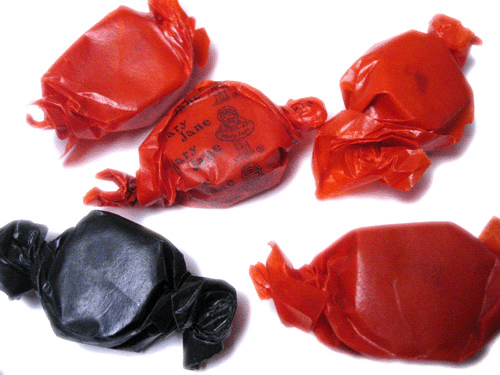
In today’s free and easy e-book climate, e-texts of traditionally-published books are passed around like wax-paper toffee on Halloween night–you want some of this? Have four! Have six! No one likes ’em anyway. And that’s not even counting the scads of self-published e-books that are either free or 3 cents each. Most of those are the strawberry candies in the red plastic– no one wanted them either.

OK, I’m exaggerating. It’s not that free books are actually bad. Few books are as awfully nasty as wax-paper toffee, and many free books are very good–it’s just that their plentiful availability threatens to devalue them, like so many strawberry candies dumped straight in the trash can.

Seth Godin, prophet of social media and cultural change, thinks free books can be a good promotional tool. In fact, he thinks the way for debut authors to make it in this day and age is to give away their first books for free.

He said so, in this interview with Michael Hyatt of July 6, 2011. It’s well worth watching simply for all the debatable points he raises about where our book culture is headed and how we should handle that change. Seth Godin is an excellent persuasive speaker–but that doesn’t mean he is always right.

Free books have a very serious downside, and the best article I’ve read on that downside is by Janet Kobobel Grant of Books and Such Literary Agency. Here’s one of her main points, paraphrased:

Will free books flood the market to the extent that readers realize they no longer have to pay for their reading material?

Will readers think: “Why should I buy Ms. Ninja-Writer’s book now, when I can wait 9 months and get that same book for free as a marketing ploy for her next book?” In a tight economy, readers may resolve: “I am going to save money by never paying for a book again.”

My husband works in sales, and he is very good at it. He understands you can sometimes give away free stuff, but giving away too much or giving away the wrong products destroys your own customer base. He thinks this free e-book and 99 cent e-book stuff in the publishing industry is going to smash the market to tiny little pieces.

How many corporations can resist the lure of the quick buck?

Here’s the problem: corporations have always been very bad at resisting the lure of short-term gratification (such as temporary increased sales for a certain author) in favor of a wise long-term strategy (such as limiting or refusing the issue of free books). They have to compete, they want to make money in the ways they see others making money, whether it’s going to work in the long-term or not. For many executives, it’s easier to believe those who tell them that the short-term strategy is awesome and won’t cause any problems. Fewer executives want to hear the voice of caution and contrarianism–it’s too inconvenient.

My  question for you: Will the changes caused by free e-books permanently affect the ability of authors and publishers to make a living at their work? Will the major publishers collapse and only the best entrepreneurs rise out of the internet heap… entrepreneurs who may not be the best writers? Or do you agree with Seth Godin that free books are a fabulous strategy and the wave of the future for marketing?

Writers — Develop a thick skin!

Do you remember how you felt the first time you confessed to someone that you wanted to be or was a writer? Did you heart pound and your palms sweat? Mine did.

Develop a thick skin if you want to be a writer.

Becoming a published author almost seemed too lofty a goal for little old me to aspire to. What would people think? Would they laugh at me? Scorn me? Ask me why I thought I could ever be successful?

When you made your proclamation saying you were an aspiring writer did the words tumble out in a torrent of excitement or did you choke them out, fearful that one day you would be forced to eat them, a bitter morsel?

Chances are, after a while your friends and family get onboard with your plans and even inquired about your progress or encouraged your efforts. And that’s a good thing. Because after you’ve overcome that initial fear of telling others you want to be published, you actually have to put your work out there for critique and for submission, and then you really need to toughen up and not let the barbs of critiques or the arrows of rejection take you down—at least not if you want to be successful.

Take heart. Be brave. Nothing ventured, nothing gained. Find a quote or a verse of scripture that will speak encouragement to you. I know some writers who have inspirational quotes tacked up in their writing area or committed to heart. Bible Gateway or Quote Garden are good places to find words of emotional sustenance. This verse kept me writing and writing.

When you first expose your writing for someone to look over, be brave and be humble. Just because you arranged words together on a line, doesn’t mean that you’re going to get the next big literary prize—not even if your mother/spouse/best friend/child says so.

Putting your work out there for critique requires you to be humble enough to take suggestions and comments. One thing I’ve discovered is that you can’t defend your work. When I hear someone who submitted work for critique begin to defend or explain their work, then I know they’re still pretty green. They don’t want anyone to change a word or tweak a sentence. But the truth is, when your work is finally published, you won’t be able to sit alongside your reader and explain every scene. If your first readers don’t understand what you’re trying to say, then rewrite it.

Sometimes it’s hard to receive a critique, but it doesn’t kill you. You’ll be okay, the sun will still shine, and you’ll still be loved and respected by those who care for you. Our agent Rachelle Gardner wrote down her thoughts about being thick skinned on her blog. Take a look, be encouraged.

It’s difficult to hear negative words about the story you labored over. If you’re frustrated, that’s okay. Take a walk, call a friend, and write more words. Just keep moving forward. But don’t be too discouraged, there are always (or there should be) good points raised during a critique.

Becoming published won’t happen if you don’t work at it. Remember, some people dream of success, while others actually do the work to accomplish success. So write on!

What advice do you have to overcome the pain of critique/rejection?

Say what? — Writing believable dialogue

Whether you write fiction or non-fiction, good dialogue is essential to the success of your work. Either the dialogue will draw the reader into the scene, or it will bore the reader—and as a result, she may choose to close your book without finishing it.

Know that good dialogue in books does not correlate to real-life speech. When you stop in the grocery store to have a few words with a neighbor the conversation is usually small talk. It doesn’t have to mean much except that you value the person enough to spend a few minutes chatting. But in fiction (and in non-fiction), dialogue exists to enhance characterization, support the mood, convey emotion, and control the pace of the story.

The first rule of dialogue is to avoid dialogue ping-pong. People don’t speak logically, and sometimes it’s more effective to answer a statement or a question with a question.

The following examples illustrate dialogue ping-pong and interesting pull-you-into-the-story dialogue:

Suzanne slipped into the seat across from Angela. The cool vinyl chilled her thighs as she scooted to the middle of the booth.

“Thanks for joining me, Suzanne.”

“You’re welcome. How have you been?”

“I’ve been fine, thank you. And you?”

“I’ve been better, thanks.”

Angela picked up the red menu. “What are you going to order?”

“I’ve heard the turkey sandwich is delicious.”

***

Suzanne slipped into the seat across from Angela. The cool vinyl chilled her thighs as she scooted to the middle of the booth.

“Thanks for joining me, Suzanna.”

“Did I have a choice?”

Angela slid the menu across the Formica table and flipped it open. “It was an absolute stroke of luck that I ran into Crystal at the flea market last weekend. If not, I would have never heard about your situation.”

Suzanne gazed down at the greasy menu. “I may just order tea.”

“I’ve heard the gazpacho is delicious.” Angela cocked her head. “And like revenge, it’s a dish best served cold.”

Good dialogue develops and establishes characters. Characters need to speak differently from one another. Give your characters a verbal tic—“Ya, know.” Have one character refer to dad as Dad and another call him Pops. Consider that characters may have different vocabularies with different people. A polished lawyer will speak one way in court, but when he goes home to the bayou, he’d speak differently.

Dialogue describes conflict, setting, and characters. Rather than writing, Angela was the kind of woman you couldn’t trust, have one of your characters say, “Look out for Angela. That girl will stab you in the back and then accuse you of carrying a concealed weapon.” Also consider that what is not said in dialogue is just as important as what is said.

Dialogue can control the pace of the story. To speed up the story, use short sentences with few action beats. This will give you a lot of white space on the page and create a feeling of fast motion. To slow down the pace of a story, put action beats, thoughts, or description into the story.

Avoid using dialogue as an information dump“Edward, I know you’re sensitive about people questioning your motives because of that incident that happened to you in high school when the principal misunderstood why you were leaving the campus early.”

Dialogue is more than a way to express your character’s words—it’s a way to express the world you’re inviting your readers to enter. And as long as you can write good dialogue, your chances of being published will increase!

I don’t pretend to be a dialogue know-it-all, so please share some of your tips and advice on writing good dialogue. Don’t be shy, what are they?

Energize Your Marketing Strategies

On  August 1st I wrote a marketing blog, Marketing Can Be Fun, Really! to coincide with Rachelle Gardner’s Blog, How To Market Your Book, that week. What I want to do today is encourage you as you look for ways to market your product. Yes, our books are products and they are very important for our life’s work.

We need to think like business folks as well as authors. This may not come naturally and then again maybe you’re good at this particular aspect of the business. It’s grown on me.  I met a guy at Mt.Hermon a few years ago. Some of you may know him, Jim Rubart. Listening to Jim made me think a bit harder about my natural instinct to market though I didn’t have much experience because up until I’d sold my novel there hadn’t been a need.

I counsel and teach nursing students at my day job. One of the problems some of them encounter in the college is test anxiety. I start my lectures with the words, “Have courage.” That’s what I want you to do when it comes to marketing your novels, have courage.

I want you to brainstorm marketing ideas with someone you trust. Just sit down and rattle off anything you can think of and then pick three that you really like that will energize you as well as your marketing plan. Think out of the box. I’m going to share three of my ideas that I’ve really liked exploring and working on to promote and market my  first book to it’s best advantage.

  •  Find the biggest book marketing opportunity in your area

          I mentioned Books by the Banks (that’s the riverbanks of Cincinnati), in the blog post on my personal blog. Since Secrets of the Heart was chosen for this opportunity some really cool things have happened. (1) I informed my publisher, Realms/Charisma, about signing at Books by the Banks. They kindly offered to send me 1,200 postcards to use for that day and to help promote my book at the American Christian Fiction Writer’s Conference later this month. That’s awesome! The postcards have my book cover on one side and a nice blurb on the opposite side with my website and the publisher’s website. (2) Dennis Lehane and Judy Collins are now promoting and signing their books at the same event. This will draw an even bigger crowd than expected and last year there were approximately 3,600 attendees.Opportunity galore!

  • Hospital Gift Shops

          I work in a large hospital in Cincinnati,Ohio. I asked the woman who runs our gift shop if she would carry my book. She said YES! Also, a dear friend of ours is the coordinator of volunteer services at the hospital where my husband works. She suggested I talk to the woman who runs the gift shop at there. I did and now they carry my book as well. My husband is an awesome publicist at his hospital and has been wonderful in talking up my book at his hospital. I also have the postcards at the register at both hospitals now. And I’m not stopping there. As time allows I’m asking the other hospital gift shops in the area.

  • Christian Bookstore Week

          When Cara Putman announced information about Christian Bookstore Week on our ACFW loop I got to work and now have a signing at a Kentucky Bookstore the week of the celebration and I’m going to ask one more store near me in Cincinnati if they are interested in having me come sign. So don’t waste time. Get on-line and get on your phone and market your novels.

This is just the tip of the iceberg related to opportunity and marketing savvy. Next month on October 24th, I will report back on what my experience was like at Books by the Banks on October 22nd.

Remember, even if you don’t have a book contract yet, if you’re serious about your writing you need to have an on-line presence, your home on the web. Though it’s hard to draw an audience it’s a good thing to get practice in on how to formulate blog posts, etc. 

What are you doing to energize your marketing plan?

Post Author: Jillian Kent

 Jillian Kent is more than enthusiastic about the release of her first novel, Secrets of the Heart, The Ravensmoore Chronicles, Book One. She’s a full-time counselor for nursing students and holds a masters degree in social work. She’s fascinated with human behavior and thought it would be interesting to explore what might have happened in a lunatic asylum during England’s Regency era, her favorite time period. Jillian hopes you will escape into the past with her and find faith for the future.

Besides Using Google, How Can I Do Research for My Book?

Research Tools for Fiction and Non-fiction Writers

The majority of writers know how to use the Internet when they need to investigate a topic. Most of us pop onto a search engine like Google, bing, or Yahoo! Search and type our subject of interest into the search box.

But let’s say you are researching a term like “cancer.” Thousands of sites are going to show up. Some may offer helpful material, but many of the links are going to be useless. You may get scams and offers of miracle cures all mixed in with legitimate websites.

So how do you sort through all the extraneous material to get to the good stuff?

Here’s a simple trick I always use: Type the words “site: edu” after the term you are searching. (Don’t use quotation marks.) Inside your browser it’s going to look like this:

cancer site: edu

Now, the first websites that are going to be listed have been sifted through an educational institution. You are much more likely to find helpful material for your writing.

I write about self-care, so let’s say I have a question in my mind like, “I wonder how listening to music benefits cancer patients?”

Once again I could Google my question, but how will I know if the answers are valid? Maybe someone wrote them on a blog post without verifying the facts. Wouldn’t it be nice to know that the answers have been studied scientifically? Vetted by other scholars? Wouldn’t it be nice to know how the study was done, and whether the research was current?

Even as recent as ten years ago, you had to search tomes or giant stacks of professional journals in an actual library in order to get valid research. But with today’s computer technology it is simple to access serious research for your fiction or non-fiction book.

Hang with me here. It’s not as difficult as it might sound.

My library here in Littleton, Colorado (Jefferson County Library) lets me access professional journals from my home computer. I’m going to show you how Jefferson County’s library system does this. Your library system may vary, so If you need help, ask your librarian for assistance. Also, you need to make sure you have a library card so you can access the system. Here’s what I do:

  1. I go to Jefferson County Library’s web site
  2. I click on the maroon icon labeled, “Research Tools”
  3. I click on “Magazines and Newspapers” (on the left-hand side)

*My library subscribes to something called EBSCOhost, which provides online databases to libraries worldwide. All libraries are different, but most will give you access to two “workhorse, all-purpose” databases: Academic Search Premier and/or ProQuest. These allow you to search specific topics under a broad umbrella rather than having to narrow your research to certain journals (e.g. nursing journals or psychology journals).

Now you’re going to guess at some key words to put into the search box. I start by entering the words:

 affects music cancer patients

This next part is important:

Before I click the search button, I narrow my search by using limiters:

I want to limit my search to scholarly material because I don’t want information to come from non-scholarly magazines such as People or Newsweek, so I check “Scholarly (Peer Reviewed) Journals.”

I only want to look at the articles where I can read the entire article, not just the summary or abstract, so I check “Full Text.”

And lastly, I want the research to be current, so I’ll limit the date to the last ten years.

As I find articles, I look to see which key words are noted so I can try searching those if I’m not finding what I need. When I find my article, I can read it online, print it out in PDF format, or even email it to others or myself. If you are a visual learner, maybe a video showing how I do research will be a helpful addition.

 Do you have some research tips to offer other writers?

A Word Miser’s Experience with Line Edits

I have two confessions.

I hold tightly to my words.

And of all the things that lay ahead as a contracted author, line-edits made me the most nervous.

Here’s my truth. I’m in love with words. I love stringing them together in creative and clever ways to paint pictures for the reader. I don’t like deleting them. And I’m super protective of my voice.

So the idea of line-editing scared me.

I admitted all this to my incredibly talented line-editor, Lissa Johnson, and she said it’s a common malady for writers, especially beginners. Which makes sense if you think about parenting. We tend to be much more uptight with our first born, don’t we?

So how did line-edits go? Did I have to get rid of words I wanted to keep? Does the writing still sound like me? Was it as painful as I feared? Is the story better?

Good. Yes. Yes. Yes (but not in the way I expected). Very much.

Allow me to elaborate….

I deleted words I wanted to keep.
This is a reality for line-editing. I had to delete some of my more creative descriptions. One of the things I loved about Lissa was that she didn’t just tell me to delete them. She explained why they weren’t working.

Descriptions shouldn’t pull the reader from the story. Not even for the sake of admiring the prose. We can get away with it on occasion, but the more often we do it, the more we risk creating a choppy read for our audience. And choppy’s never good.

I’m learning that subtle and simple is usually best. A hard lesson for a writer who tends to go purple.

My voice is still my voice.
Lissa suggested changes, and even made changes, but she did so in my voice. She stayed true to who I am on the page and put to rest my biggest fear: That by the time this story makes it to the shelf, it will no longer sound like me.

Line-editing is painful.
Yes, it is. But not for the reasons I expected.

Deleting a beloved description wasn’t the painful part.

Having to scrutinize a novel I didn’t want to scrutinize was.

I had to look at so many of my words and make sure they meant what I wanted them to say. I had to look at so many of my details and make sure they were accurate and well-researched.

And I had to do it all while wanting to chuck the story out the window. At this point, I’ve edited this thing more times than I can count.

Combing through it so meticulously yet again made me cross-eyed. My lovely editor, Shannon Marchese, assured me that my strong feelings of dislike toward my story were very normal.

The pain is worth it.
Saying goodbye to some of my words was hard. But after stepping back, I discovered that Lissa was usually right. The changes improved the story. And although I might be permanently cross-eyed, it’s now much cleaner. Much smoother. Much better.

I’m learning something I always suspected. Editors are amazing. At least the good ones are.

And when it comes to editing, we’re wise to ignore those feelings of defensiveness, embrace some humility, and trust that they know what they’re doing.

Chances are, they’ve been doing it a lot longer than we have.

***

What scares you most about getting a book ready for publication? What excites you the most?