What Do Collard Greens have to do with Marketing Mojo?

Hey y’all, let’s chat…I’m Shellie, they call me the Belle of All Things Southern, and I’m here to talk about marketing. Don’t roll your eyes at me. These talks are good for us. (Right, Super Agent Greg?) Being an incurable storyteller, it’s my natural inclination to open any discussion with a tale to illustrate my point, and my Papa tells a childhood story that perfectly captures my thoughts on marketing. So, please, join me on memory lane.

Ola Mae Rushing was my paternal grandmother. I remember her as a widow woman, worn slap dab out and spending most of her days resting her bones in a squeaky green recliner, watching the seasons of the Louisiana Delta change outside her picture window and Bob Barker charming the masses on her black and white TV. Together my grandparents had raised a dozen kids to adulthood before Papaw Rushing passed away. After his death, Grandmaw sat down and retired–from most everything. Papaw Claude had worked the land as hard as a plot of ground has ever been farmed during those early years, but life was anything but easy. There had always been more month than money and more hungry mouths than food to feed ’em, which brings me to the point of our story.

One day Grandmaw set a single pot of collard greens on the table and told everyone to help themselves. Papa was just a little boy, and collard greens were the last thing he had in mind to fill the pit in his hungry stomach.

“I don’t like collard greens!” he announced. “I hate collard greens. I ain’t eating any collard greens!”

The way Papa tells it, Grandma promptly escorted him outside for a Come to Jesus meeting.  Upon his return, Papa wasted no time pulling his chair up to the table and saying, “Pass the collard greens, please.”

That’s the sort of love/hate relationship I have with marketing. To be perfectly honest, it takes a remedial Come to Jesus meeting to keep my thinking straight on this one, but God is ever faithful to help me adjust my attitude. This writing life is a hard one, but it’s a blessed one. I’m getting to do what I’ve dreamed of doing from childhood when I spent my days in the arms of my favorite tree with a pile of books, a #2 pencil, and my Red Chief notebook. I write words, and people read them.

Sure, my “brand” was a huge surprise. I never intended to be a walking, talking, southern celebration, and I never ever set out to write humor. This is the platform that God built. Due to its perpetual deadlines, I get to build line upon line relationships with people, which brings us to a place where I can speak more important things into their lives than Suck Your Stomach In and Put Some Color On or Sue Ellen’s Girl Ain’t Fat, She Just Weighs Heavy. Not that those aren’t serious issues, but I live to talk All Things Jesus. Towards that end, I’ll gladly pull my chair up to my desk today, tomorrow, and as often as is necessary with a smile on my face and a burning resolve in my heart.

“Pass the marketing notes, please.”

Hugs, Shellie

What helps inspire your marketing mojo?

How I Really Landed a Book Contract

BlackberriesAs a child visiting the family homestead, I went on numerous blackberry-picking adventures with my Missouri cousins. Toting buckets, we ventured deep into woods thick with brambles while keeping an eye out for iron pyrite nuggets to load down our pockets.

We returned, hours later, to be met by Aunt Ethel and her various soaps and ointments. Despite our bites and bugs and itches, we had little to show for our efforts but purple stains on our face and hands. I still remember the taste of sun-warmed berries cramming my mouth, handful by greedy handful. I remember, too, the sting of berry juice in the long red welts I collected.

Exchanging pain for sweetness seemed a reasonable trade to me as a child. I’m more circumspect now.

My life as a writer has had its share of thorns. I’ve tried hard to make my dreams come true, which means that I’ve gathered my share of rejections. When my golden moment finally came, and I held a contract for my first nonfiction book in my hand, it seemed surreal.

The contract fell through.

Looking back with the knowledge I have now, I probably had a lucky escape from a disreputable offer. As I learned in my childhood, all that glitters may be fool’s gold.  I knew none of this then. All I understood was that I had held my dream in my hands and watched it crumble to nothing.

I gave up writing. For life. If I didn’t try, I couldn’t fail again. My scratches wouldn’t have to sting.

But I tasted no sweetness either.

Years went by and still I did not write. Had I not made time for daily devotions, I might not have returned to writing at all. I prayed to understand God’s plan for my life, and a funny little question formed in the back of my mind: I’m not supposed to be writing, now am I? I pushed the irritating thought away, but it returned. No matter how I tried to ignore the idea, it would not be stilled. To appease my conscience, I gave lip service to writing again but avoided doing so. And when several people invited me to join the same writing group, Northwest Christian Writers (NCWA), I expressed an interest but put it off.

And then, one morning while in prayer, I surrendered my fears to God.

At the first NCWA meeting I attended, I felt lost. Everyone else seemed to know exactly what they were doing while I had no plans beyond showing up at meetings. After several months, I’d identified a goal. I would finish writing the epic fantasy series I’d abandoned so many years ago. This January I signed a contract with Harbourlight Books for publication of DawnSinger and WayFarer, the first novels in my Tales of Faeraven series.

In risking the thorns again, I’ve learned to approach my desires with more caution. I no longer have writing ambitions; I have a calling to write, something altogether different. Although I’ve attained it, my first goal is no longer publication, but rather to tell my stories with truth and grace. If I succeed in this, I’ve accomplished a different and better dream, one that’s worth a few scratches.

Celebrate with a Launch Party

Photo Credit: Jeff McVay

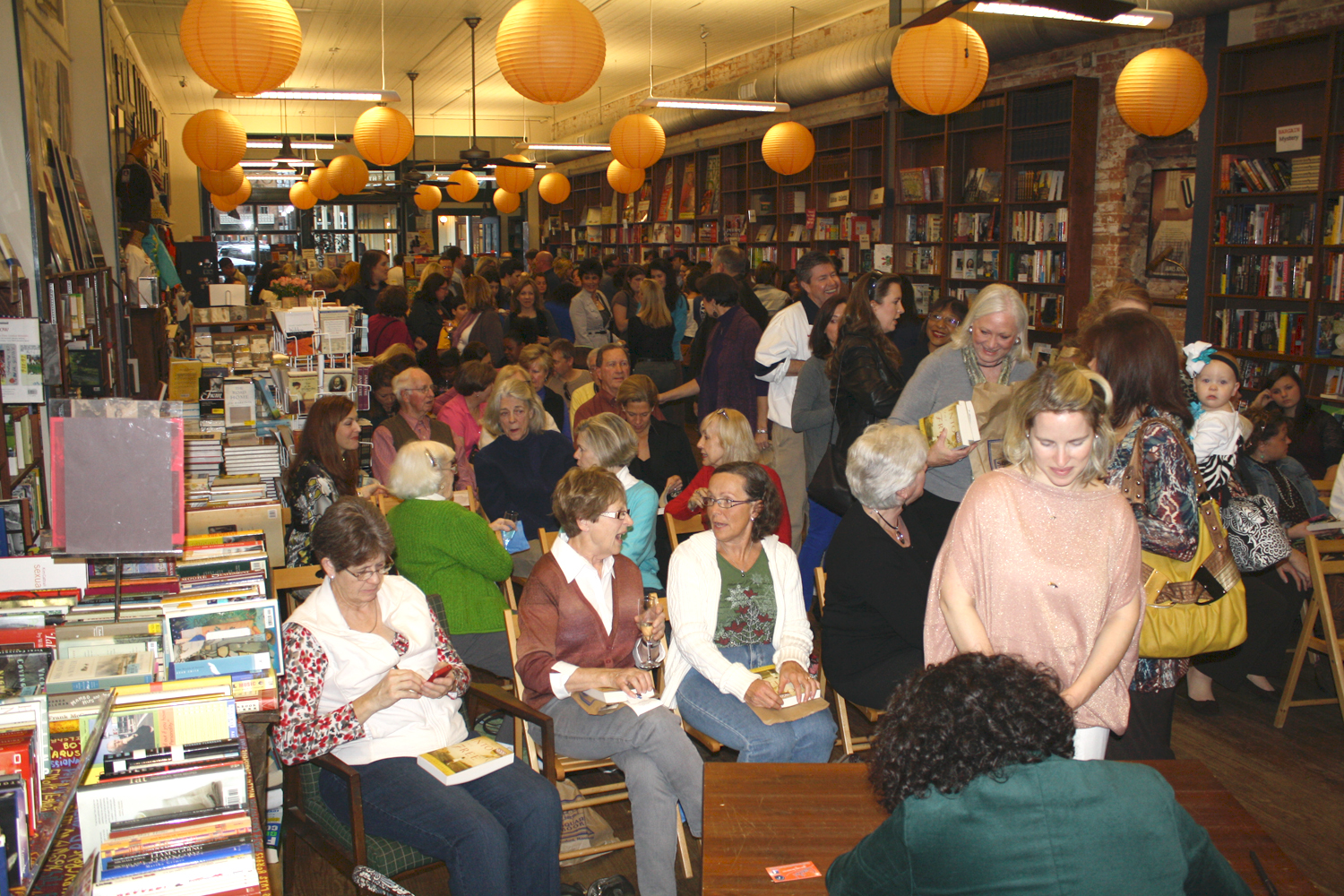
When my debut novel hit shelves, I wanted to do something special. Too many people in my community had played a part in the journey, and I wanted everyone involved to be publicly acknowledged for their contributions to the book.

The night before the official release date, we held a Launch Party at our local bookstore, Square Books. I didn’t have a big budget, so we served Champagne and Chocolate to keep the event nice but affordable. (We also provided non-alcoholic bubbly so everyone could participate in the toast.) The night was lovely. Beyond lovely. And it will always be a favorite memory of mine.

If you’re thinking of having a launch party, and I strongly encourage you to do so, keep these simple tips in mind when planning your big event.

1. Consider your crowd. Ours is a laid back group from all walks of life, so I wanted everyone to feel comfortable. We kept it very low key and emphasized the “come as you are, bring the kids” aspect of the evening. The public was invited.
2. Consider your space. Our bookstore hosts many author events each month and is prepared for such crowds. It’s always great to support a local bookseller, but if you don’t have access to such a store/gift shop, think of themes that correspond with your book (knitting, outdoors, swimming, cooking, etc.) and tie the launch party into a suitable location.
3. Consider your time. A typical schedule is to have a “soft start.” Allow folks to trickle in and mingle, enjoying the free refreshments while you chat and sign a few copies to get the evening going. Then the bookseller (host) introduces you, and you speak for approximately 20 minutes. Then, you sign again.
4. Consider your speech. It’s best to mix up your presentation with a little reading, telling how the book came to be, thanking folks involved, and…if appropriate…inserting some sort of entertainment. I had two singers perform one song each to give voice to two of my favorite characters. Both gave emotional performances that moved many to tears, and I think it was the best part of the night.
5. Consider your signature. I admit I have AWFUL penmanship, but I do plan ahead and bring a stash of good pens. Always a good idea.

You’ll probably be too busy to think about taking pictures, so ask a friend to capture the night on film. Believe me, it’ll all be a blur. And don’t forget the minor details: wine glasses, champagne flutes, bottle openers, cake knife, napkins, plates, utensils, tablecloth, camera, extra books, bookmarks, etc.

Finally, if you plan to sell books at the launch, I strongly recommend you let someone else handle the sales. The last thing you want to worry about is money. It’s a once in a lifetime moment. Live it up!

Five Ways to Handle Stress in Your Writing Process

Are you overwhelmed with stress in your writing life? The book of Lamentations offers a clear word on how to deal with stress. “When life is heavy and hard to take, go off by yourself. Enter the silence. Bow in prayer. Don’t ask questions: Wait for hope to appear” (Lam. 3:28-29 MSG).

1. Go off by yourself. Solitude often seems impossible for me, even with an “empty nest.” But Jesus knew the importance of spending time alone with His Father. When He needed to listen, He would pull away from everyone. Matthew 14 says that after Jesus fed the 5,000, He “climbed the mountain so he could be by himself and pray. He stayed there alone, late into the night” (23).

2. Enter the silence. When we seek God in silence, often the accuser (Rev. 12:10) tries to distract us with fear, like in the story of Hannah (1 Samuel 1). Hanna’s husband had two wives—talk about stress! And her husband’s other wife taunted her year after year, blaming and accusing God for Hannah’s inability to conceive children. Then, when Hannah prayed, her spiritual leader misunderstood her. “Hannah was praying in her heart, silently. Her lips moved, but no sound was heard. Eli jumped to the conclusion that she was drunk” (13).

3. Bow in prayer. Prayer can be as natural as talking with a good friend or as intimate as sharing a secret whisper. It can occur any time of day, no matter where you are or what you are doing. God promises that if we call on His Name, He’ll listen. “And if we’re confident that he’s listening, we know that what we’ve asked for is as good as ours” (1 John 5:15).

4. Don’t ask questions. My questions often interfere with my communication with God—I’m talking, instead of listening. When Jesus taught His disciples, He asked them on several occasions, “Are you listening to this? Really listening?” (Matt.11:15).

5. Wait for hope to appear. Waiting rooms seem to bring out the worst in me, like my impatience or frustration. But waiting does not have to be hopeless. The psalmist speaks of “waiting” in Psalm 40, “I waited and waited and waited for God. At last he looked; finally he listened. He lifted me out of the ditch, pulled me from deep mud. He stood me up on a solid rock to make sure I wouldn’t slip” (1-2 MSG).

Reflection: Matthew 6:30-34 advises, “Give your entire attention to what God is doing right now, and don’t get worked up about what may or may not happen tomorrow. God will help you deal with whatever hard things come up when the time comes” (MSG).

So, remember, “When life is heavy and hard to take, go off by yourself. Enter the silence. Bow in prayer. Don’t ask questions: Wait for hope to appear” (Lam. 3:28-29 MSG).

Photo/KarenJordan

What helps you handle the stressful times in your writing life?


Associate Agent by Day, Writer by Night (Sometimes)

Like many of you, I had grandiose dreams of seeing my name on the front cover of a book in Barnes and Noble. I think it started when I was five, and my mom would post copies of my poems all over the fridge. Instead of drawing pictures of kittens or rainbows, I would write. Mostly about my Grandma Mason’s apple pie.

However, somewhere along the way, the dream of writing became a bit more fine tuned, and I realized that I really wanted to help others along their writing journey more than I wanted to write my own novel. I thought today might be a good one for looking at exactly what shaped my desire to become an associate agent over my desire to become a writer

I failed kindergarten cutting. As a left-handed cutter in a right-handed-at-everything-else body, I was doomed from the beginning. My teachers didn’t believe that I was really a left-handed cutter because everything else came naturally to me as a right hander. There were only a limited amount of left-handed scissors after all. As early as age five, I knew that only certain people could use the left-handed scissors. I was not one of them.
I used to memorize publishing houses. Not only did I read my favorite authors or genres as a child, but there was a time when I would only read from my favorite publishing houses. I would dream of the day when I could be a part of that particular team. My writing dreams were never really of me being a shining star—they were always of me creating something spectacular with others.

My story arc never expands beyond 15 pages. Have any of you ever read Moby Dick? No, let me ask that again. Have any of you ever read Moby Dick and liked it? To this day, I can only make it through the first 100 pages. About the time the crew leaves for sea, I give up. I love Melville as a short story writer but not so much as a novelist. And I like to compare myself to Melville, although I know I am not nearly as good. I am best with short forms of storytelling or even poems. I am just not a fan of writing 70,000+ words about the same people and place. I give up after about 5,600 words and want to move on to something else.

I do, however, love working with other people’s words. I like to think through how I can make someone else’s story even stronger. The words have already been written; now I get to go in and play. I am like a decorator on Extreme Home Makeover. (Anyone else sob during the last episode?) I am thrilled to let someone else build the frame and put up the drywall. I want to go in and build a pirate ship into a child’s room or create a sanctuary for Mom and Dad.

Even though I am not a novelist, I do still like to write. Writing is a hobby now—something that I do for fun now and then. And, sometimes, I like to share my words with others. So, if you can promise me that you won’t come after me with pitchforks and tar and feathers if you don’t like my words, here is my is my Saturday gift to you:

FEBRUARY 28

They say you will reach me at a time when the

Impassable becomes the necessary.

Like conscientious birds refusing to fly,

Mine is a tombless marriage.

Cotton-candied windows reflect

Pastel letters, “A”, “B”, “C”

The soft skull of books is no longer a comfort

Crushing frozen syllables,

My city is ineffective.

* Line 8 of this poem is taken from Neruda’s poem, “Heights of Macchu Picchu: VIII, Clime up with Me”

Since I shared my creativity with you, would you be willing to share some of your writing with me? I would love to read something that is outside of your normal genre. Pull your poems out from under your bed. Let me see the songs that you wrote (but didn’t send to) the winners of American Idol. Or, if you’re in a creative mood, write me something new.

Revolution, not Resolutions

So, how are you coming on those New Year’s resolutions?

(Are those crickets I hear?)

Yeah, me too.

That’s why I’ve been thinking about doing away with the whole resolution thing (or “thang,” as we say here in the Lone Star State). Instead, I’m praying for a revolution. After all, without God, I wouldn’t be able to accomplish anything…even getting out of bed in the morning.

I’m greedy this year, but in a good way. I’m greedy for more of His presence, more answered prayers–not just for me, but also for all those who are hurting–and more of His words in my ear, on my lips, and in my mind.

I’m asking God…

  • To take my thoughts away from the markets and focus them on stewardship. I truly want to honor Him with my writing. This means (gulp!) that I’ll need to ask for His strength to be more disciplined. When He gives me an idea, I need to turn off the television, put down the latest decorating magazine, and write–without worrying about how the piece will fit into a publisher’s plans. Oh, God, help me stop obsessing over markets and contracts and instead be faithful to write the things you want me to write.
  • To help me be content. I’ve always been goal-oriented…to a fault. Too often, my ambitions led me off-track. Instead of being led by the Spirit, I’ve been driven. And since I’m being honest, I’ll admit that I have compared my blog stats/Amazon numbers/speaking schedule to other writers and felt insecure–or, worse, envious. I’ve browsed bookstore shelves and gone from admiring to coveting. I’ve admired another writer’s website and wished it were mine. Oh, Father, forgive me. Help me to know the secret Paul talked about–of being perfectly fine right where you’ve placed me….whether on bestseller lists or in remainder bins, in Barnes and Noble or on my blog, on a designer site or a “homemade” masterpiece. You have given me so much! Help me to count my blessings instead of my bills. In the midst of economic uncertainties, may I covet nothing but your peace.
  • To fill my heart with simple joys. Too often, I get mired in the past (Should I have Twitter-ed that? What did he think of my idea? Did I mess up my career for good this time?) or the future (Will I make enough $$$ for us to have a real vacation this year? What’s my editor going to say?– and–How in the world will I find time to write when I actually get the contract?!). What I really need to do is 1) take a deep breath and 2) let ordinary miracles bowl me over, preferably every five minutes. Frederick Beuchner wrote, “Life itself is grace.” So are used bookstores, computers, and online friends.  Abba, remind me to read and write more deeply. Prod me to study and meditate on scripture, instead of just quoting from it for my latest WIP. Rip my blinders off so I can appreciate every connection and blessing you’ve given on this path you’ve ordained for me.  
  • To show up and show off. I once had a music director who prayed a version of this during Wednesday night choir practice. He believed that we should spend as much time talking to God together as we did rehearsing…and boy, was he right. This same director invited anyone to sing in “his” choir–church member or atheist, bank president or convenience store clerk. Many who came out of their love for music–or just pure curiosity–stayed week after week, and their lives were inevitably changed. They showed up, and God showed off. Lord, never let me forget that I can do nothing without You. In You, and You alone, I move and live and have my being. You are my source, my guide, and my goal. Please show up and show off in my career, family, and relationships. Do what you do best, Lord. 

A few years ago, I led worship at a ladies’ retreat. The speaker was wise, peaceful, and totally centered on Jesus. I wanted what she had, but I guess I was afraid to ask God for such a faith (maybe I knew it would be costly).

After dinner one night, she and I were discussing the books I had written (my first three books had come out, but then I received a ton of rejections and was sure my career was over), and she mentioned that she was considering writing a book based on her retreat material.

“I’d love to write more books,” I admitted, “It’s a passion of mine. But I can’t get another contract, and I don’t have the money to self-publish. It’s really discouraging!”

She looked at me and smiled. The next words out of her mouth went straight to my egocentric heart and lodged there, like a stubborn splinter.

“I don’t need a contract,” she said. “I just need more of Jesus.”

I’ve been working that out ever since.

Authorship Is A Lesson In Humility

The pain was almost unbearable as I read my book doctor’s lengthy and critical evaluation of my first manuscript. I felt like my heart was being ripped out of my chest. Without significant additional help, not to mention hundreds of hours of work and a lot of money for surgery, my manuscript wasn’t going to live. It was my first lesson in humility as a would-be author.

Thankfully, my book doctor was funny and tactful as he delivered his prognosis. He told me he could teach me how to resuscitate my baby if I was willing to pay the $80 per hour co-pay.

As if my deficiencies as a writer weren’t a big enough blow to my ego, I was also told I had to wait three months before he could carve out time for my writing lessons. Come on, man! Three months? Really?

The harsh truth was no matter how much authority and respect I garnered in my day job as a physician, in the world of book-writing and publishing, I was a vulnerable, inexperienced nobody. I couldn’t even get a writing coach’s quick attention when I was paying.

Fast forward a year, and thanks to my book doctor’s worth-the-wait teaching, plus my own endurance through repeated rejections and humiliation, I produced a much-improved manuscript and ultimately went on to secure Greg Johnson as my agent and a publishing contract with Zondervan for The Eden Diet.

Woo-hoo! I got an amazing agent and a book contract! I thought that meant, “No more begging for people’s time and attention regarding my book.” Wrong! I hadn’t yet even begun to market. I didn’t know yet how humiliating book signings can be, “Please, Mrs. Bookstore Patron, may I interrupt your shopping agenda and tell you about my book?” Many stopped and listened, politely, but some walked right by, as if they didn’t hear me talking.

Compare that to my life at the office. In my doctor-world, I have actual authority and garner near-immediate respect from people who don’t even know me.

Fast forward again and now I have a contract with Strang/Charisma House for a book that can help even more people. Will I risk rejection again as I hold book signings and market for this second book? Absolutely. I counted the cost, and it’s worth the price. My message can bring countless readers into physical, mental and spiritual wholeness. Isn’t their profound healing worth a little momentary discomfort on my part?

Besides, any tiny shred of humiliation I endure along the way to help other people is infinitesimally small compared to the humiliation my Lord suffered when He was hung on the cross. Actually, now that I think about His humiliation for the greater good, I don’t even have the right to talk about humility.

Word of Mouth or Cyber Bully?

I’m hearing more and more conversations crop up lately from small business owners who say dissatisfied customers with even an ounce of Internet savvy can create an unfair disadvantage for their businesses. They argue customers are too quick to zap off a bad review, poor rating, or negative ‘word of mouth’ without ever giving the business a chance to make it right. “Feedback is a gift,” business owners claim. “And I never even got to open it until it was too late.” I can’t help wondering if it’s more like a party too many businesses don’t pay attention to until a hundred people jump out of the dark and yell “Surprise!” Either way, these highly visible online rants and ratings of the unhappy and dissatisfied can be a real detriment to acquiring new customers. And some businesses are crying, “Cyber bully!” 

But are they really? Let me take it closer to home: enter the novice or mid-list author. These author folks may feel a similar squeeze when negative comments or one-star ratings crop up for their books at various reader/author social networking sites or online booksellers—sometimes even before the book is released and based solely on how excited someone is (or isn’t) to read the book. Add the rumor of authors gaming the system by soliciting everyone and their brother for 4 and 5 star ratings and by low-balling competitors’ titles, and you can see why authors can be squeamish about the power of word of mouth on the Internet. At its best, it works for you. At its worst, not so much.

But does that mean people who scatter low ratings like jellybeans at an Easter egg hunt—with or without commentary to support them—are really abusing the author? Don’t readers realize how much power they wield, how much of a boon or a detriment their ratings could be for an emerging author? 

Probably not. And not only is it a bad idea to police the system, I think it’s futile to try. Internet word of mouth is organic in nature. Those who trust and value the opinions of others will continue to seek them out, and in the long run, that’s a good thing for everyone. Just like when we write we make positive assumptions about our reader’s intelligence and ability to follow our stream of consciousness, we shouldn’t underestimate the sensibility of those same readers when it comes to their ability to sort through the good, the bad and the ugly reviews. I like to think unless the negative rating came from a highly trusted or personal source, most prospective readers toss out the outliers and look for themes anyway.

What about you? As a reader, how much do negative ratings influence your decision to try a new author?

Taming the Marketing Monster

When my daughters were little, they were convinced that a scary monster was waiting in the bedroom closet at night. Our solution was an easy one: I gave them a small hammer to put under their pillow, so when the monster came out, they could conk it on the head. Oddly enough, the monster never showed up, and my daughters slept soundly through the nights.

Empowerment is a wonderful thing.

Now that I’ve become a published novelist, I’ve discovered that most authors have a similar problem: there’s a scary monster in our closets named Marketing, and it will come out of hiding even if you keep a hammer under your pillow. Not only that, but if you ignore it, Marketing will sneak out when you’re not looking to destroy all your hard work to become published.

On the other hand, if you learn to tame it, Marketing will become your faithful friend, bringing you exposure, opportunities, and book sales.  So instead of the hammer, here are a few empowering ideas to stick under your pillow tonight to help you begin the taming of your marketing monster.

  1. It’s YOUR monster. No one else is going to take responsibility for it, so you need to learn as much as possible about the feeding and care of it. Read blogs and books about book marketing. Create a list of media contacts in your area that includes radio stations, televisions, newspapers, magazines and even bulletin boards (find out who gives approval to use them!).  Add the names of librarians, book store managers, and book club contacts. Make a roster of blogs that relate to your topic/novel where you can visit and leave comments. By creating your own database of ideas and contacts, the question of “what do I do?” becomes “where do I start?”
  2. Feed your monster every day. Choose one marketing activity. Do it. Today. Write an announcement/press release of your book’s publication and email it to your contact list. Visit five blogs and mention your book. Donate a copy to the library. Get a Facebook page. Don’t worry about results at this point; just get the word out that you’ve got a book published. Tomorrow, choose another marketing task and do it. The next day, do the same thing. Feeding your monster a steady diet of small marketing activities will keep it content and much less scary. Over time, all those tidbits of publicity you’ve done will add up and begin to yield the bigger results you want: a growing readership.
  3. Take your monster out to play on a regular basis. Meet other authors and network with them on marketing ideas and contacts. Plan joint events. Share experiences. Commiserate over the failures. Celebrate the triumphs. Laugh. Create your own marketing support group.

Most of all, don’t let Marketing scare you. All it really wants is your attention…and to get out of that closet. You just have to open the door.

What scares you the most about Marketing? Has your monster brought you unexpected gifts?

7 Tips for Self-Editing Your Novel

Before I signed with my awesome agent, Barbara Scott, I knew my novel needed another round of edits. I looked at several freelance editors, but I just couldn’t afford the cost. So, I rolled up my shirt sleeves, prayed, and decided to do it myself. Again.

At this point, I’d already gone through my book for grammatical errors, typos, etc. I’d had a published writer and several beta readers go through it. Three other agents expressed interest if I could go back and make my novel stronger.

Here are the tips I learned that pushed my book from a maybe to yes.

1. Print it out. I fought this (don’t ask me why, my frugalness I suppose, sounds better than stubbornness), but it truly makes a huge difference. Your eye will catch things on the printed page you won’t see on the computer screen.

2. Only edit one thing at a time. Go through your manuscript focusing on one thing at a time. Do a sweep for dialogue. Is there useless chatter? Talking that doesn’t move the story forward? Do you have too many tags? Then go back for description. And so forth.

3. Examine every character. Don’t waste time with cardboard characters or the stereotypical bad guy. I highly recommend Deb Dixon’s Goal Motivation and Conflict.

4. Setting. Regardless if you write historical or contemporary, you need to research your setting. Find some of the not so common places to set your characters in. For example, lots of scenes are in restaurants, change it up and put them on a picnic at some fantastic landmark.

5. Hooks and cliff-hangers. Check out the beginning of every chapter and the ending. What can you do to make it stronger? What could happen that would ensure the reader couldn’t put your book down because they have to know what happens next? Is your heroine being chased by a wolf? Then make it a pack of wolves and have her twist her ankle. Take it a step further and do this to every scene. I recommend James Scott Bell’s Revision and Self-Editing.

6. Description. Remember to include things beyond sight. Let us know how it smells, tastes, feels, and sounds. Is the rain splattering or pounding? Are the hero’s hands calloused or warm? See Frontierinternetservices.com.

7. Wrapping up all the ends. Make sure all the sub-plots and story lines are resolved. You can set things up for a sequel, but you can’t leave things undone. Readers will feel cheated if they have to buy the next book to find out what happens to the main storyline in book one.

What are some of your favorite non-fiction writing books? Do you have any tips or tricks you use when editing?