Writing Bible Studies: Feeling the Nudge?

Writing Bible studies is my passion, but it used to scare my freckles white. How are we supposed to improve on the inerrant Word? Thankfully, that’s not our goal. Whew! A good Bible study provides practical, 21st-century application to timeless truths filtered through the author’s life experiences.

So where do we begin? Some writers start with a theme such as comfort or joy. I love to start with a few passages of Scripture that resonate in my heart and mind that I’ve read during my morning quiet time, or heard in a sermon or Bible class. Both approaches work well because they provide a solid starting point.

Whether you’re writing a full-length Bible study, an abbreviated study for a magazine, or teaching a Bible class, I’ve learned there are five basic steps that seldom change. Begin by asking God for His wisdom and guidance, then:

1. Immerse yourself in the scene.

Writing Bible studies involves telling a story, so don’t neglect the scenery, human interaction, or history. Who wrote the passages? Where do they take place? What season is it? What’s the emotional temperature? Is there conflict? Who’s involved? From whose POV is the story told? How is God revealed? What’s the overarching lesson? Incorporating some or all of these elements invites readers to relate on a personal level.

2.  Look up the passages in their original language.

Whether Greek (New Testament) or Hebrew (Old Testament), it’s crucial to understand the accurate meaning of the words used. The Hebrew language contains no vowels, so English translators added them so we could understand the text. But sometimes the interpretations fall short of capturing the original connotation. For example, Psalm 23:3 promises, “He restores my soul.” In the Hebrew, “restores” means “to reset.” In other words, God reboots us! The rich meanings that I learn during this step often alter the trajectory of an entire study.

3. Research the culture of that time period.

For example, it’s hard to understand the depth of love that drove the prodigal son‘s father to run and welcome his son home until we learn that it was utterly disgraceful in that culture for a man of the father’s stature to lift his robes, run, and reveal his hairy knees. (Yes, really!) That cultural detail allows us to grasp on a deeper level God’s passionate pursuit of us when we go astray. Researching the cultural background provides vivid history and valuable insight.

4. Read Biblical commentaries.

Scholars use their theological expertise to point out nuances in the original languages and cultural idiosyncrasies that help you parallel today’s trends. They often cross-reference words, verses, and similar scenarios throughout Scripture that aid your writing perspective. Also, several commentators lived in the 19-20th centuries, so that really cool, old-school writing style lights up my imagination!

5. Use reference books and resources.

Just like the Chicago Manual of Style represents a must-have for fiction writers, Bible study writers need particular resources readily available. I find these indispensable:

Last, but by no means least, every Bible study writer needs to be a faithful student of Scripture. Here’s a handy Bible Reading Checklist to download and tuck in your Bible. It’s a useful tool to check off the books and chapters as you read them.

Regardless of how you approach writing Bible studies, keep writing. Relentlessly ask God to guide you. Your freckles will return, I promise! This process enriches your spiritual journey and provides that same opportunity for others. This may be a tedious process, but you’re not just writing about any story. It’s THE story.

Let’s chat:  If you write Bible studies, what works for you?  If you’ve never written one, what did you find most helpful?

Build Your Platform – Get Yourself Some Gigs

Here is a terrifying sentence: If you want to be a writer, you probably need to be a speaker as well.

Gulp.

I know that most writers would rather hang out a coffee shop or with their cat writing the day away than speak. I know a few writers who would rather stab themselves in the eye with a sharpened yellow #2 pencil than speak. But if you are working on building a platform, speaking is your quickest way of doing that.

Just today, I had a woman from Texas call me up and say, “I’m ready to speak, but I don’t know how to launch that part of my business/ministry.” Since a good part of each of my work days are spent finding speaking gigs, I thought it would be helpful to share some of my strategies each time I blog here.

Tip #1

Speak for Free

It is the bane of every speaker’s existence. That moment when your event coordinator says, “We don’t really have a budget for speakers, but we would love to have you come.”

In my opinion, unless you are already booked to capacity, take the gig.

Yes, you are worth more than that, and your time is valuable. However, the best way to get more speaking engagements is by speaking. It is a false economy to sit at home all day creating flyers and making phone calls looking for paid speaking engagements, when you have passed up the opportunity to speak for free.

Speaking is your best form of advertisement. When someone is sitting in the audience listening to you, chances are she belongs to at least one or two other groups or organizations that use speakers on a fairly regular basis. Multiply that by the number of people sitting in the audience, and that is the best form of marketing.

Recently, a large church asked me to speak for free to a group of over 150 women. At first I was put off because surly they could afford to pay me. I thought better of it and accepted the gig.

From that one engagement, I have had three paid bookings, and another spin-off booking. Plus, I got a great recording from that one engagement.

If you are going to speak for free, make sure you get something out of it besides free advertising:

  • I always ask for my expenses to be reimbursed, (food, travel etc,) Don’t ever let your speaking cost you money.
  • Ask your venue if they can record you. Having that recording is essential when you are booking other gigs and they want to hear what you can do.
  • Build a great book table so even if you are not getting paid to speak, you can make money by selling your products.
  • Ask if the event coordinator will be a reference for you.

Action Plan:

  • Let the world know your are available. Tell friends, coworker fellow church members that you are open for business and willing to speak no matter the fee
  • Search our religious, community, and industry groups who are looking for free speakers
  • Even if it is not a subject that you are an expert on or passionate about, see if there is a way you can make it work for the group. This is especially important if you are fiction author. Your local MOPS group probably isn’t going to book you to talk about your latest historical novel, but they might just love your talk on Pursuing Your Passions as you talk about what it took to get published. Or how about a talk on making history come alive to kids?   Just figure out how to become a niche expert for any group by bringing in your specific expertise.

Question for You – If you speak, how are you getting your speaking engagements. If you don’t speak, why not?

Just do (aka write) it!

When I was a teen, I had a habit of using the words “I’ll try” often. In my teenage mind, saying this was non-committal and got me out of stuff.

Mom: “Krista, clean your room.”

Krista: “Okay, I’ll try to get it done tonight.”

If I didn’t… oh, well. I tried. Just got busy and wasn’t able to finish. Shucks….

I remember at one point, my to-be-husband and I were talking about something (I don’t recall what now) and I responded with the reply, “Well, I guess I’ll try.”

It is his response that I DO remember.

“Don’t try, Krista. Just do it.”

I then realized how much my “I’ll try” excuse was just that. A big honkin’ excuse for mediocrity. A way to not feel so bad when I didn’t succeed. Because at least I tried, right?

Now don’t get me wrong. Trying is a GOOD THING. Too many people drag their feet and never TRY something because they fear failure or are just too dadgum lazy.

But that wasn’t me. My trying was only an excuse.

I’ve realized lately that “trying” has crept into my writing. “I’ll try to get some writing time in…” and then time just floats away like a helium balloon you give your kid outside and expect them to actually NOT let go of. At the end of the day, little writing done, I will look back and say, “Whoops. Well, I tried. I’ll try again tomorrow.”

At some point, if we’re going to be serious writers, we have to do more than just try. We have to glue ourselves to the chair, duct tape our wrists to the keyboard, and just WRITE.

If you were running a business (which if you are a writer, YOU ARE!) would you tell your customer, “Well, I tried to _________ but just got busy. Maybe tomorrow…?”

There will always be distractions. Other things to do. Kids to take care of. And sometimes those things DO take priority.

My youngest of four daughters has spent almost the last year in the hospital, and after several failed open heart surgeries and three very long months of waiting, she received a heart transplant in April. She’s been in the hospital 4 times again since May after her first 10 month hospital stay. Um, priority? YES. I wrote VERY little this past year.

But even as crazy as my life is now with meds 4 times a day, vitals to take, a Gtube to feed through, oxygen to manage, and a billion and one doctor’s visits, if I’m gonna be serious about this writing thing, I gotta stop just trying to write.

I have to just do it.

Because she’s home, and if I don’t get back to it now, I might as well quit. And quitting is NOT an option.

Tips for “Just doing it”

Enlist the help of your family. That’s what I have done. When my hubby is home, he will take over for an hour or two so I can hunker down at the computer.

Take advantage of even the little times. A few weeks ago, between physical therapy and transplant clinic appointments, Annabelle and I parked ourselves in Panera near the hospital. She napped while Mommy wrote for an hour! I wrote maybe 500 words, but it was something. And that something counts!

Set a schedule. SO many people do this successfully. I’m not one of those thus far, but I’m working toward it! Having a set time to write not only makes you honor your writing commitment like a professional, but it also helps you to act the part of a time managing business professional too.

Set goals. Some have a daily word count goal. Others have a weekly goal, or maybe even a month goal. Still others just have a goal related to time, say, spending an hour a day. Or maybe you’re editing and it’s to edit a chapter a day. Whatever your pleasure, set a goal, high enough that you have to work at it, but not too high that it’s unattainable. (i.e. no 100 words a week… but no 100,000 words a week either!!)

How do you carve out your writing time? Any tips to making yourself “just do it” even when life could easily take over? What are some excuses YOU have made?

Getting Your Feet Wet

This past month, my family and I spent a week camping in the San Juan Mountains of Colorado. We enjoyed the cool temperatures and the awesome beauty there and spent several days hiking the many trails that stretched just yonder before us. One such day led me to unknown waters–or rather, an unknown way to cross a certain mountain stream, without getting my feet wet. [BTW, I failed miserably. If interested, you can read about the disaster here.]

Sometimes, we just have to get our feet wet–if not our legs, arms, and ears. When it came to marketing and promoting my first book with Zondervan in 2009, I knew I needed to jump in with both feet.

Having read various marketing blogs and having studied the ideas of many ACFW authors, I had a good idea of what I wanted. I planned to schedule book signings, visit bookstores, create bookmarks, etc. But having this knowledge and knowing what to do with it (when you have a marketing budget) are two different things.

Once I received my advance, I had actual money to work with. Yay! So, I began with a budget. Oh, but wait! After reading through all my notes and research, there seemed to be a LOT of controversy on how much to allot toward marketing. Some authors put all of their advances toward marketing, while others spent hardly any, depending solely on their publishers. If my husband had his say in the matter, a very low percentage of mine would be given to marketing. LOL. After all, if God wanted my book to sell, He’d provide a way. Right?

After much deliberation, calculation, and prayer, my husband and I came up with a percentage of the advance we thought would work, budgeting out certain amounts for things I deemed necessary and leaving room for items that were a bit more extravagant. For learning purposes, my budget had the following items:

  • High Speed Internet and Updated Computer
  • Author Website
  • Publicity Photo
  • Book Trailer
  • Book Launch
  • Promotional Items (bookmarks, pens, etc.)
  • Book Signings (travel, meals, etc.)
  • Conferences/ICRS

Did I stay within my budget? I’m happy to report that I did. Next month, I’ll share my plans for creating an author website–what I wanted in the beginning, what I settled for, and how it all turned out. Until then, enjoy the moments AND don’t be afraid to get your feet wet.

Platform Builders

When I started writing seriously in 2004, my focus lay completely in fiction. I’d written devotionals and snippets of life pieces in the past, but they served my own need for expression, then resided silently in a folder on my computer. Fiction was and is my passion.

But then something unexpected happened. In 2006 God presented me with the desire and opportunity to write as part of a team for a blog to help those in spiritually mismatched marriages like my own. I jumped in because I wanted to help other women avoid some of the heartache I’d experienced to reach a place of thriving in my faith and my marriage.

From this blog a ministry was born. Readership grew as did our perspective and understanding of the need we’d tapped into. This led to a book about how to thrive in this type of challenging marriage (aren’t all types challenging?), a Facebook presence, then a Twitter page. We suddenly found ourselves reaching readers in ways we hadn’t thought possible at the beginning. Our main site (www.SpirituallyUnequalMarriage.com) started showing up as a resource on other ministry and church websites. Thank goodness for Google Alerts to let us know!

All this coalesced into our platform, which became the turning point for a publisher to say yes to our book. How did that happen?

Here’s what I did:
1. Identify a need. As authors, we pretty much get the message today that we have to do more than just market our book. People want more. Common trends have set a pattern of having take away value. So, identify a need you can fill. Offer something to your reader that they can use and apply to their own lives. Once you identify a need, you can clarify your message. And you’ve just identified your market.

2. Create a presence. Social media has exploded at an astonishing rate in the last year alone. The heavy hitters (Facebook and Twitter) revolutionized communication. And now Google+ looks to be another joining the slew of social media giants. For our purposes, I will say that Facebook turned out to be surprising success. We wanted another means to connect with readers and be a resource and that’s what happened. Why? Because we made our page about our readers and meeting their needs, not about selling our book. Again there’s that take away value.

3. Consistency. Though we started with just our blog, we were and are consistent about content and postings. We brought this pattern over to our Facebook and Twitter pages, which builds presence, trust and reliability. Readers trust a growing presence that’s consistently putting information out there with a clear message that has no strings attached. Trust me, people smell an ulterior motive faster than the garbage dump next door. Be honest, be authentic and be original, but always stay true to your message.

4. Become a resource. Past experience opened the door to serve a specific market with the goal of being a resource. That was always the purpose—how did we assist others in finding the help they needed in a difficult marriage? What could people take away and apply to their lives and marriages? Over time, we presented ourselves as a reliable and helpful resource that other sites and churches could tap into. We showed we were there to help, to partner with individuals and groups, and to share what had worked for us in order to help others on the same path.

5. Be patient. (I can still hear my wise agent, Rachelle Gardner, telling me this.) Building a platform takes time. Factor that into your writing plan. Don’t rush to submit a project before it’s reached its potential because it’s a bigger challenge to turn a no into yes.

As I said this journey began in 2004 with my focus on learning the craft of writing and growing in my understanding and abilities. From mid 2006 to late 2009, our platform grew to the point that a publisher was willing to take a chance with our message. That platform is still growing to day with the addition of a special book site (www.WinningHimWithoutWords.com) focused on the message of the book and offering free resources for listening and downloading, as well as teaching videos. We’re also working on partnering with other authors to promote each other’s books and ministries through our newsletter, websites, and speaking engagements.

How does that affect my future as a fiction writer? Same game plan with some minor adjustments. The stories I write serve the same niche we found for our nonfiction and thus brings me back to step one. And away I go! See you on the shelves!

The Writer’s Life: On the Edge of the Cliffs of Insanity

BeingThe Cliffs of Insanity a writer can make you crazy.

Think about it:

  • Your literary heritage? A long line of creative alcoholics and drug users: Ernest Hemingway. O. Henry. Tennessee Williams. Dorothy Parker. Edgar Allen Poe.
  • Betting your life on a maybe, dependent on the kindness of others–agents, editors, publishers–for your success. And, really, their decisions have nothing to do with kindness.
  • Balancing your hopes on the seesaw of contradiction: Write your passion. Write what the market wants.
  • Hearing voices. The fictitious ones in your head that you tell what to do–and then you wreak havoc on them when they don’t. Meanwhile, the ever-present voices in the real world–your boss, your spouse, your kids–demand you focus on the here and now. The business meeting. The bills. The moody pre-teen inhabiting your daughter’s body.
  • Facing unending emotional upheaval. Waiting. Rejections. The mixture of joy and jealousy when a friend earns “the call.” (Not that you’d ever admit to even a passing acquaintance with the green-eyed monster. Inconceivable.)

Being a writer can push you to consider changing your name to Poe or Hemingway. The craziest part? You chose this life. You’re committed to this insanity. Here are a few suggestions for managing the madness:

  • Pick your mentors wisely. Just because writing drove others to indulge in mind-altering escapes doesn’t mean you must. I admire my mentors for their lifestyle choices, not just their writing skills.
  • Don’t let all your dreams be based on maybes. I have limited control over my success as a writer. Writing, however, is not all of my life. I’m pursuing other dreams with both short and long-term goals.
  • Choose between your passion and writing for the market. Or not. Maybe you’ll be the lucky author who hits the market when your passions collide with what “they” want. (Romantic-Amish-Vampire-Time-Travel-Steampunk-with-a-moral, anyone?)
  • Jump off the seesaw. The whole “balancing the writing world with the real world” challenge? I may never master that. Sometimes my mind seems full of shrieking eels, all screaming, “If only these people (husband, kids, friends) would leave me alone, I could accomplish the more important goals!” Then I know it’s time to shut down my computer and connect with family.
  • Admit you experience emotions. If emotions are good for our fictional characters, why are they bad for us? Sometimes we’re conflicted: over-the-moon-happy for our friend who landed a contract and also disappointed we’re not the one signing on the dotted line. That’s reality.

I’m curious: Am I the only writer pushed to the edge of the Cliffs of Insanity? How do you keep yourself from leaping off? (And can anyone tell me where the Cliffs of Insanity exist?)  ;o)

Post Author: Beth K. Vogt

Beth K. Vogt is a non-fiction author and editor who said she’d never write fiction. She’s the wife of an air force physician (now in solo practice) who said she’d never marry a doctor—or anyone in the military. She’s a mom of four who said she’d never have kids. She’s discovered that God’s best often waits behind the doors marked “Never.” She writes contemporary romance because she believes there’s more to happily ever after than the fairy tales tell us.

The Story Of Her Life

Have you ever read a book that caused you to take a risk, accept a challenge, or—as in my case—plan a parade? Donald Miller and his book, A Million Miles In A Thousand Years, inspired me to help my dying mother accept her story’s starring role.


“Look what I’ve got for you, Mom,” I say, not knowing if she’ll like the Happy Birthday banner, replete with pink and purple butterflies, that I hope to hang at ceiling level in her nursing home room.

I have no idea whether my siblings and I will be able to give Mom a wonderful celebration or not. So much depends on her, and the truth is that for the past few years, she often doesn’t want to be the main character in her own narrative.

But this is her life, her one true story. These are the only memories she gets to make with her family. The only memories we have a chance, at this late date, to make with her.

“I love it,” she says.

I am more than surprised. I climb onto her desk, then step even higher onto her dresser to thumbtack the banner across the top of the wall. She smiles and I think This day could turn out to be amazing.

We plan to scoot Mom in her wheelchair across the busy road to the Mexican restaurant. She’s been looking forward to the guacamole and the Margarita for weeks. What she doesn’t know is that we’re going to make a grand parade out of it. We’ll stop traffic if it’s the last thing we do, and she is going to be the center of attention, the starring attraction in her life.

When she’s dressed, make-up on and hair curled, we head to the lobby, where my siblings are meeting us. I spin Mom around the corner and there they are, bearing the rest of the party paraphernalia: cameras, cake, and huge grins.

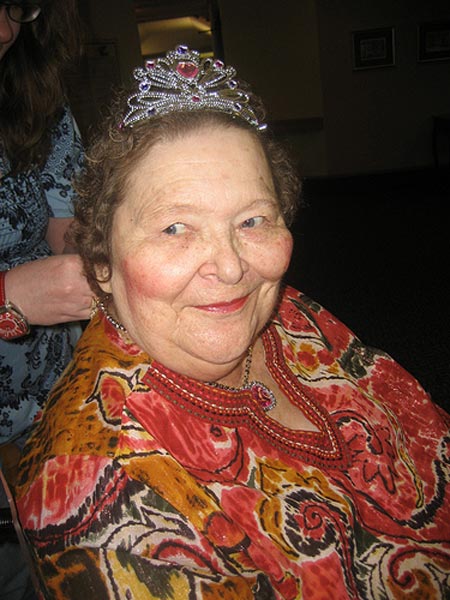
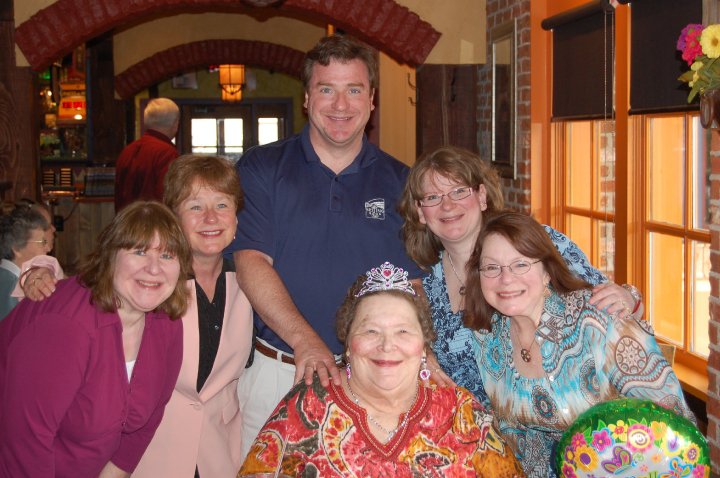
Mary McKennaOne places a child’s dress-up pendant around Mom’s neck, a gaudy piece of bling on her finger, and a glitzy tiara on her head. Mom beams! Another ties helium balloons to Mom’s wheelchair, passes out the horns, and gives Mom a big kiss. I distribute bottles of bubbles.

“What on earth is happening?” Mom asks.

“A parade,” I say. “And it’s all about you.”

For once, she does not object. She does not tell us it’s too much for her to be the heroine, for us to make over her and act goofy and pretend together that we’re a bunch of little kids who don’t intend to grow up until far into the evening. We open the door of the facility and are greeted by the bright sunshine of a fantastic April day.

McKenna ParadeWe start waving our bubble wands and blowing our horns and shouting, “Happy Birthday, Mom!” Dozens of cars slow down, pull over, open their windows, and call out their own birthday wishes for our mother. They honk, give thumbs up, and blow kisses as they pass by, all to Mom’s delight.

By the time the party’s over, she is tired, but not so much that she doesn’t get a huge kick out of it when a young mom (followed by her husband and awe-struck children) stops, points to Mom’s tiara, and says, “We didn’t know we’d be in the presence of royalty!”

We wheel her back across the road, still blowing bubbles and tooting our horns, but with somewhat less enthusiasm than we had on the way there.

Because stories end, and this one was reaching its curtain call.

Out of nowhere, I hear my long-dead father’s voice singing, for old times’ sake, a 1950s-era Nat King Cole song. One he’d sung hundreds of times when he and Mom were young and I was younger still, one that always seemed so sad to me, because even a child knows what’s eventually coming.

The party’s over
It’s time to call it a day.
They’ve burst your pretty balloon
And taken the moon away…

“Do you want me to take your Happy Birthday banner down now, Mom?” I ask, when we arrive in her room. She never did like fanfare.

“No! I don’t want you to take it down, ever.”

The party’s over
The candles flicker and dim…
Now you must wake up, all dreams must end.

McKenna FamilyMom didn’t live to celebrate another birthday. But this my mother did: She grabbed hold of that final party, wringing every ounce of joy from it, composing the perfect ending in our hearts—and in her own.

And she gave me the courage to keep writing my story, too.

Brand Basics

If you’re interested in delving into this business of publishing, then you’ve likely heard a lot of talk about branding. Simply put, branding clearly identifies you with a product. For the author, it might be their brand of fiction or their platform. Your brand is strong if someone hears either your book or your name and can identify the other. For instance, if I said “Stephen King”, certain things would pop into your mind even if you’ve never picked up one of his novels. If I said, “The Shining”, you could likely name the author. Stephen King has a strong brand.

Your brand needs to be supported by your internet presence such as your blog or web site. Think about the images you want to portray. Are you a contemporary women’s author? Then, your site should have a different “feel” compared to someone who writes suspense.

I worked with Tekeme Studios for my blog design. First hurdle to overcome was the content of the blog. How can I be different from the other thousands of blogs that are out there? What I noticed myself doing was answering a lot of medical questions for fellow writers. I couldn’t find anyone else with this type of blog. That was good because perhaps I could provide a service for other authors that was thus far unfulfilled.

Second was to think of the feelings I wanted to invoke when people first visited my site. For me, these were intrigue, medical, with a slight suspense feel.

Here was the first design:

Here comes the third part. You have to be willing to speak up if you don’t like the design. After all, this is your brand and your investment. You should have strong feelings about it. For me, the design read historical. The man was dressed in period garb and the cabin looked like one you’d find on the frontier. This image didn’t support my brand as a suspense novelist. Plus, I‘m a woman and why did it need to be a man answering those calls for help? Also, too bright and orange (not a huge fan of that color). Not an ominous feel at all.

You’ll know you’re with the right design team when they understand your concerns about the design and are not offended about making changes. After discussing my concerns, it became as follows. You can check out the full implemented design at http://jordynredwood.blogspot.com/.

My challenge to you:  Are you thinking about what your brand is? How are you evoking that brand image with your internet presence? Ask people to visit your site and give you thoughts about what they feel. If you’re a suspense writer, people should feel ominous… maybe a little worried, like they will when they read your novels.

These are some examples of authors who I think have portrayed this well. Visit their sites for a little homework. Do they have a strong brand? Do they evoke certain feelings when you see their imagery? I think what they’re doing supports their brand of novels.

  1. Brandilyn Collins
  2. Tosca Lee
  3. Robert Liparulo

What are some things you’re doing to support your brand?

Surviving My First Year As A Published Author

It’s hard to believe that I’ve been a published author for over a year now. My first book (A Tailor-Made Bride) debuted in June 2010, and last May my third book with Bethany House, To Win Her Heart, hit the shelves. What an exciting whirlwind adventure this has been!

For those of you who are not yet published, I thought I’d share a few of the myriad lessons I’ve learned during the transition from hopeful writer to published author. Believe it or not, signing a publishing contract is not the pot of gold at the end of the rainbow. It is just the beginning of another journey, one that will take you through unfamiliar territory with a whole new set of obstacles and pitfalls to navigate.

Learning to work with an editor

Most of you have probably worked with a critique group or received feedback from contest judges on your manuscript. Some of you may have even invested in hiring a freelance editor to go over your book. All of this is wonderful for helping you perfect your craft, and I highly recommend it. I still work with my critique group on every book I write. However, making the switch from critique group to publishing house editor is like switching from working with a high school baseball coach to a major league manager. The expectations placed upon you increase and the time to make improvements decreases. Thankfully, the editor wants you to succeed just as much as you want to succeed, so it can be a marvelously rewarding partnership.

In learning to work with an editor, attitude makes all the difference. Here are some tips for making this process a blessing instead of a trial:

  • Trust your baby to the care of another. You are no longer simply a passionate writer, creating the story that best pleases you. You are now a professional writer who must please a publisher and readers. Don’t forfeit the passion, but temper it with professionalism. I often hear unpublished writers say things like, “If an editor ever suggested I change X about my manuscript, I’d find a different publisher.” I strongly caution against this attitude. Publishing is a team effort. Be a team player and remember that the publishing world is a small one. Don’t make things harder on yourself by gaining a reputation as a diva.
  • Editors are allies, not enemies. It might not feel true when you get that 12 page, single-spaced substantive edit letter, but keep your defenses in check. Remember that your editor is there to help you create the best manuscript possible.
  • Approach conversations with humility. Editors know the market better than you do. They know what their readers like. Submit to their mentoring and heed their advice, but don’t be afraid to respectfully speak your mind if you have a strong aversion to one of their suggestions.

Dealing with deadlines.

Everyone writes differently. Some pour out their stories unchecked then go back and add layers, weaving in editing as they work through multiple drafts. Some outline extensively before ever writing a word. Some spend weeks delving into research. I’m one of those odd ducks who uses both sides of my brain at the same time, editing as I go. This makes my pace slow as I constantly edit as I create, but I essentially write only one draft.

The key to dealing with deadlines is to know your writing pace and plan accordingly. Set realistic intermediary goals. (For example, instead of a daily word count, I choose to set weekly goals. I try to write one polished chapter a week.) Then be sure to budget a cushion into your schedule to allow for unforeseen circumstances. Illness, family vacations, work duties—many things can pull you away from your writing. Don’t add to your deadline stress by cutting things too close. I try to pad my deadline by 2-4 weeks to give myself some flexibility. Plus it’s cool to get brownie points by turning in a manuscript early.

Handling Reviews

Good reviews can send your spirit soaring, and bad reviews can send you plummeting into a pool of doubt and insecurity. You must learn to find balance. Some wise authors I know choose not to read reviews at all. I have to admit that I can’t seem to resist the lure. I check my reviews on Amazon every day and eagerly await news from my publisher about trade reviews. Publisher’s Weekly tends to give me great write-ups, yet the ones from Romantic Times are usually a bit lackluster. The inconsistency can be frustrating, but I constantly remind myself that reviews are subjective. That fact became very evident when my publisher decided to offer my debut novel as a free e-book download in May. I was pleasantly surprised by all the new 4 and 5 star reviews, but then there were the 1 star reviews that came with them. Ick.

  • Not everyone will love your book, so gird your loins in advance.
  • Enjoy the pleasure of positive reviews, but don’t let them puff you up with pride. When pride comes, then comes disgrace, but with humility comes wisdom. ~Proverbs 11:2
  • Learn what you can from a harsh review. Look for ways to improve your craft for future projects. However, don’t dwell on the sour words. They will destroy your confidence and steal your passion. Glean what you can, then walk away.

This publishing journey can be a long and arduous one, but it is rich with rewards as well.

For those of you who are still seeking publication—what makes you the most nervous about making the transition to published author?

And for you published authors—what other advice would you share with upcoming writers regarding what to expect after the contract is signed?

Learning to Let Go

This week my oldest son is preparing to return to college. Instead of rooming in the dorms, he will be sharing an apartment with three of his friends. As the piles grow in the dining room and shrink in his bedroom, I’m reminded of the day we took him to college for the first time two years ago.

I awoke that morning, smiling and vowing to stay positive. It was going to be a great day. The beginning of a new adventure for him. He was leaving the family nest to spread his wings. Hubby made a manly breakfast for a new college freshman. We joked during breakfast and pretended it was like any other day.

Hubby and our two boys loaded the trunk while I finished getting ready. As I applied mascara, it hit me—no not the mascara wand, but my little boy was a man now and heading out for a new path in his life. I teared up, sniffed a little, and reached for my lip gloss. Before I could apply the color to my lips, I had my face buried in a hand towel to muffle my sobs. I was so not ready for this. He was just a baby. He needed me.

No, not really.

I needed him to need me more than he actually needed me.

I dried my tears, reapplied makeup and rode the 90 minutes to his campus. We emptied the car and transported everything to his very generic dorm room. When it was time to leave, he wrapped his arms around me and said, “I love you, Mommy.” Suddenly he was five again and heading off to his first day of kindergarten. My chest ached from holding back the sob, but I managed to squeak out an “I love you” in return and smiled. As we pulled away from the curb, my hand clutched the door handle as my brain screamed, “I’m not ready to let him go yet.” My heart felt as though it was being shaved with a carrot peeler.

Thoughts tumbled through my head—I should have prayed more for him. I should have forced him to study more and do less gaming. The “I should haves” lasted for about five minutes until the sobs rocked my chest. It was a rough night and next morning.

But I did what every good parent needs to do—I let him go. It was his time to make his way in the world. We are always here to support and encourage him, but he has to make mistakes and learn from them.

As writers, we create stories, nurture them, and edit until the prose shines. We dream of the future, of getting the call. But none of that can happen until we press send or drop that manuscript in the mailbox.

While our manuscripts are not our babies, we have parallel feelings between parenthood and writing. Writers spend a lot of creative and emotional energy crafting their books and novels. Whether it’s non-fiction or fiction, we become a part of that topic or those characters. As a novelist, I know my characters better than I do some family members.

Once we’ve written those books to the best of our abilities, it’s time to let them go—time to send that manuscript to the destination it was intended. As the postman drives off with it or we receive that SENT window in our email, we may think, “Wait, I’m not ready yet.” But we have to learn to let go. Then we are faced with waiting and possibly rejection.

Just as sending my son off to college is a necessary part of his development, letting go of our work and submitting it for possible publication is necessary growth for a writer.

By the way, it does get easier—submitting those manuscripts and having my son return to college. Remind me of that next August when my youngest son heads off to college.

Your turn: What experience in your life has helped you let go of something, even though it may have been hard at the time? Do you struggle with letting go of your manuscripts when it’s time to submit?

Photo credit: gerbrak