Keywording 201 for SEO Prowess: Three Simple To-Dos to Improve SEO

A few weeks ago, I gave you the 411 on how to choose thematic keywords for your site.  And, now that y’all have researched your keywords on Google Adwords and Insights, honed your theme and come up with a strong list of 10-15 keywords (you did that, right?), you’re probably wondering what to do with said list.

Using keywords correctly is complicated.  Really complicated.  And to be honest, figuring out the algorithm takes rocket-scientist brainpower and the ability to focus on complicated things like numbers and graphs for long stretches of time (12 minutes at least).  And, since I’m guessing that doesn’t sound like something you want to do when you could be doing fun things like NaNoWriMoing, I’m going to make it really, really easy for you.  So easy, in fact, that even a busy NaNoWriMoing novelist with less than 4 minutes of free time between soccer drop-off and throwing dinner in the crock-pot can get it done.

Homework caveat:  Before you can complete this to-do list, you’ll need to come up with a list of 10-15 thematic keywords for your blog.  Refer to this post for instructions.

Three Simple To-Dos That Will Improve Your SEO

  1. Use at least ONE of your keywords in the TITLE of a blog post at least one time per week.  (Why?  Title or H1 tags—especially title tags on WordPress which is built for SEO—have a strong SEO value.  That means that when you use a word in the title, the Google crawlers will automatically assume the article has something to do thematically with that word.)
  2. Make a hyperlink to a different blog article on your site in each blog post you write.   BONUS:  If possible, make the word that’s hyperlinked be one of your keywords.   For example:  if your keyword is “women of faith”, try to link the words “women of faith” to a separate article on your site that’s about women of faith.   (Why?  Just like title tags, Google crawlers assume that when your article links to another article, it has strong relevancy to that theme.)
  3.   Try to use at least one of your keywords in every article you write.  (Why?  It’s the thematic relevancy thing again—the more you organically use your words, the more Google is going to assume you know what you’re talking about when it comes to those themes.)

That’s it!  Easy, peasy, right?

Question for you:  What is the hardest thing for you about SEO?

Using Stolen Moments to Write

NaNoWriMo begins today. Around the world, millions of writers are pounding on their keys to produce a novel in 30 days.

Many writers aren’t like Richard Castle with styling offices and ability to write full-time. Most writers I know work full-time inside or outside the home, care for a family, have church responsibilities, act as the family chauffeur, battle dust bunnies from overtaking their homes, and try to squeeze in a decent night’s sleep.

Who has time to write? Well, many of them may not have time to write, but the majority of them MAKE the time to write.

I’m a stay-at-home-work-at-home-mom who owns and operates an in-home family childcare program. Not working isn’t an option. With my My Book Therapy responsibilities, book contracts, family and church commitments, life can be a bit crazy.

A schedule and stolen moments help me find time to write. Also, I’ve encouraged my family to help with housework, laundry and cooking. Plus I use my Crock Pot and bread machine a lot. I write in the evenings so Hubby runs errands and chauffeurs our son.

If you don’t have evenings to write, do you have 15 minutes in your day? The Fly Lady has a great site to help people get their homes and lives in order. One of her principles is you can do anything in 15 minutes … including writing.

I downloaded an egg timer for my computer. When I’m stuck on a scene or needing motivation, I set timer for 15 minutes and free write without editing. When I’m writing my rough drafts, I use my timer to increase my word count. After all, rough drafts are allowed to be rough.

If you are serious about your writing and want to make progress, enlist your family to help out. Delegate household duties, grab the timer and have everyone work for 15 minutes.

Another way to get some writing time is to ask your spouse to take your children for an hour or two each evening. The children and spouse will have a special bonding time and you will have time to write. Turn off the Internet and focus on your manuscript.

If you don’t have a spouse, consider doing a play date swap with a friend or neighbor. Ask a high school student to entertain your kids for an hour or so. Or write after your kids go to bed. If that won’t work, get up an hour earlier in the mornings. If you work outside the home, write during lunch. If you have to chauffeur your kids, take your laptop or a notebook and write while you’re waiting.

Set a daily writing goal and use stolen moments to build your word count. Remember, your first draft doesn’t need to be perfect.

Balancing life with work, family and writing can be a juggling act. Find what works for you. If you don’t take your writing time seriously, no one else will either.

**A bit of self-promotion: My debut novel, Lakeside Reunion, releases today! I’m having contests to promote my book. Visit my Lakeside Reunion Contest Page for more information. The token for this blog is a novel.

Your Turn: Are you participating in NaNoWriMo? How do you find time to write?

Good News! We Are Not Alone!

Don’t you love Saturdays? I do. And today, because it’s the weekend and I thought we could all use a little good news, I’ve got a treat for you. If you’re reading this blog, you’re probably a writer. You may already be published or still waiting for that day, but you’re writing away, studying your craft and just hoping that soon and very soon, all your hard work will pay off in a nice three-book deal.

Will you be ready?

How many of you, (ahem, like me), were so focussed on reaching the almighty goal of becoming a published author that you gave little thought to what you were going to do when you got there?

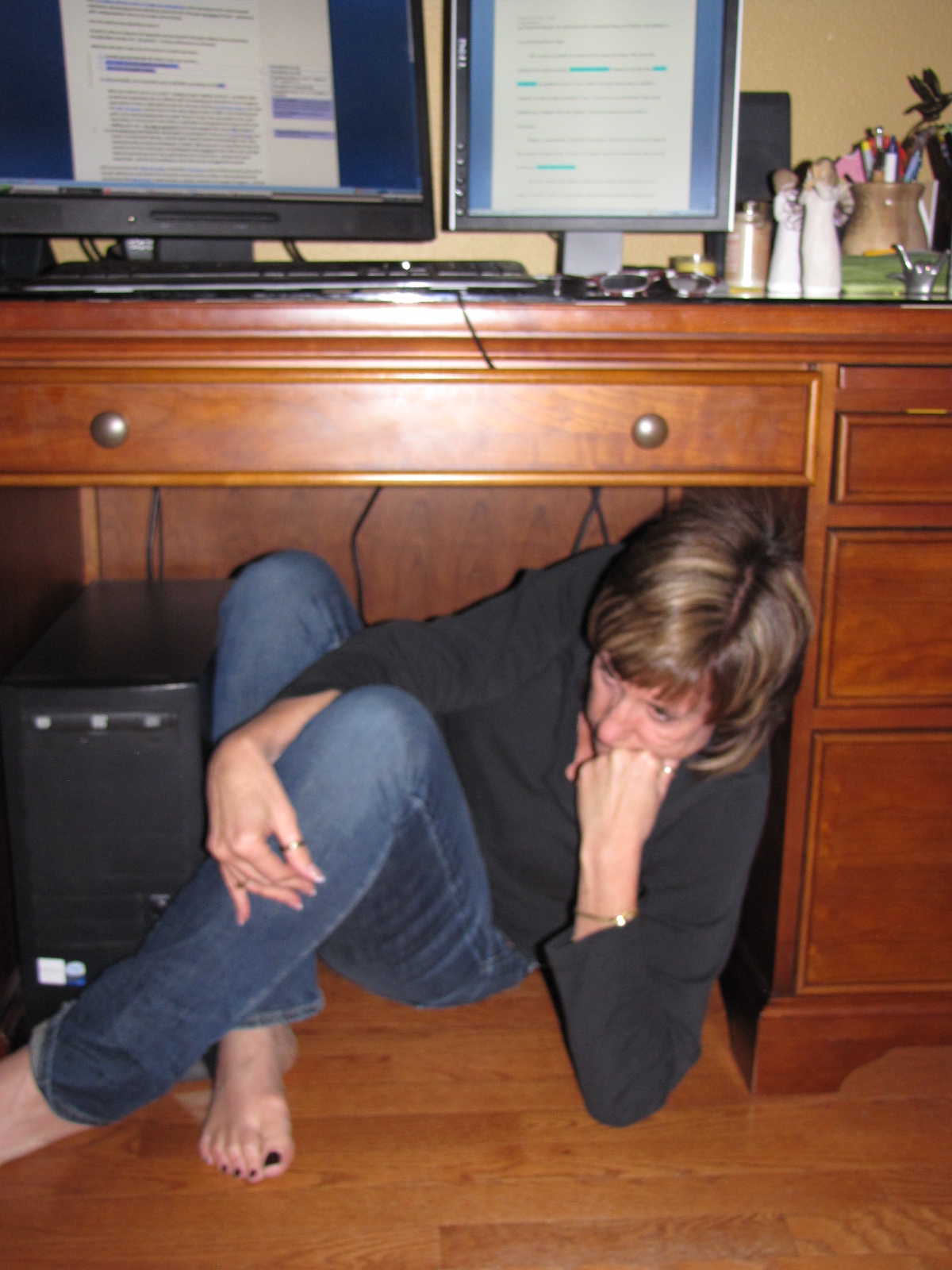
Shortly after my first novel, Yesterday’s Tomorrow released, once the bubbles in the champagne fizzed away and I stopped grinning and pinching myself, I admit to being completely overwhelmed and hiding under the covers for several days once I realized Oprah wasn’t going to call  reality set in.

Oh, I know. That won’t be your story. Your book will skyrocket to #1 on the NYT Bestseller List. Of course it will. But, just incase it doesn’t, at least not right away, you’re probably going to need a little help getting it into the right hands.

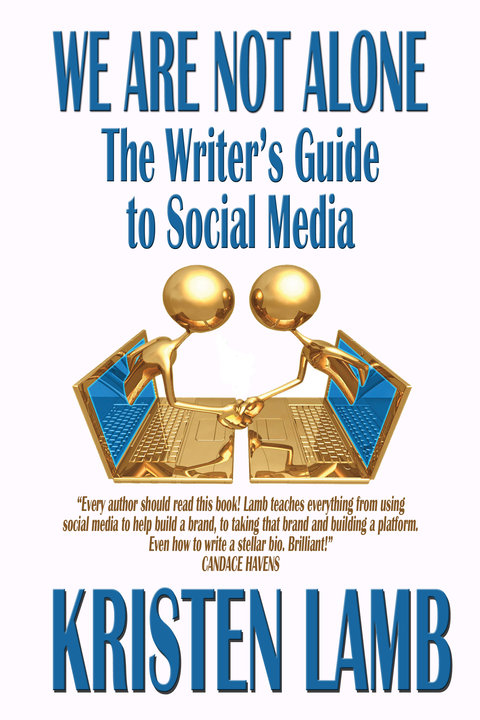
SO I’m really excited to introduce you to Kristen Lamb, the author of two books every published or not quite published author should rush out and buy – We Are Not Alone – The Writer’s Guide to Social Media, and, Are You There Blog? It’s Me, Writer.
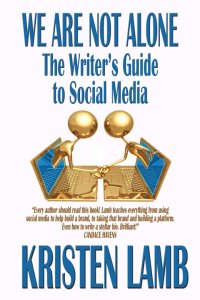
       

If you’ve been at this gig for a while, I’m sure you know Kristen. If not, I hope you enjoy meeting her today. Watch Read and learn.

Kristen, I love your tag line, We Are Not Alone… Tell us what this means to you and how you came up with it.

I didn’t start out wanting to be a social media expert. In fact, the words “social media expert” made me feel a tad queasy and overwhelmed. Yet, I kept going to conferences where “gurus” were teaching what I felt was a bunch of garbage. I was a writer first and knew that one couldn’t treat books like toothpaste and writers like tacos. So after a bunch of griping, I decided to own up and write a book. I wanted my book to be different. I wanted it to reflect what social media was really about—people and human relationships.

Too many writers couldn’t see the real advantage. We finally had control over our writing futures. We had help! So when it came time to NAME my book, the publisher wanted to call it something like  “Social Marketing for Writers” and I was like, “Why not just punch them in the face?”

I argued that my demographic played World of Warcraft and collected action figures and had season passes to Renaissance festivals and Trekkie conventions…like me. I knew if I named my book “Marketing for Writers” that writers would be more likely to power drink than buy my book. So, when I told this to my editor Jen Talty, she said, “Well, then what do you want writers to feel  when reading your book?”

And I said, “I don’t know *pout face.* Maybe, um. Hell, I want them to know that they aren’t alone.”

Then Jen said, “Why Not, ‘We Are Not Alone’?”

 I would love to claim that I came up with this brilliant title, but the credit goes to Jen.

You have certainly carved out quite a niche for yourself as a “social-media guru” and your books are extremely popular (and invaluable, I might add) within the writing community and beyond. Give us a glimpse of the journey you took to get here.

I spent way too much time on Twitter than is healthy for any sane person.

Wait…oh yeah. Inside words stay inside.

I hit a lot of buttons and made a lot of stupid mistakes. Then I figured out how to correct those mistakes and do things better and faster. I thank God every day that New York Times Best-Selling Author Bob Mayer let me have carte blanche to experiment on him…um, his platform.  In retrospect it was probably a good thing Bob had no idea what he was signing up for.

Bob was a unique challenge because he had been a best-selling author in FIVE genres and he had more personalities (pen names) than Sybil running around unattended.  It was a real challenge to figure out a way to balance all of Bob’s identities, genres and roles (fiction author, NF writer, teacher, speaker, publisher) without having him spread so thinly that social media was either a time-suck or a time-waste. I leaned A LOT from that experience. ..first and foremost that pen names are evil.

Bob got free social media help so long as he was willing to define “help” loosely…very loosely. Once I really got good at what I was doing, Bob asked me to write a book for Who Dares Wins Publishing and We Are Not Alone was born.

…and I sold ten copies the first month. Most of them to my mother.

I had spent so much time helping Bob build his platform, I kinda forgot my own. I had to buckle down and get to work building a platform and defining myself as a social media expert.

So when I tell you guys I made all the dumb mistakes so you don’t have to, I am really being serious.

What was the one thing you most hoped to accomplish through your book, and would you say you’ve succeeded in doing so?

I wanted writers to become a team, to love each other and support each other. Historically we have worked in isolation. Most people assume it’s because we are loners, weird or socially awkward. The real reason is we don’t want to share our Star Wars t-shirts. There, the truth is out.

I think many writers worked in isolation because, what was the alternative? Now, we have a way to combine our creative energies for good. We are like superheroes who have mad grammar skillz.

Do I think I’ve succeeded? WOW YES! By my calculations, writers WILL rule the world by sometime next year…which might explain why the Mayans predicted it would end.

How important is it for the author not yet published to create an online presence/platform?

Writing a great book is ALWAYS FIRST. But when you land that agent and the three-book deal, you DON’T want to be pulling a social platform out of your…ear. Start early. Slow and steady wins the race. I think a writer with a viable social platform is going to be the new norm in two years. Start now while it is still an advantage.

Fiction authors have a staggering failure rate. According to BEA statistics, in 2004, 93% of books sold less than 1000 copies (traditionally and non-traditionally published). This isn’t to scare anyone as much as it is to give you guys hope that we can finally beat those hellish odds.

There are only two ways to sell books—good book and word of mouth. We always had control over a good book, and had a 93% FAILURE rate. Oh, and those stats are from 2004, before my cat could get published. Lots more competition these days, so we are wise to do what we can to get an edge.

If you think you might want to self-publish or go indie, then you don’t have a choice. You MUST be on social media and do it well (For those who doubt, refer to  Kristen’s first book sales in question above).

What marketing advice would you give to a newly published author?

Don’t. Write more books. Write better and better books. Talk to people. Be authentic. Self-promote too much on social media and we call that spam.

Traditional marketing doesn’t sell books. Total waste of time. Bookmarks and book plates and giveaways might drive a handful of sales, but they are really tactics that make writers “feel” productive. Writers are better off spending that time on writing more books and better books. Spend the money on a massage and wine instead of a book trailer. The massage will do more for your writing career and the wine is wine…HELLO!

What is the best piece of advice anybody ever gave you?

You can have anything you want in life, if you help enough other people get what they want. ~ Zig Ziglar. Serve others first. Don’t worry about you. Focus on others and it comes back.

If you HAD to give up one area of Social Media (Facebook, Twitter, Google+, etc…), which one would you let go, and why?

I don’t care for G+. Maybe it is new, but I don’t see any advantages. Sure it has circles, but Facebook has lists. And I wouldn’t get all giddy about circles anyway. I don’t like sectioning people off based off what I think they might want to know. Hey, I’m a writer and if you don’t want to hear about writing don’t let the digital door hit you in the digital butt.

Thing is, we never know who is watching us. Some of those people you think don’t want to hear about all your writing crap are actually gonna be your biggest fans. The receptionist at my son’s pediatrician has bought three books off me and talks about me to anyone she meets.

I’m the only writer she’s ever met. To her, I’m a celebrity. Okay, so maybe she needs to get out more. But my point is, what if I had put her in a circle of people I thought didn’t want to hear about my writing?

Also, if your mother can’t read what you are posting, don’t post it.

Anything else you’d like to share, personally or professionally?

Learn to have a healthy relationship with failure. If we aren’t failing then we aren’t doing anything interesting. I would love to tell you guys that my books and blogging classes will make you a perfect blogger on Day One, but that would be awesome marketing a lie.

Just Do It

The more we write, the better we get at blogging and writing novels. We try, we fail, we reflect, we try again. The better we get at failing, the faster we will meet with success.

It’s been great having Kristen with us today! So let’s talk.

Do you have any burning questions about social marketing? Do you feel you’ve got a good handle on it or does the whole thing still scare the beejeebers out of you?

About Kristen Lamb:
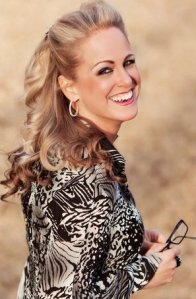
Kristen worked in international sales before transitioning into a career as an author, freelance editor and speaker, and she takes her years of experience in sales & promotion and merges it with almost a decade as a writer to create a program designed to help authors construct a platform in the new paradigm of publishing. Kristen has guided writers of all levels, from unpublished green peas to NY Times best-selling big fish, how to use social media to create a solid platform and brand. Most importantly, Kristen helps authors of all levels connect to their READERS and then maintain a relationship that grows into a long-term fanbase.

Currently Kristen is teaching workshops based off her best-selling book We Are Not Alone–The Writer’s Guide to Social Media at various writer conferences across the country. Stay tuned for a workshop in your area.

Kristen is represented by Russell Galen at Scovil, Galen and Ghosh Literary, Inc in NYC.

Police Work and Writing

For the past twenty years, I’ve worked as a 911 dispatcher. In the beginning of my career, I worked the graveyard shift at a busy California Bay Area police department. I cut my teeth on everything from stabbings to suicidal callers. My husband and I first met over a homicide. I dispatched him to the call; a drug deal gone bad. I know, not your average boy meets girl story.

Over my career, I’ve taken thousands of emergency calls and each one has molded and shaped my dark sense of humor and often cynical-quick-to-judge personality. After all, I get paid to judge in a matter of seconds, type-coding a call that will determine the response of police/fire/ambulance.

As an author, the road to publication twisted and shaped the writer I am as well. I can’t help but see clear parallels between a writer and police work.

It’s not always what it seems. A detective is trained to look for what the untrained eye doesn’t see—things like blood patterns, fingerprints, and previous cell phone activity. A writer’s path isn’t always an obvious three-step plan either. The craft must be studied, worked on, and almost never is how we dreamed it would turn out, with twists and turns taking you places you never thought you’d be. My two-page personal essay became a nonfiction book for moms—who knew?

Friends matter. Whether you’re the suspect or the victim of a crime, who you’ve associated with always comes into play. As a writer, who do you hang out with? Do you network with other writers/authors? Or, do you think your work is so good you’ll be miraculously discovered? If you truly believe this way, you couldn’t be more wrong. Trust me when I say: it’s only a matter of time before you’re a victim of un-success. Writing can be very solitary. Having someone come alongside who understands the ups and downs can make all the difference.

Word of mouth. Home invasions are almost always drug-related, a targeted place where the suspect has planned to regain their lost monies or steal drugs from someone they know. Occasionally, it’s a friend of a friend who bragged to the wrong person about their parents jewelry and non-belief in banks. As a writer, your reputation begins as soon as you share, “I’m a writer.” Once your words are published via blog, articles, or any other venue, your branding begins. Conferences, retreats, writer’s groups, and online relations are where your reputation is formed. Use every connection as an opportunity for helping other writers as well. I like to remind myself, no matter how well I write, I will never rise above the reputation my family, colleagues, and readers have of me.

Are you a victim?  I hate to break it to you…there aren’t as many victims as you think. Tough to hear? It’s true. The media loves to play on viewers emotions. As a writer, are you a victim? Do you suffer from itshouldbeme-syndrome? Do you believe every agent/publisher/editor just doesn’t understand your talent? Are you giving up the writer-ghost while complaining to everyone who will listen? Writer-victims aren’t as common as you’d like to think either. If your work is really that good and you are actively putting it in front of the right people, it will eventually be recognized. So, hang in there!

Writing and police work have a lot in common. After twenty years, my heart still races when I handle a hot call. There’s nothing like calming a woman who’s hiding from an intruder downstairs, encouraging someone to live another day, soothing a child who’s called an ambulance for their sick grandma, or the sound of a baby being born. The same can be said about writing. My heart still races when I submit an article, or speak before a crowd. There have been sleepless nights, anxious calls to writer-friends, and though my first published book is far from the New York Times best seller list—it’s been the ride of my life.

What about YOU? Does your writing journey have anything in common with your paying job?

A Writer’s Life: The Pit of Despair

Whenever I watch The Princess Bride, I skip the Pit of Despair segments. Popcorn, anyone? Maybe rewind to the Fire Swamp?

Sure, the Albino with the needs-to-cough-up-a-hairball voice is a bit of comedic relief before discovering our hero Westley is in the Pit of Despair. His future? Torture — attached to a life-sucking machine. His only escape? Death.

Am I the only one who skips these scenes?

As writers, there are days we are trapped in our personal Pit of Despair, without even a somewhat friendly Albino nearby. Life — our passion — is being sucked out of us, bit by bit.

What does Westley’s trip to the Pit teach us? Consider two truths:

  1. Truth # 1: Enemies get you into the Pit.
  2.  Truth # 2: Friends get you out of the Pit.

What about those enemies?
Inconceivable, isn’t it, how both success and failure dump us in the Pit.

When you succeed as a writer — land an agent, sign a contract — you think: Other people have expectations for me. What if I fail? Overloading yourself with the real or imaginary expectations of others tumble you into the Pit faster than the Dread Pirate Roberts can scale the Cliffs of Insanity.

And then there’s the slippery slope of failure: never attaining your goals, never quite grasping whatever spells “victory” for you. The root problem is the same: expectations. Fear you won’t meet others’ expectations or disappointment in yourself for not fulfilling your own. The bigger question? How do you navigate both success and failure?

At last! It’s time for the friends.
Westley didn’t rescue himself. The heroes? Fezzik and Inigo, who found a “mostly dead” Westley in the Pit. But that didn’t stop his friends from hauling his body out to go looking for a miracle.

When you can’t see the faintest hope of a miracle for the forest of despair surrounding your writing dreams, who searches for you? When you no longer believe in yourself, in your story, who believes in it for you? And — perhaps even more importantly — who do you go looking for when they’ve been dragged off into the Pit of Despair?

We’ve peered over the Cliffs of Insanity, survived the Fire Swamp, and now find ourselves at the Pit of Despair. Which have you found to be the greater enemy: success or failure? How have friends rescued you? Like Miracle Max, I believe it takes a miracle sometimes for changes to happen … so if you have any of those to share, please do!

For Fun: The Princess Bride 25th Anniversary cast reunion

Post Author: Beth K. Vogt

Beth K. Vogt is a non-fiction author and editor who said she’d never write fiction. She’s the wife of an air force physician (now in solo practice) who said she’d never marry a doctor—or anyone in the military. She’s a mom of four who said she’d never have kids. She’s discovered that God’s best often waits behind the doors marked “Never.” She writes contemporary romance because she believes there’s more to happily ever after than the fairy tales tell us.

First Contract Jitters

It wouldn’t happen to me.

At least not full-blown.

After all, I’d written for ten years, penned multiple novels, experienced a myriad of rejections letters, sold a bunch of articles, and met repeated free-lance deadlines.

I would NOT get the dreaded-first-contracted-book-jitters. Or writer’s block. I was a professional, just taking a next step in the industry.

Right?

You know what’s coming. My first book deal was contracted on a chapter and a synopsis. It was time to write to meet my first book deadline.

Only I needed to do more research. Read more widely within the genre.

I read 13 novellas in less than two weeks.

Obviously, it was becoming an addiction, all of this reading instead of writing.

I should quit—and would—as soon as I finished the 400 page novel that just arrived in the mail.

Then my friend brought me her collection of novellas to help with my research.

(Why do best friends feed addictions? Seriously!)

I had to write.

So I tackled every left-brained project I could find. I wrote non-fiction free-lance assignments, submitted proposals, started a devotional facebook page, and spent a bunch of time networking and marketing.

Which made my brain hurt, so I slipped away with a good book . . .

Renewed and with great resolve I went to bed excited for the morrow, when I would do nothing but write my first contracted novella.

I got up earlier than usual—not because I was eager to write, but due to the need to escape nightmares about inadequacy.

Bleary-eyed, I curled in my recliner, grabbed my journal and Bible, and prayed it through. The Lord reminded me of His promise ten years ago to lead me on the best pathway for my life, to guide me and watch over my writing journey (Psalm 32:8).

He asked if He’d done a good job so far. I said yes. He asked why I would think He would stop now. I said He wouldn’t. He promised to be with me.

Buoyed by God’s assurances for this new writing season I told my husband the whole wonderful story. Then promptly burst into tears.

The sweet man tried to hide his chuckles as he reminded me I was living my dream—that I could do this. Then he resorted to an illustration that good, non-fiction reading, left-brained, red-blooded husbands turn to: football.

Quoting Tim Tebow, the Bronco’s new wonder boy, my husband talked about going out there and doing what you love because you love it and because it is fun.

Oh, yeah.

This is what I love to do, this thing I’ve been avoiding for the past month. It’s fun.

No more fear! I’m going to get creative and let this story pour from my fingertips  . . .

Tomorrow.

(How about you? Got a “first contract jitters” story?)

Guest Blogger: Emily Rodmell for Love Inspired Historical

I’m excited to welcome a special guest to the WordServe Water Cooler–Emily Rodmell, associate editor for Love Inspired, Love Inspired Suspense and Love Inspired Historical. She also coordinates the lines’ continuity series. You can find her online at Twitter @EmilyRodmell or at Harlequin.com.

Good morning Wordserve Water Cooler. My name is Emily Rodmell, and I’m here today to chat with you all about a great opportunity for historical romance authors.

As associate editor for Harlequin’s Love Inspired lines, I get to work on inspirational contemporary romance, romantic suspense and historical romance. And it’s the Love Inspired Historical line that I’m here to talk about today.

Love Inspired Historical is a line dedicated to Christian historical romance from any time period before World War II. It started publishing two books a month in 2008, and early this year we doubled the amount of books we put out each month to four. That’s great news for historical romance readers, but it’s also great news for historical romance writers because it means that we need double the amount of authors. Since the expansion, we’ve welcomed around 20 new authors to the group, and we still have room for more.

If you love the days of old, we’d love to see a submission from you. We’re looking for great, emotional love stories set in a variety of settings and time periods. We always welcome Western stories, but we’d also love to see settings such as Biblical, Regency, Amish, Scottish, missionary and other unique eras that you’re passionate about. Make your characters relatable and your plots unpredictable. While we all know that the hero and heroine end up together in a romance novel, it’s the journey to that happily ever after that’s the fun part. Also, make sure your characters have something keeping them apart that they must overcome. Conflict, both internal and external, is vital to a successful romance.

We’re open to both published and unpublished authors. If you’re a published romance author, we accept a submission of a proposal (synopsis and three chapters). If you’re unpublished in romance, start with a query letter and synopsis, but make sure to have a full manuscript ready to send should we request it. I’m also open to submissions for our other two lines: Love Inspired and Love Inspired Suspense. You can mail your queries to my attention at 233 Broadway, Ste. 1001 New York, NY 10279 or have your agents get in touch.

Your Turn: We’re eager to see what you come up with. I’ll be around today to answer any questions you’d like to ask about writing for Love Inspired Historical.

My Reader, My Patron: How Authors will Survive in the Brave New Publishing World

I want to tell you about a musician friend of mine from college. The fact that this particular musician is a long-ago friend of mine has given me some serious street cred with my boardgamer buddies. But I’m not telling you about him to increase my geek-chic quotient. Instead, I want you to know that this very smart guy figured out how to make a living in the music industry–even though the industry had changed overnight from a scene dominated by major labels to a fragmented cyberworld of digital downloads. (Sound familiar to anyone in publishing?)

Six years ago, Jonathan Coulton realized that he had to appeal directly to his fans to support his art. He quit his job and started amassing a collection of his music online. He put fans on their honor to pay him for his digital music downloads, even though they could be downloaded free. He recommended a donation of $1 per song. Here’s an article about what he did. You’ll see many parallels in his life to what’s going on for authors in publishing today.

It worked. His determined fan base gathered around his website and sent him money to buy his music, because they knew that without it, he could not continue to make art. Eventually, he moved to a more traditional sales model, but the foundation of his success was appealing directly to his fans and letting them know they were his only patrons.

Writers, we need to support a similar revolution in consciousness among our readers. Right now, readers don’t realize that each one of them is a patron of the arts–that each buying decision determines which writer will survive and which will not. The reader’s power is disguised by the middle men: publishers and booksellers. Readers think that because our books are available in bookstores, someone must be buying them, correct? So what does it matter if they pay for a book or just get one from the library?

We have this new and growing problem: readers who would ordinarily be our most devoted patrons are starting to get our books for free through promotions, especially through e-book giveaways. These valuable readers don’t realize that the cascade of free books will eventually cause the professional demise of the authors they love. It’s not clear to them that they are our patrons, and without their support, we perish.

As a reader, I have my own strategy to support my favorite authors and allow them to keep writing, so I’ll share it with you here as advice for those who also wish to support the novels they love.

Patrons must be selective. When you choose books to buy, make sure you’re buying the books you love most. If you receive books for free, but you absolutely love one of those books, then go out of our way to purchase a copy of that same book. Give multiple copies as gifts, if the book is that good. If you don’t buy it, you can’t count on other people to do so and thereby support the author so you get to keep reading his books. YOU are the patron.

I hold fast to the hope that in the next few years, new models of publishing will develop that strengthen the bond of support between reader and author. I think we’re going to see a resurgence of patronage for writers through these more direct sales channels, and wonderful things will result. But as we move into this brave new world, we’re all going to have to be more conscious that as readers, we are patrons. And as writers in a world where books are being devalued by giveaways, we need to find tactful ways to make it clear to readers that without their financial patronage, our work will not survive.

Carpe Diem—Seize the Day!

Carpe diem, quam minimum credula postero
“Seize the Day, putting as little trust as possible in the future.”
~ Horace


My first few heady months on the fiction venture promised much.

The last word of my manuscript hit the page less than four months after my first fiction word. Another four months flew by as I started a blog and attended a writer’s conference—garnering one agent’s rejection, one editor’s request for a proposal and manuscript, and a second agent’s offer of representation.

God Himself seemed to prompt the flow of words and throw open doors for this new calling. I surely owed Him my best in return, and wholeheartedly threw myself into pursuit of publication, believing I’d obtained a ticket on the fast track.

Then reality hit. Decades of only legal and ministry writing left some room for developing fiction craft. More than one re-write lay before me. Platform building needed some time.

Other writers offered Helpful Tips:

“The secret to writing is butt in chair—put it there and don’t move it.”

“A sign on the closed door to my office reminds the kids: ‘DON’T KNOCK UNLESS YOU’VE ALREADY CALLED 911.’ ”

“Followers = Platform! Spend hours on blogs, leave oodles of comments, and watch your numbers soar.”

Such measures never quite hooked me. But my perspectives did shift. I kept the fridge stocked and laundry baskets filled with clean clothes, lest ordinary mortal tasks of meal preparation and laundry be utterly neglected. Sleep became a nuisance once my art-driven energy soared. Spare moments were afforded to non-online faces.

Somewhere along the way, I started to forget: Writing about life doesn’t replace living life.

So teach us to number our days,
That we may gain a heart of wisdom.
~ Psalm 90:12 (NKJV)

Thank God for kids who won’t be ignored. However compelling the calling to write, God forbid that I ever see the day’s word count or blog post as more important than my husband or kids being certain of my love, than working through conflict, than spending some time with someone who’s hurting.

I do have a calling to write which is blessed by the Lord and worthy of my dedication. Professionals have affirmed the compelling story I’ve written. My stellar agent and I both have high hopes for my future in publishing.

But I’m content to wait for a novel’s release date, now that I’ve learned:

“Every day is an opportunity to make a new happy ending.”
~ Unknown

P.S. to post: I never actually adopted those tips, or employed that sign. But feel free to use it if the Lord leads YOU …

How to Get Any Book Into Your Lap…Free!

Have you ever been in the situation of wanting to look up one item in a book, but the book is either expensive or obscure. Chances are you turn to your local library. Many people know about Interlibrary Loan (ILL) within their own library system, but what happens if your library system doesn’t carry a specific book?

In my last post I described how to get ahold of serious research in professional journals by accessing your library’s computer database. Today I want to describe how to get any book, from places all over the world, and have it delivered directly to your library branch?

The first time you do this it may seem tedious, but once you know how, it’s a breeze. I typically order about a dozen books a month this way. Your library system may vary, but here’s how my library does it:

  1. Bring up my library web site: Jefferson County Library
  2. Click on maroon-colored icon called “Research tools”
  3. This brings up:  “Subscription Databases A – Z” Click on this.
  4. In the Databases A to Z, click on “W” and choose “World Cat” or scroll down to “World Cat” Click link.
  5. Search for book. It is best to put several items in the search boxes. For instance, the book title and the author. Here I selected the title Seeking Peace and the author Mary Pipher. (I write about self-care and wanted to see how a bestselling author and psychotherapist burned out and subsequently learned to simplify her life.)
  6. When the world catalog finds your book, either print out the page, move it over to a dual monitor, or jot down the most important items: Publisher, year, and the OCLC number. (For Mary Pipher’s book the OCLC number is at the bottom of the page and is 233547957)
  7. Now go back to your library’s main screen. Choose the blue icon on the left side, “Find Library Books and More” – You will find a link called “Interlibrary Loan Request.” Double click. At the bottom of this page is a link called “ILL form for Books/AV Materials.” Click on that.
  8. Fill out the author, title of book, publisher/place/date, format (book, video, DVD), pick-up location (for me that is “Columbine Library”) and OCLC number.

*I don’t fill out the part about paying money for the request or the “cancel if not filled by date” information.

At the bottom of the page, I type my name and library card number.

Voila!

Almost any title from across the miles will be delivered right to my library. It takes about a week. If you find this confusing, go into your library and ask how you can use the World Catalog and Interlibrary Loan. Chances are your librarian has a bookmark with instructions already printed on them.

I’m curious, did you know you could do this?  What research tips do you have to offer writers?