Through A Curtain Darkly

“You should close your eyes and rest,” my husband said. “Doctor’s orders.”

He led me to our room, this kind man of mine, and started to pull the shades.

“Leave them open,” I said. “I need to see.”

I’d just lost our first son to miscarriage. I’d held his perfect body in my hands, his spirit by then already flown to Jesus. We baptized him ourselves with our tears, somehow finding the grace in that holy moment to accept the most solemn of truths:

The Lord both gives and takes away.

And so my love left me there upon our bed, a mother without a child, to focus through wispy curtains on the outdoor landscape. The land of the living, so far beyond my reach.

Out there, somewhere in the sky, was my baby, my heart. The trees bore only the merest buds of springtime that afternoon, little more than hopeful witness to the coming leaves of summer. But the frothy valances, stirred into sashaying billows by the open windows’ April breeze, slipped into ethereal life.

When I narrowed my eyes, the roses woven into the lace became buoyant blooms superimposed on the naked treetops like bouquets of pure white, their stems wrapped in brown satin ribbons.

I opened the drawer of my table, pulled out a paper and pencil, and began to write. The words flowed from my brokenness through my fingertips—a poem about how God counts the leaves on the trees, the grains of sand around the seas, and most of all, His children’s tears.

How He saves those tears in a bottle.

As I neared the end of the page, I squinted against the dimming of the day’s slanted light, unsure even then if the growing shadows were cast by the sun or by my soul. The lacy roses blowing through the treetops glistened like diamonds. I imagined our baby sprinkling fairy dust onto the blossoms, laughing with delight as he made each one twinkle.

For my eyes only.

The last lines of the poem came to me then, and I scribbled them beneath the others.

“There He’ll give us each a crown; Each tear will be a gem.                                            The bottles will be emptied, and we’ll never cry again.”

It happened many years ago, this otherworldly vision, almost another lifetime ago. But I still recall feeling suspended between heaven and earth as I captured my fleeting feelings, and I’ve never forgotten the magic of the rose trees swaying in the breeze.

Whenever I lay my head upon my pillow, from then until now, a journal and pen rest nearby. Of the hundreds of thousands of words I’ve composed since that tear-stained afternoon, many have been written between dusk and dark.

Who knows? Perhaps in the filtered light at sunset on an evening yet to come, roses may once again take flight.

And my words will reach God’s heart on petals of shimmering lace.

A Match Made In (Critique) Heaven

If Katherine and I start looking like this, we're going to the spa.

Finding the right partner can be fun, enlightening, and even life-changing, but it can also be fraught with disappointments, hurt feelings, and confusion. Um, I’m talking about critique partners. What were you thinking?

I am blessed to have worked with Katherine Hyde for over six years. I knew critiquing was a valuable part of the writing process, but it was scary to think of turning my words over to someone else. And it was just as intimidating to give feedback to someone else about their story. Katherine and I have assembled a few pointers for successful partnerships.

Finding the One                                                                                                        Charise: Katherine and I met at a writer’s conference. And actually, I met my other partner at a writer’s conference. So, there’s one thing: you don’t have to have just one (unlike in life partners and then, really, one is plenty unless you want a reality show and legal trouble). You can find a critique partner through conferences, local writing groups, and national associations.  I think it’s important to have some mutual understandings of how the process will work. Maybe try a sample first to see if you’re a good match. You are inviting criticism of something precious to you (your story, your words) so you want to be sure your partner will not only be honest, but be honest in a way that leads you to better writing and doesn’t crush you, rewrite you, or delude you that you’re better than you are.                                            Katherine: How do you know you’ve found The One? She gets your writing on a deep level. She loves your writing for itself; she’s not constantly trying to make it over into her own image. She wants the best for you, and that means she’ll be both honest and compassionate. Her critiquing style fits with your style; her strengths and weaknesses complement yours.

Keeping the Romance Alive                                                                              Charise: I like that my partners and I have a friendship beyond critiquing. I value our rapport beyond the critiques we exchange. And I feel that friendship helps us “get” each other better on a writing level too. Even if you’ve been together for a while, remind your partner of why you appreciate them. We writers can be fragile souls. It helps to hear that our insights are valued. That our attempt at creating something with words is worth it. I also like flowers and chocolate…                             Katherine: Make sure you both know the rules going in. The rules for how much material you exchange and on what schedule, what depth of critique you want, etc. The rules can be flexible, as long as you work them out together. Always make sure any negative feedback is tempered by something positive. Be reliable–keep to your commitments or let her know why you can’t. And remember, what happens in the critique relationship stays in the critique relationship.

Resolving Differences                                                                                   Charise: As with all relationships, communication is key. I think it’s important to not lose sight of the fact that it is only your opinion (no matter how right it may be) you are giving to your partner. Don’t forget their story is THEIRS, so it is your partner’s prerogative to ignore you. However, before you ignore something, think it over and make sure you’re not being defensive. You need to be open to learning.       Katherine: Your relationship should be based on mutual respect, kindness, and remembering you’re on the same team. These will go a long way toward resolving any differences you might face. Try to remember that even though your WIP feels like your baby, or sometimes like your own raw stripped-to-the-bone self, to your readers it’s just a book. It has to work as a book. Your critique partner is there to help you make it work.

As humans we are made for relationships with our true loves, friends, family, and even our pets—as writers we are made to have a critique partner. If you refuse to critique others or have your work critiqued, you will not be romanticized like some George Clooney-esque confirmed bachelor. You will be the lonely hermit that people whisper about. Okay, not really. But the right critique partnership will make you a better writer. And who doesn’t want that?

Questions for the readers: Do you have a critique partner? Do you have more than one? How did you meet? What’s it like for you? Do you have any good tips for successful partnerships?

Post Author: Charise Olson

Charise Olson writes contemporary women’s fiction. She likes to say she writes California Fiction. It’s like Southern Fiction, but without all that humidity. Her characters face serious life situations and cope with humor. Someone always has a smart mouth and Charise claims IM-plausibile deniability as to their origin. Charise is a mom to anyone needing mothering (whether they think they need it or not!) and owns two alpacas. Why alpacas? Because they were cheaper than a lawn mower. The menagerie also includes two dogs and two cats. In addition to her fiction writing and family, Charise has a paycheck career in social services and education.

Everyday (budget-friendly) Marketing Opportunities

When we dream of marketing, we think of big bucks poured into paid advertisements in magazines or online site, eye-catching displays in bookstores, engaging book trailers, or flashy billboards (hey, I told you it was a dream).

Don’t lose heart. There are opportunities for everyday marketing that cost little to nothing:

  • Blog—Maintain a blog.
  • Group blog—Participating with friends in a themed blog. The upside is that you don’t shoulder the entire responsibility to update a group blog. Our WordServe Water Cooler blog has 46 contributors.
  • Blog hop/blog tour—Spread the word about your book by creating a blog tour on friends’ and influencers blogs. If you’ve already published, perhaps some of your readers might be happy to participate.
  • Online radio—There are several programs interested in hosting authors. Email the hosts to see if there’s a good fit. Check out Virtue Radio Network or Blog Talk Radio.
  • eNewsletter—Whenever you do a book signing or author appearance provide a sign-up sheet for your newsletter. Also make sure readers can sign up on your website, and send readers to sign up from your blog or Facebook. Here are some different options for newsletter programs: Constant Contact, Vertical Response, Your Mailing List Provider, Mail Chimp.
  • Local radio—Yes, there still are local radio stations that would consider hosting you on one of their programs.
  • City and County TV stations—I’ve been fortunate enough to be a guest on two different local TV shows about books and authors. Both of them were affiliated with the community library system. Don’t discount this opportunity, both programs were re-run many, many times, and lots of friends and acquaintances mentioned they’d seen the show.
  • Local magazines/weeklies: send a press release.
  • Library events—contact your local library to see how they work with authors.
  • Booksigning/author events: My town loves to close down Mainstreet on Sundays from late spring to early autumn for a farmer’s market and merchant festival. The library district loans out its booth to local authors. Check with your library PR person or Chamber of Commerce to see if your area has opportunities like this.
  • Twitter
  • Facebook
  • Be available to speak in your community
  • Often employers will let you mention your new book in their newsletter.
  • Church/community newsletters might let your place a blurb.
  • College alumni magazine—Send them a press release about your book.
  • I put a notice and some bookmarks on the community bulletin board at my neighborhood rec center, and a neighbor I’ve never met bought four copies and contacted me to sign them for her. Isn’t that cool?
  • Charity events: donate $1 for each book sold at a local event.
  • Respond to writers’ loop emails, and be helpful. Get to know other writers because writers are also readers.
  • As soon as you have cover art, print bookmarks and pass them out everywhere! I give bookmarks to wait staff at restaurants, people in line at the grocery store, etc. Send them in Christmas cards.
  • Be brave: discuss your accomplishment everywhere—dentist, pharmacist.
  • Put a notice on your website that you will visit local book clubs and be available for conference call visits with book clubs.

Do you have any marketing ideas that you can share? Please do!

Simple and Sincere

Novel readers and children share a common characteristic.  Both have a nose for sincerity. If they catch the faintest whiff of guile or disingenuousness, you’ve lost them.

In writing and teaching children, you must be sincere.

I pondered this when I watched a videotape of my first grade music students. They sang about falling leaves, and the excitement in my voice as I guided them was obvious. Their faces and singing voices reflected my enthusiasm.

Watching the tape reinforced my suspicion: students respond to me because I love their songs. Though I’ve sung opera and studied the classics, I haven’t lost my taste for the simple things. I find simple truth in “Shoo, Fly” and simple beauty in “All night, all day, angels watching over me, my Lord.”

When I sing the songs of childhood, I believe them in the most hidden labyrinth of my soul. They resonate with me, and not because they’re “cute”. Fun, certainly. Entertaining, beyond a doubt. But if a song smacks of cuteness, I refuse to sing it. My students are too precious to patronize. They deserve simple, powerful songs that convey joy, truth, and beauty.

So do readers. They deserve a story we believe in, one that conveys truth, joy, or beauty, and preferably all three. They won’t be pandered to. They will respond to a book that burns its way out of us with tears, smiles, excitement, pain, or revelation. They will sense the engine of passion behind each line, in the subtle rhythm of a story we had to write. That doesn’t mean they’ll love the story. But if we tap into that rhythm, they might continue reading until the last page, until the last chord fades.

Honest, uncontrived passion. That’s what students and readers crave.

Did you ever try to write a book that didn’t resonate with you? Did you keep at it until it did, or did you scrap it and move on to a new project?

First Do No Harm

There’s a saying among medical practitioners, loosely based on the Hippocratic Oath: First do no harm.

This tenet works as a fundamental principle for editing someone’s manuscript too. Before you pick up that red pen, remember: First do no harm.

A writing buddy shared how one editor repeatedly told her that she wrote absolute junk–and that she’d never be published. The result? My friend stopped writing. With that kind of editorial feedback, can you blame her?

When I edit  or critique someone else’s writing, I remember these key guidelines:

  1. If you can’t say anything nice, don’t say anything at all. My mom told me this all the time when I was a kid–and it’s still applicable today. Don’t jump right to the “this isn’t working for me” comments. You’re holding a pen, not a butcher knife. What do you like about the manuscript? Comment on that first.
  2. Just because you see dozens of things wrong with a manuscript doesn’t mean you have to point out every single one of them. If you’re in a critique group, more than likely someone else will also notice misspellings or passive verbs. Pick two things to talk about–maybe how the hook could be strengthened or how the writer head-hopped.
  3. Above all else, be trustworthy. Respect each writer’s work. Isn’t that what you want? Editing or critiquing isn’t altering someone else’s writing so that it’s an echo of your voice. Editing means helping someone else’s voice shine more clearly, unencumbered by run-on sentences or rabbit trails or an avalanche of adjectives and adverbs.

The next time you have a chance to critique or edit another writer’s work, ask yourself:

  • How would I feel if someone critiqued my work-in-progress (WIP) this way?
  • Is my feedback going to encourage or discourage this writer?
Before you pick up your red pen, remember to do no harm to your fellow writer.
So tell me, have you had any experiences with harmful feedback? How did you handle it? Any suggestions for giving worthwhile critique or edits to another writer?
 

Post Author: Beth K. Vogt

Beth K. Vogt is a non-fiction author and editor who said she’d never write fiction. She’s the wife of an air force physician (now in solo practice) who said she’d never marry a doctor—or anyone in the military. She’s a mom of four who said she’d never have kids. She’s discovered that God’s best often waits behind the doors marked “Never.” She writes contemporary romance because she believes there’s more to happily ever after than the fairy tales tell us.

Speed Bumps On The Road To Publication

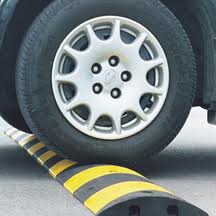
I was driving through the resort grounds in Jamaica, navigating the unfamiliar territory with difficulty in the darkness, when I saw the sign: “Sleeping Policeman.” I was wondering what a police barracks was doing on the grounds of the hotel when I was sent airborne, straining at the seatbelt while my back teeth clattered together. In the clarity that followed, I realized that I’d just seen the Jamaican equivalent of a “Speed Bump” sign.

Just as there are speed bumps on the roads we travel, there are speed bumps on our road to writing. Let me warn you about a few I’ve encountered, because—as I learned the hard way—when we know about the speed bumps they don’t bother us as much.

1) Constructive criticism is necessary. When we write, we know that ultimately someone is going to read what we produce. That’s what it’s all about. But if the only person who reads our work before we submit it to an agent or editor is our spouse or parent or Aunt Sally, we can’t expect any beneficial feedback.

The beginning writer doesn’t generally produce a Pulitzer Prize-winning first novel. But informed and constructive criticism allows us to correct our errors—and hopefully refrain from repeating them—so that everything we write afterwards is better than what went before. Find someone who is knowledgeable, ask them to read and critique your work, and be prepared to experience both pain and growth as a writer.

2) Rejections can convey a message. For a writer, rejections are a way of life. We might as well get used to it. But sometimes, in addition to the usual boilerplate language of “Not right for us at this time” or “Doesn’t fit into our plans”—both of which could be true—an agent or editor may make a comment. When that happens, pay attention.

Admittedly, there are times when the comments aren’t exactly helpful, as when an editor returned one of Tony Hillerman’s stories with a note to the effect of, “This might be better if you get rid of all that Indian stuff.” Of course, Hillerman went on to be an award-winning, multi-published novelist with his books about Jim Chee and Joe Leaphorn. But sometimes there’s a ray of hope in the comment, such as “I’d be interested in reading this again if you (fill in the blanks)” or “This shows great promise. I’d like to see your next one.” That’s when you take a deep breath and plunge on. The speed bump has slowed you, but it hasn’t brought you to a stop—just redirected you.

3) Hurrying can cause problems. Admittedly, I was in a hurry when I first made the acquaintance of the “Sleeping Policeman” in Jamaica. I’d have been better served by driving more slowly in the first place. That lesson can carry over into writing. Don’t be in a hurry.

You’ve just typed the last line of your first novel. Now how quickly can you send it off the every agent on your list? Hold on. I did something like that with my first novel, submitting it to the editor who’d encouraged me at a conference, and now I’m embarrassed to read it. It was a good first effort, but by no means was it a publishable book. The best advice I can give you is to let the manuscript cool—for a week, a month, or more. Then read through it like an editor, not a writer. Can you remove excess words (or, as Mark Twain put it, kill the adverbs) and passive voice passages? Are your characters well-drawn? Does the plot move smoothly and logically? Then, when you are sure it’s your best work, send it off.

What next? Why, start on the next book. Speed bumps are meant to slow you down, not stop you and make you turn back. Good luck.

The Bloody Page

I received my first critique of my first book (from someone other than my mom or husband) in the spring of 2008.

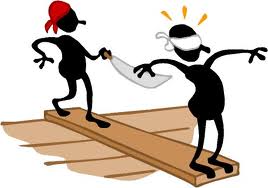
After much fear and trembling, I’d joined a small critique group through ACFW (American Christian Fiction Writers.) Pushing send on that first submission made me feel like I was walking the plank on a gigantic pirate ship, destined to plunge into the shark-filled waters, causing my poor words to be slashed and slaughtered.

What if they hated it? What if they came back and said it was the worst thing they’d ever read? Worse, yet, what if they said it was fabulous but silently snickered behind their cyber-mail back and plotted ways to kick my sorry rear-end out of the group?

But then a thought came to me. What if they really DID love it? What if my work was utter brilliance, and they begged me to critique their work because of what they felt they would glean from my writing prowess? (Think jumping off the plank only to be rescued by friendly dolphins who let me ride on their backs while those on the ship hoot, holler, and applaud!)

I’m sorry to report, the reality was somewhere in between, leaning toward option A.

The critiques I received back were a bloody mess. And I’m not swearing in a British accent there. Comments overwhelmed the pages, words were sliced everywhere, whole paragraphs were victims of the brutal attack.

At first, I was left numb. But as I read through the notes, the wheels in my head started to unthaw and turn. Their notes to a very novice writer started to make sense. Show, don’t tell. Don’t explain here. Explain this more. Adverbs in every sentence is not a fab idea. Adjectives after every noun doesn’t help the cause. Beats, not tags. The list of my faux pas goes on and on.

After a day of mourning, I got to work.

I’d love to tell you that I rewrote that chapter and it was perfect. No such luck. I’ve edited that chapter about 100 times since then, even getting more dripping red critiques.Much of my problem was that I was trying to put Barbie Band-aids on very large holes that really needed antiseptic ointment, gauze and an ace bandage, if not amputation all together.

Fast forward three years. My original manuscript is sitting, bandages still intact, in ICU.

A new baby was born a few years ago and survived the plank a little better. In September, I was tickled pink to sign my FIRST publishing contract. Sandwich, With a Side of Romance is set to release September 2012.

But very, very soon, my poor sandwich book will be dripping in blood again, but from a new source. A publishing house editor!

I’m getting ready to walk the plank again. On one hand, the safety of the boat sounds really nice. To live in my-book-is-wonderful land is tempting! But I’ve survived many massacres now, from critique groups, to rejections, to contest results. And I’ve learned that what doesn’t kill my book will make it better.

Discussion: For you unpubbed out there… who do YOU have to “bleed” your writing? Have you survived, or did the coroner have to get involved? For you pubbed among us… *gulp* does it hurt too badly???

Using a Plot Board to Plot Your Novel

Way back in Mid-August, I posted here about how a Plot First Novelist Builds Character(s). I admitted to being a plot-first writer and a dedicated ‘Plotter.’ Boy howdy, if you want to divide a room full of novelists quicker’n Shergar won the Derby, ask who is a plotter and who is a ‘pantser.’

But, though novelists fall mostly into two camps, each side often wonders about how the other manages to write books using their method. I thought I’d give you a peek into my plotting method.

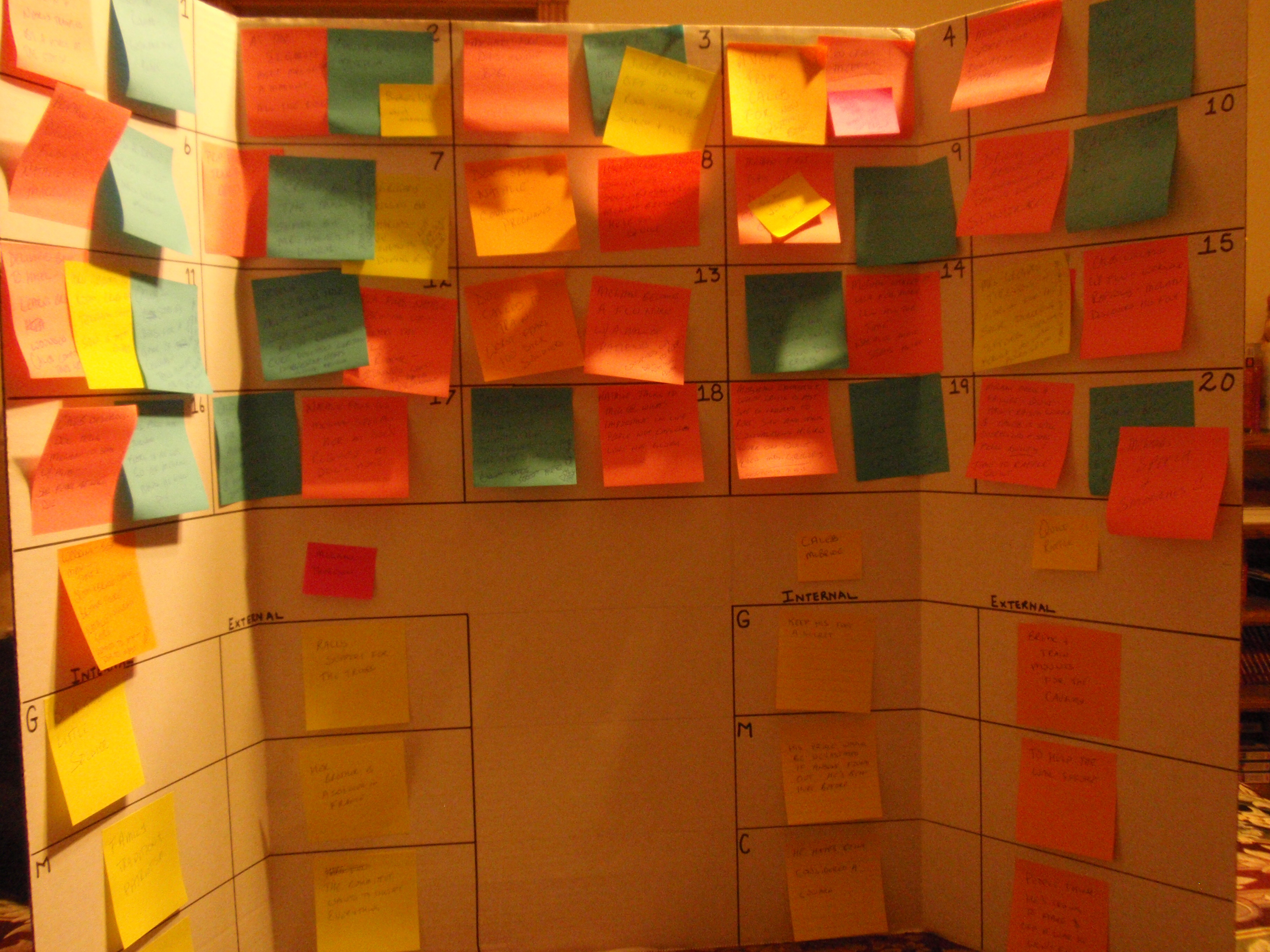
I use a plot board. I first came across this idea on the Seekerville blog where a guest had a photograph of her own plot board. Since I’m a visual person, I glommed onto the idea and created a board of my own to see if it would work for me too.

And it sure does! There are so many things I love about using my plot board. The plot board allows me to see at a glance how many scenes I have, who is the point-of-view character, and the characters’ Goals, Motivations, & Conflicts. It forces me to write out, however briefly, the internal and external goals of the characters and really think about what it is I’m trying to say with the story. Oh, and I get to play with post-it notes. 🙂

One other thing I love is that it’s easy-peasy to change your mind about something. You just move the post-it to a new place or throw it away and write out a new one. I found this particularly appealing, especially since I tend to change my mind a lot while plotting.

The top half of my plot board is divided into 20 equal sections and numbered across the rows. Each of the numbered boxes represents a chapter in the story.  (Twenty is just a starting point. I lengthen or shorten the story based upon what is needed. But there is only room for about 20 boxes on the plot board. If I need more, I have to scrunch things and overlap.)The bottom half is divided into two parts with six equal sections in each part. These are for the characters.

Prior to writing anything out for the plot board, I’ve researched, ruminated, and spent days and weeks reading and thinking about the story. I’ve got a few high points of the plot in my head, and I have a fair idea of setting, time period, etc. I have a rudimentary idea of the characters, too. This pre-plotting prep is necessary for me. If I dive into plotting too early, before the story has had a chance to marinate in my subconscious, I find myself staring at the blank plot board the same way I stare at a blank screen if I haven’t plotted beforehand.

When it comes time to begin filling in my plot board, I start at the bottom of the board with the two six-chambered grids. On each side, one column is labeled External, and one is labeled Internal. This is where I put the Goals, Motivations, and the Conflicts for each of the two main characters. Since I write romance, this means the hero and the heroine. What do they want, why do they want it, and what is keeping them from getting it? I decide what personality types my characters are (click on the first link in this post to see how I do that) and start plotting the story.

 
Then I grab my smallest post-its, about 1.5 x 1 inch. I write the major plot points out and stick them to a notebook page. (Things like Avalanche hits Train, or Finds Out He’s Adopted.) As fast as the ideas come to me, I jot them down, keeping it brief and fairly broad. When I think I’ve got the big ideas of the story set down, I start arranging them on the plot board. I keep them in chronological order, but I don’t sweat too much whether they are in their final position or not. I know it’s probably going to change as I go. When I have the bones of the story down, I start making logical connections with scenes. What has to happen in order to get the character from major plot point one to major plot point two?  I use the next larger size post-it for these in various colors. Pink for the heroine’s POV and blue for the hero’s. Orange, yellow, purple, chartreuse…those are for secondary characters’ POV scenes. By color coding the post its, I can see at a glance if I’ve kept a good balance of his/her scenes and if I’ve lost anyone in the shuffle.
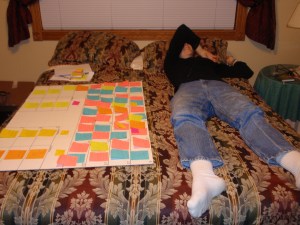
One thing I mustn’t forget to mention is that the whole time I’m doing this, I’m talking. Usually to my daughter. (When we finished plotting the last novel, she crashed on her bed and I had to take a picture.) By talking it out and letting someone not as familiar with the story ask “Why?” kinds of questions, I minimize the plot holes as much as I can up front. My daughter is great at this, and I plot much better and quicker when she’s involved in the process.

When I get all the scenes filled in, I tell the story once more aloud, making sure I have it the way I want it. Then I use the plot board to type out a chapter-by-chapter, scene-by-scene synopsis, including what I want to accomplish in each scene. I know without a doubt that when I have that road map in my mind and in my hands, I write much faster than if I’m feeling my way around with no idea where I’m supposed to be going.

So there you have it. My plotting system. It works for me, and it’s been tweaked and refined each time I go through the process of plotting a new story. I hope you can glean something that will help you.

Question for you: Plotter or Pantser? Does the thought of using a plot board excite you or make you want to run screaming to the nearest bag of chocolate chips?

Post Author: Erica Vetsch

Erica Vetsch is a transplanted Kansan now residing in Minnesota. She loves history and reading, and is blessed to be able to combine the two by writing historical fiction set in the American West. Whenever she’s not following flights of fancy in her fictional world, she’s the company bookkeeper for the family lumber business, mother of two terrific teens, wife to a man who is her total opposite and soul-mate, and avid museum patron.

A Writer’s Life: The Waiting Room

Today I’d like to invite you to join me someplace most, if not all, writers are familiar with. Where’s that, you ask?

The Waiting Room.

Oh. My. Word. Your groans probably registered on the Richter scale. Stop it right now and come on in. Yeah, the Waiting Room is crowded. And the magazines are out-of-date. But we’re here to talk, not peruse the 2005 issue of Bowhunter magazine

If you’re a writer, the Waiting Room is unavoidable. Truth is, if you stay the course, you’ll make repeated trips to this room where the hands on the clock never seem to move and you languish forever, wondering when someone will call your name and say, “We’ll see you now.”

Aren’t I just the messenger of all things light and breezy today?

Why, you ask, why the Waiting Room? It’s such a waste of time.

Is it really? 

What can you learn while you wait? (Yes, I know you’d rather get seen and get out of here. But stick with me.)

  1.  Understand attitude is key. If I expect to wait then I avoid the “Woe is me” attitude — or at least succumb to fewer attacks of self-pity. If I get into my appointment on time or — gasp! — early, then I celebrate. Translation: No one is an overnight success. If some author tells you that they were, they’re lying. (You can tell them I said so.)
  2. Come prepared to wait. Do I want to waste time thumbing through magazines I’d never read even if I was stranded on a desert island? Translation: What are you doing while you wait for “the call”? Are you counting time or making time count by revising your manuscript, attending conferences, connecting with other writers — maybe even encouraging other writers?
  3. Realize everyone hates waiting. Medical professionals hate being behind schedule as much as you hate waiting. Translation: Editors wait too. And agents. And publishers. (Side note: Please, no comments with “waiting for my doctor” horror stories.  Not the point of this post. If you really need to vent, email me at beth@bethvogt.com. I’m married to a doctor. I can take it.)

Time for me to sit back and see what y’all have to say about time spent in the Waiting Room. Tell me how you handle waiting for feedback from your critique group. Or from your agent. Or for the “sign here and would you like an advance with that?” phone call. How do you make waiting worthwhile?


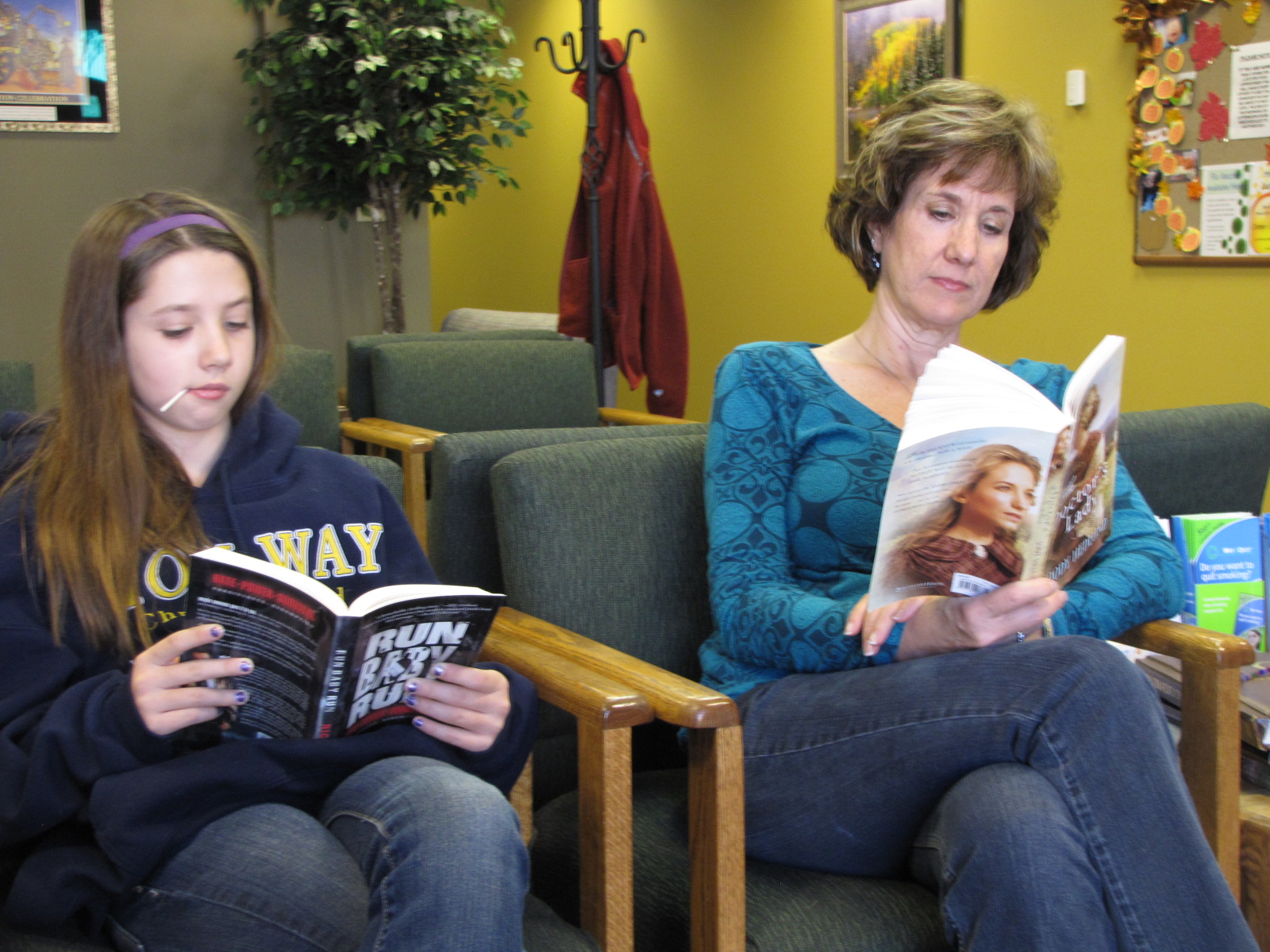
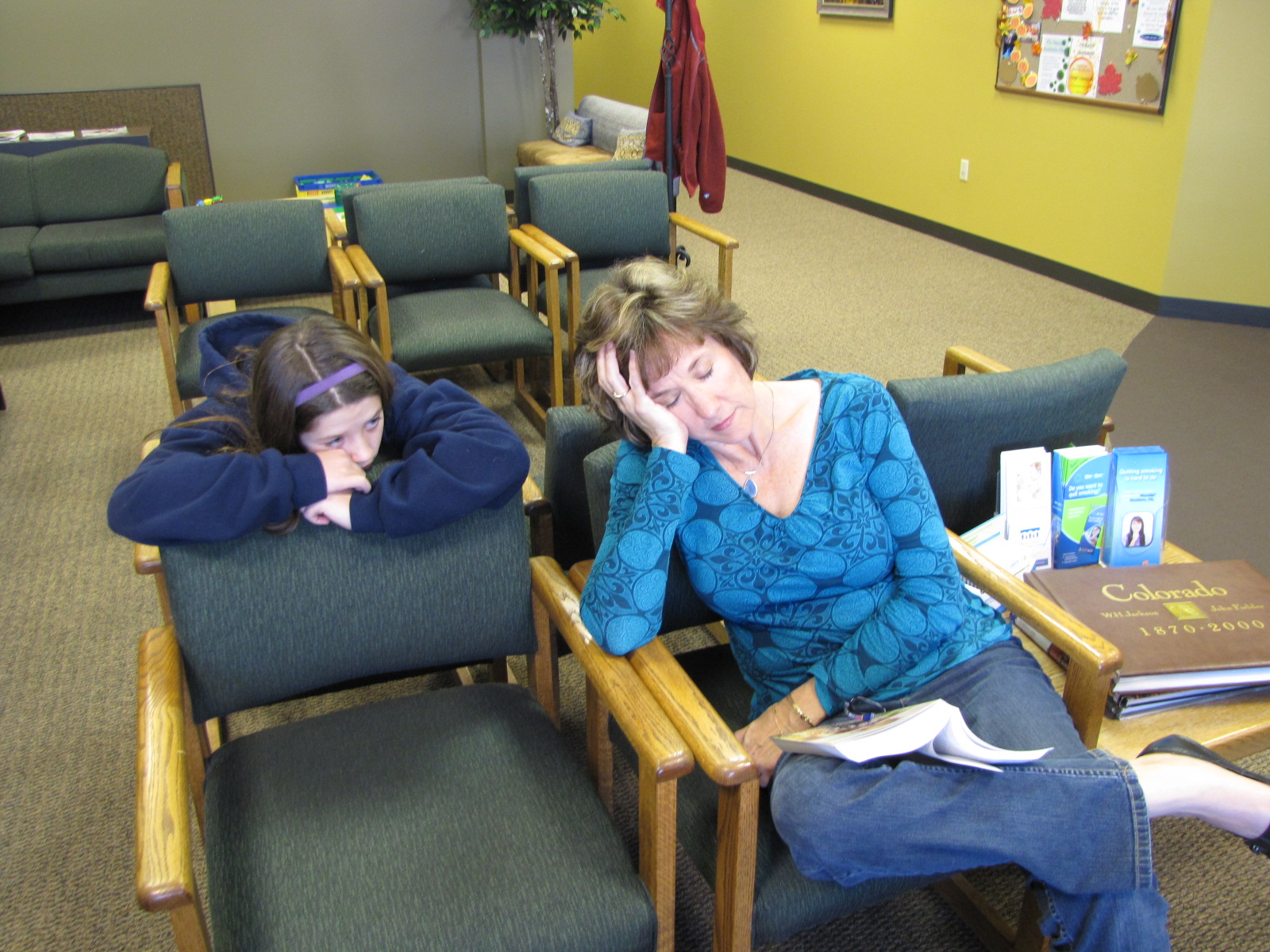
*Photo credit: That’s me and my daughter. In my husband’s waiting room. With a copy of author Jody Hedlund’s latest release, The Doctor’s Lady. The sleeping pose is for the sake of the column — not a statement on Jody’s writing. I loved reading The Doctor’s Lady!

Post Author: Beth K. Vogt

Beth K. Vogt is a non-fiction author and editor who said she’d never write fiction. She’s the wife of an air force physician (now in solo practice) who said she’d never marry a doctor—or anyone in the military. She’s a mom of four who said she’d never have kids. She’s discovered that God’s best often waits behind the doors marked “Never.” She writes contemporary romance because she believes there’s more to happily ever after than the fairy tales tell us.

Creative Nonfiction: Top Tips for Memorable Memoirs and MORE!

Photo Credit: Simon Howden / http://www.freedigitalphotos.net

My husband parks our silver F150 in a turnoff, which is really a patch of pounded land where folks have repeatedly turned their cars around after realizing the road goes nowhere. I imagine drug dealers, prostitutes, meth heads, and hormonal teens fighting for this spot on steamy summer nights, but for now, it’s just Charles and me. And my doubts.

He turns off the engine, and in the silence, we wait. We are surrounded by thousands of acres of farm fields, old growth hardwoods, and murky cattle ponds. The land is beautiful, and this type of setting would normally calm my nerves, but not this time. Not now, as I’m waiting at the end of the road for a stranger to arrive. My heart races and my breath quickens, as I realize, with sudden alarm, that we might be in danger.

“Should we have brought the gun?” A question I never thought I’d ask. Even though I despise America’s love affair with arsenals, in this position, I wish I was holding a gun.

“What gun?” He’s barely paying attention to me as he checks email on his phone.

“The one in the garage.”

Charles laughs. “It’s a 22.” With sarcasm he insinuates that if we find ourselves going head-to-head with a coyote or a tom cat it might come in handy. A hardened criminal? Not so much.

“Well what if it’s a setup. One of those Craigslist crimes?”

He doesn’t answer. Just keeps emailing.

11:49. No sign of the white Ford truck we are waiting for. “Of course it’s a white Ford,” I say. “Does anyone drive anything else around here?” I’m sure we’ve passed at least forty-seven white trucks since we left the interstate. Forty-six of them, Fords.

I open the door and get out to stretch my legs. The sounds of rubber tires and gasoline engines roar in the distance. Somewhere, within earshot, the newer highway ribbons through these fields, and I feel a little comfort thinking I can run toward the noise if it comes to that.

Then the engine noise comes closer, and the white truck we’ve been waiting for eases its way into a corner field and comes to a stop in front of a metal gate, a rusty chain locking the gate closed.

In the movies, headlights would have flashed, drums would have punched a dramatic rhythm, and a heavy pause would have filled the screen. Instead, Charles’s phone rings. “Yep, I see you. We’re headed that way now.”

I return to my passenger perch and close my door just in time, as Charles is already putting the truck in gear.

“You have the money?” he bites his nails, a habit he’s had all his life.

“Yes,” I check my purse, just to make sure. Cash only, I remember the stranger’s instructions. My pulse shoots flares.

And then it happens. We climb down from the bench seat and enter an isolated pasture with a man we’ve never met.

What’s this scene about? Do you suspect this couple is about to engage in some sort of illegal transaction? Are they in danger? Or is it just a creative twist on something as ordinary and realistic as buying a cow?

If you guessed a cow, you’re right. This is part of a creative non-fiction proposal that enabled me to become the 2012 recipient of the Mississippi Arts Commission’s Literary Arts Fellowship, an honor I am privileged to accept.

Whether writing about cooking or canines, remember non-fiction doesn’t have to be dry.

Try these tips:

  • At some point, let us know exactly where and when the event takes place, but use subtle hints to set the scene (music, tv, news, technology, etc., to hint at the era.)
  • Use sensory details – smells, sounds, sights (avoid writing “I see… I smell…I hear…”)
  • Involve more than one person in the scene…it’s not all about YOU. Describe something specific about the other characters. Use a few snips of dialog and let unique personalities shine.
  • Elicit an emotional response from the reader. How do you want them to FEEL when they read the story?
  • What is the main point of the story? What question do you want to answer? Try to leave the reader with one main thought, all while trying to show rather than tell.

When you write, what approach do you take to make the mundane magnificent? Share your thoughts about creative nonfiction and learn more about this interesting genre by visiting http://www.creativenonfiction.org/

Julie’s first novel, Into the Free, hits shelves February 1. Learn more at www.juliecantrell.com