What My Students and I Learned This Semester in Creative Nonfiction Workshop

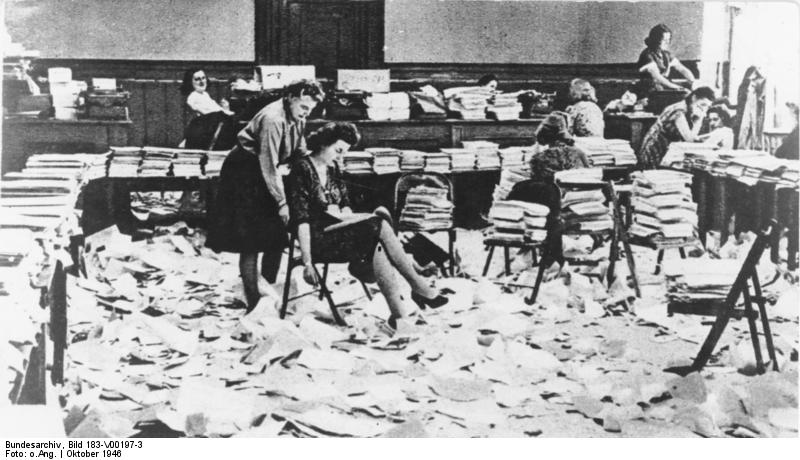
Big Thing #1: Neatening the messy truth never works. Nürnberg Prozess, Büro für Druckschriften-HerstellungStory: A sweet-hearted student wrote a moving essay about her difficulty with “being held” following her father’s death. She began her essay with an amusingly awkward forced hug—an assignment from her Family Sexuality class to practice “hugging until relaxed”—and concluded with her “surrender” into her friend’s arms at the hug’s end. Everyone loved the essay except for its conclusion.
In a conference with the student after workshop, I explained what I thought was the problem: the resolution just wasn’t as concrete and thus convincing as the wrenchingly funny opening scene. “Did this surrender really happen?” I asked. “It sounds like you’re lying.”

I didn’t really mean to accuse her of lying, only to convince her of that disparity in concreteness. Turns out, though, she had lied—not intentionally, of course, or even with intent to deceive but just to simplify the messiness of her struggle into a more satisfyingly redemptive conclusion. There’d been no surrender in that hug. After we both recovered from her surprising lie—as much to her as to me—she revised the piece to reveal what really happened, transforming a good essay into a publishable one.

Application: Tell the truth, don’t prettify it.

Big Thing #2: Contrary to the usual creative writing mandate to “Show, don’t tell,” most good writing requires both.

Story: Two students who particularly explored this truth were a chemistry major and a woman from a missionary family in Kenya. Both wrote from a knowledge-base completely foreign to us, thus running into a classic writerly problem which the missionary-kid characterized as “balancing explanation with story.” Explain too much, and you end up with a boring commentary on what happened; explain too little, and readers get lost. As the chemistry major said, “The audience cannot read your mind.”

Throughout the course, the students tugged at the delicate membrane between showing and telling, testing the delights and dangers of being too baffling or too, as I call it, “explainy.” By semester’s end, both consistently wowed us with their work, delighting us especially with a close-up of cosy Nairobi teatimes and a wacky book review/lab manual hybrid on the chemistry of poisons.

Application: To take us somewhere we’ve never been—which is, after all, every creative nonfiction writer’s job—you need to show AND tell, judiciously.

Big Thing #3: Scheduled, specific assignments not only motivate idea-less students but—counter-intuitively—often result in their most creative work.

Story: Several students struggled with motivation and, as one put it, “finding something to write about” for the course’s ten pieces. The first six assignments were pretty narrowly defined and came one right after the next; pretty much everyone found those fun, easy to write, and creatively empowering. Open assignments with longer deadlines were more challenging.

Application: If you’re stuck, give yourself an assignment. And a due date.

Embarrassed_Father_-_Vintage_family_PhotoBig Thing #4: Learning to write better teaches humility.

Story: Several students identified “taking criticism” as a struggle in the course of the semester. Here’s a reflection from one student’s revision account: “I was pretty judgmental of the big guy, so I tamed that part down. It felt mean when I looked at it again. I don’t think I lost anything at all, the scene wasn’t really about him anyway.” The student’s introspection and writerly focus say it all.

Application: Find yourself some honest readers, then pay attention to them. It’ll help your writing and your soul.

Malassezia_lipophilis_3_loresLittle Thing #1 (Big Thing #5): Clichés are like fungus: ubiquitous but strangely more embarrassing and disgusting than most other writerly ills.

Story: Student after student confessed to clichés. They hardly needed to, since I routinely point them out in class. Even their revisions had clichés—as do my own, unless I’m super vigilant. In class, I put quotation marks around their clichés in Google to convince them. The phrase “inextricably linked,” for example, gets “About 715,000 results (0.15 seconds).”

In a way, clichés are wonderful: someone’s once-creative, collectively approved wording. That said, clichés remain the bane of good writing—Oh no! That’s “About 3,160 results (0.51 seconds.)”

Application: Look again. And again. They’re there.

Rewriting: 7 Simple Tips – Part Two

file6681269982727

A book is made in the rewrite. We take the words and begin to refine and reshape them into the finished book. We compose the first draft quickly, getting the words down on paper as they flow. Then we begin the work of rewriting.

Here are our final four tips on rewriting with examples from The Shepherd’s Song. You can read the first three tips here.

4. Watch out for the word “felt” when describing a character’s feelings.  Remember the old saying: show don’t tell.

FIRST DRAFT: She felt confused and out of control.  

This is okay for a first draft but needs rewriting.

FINAL DRAFT: “What’s your name?”

She tried to focus. Her name?

“Kate . . . McConnell.” She gasped out each word.

“Your birthday?”

She tried to come up with the answer, but it was too confusing. Tears welled up.

“It’s all right. Just stay with me.”

“What hap…?” She wanted to finish the sentence but could not.

5. Eliminate prepositional phrases that tell us about the character or action.

FIRST DRAFT:  Without hesitation the nurses joined Dr. Belding in pushing the stretcher toward the elevators.

Instead of telling the reader “without hesitation,” why not put the scene in play and show them?

FINAL DRAFT:  Dr. Belding grabbed the end of the stretcher. “Okay, people. Let’s get her down to the OR.” He turned to the nurse. “Has the family been called?”

file0001346272648

6. Watch out for the word “saw.” Show us what the character is seeing instead.

FIRST DRAFT: He slipped the phone out of his pocket and saw the text message from his dad.

We don’t need to explain that the character saw something.  Show it from the character’s POV.

FINAL DRAFT:  Matt slipped the phone out of his pocket.

‘Emergency. Call me.’

A text from his dad. That was unusual.

7. Evaluate each adverb. Is there a better way to show the reader what is happening?

FIRST DRAFT: John McConnell looked up in irritation at his secretary.  

“I said hold all calls,” he said impatiently.  

Telling reminds the reader that it is not real. Staying in the character’s head means we show through the character’s actions what is happening, and how they are feeling. We had to rewrite to show his impatience.

FINAL DRAFT: “Mr. McConnell. A phone call, line three.” His secretary spoke from the doorway.

“I said to hold all calls.” He continued scanning the document in front of him.

“I know, but.”

“I am well aware that we all need to get out of here.”

IMG_0105

These simple tips help us with our writing. Do you have others to share?

Betsy and Laurie

http://www.WritingSisters.com

Grunge ornamental cover for an album with photos

The Heart of An Artist

Hands of Businesswoman Using LaptopWe think, we feel, we bleed on the page. We’re sewers of words, stitch by stitch until our heads unravel fuzzy.  Hey, are you talking to me?

People don’t always “get” us, and we’re okay with that because we already know we’re a bit strange, no shocker. Our dearest people love us anyway.

We writers draw boundaries and let our voice mail field calls. We plop our rears on chairs and pop up prayers and Advils and away we go, ready to transport our readers.

A thousand distractions call, but we have a dream-scream and God put it there. And if God put it there, nobody can take it away. And who needs to clean her house anyway? We have books to write.

We’re emotional creatures, God bless us. We’re well endowed with feelings. We love and hate our emotions with a passion. We get a high when we make readers laugh, cry, and get angry, boom-boom-boom, sometimes all at the same time.

My husband wipes his eyes as he reads the fruit of my year-long labor. He’s lost in the part where Ema McKinley swallows her grandsons into a hug. It’s her first hug since the miracle. And as Ema absorbs the feel of those boys, my husband sniffles and I swell. Swell with the joy of the craft and the miracles and the emotion-packed words.

Jesus had emotions. Remember how he wept? To love is to feel, and when Lazarus died, Jesus felt what we’d feel. In love, He felt for us.

We feel for our audience when we write, and this is our love gift.  We want to love them closer to something. Just like Jesus, the Living Word, wants to love us closer to Himself.

Hey, big-hearted artist, what do you love most about writing? What drives you to do what you do?

Beautiful words stir my heart. I will recite a lovely poem about the king, for my tongue is like the pen of a skillful poet. Psalm 45:1

Words from Another World

“Sticks and stones might break my bones but words will never hurt me!” Wrong.

As an adult I’ve long since conceded that the childhood nursery rhyme we sang to protect ourselves couldn’t be further from the truth. I no longer deny that words can inflict lasting pain but my fascination is with their power to change the world.

This ability of ours to communicate, it’s combustible.

fire

Picture if you will the disciples of Christ sitting in an upper room waiting and praying, praying and waiting. Before leaving in the clouds, Jesus had promised to send them power to take His message to the ends of the earth. He didn’t tell them what this power would look like or how long they’d have to wait for it, only that they must.

Finally, after days and nights of waiting, after all the anticipation and questions surrounding this mysterious force Jesus had spoken of, after weeks of wondering what this supernatural aid might be and how they would wield it, God’s promised fire fell “as cloven tongues of fire.”

How interesting. Fiery cloven tongues of an other-worldly origin.

I find it fascinating that out of all the body parts the writer could’ve used to describe this amazing scene when God’s fire power fell on man, he chose a human tongue. What a visual of God’s plan to employ these fleshy instruments of ours to speak from the understanding of one human to that of another, each witnessing of the consuming fire lit in his or her heart.

In light of such a mission, is it any wonder that we’re so strictly charged to monitor our tongues and the power of language? How can we allow ourselves to use whatever words we want with whomever we want whenever we want-–knowing that God has chosen these same tongues as holy messengers to take His gospel into all the world?

From the same mouth come blessing and cursing. My brothers, these things ought not to be so. James 3:10

For those of us who feel called to write, these questions should weigh even heavier.

My prayer is for our words and our tongues to have fire power because they’re yielded to His will instead of our whim.

Hugs, Shellie

Setting and Straying from your Brand

BrandBranding is even more about defining the essence of a writer than it is defining the niche or genre. We all leave an imprint on others—some of us do this in a strategic way while others leave a message without meaning to. So why not be intentional?

How is it some can write different types of books and be consistent to their brand and others seem to be disloyal to their readers by branching out? It all depends on voice. Does the voice match the brand?

For example: Liz Curtis Higgs. I once talked with her at the International Christian Retail Show (ICRS) and told her, “I use you as an example in my marketing classes. When I teach branding, I explain that writers don’t have to declare a niche but they have to be true to their writing essence. Even though you write fiction, nonfiction, Bible Studies, humor and children’s books, your voice is consistent in each work. I see and hear Liz Curtis Higgs in every piece I read by you. You have no idea what a relief that is to writers who are so confused by the industry push to get branded into just one little box.” We had a good discussion about this topic. Then I told her, “When you are true to your voice, that’s the best brand of all, because it’s the imprint God wants you to leave.”

But then there’s John Grisham. His readers expect legal suspense. And he’s good at it. Made his money with this point of view. Any time he veers from this identity, some of his loyal readers feel betrayed. They don’t get what they are looking for in between the covers. They find a confused voice. Others have loved it. Is it worth it to take the risk? He can get away with it because if only 25% of his loyal readers buy his books when he strays from his brand, that’s still a big seller, but can a regular writer afford to only sell 25% of their normal book sales if they depart from their brand?

My advice to writers setting up a brand is to create a think tank or wisdom team and conduct a survey. Make sure it’s a variety of people who know you well (in the publishing industry, in ministry, from your target audience, family and friends). Ask them to give you some key words that best describe your essence (as a person, in your writing, in your speaking, in your ministry, etc.). Pay attention to the words that pop up on several lists. Try to capture those descriptors in your brand, and also make sure it has a “deliverable” quality to it. Those paying attention to your brand have a WII-FM mentality (What’s In It For Me).

For me, the words “light” and “shine” kept popping up. So I created my taglines and brand around that impression. This way, people know my voice, and know what I bring to the table when they connect with me.

Brand combines voice, style, audience, content, tagline, logo, style, colors, and more. It’s that overall impression you make (strategic) or leave (accidental).

The industry does want your brand—your voice—to speak to certain groups. It’s easier to sell to niche markets than to general markets. It’s better to categorize yourself as a certain type of writer, and then set yourself up as a go-to-writer in those genres or categories. Once you are established, and you think you can be true to your voice, then you can branch out. Let your brand be your filter so you know what projects are a good fit, and which ones to pass up.

What impression are you leaving?

************************************************************************************************
KathyWillisKathy Carlton Willis spins many plates as writer, speaker, editor, and platform coach. She writes and speaks with a balance of funny and faith—whimsy and wisdom. Kathy discusses the key issues that hold believers back and shines the light on their paths to freedom. Kathy’s passionate about helping audiences have lightbulb moments. All told, nearly a thousand of Kathy’s articles have been published online and in print publications. Speaker to Speaker: The Essential Speaker’s Companion (OakTara) and Grin with Grace (AMG) are set to release in 2014. She serves alongside her pastor husband, Russ Willis, in local church ministry.

How to Edit a Manuscript

You’ve edited a paragraph, a chapter, maybe a few chapters, but now your manuscript is Kariss editingready to go and your editor sent you back the first round of edits full of major content changes. Where do you begin?

Editing the manuscript as a whole can seem like a daunting task. Editing is a necessary evil to me. I prefer writing any day. But I’m always pleased with the end result after time spent editing.

The truth is that editing needs to be a matter of prayer before you feel tempted to knock your computer off the desk. (Kidding. Kind of.) It can feel frustrating and detailed and confining after a fluid writing process to finish your book.

Here’s the good news: If you crafted your story correctly, it should be frustrating. Just look at it as a challenge to overcome. Content edits often include tweaking details used in major story lines. You have to track each story line down and make sure your changes are consistent. If you tweak one detail, it may cause you to slightly amend a detail in another story line. I was thankful to see that my story lines were so interwoven that one change affected another but was terrified I would miss something. But don’t worry, that’s where your editor comes in to catch anything you missed. Just try to do your due diligence on the front end.

I just finished a round of edits for my second book, Shadowed. Here are some of my takeaways for a major content edit:

1) Start small.

Read through ALL of the suggestions from your editor. Weigh what she is asking. Then set the manuscript aside for a couple of days. Process the best way you can tackle the job. Pray that you will know the parts to keep and parts to cut, when to kill your darlings and when to fight.

2) Make a plan.

I found it difficult to keep scrolling through the manuscript to find all the places I needed to fix, especially when it came to juggling scenes and chapters for better time placement. Write down a knock list and cross out each item as your finish it. You will feel accomplished and know you are moving in the right direction. Even if the list is extensive, take it one step at a time. If something else comes to mind, write it down and come back to it. You can do this!

3) Take your first pass.

Start at the top and work through until THE END. Write down any questions you may have about research or editor comments. Make all the smaller changes you can make right away. For instance, I noticed I referred to an organization two different ways in my manuscript. For consistency’s sake, I used the “Find and Replace” feature in Word for an easy fix to ensure accuracy. Easy check mark on my list!

4) Attack the major problems with gusto.

It helped me to print my manuscript, make notes, and then get to work. My editor Kariss manuscriptssuggested some things that I struggled to pull off. However, when I looked at a clean, printed manuscript, I was able to take her suggestions with my preferences and style and make the changes something that fit the story better. I love to work with my hands, so it helped to have something to hold and mark up with a pen. It also got me time away from my computer screen, which gave me a great brain break.

5) Finish strong and pray.

Time for that final look. I try to make it my goal to tackle as many issues as possible so the next edit is easier. Send the editor any notes she may need to do her job well and help you. I learned on my last edit that sending an accompanying timeline saves LOADS of time for both you and the editor.

Finish by praying that God will use this for the process ahead and that the finished product will bring God glory. Take a deep breath, type that email, and click send. Your manuscript is changing, but so are you!

What lessons have you learned during editing? What process helps you?

Should a Non-Fiction Author Write Novels and Vice-Versa?

Gift Wrapped Package
Are Shiny Objects Calling You?

One of my coaching clients has to guard against his propensity to chase every shiny new object. I can identify with his temptations, as I struggle with similar ones in my writing. Can I author both fiction and non-fiction? Can you? Let’s explore the question, and see if we arrive at the same conclusions.

Recently, I had a conversation with my literary agent that went something like this: 

Me, “I’m grateful my non-fiction books are selling, and my platform is building in the genre, but I have these two great novel ideas. What do you think? Would it be okay for me to pursue them?”

Alice, in a gentle tone after taking a deep breath, (I’m sure praying for patience with this crazy, bling-chasing author she has to deal with), “We normally recommend trying to stick with one genre. Otherwise it confuses your audience.”

“Could I do it using a pen name? I have one picked out.”

“Possibly. But then you’re using twice the energy to build two platforms simultaneously.”

That sounded like a whole lot of work to me.

Alice, “Can you turn your novel ideas into non-fiction?”

“Fiction is more fun to write.”

“I’m sure. But why don’t we focus on finishing your current book, then revisit this when you’re done?”

She’s a wise woman. I’m sure she believed the luster of authoring fiction would fade with time. And to a degree, she was right.

I’ve since researched the subject further, and found there are some common concerns and benefits listed from those with vast experience and knowledge. Publishers, agents, and even high-profile authors said much of the same. Here are the highlights of what I learned about the subject.

Keep Your Promises
Reader Expectation Can Drive their Trust

Cons:

1. Most readers will try a favorite author’s book in a new genre once, but if they don’t like it, may not buy any books written by them again. Including those they loved before.

2. Loyal readers often feel betrayed by the switch, and never regain trust. Genre confusion can cause authors to lose whole segments of audiences who now view them as promise-breakers.

3. If you switch genres, and the new book tanks, it can take years to rebuild publisher confidence and marketing momentum.

Pros:

1. Writing too much of a similar thing can cause an author to sound scripted, formulaic, and stale in later books. A change in the creative landscape can infuse fresh dimension into their craft.

2. Opportunities to cultivate new audiences grow with change. For example, if you write murder mysteries, but switch to a practical how-to, you chance reaching people who won’t read the mystery.

3. Authors like C.S. Lewis successfully carried their voices into cross-over markets, reaching many more people. If you are careful to stay true to your writing self, you potentially could do the same.

Old TypewriterAfter talking it over with my agent, researching, praying, and much pondering, I think I’ve had a change of heart. Turning my novel ideas into non-fiction is feasible. And I know successful writers are teachable and flexible. If I want to thrive in the writing world, I need to mirror those traits, and listen to those with voices of wisdom.

Down the writing road, I may change my mind or the market may shift, but at this point, why mess with success? I’d hate to have a shiny new object deflect me from the blessings I already have.

Do you think it’s wise to write fiction and non-fiction? Why or why not?


How to Craft for Your Crowd

reading boysAudience. 

Every writer knows that keeping the audience in mind is essential to effective writing: you don’t include high tech specifications or advanced optical principles in a children’s picture book about microscopes, just like you wouldn’t fill your historical thriller fiction manuscript with footnotes citing the research behind your story.

But other than considering what your audience expects in style or format based on genre, how often do you start your writing project by putting the reader first, instead of the story you want to tell?

Over the last nine years (and eight books) as my writing career has developed, I’ve noticed a subtle shift in how I craft my writing. Whereas my first book – an exploration of Christian vocation – was the book I wanted to write covering what I’d learned from researching and reflecting on Scripture, I didn’t understand how to make it compelling reading for my audience, even though I sincerely wanted to communicate my own enthusiasm on the topic with my readers and believed they would benefit from it.

Big surprise: even with a national publisher, the book did not do well. I needed to regroup, and start over by clearly defining my audience, and putting their need – be it entertainment, information, or inspiration – first. Only then could I take the story I wanted to write and frame it meaningfully for my readers, because if it didn’t answer their need, they wouldn’t read, no matter how much I wanted to share it.

I had to put others first. I began to pay more attention to what readers liked to read and why, rather than focusing on what stories I wanted to tell.

I applied that approach when I created my Birder Murder Mystery series. As a bird-lover and mystery fan myself, I knew there were no cozy mysteries about birdwatchers; I knew if I wanted to satisfy that audience, I’d have to weave together a specialized knowledge of birds, engaging characters that reflected the eccentric personalities who enjoy the sport, related issues of conservation, and accurate depictions of place. That meant I needed to do research to fill in the gaps of my own knowledge to craft stories that met those demands. Using that formula, I’ve written six books in the series and acquired a loyal readership that enjoys “virtual birding” with my protagonist.

Likewise, with my girl-meets-dog-and-finds-healing spiritual memoir, the first task I completed was examining my experience to identify how others could relate to and benefit from it. By putting the need of others first, it helped me organize the book’s content: a blend of memoir, current research, spirituality, and humor. Otherwise, I may have written a straight narrative of how I learned to love our dog, which would be a nice story to share, but not unique enough to warrant publication.

The next time you sit down to start a writing project, ask yourself these questions first:

  1. What does my audience need from me?
  2. How can I be of service to my audience with this writing project?
  3. How do those answers help me craft my content?

I think you’ll find that putting others first is not only considerate, but a great way to write a book your audience will value.

Honor One Another

?????????????????????????I’m a member of the “Me” generation. Growing up in the 1960s and 1970s, I heard a lot about the importance of self-realization and doing your own thing. I wore mini-skirts and flowered shirts, watched “I Dream of Jeannie” and “The Mary Tyler Moore Show.” When I was in college, all my girlfriends focused on finding careers, not husbands; if you yearned for less than having it all – a family and a career – you were considered a dinosaur, obsolete, and terribly naïve.

Contemporary culture was all about making yourself the most important person in your world.

It was also totally NOT what my Christian faith taught. I grew up on the Golden Rule, the Lord’s Prayer and the admonishment to always put others first. Do nothing from rivalry or conceit, but in humility count others more significant than yourselves,” instructs Philippians 2:3. For me, the high school student striving to be class valedictorian, that piece of Scripture held no allure; as I recall, I was more likely to follow the advice of Thumper’s mother in the Disney movie Bambi: If you can’t say something nice, say nothing at all.

As a result, I was a very quiet high school student when it came to discussing my classmates.

Fortunately, maturity applies not only to age, but to faith as well. Marriage and motherhood obliterated any drives I’d had to compete with others as the instinct to care for my family took precedence. I didn’t think twice about putting my children or husband first – that was just the way it was, and no matter how trying or exhausting it seemed at times, I have never regretted it. In the eyes of some of my college companions, I sacrificed a career to stay home with my kids, but I took comfort from Hebrews 13:16, “Do not neglect to do good and to share what you have, for such sacrifices are pleasing to God.”

They have pleased me, too, and God continues to let me reap the fruit of putting others first. In fact, I’m reaping that fruit in a whole new way this year – I’m finding that when I put others first in my writing career, great things happen. As a memorial to my parents, I offer author programs to senior communities, who welcome me with open arms and lively discussions. As a service to fellow authors, I’ve started to organize group booksignings, which are eagerly scheduled by harried bookstore managers. I frequently donate books or talks to charities, which raise needed funds for them and expand audiences for me. I ask myself what other writers might need from me in the way of guest posts or book reviews to accomplish their own objectives.

Honor one another above yourselves,” Paul writes in Romans 12:10. Like so many Scripture passages, these are words to live – and work – by.

(Tomorrow, Jan explores how putting others first is also a key approach to the writing craft.)

The Most Important Thing You Can Do As a Writer

way of trustI get asked all the time, “Shelley, how did you get published?” The real question, though, that these folks are asking is, “Shelley, what can I do to get published?” We all want to find success in our field of interest, and if you’re reading this, there’s a good chance your field is the same as mine: communication, and in particular, writing.

While there are some GREAT steps of action you can take, and you’ll find a lot of those by following the Water Cooler, I personally have experienced the ONE that is the most important, so I want to pass that along to you as I make my debut here as a contributor. This ONE thing keeps me sane regardless of book sales. This ONE thing helps me know which project to work on and which one to table or forget altogether. The To-Do List of life, family and ministry often blur my vision and confuse my priorities, but this ONE thing really does make ALL the difference.

Ready?

It’s so simple and yet so overlooked by far too many (even Christian) writers.

Trust God.

I told you it was simple, but the truth is, the quality of our lives rises or falls on our level of trust in our Heavenly Creator–the One writing our lives. The One who knows the end from the beginning. The One who has GOOD plans for each and every one of us. Many times a creative soul like a writer gets all jumbled up in the mix of “the next new thing” and trying to have his/her voice rise above the noise of so many voices also trying to make themselves heard. But the motive behind it all is either going to be FEAR or LOVE. And that motivational force will come from the Source in whom I place my trust: myself; my agent; my abilities; my marketing team; my publisher; or my Heavenly Father.

It’s a simple principle, but that doesn’t mean it’s also an easy practice. Thankfully, there is grace for this, too! God cares more about your willingness than your perfection.

As we seek to discover where we’re placing our trust, we can ask ourselves these good questions:

  • Do I have to be a successful (however you define “successful”) writer to be of value?
  • Am I working on this current project because I sense God’s Spirit flowing through me in the process or because I feel pressure to write this?
  • Who is my audience…really? In other words, who am I most seeking to please? (Readers? Myself? God?)
  • If my writing isn’t as successful as someone else’s, is my writing still valuable?
  • What is my source for content? Am I solely relying upon my experiences, education, research, and skills, or am I inviting God’s Spirit to be my greatest influence in what I write?

According to the writer of Hebrews, one we can take some cues from as writers, “The fundamental fact of existence is that this trust in God, this faith, is the firm foundation under everything that makes life worth living. It’s our handle on what we can’t see.*”

Asking ourselves where we are placing our trust, regardless of the size of that trust, will help us navigate through all the ups and downs and unknowns that writers experience. God sees and God cares more about your calling to write than even you do. Trusting Him in the midst of every day life and trusting Him to give you the words to put ‘out there’ will give you the strength and peace to accept His plans for the reach and impact of those words.

#OnlyTrustHim

*Hebrews 11:1 The Message