Pacing in Writing

Pacing in Writing | Wordserve Water Cooler

Pacing in Writing | Wordserve Water CoolerPacing in Writing

When I was a child, a piano teacher let me play to my heart’s content without worrying about such details as tempo and timing. I’m pretty sure that wasn’t the best approach, which may be why those lessons were short-lived. It wasn’t until adulthood, when I studied vocal music, that I learned to pace myself.

Pacing, whether in music or writing, is one of the methods by which we organize the creative flow. Order prevents these creative expressions from falling flat and helps improve their impact.

What is Story Pacing?

It took me a while to understand the concept of pacing in fiction, but relating it to what I already knew about music made it easier. Basically, two elements of pacing work together within a story.

Every piece of music has a tempo, or base speed dictated by the type of music and its mood. This is also true in fiction. A sweet romance will have a slower overall speed than a thriller, for example. Knowing the right tempo for your story is an important but often overlooked consideration in pacing it correctly.

Your story plays out relative to its tempo, which means that the slowest scene in a lavish historical epic, for example, will be much slower than the slowest scene in a mystery novel, even though both may follow the same story pacing dynamics.

Vocalists are taught to hold back a little in the beginning of a song so that there will be room to crescendo later. In a story, the first scenes introduce the main characters, set up the conflict, and hook the reader.

As your story progresses, scenes ebb and flow at a slower, then faster, pace. This rhythm repeats, and as it does, the time between conflicts decreases. This builds tension leading up to the climactic scene.

The story then slows and, like music, resolves by returning to its tonal center. In the case of music, that is the first note of the scale. In fiction, there is usually a reference or some sort of return to the beginning of the story..

How to Speed Story Pacing

I’ll focus here on ways to speed story pacing, since that’s where most writers need help. However, many of these tips can be turned around to create the inverse effect.

Tension: Nothing propels a story along like wondering if the heroine is going to make it to the station before the love of her life leaves town forever. Or maybe your hero is being pursued by a gang with a vendetta. These are dramatic examples, but tension can be created more simply, as when Rhett Butler reveals he has overheard Scarlett’s declaration of love for Ashley Wilkes.

Unanswered questions create tension in these situations. What will happen when the heroine gets to the station? Will the hero escape with his life? Will Rhett keep the secret of Scarlett’s love for Ashley?

Action: Show, rather than tell, the story’s action in scenes written with minimal description, using a few details to evoke the setting. This is also not the place for introspection or thinking by your characters. Eliminate anything that would distract from the main action.

Dialogue: Because dialogue can be read quickly, it moves a scene along. To speed pacing, eliminate all extraneous tags and beats. Use conflict rather than agreement to give dialogue vitality.

Word Choice: Using short, snappy words will usually help you pick up the pace in a scene. Reserve longer words for those places where you want to slow pacing to allow the reader a moment to breathe.

Sentence Length: Remember that the more complex a sentence structure you use, the more time it takes for the reader to decipher your meaning. That’s fine in slower scenes, but use shorter sentences, which are more easily digested, in places where you want to pick up the pace.

Scene Length: A series of quick scenes can often move the pacing along better than one longer scene. You don’t want to chop things up too much, but this is a technique to keep in mind for the right application.

Chapter Length: Shorter chapters tend to be cleaner and more concise, which makes them more easily digested. They also act to quicken the pace by giving the reader a feeling of progress through the story.

Mastering Story Pacing

Learning to pace the stories you write isn’t easy. In fact, its one of the most difficult skills in writing fiction. Even if pacing doesn’t come naturally for you, keep working at it and you’ll improve. For a model that will help you plot and pace a novel, read Plotting a Novel in Three Acts and the related posts at my Live Write Breathe website for writers.
5 Things the Theater Taught Me About Writing

OLYMPUS DIGITAL CAMERAThe smell of popcorn takes me back…backstage, that is. From 1998 to 2007, my husband and I, along with several other talented individuals, performed thousands of shows to enthusiastic crowds in two small-town Texas theaters. The experience taught me enduring lessons about creativity, professionalism, and making a living through the arts. These tenets apply to your writing life and other creative endeavors, as well. Here are five things the theater taught me about writing, in no particular order:

1. Word of mouth is the best publicity

Our audiences, though small, were passionate. We provided quality entertainment and our most ardent supporters talked about us…a lot. They brought groups, gave their friends tickets, and sometimes drove hours to see us. Though we bought print ads, paid a few publicists, and had a large email newsletter, the theater’s best advertisement was—without a doubt—word of mouth. 

It’s the same with promoting your writing. Today’s readers are consumers, just as our season ticket holders were. They long for quality and consistency. They’re busy, and they need a reason to keep reading past the first few lines. And when they are delighted by what they’ve read? They’re the most loyal, vocal folks around. Because we live in an instant-communication society, bad word-of-mouth spreads fast. Make sure your writing product is stellar, and great publicity will follow.

2. Give the audience what they want

One of the owners of the first theater in which I performed often said, “Give ‘em hamburgers!” He meant that we shouldn’t mess with success. If tickets sold quickly for a 1950s music revue, we wrote another similar show. Of course, we also experimented and pushed boundaries (otherwise, all of us would have grown bored). However, we changed our product in small increments. We also created special experiences—behind-the-scenes tours, holiday packages, giveaways—for avid supporters. Cast members even called our VIPs (those folks who came to the theater over and over) on their birthdays and anniversaries, which the VIPs greatly appreciated.

In your writing, think about creating a memorable experience for the reader. How can you provide extra value (giveaways, incentives, free resources) in a professional, winsome file3691295046962manner? In what ways could you creatively and tangibly thank those who willingly support you and talk about your books?


3. Leave your ego at home

Most of the performers I worked with over the years have been gracious, humble, and diligent. A few, however, turned me off with their arrogance, over-the-top demands, or lack of discretion. The most successful artists, long term, are those who go out of their way to thank people and who treat the sound technician as well as the venue’s owner. Those are the performers who are offered more opportunities.

Ask yourself: am I approachable, warm, and thankful for the opportunities life has given me? Or I am on a mission to impress everyone I meet, in order to “build my brand”?

4. There are no small parts, only small actors

So said Constantin Stanislavski. When you perform a small role with professionalism and excellence, the people in charge notice–and they’ll eventually give you more responsibility.

The same goes for becoming a better writer. If an editor asks for a 400-word piece, I’ve learned to take it seriously and do my best work. In this age of instant access, anyone can read your work at any time, from anywhere. Who knows what small beginnings might lead to larger opportunities?

And, finally, in related wisdom…

5. Know when to stop

On stage and in writing, creatives need to develop an important skill: how to bring a something to a close. In the theater, we say that last line, spin on our heels, and exit, stage left. In writing, we find the right moment, the right phrase, the right word, and that’s it. The end.

This post is a reprint from Tweetspeak Poetry.

Is God Talking to Me?

DogAs Christian authors, we often view our books as a way to get God’s Word out in a non-threatening manner. Novels are easier to hand to someone than a Bible and generally an easier way to start a conversation.

However, two recent events are causing me to change my view on that a little. Recently, my minister said that when he’s working on a sermon series, the subject matter is usually something he’s struggling with—something God is trying to teach him.

I had the good fortune to hear Ted Dekker speak during his Outlaw Tour down in Colorado Springs. A big theme of his talk was that his struggles as a Christian come out in his books. His questions about faith. Those uneasy issues that we all contemplate. Is God real? Is He who He says He is? Is there really a Heaven? Is my belief in Christ truly enough?

Perhaps we as authors are actually working through our own issues and the collateral benefit is that we’re frequently able to help other people.

But surely my writing isn’t just about me. It can’t be because my spiritual life is all figured out . . .

I began to think through the books I’d written and the ones I was planning on writing. There were some consistent themes. Truly believing in God’s sacrificial love. Letting God take control. Being submissive to His will for our lives.

If I look honestly at these themes, they are what I struggle with the most. A God . . . people . . . the Lord of the Universe dying one of the most painful deaths ever . . . for me. My heart usually reconciles this easily but my intellectual side waivers occasionally. This is what I believe?

And sometimes with a big gulp . . . I whisper yes.

I’m a control freak by nature. It lends to the job I do every day. As an ER nurse it is expected of me to bring control to chaos. I am stubborn and independent—which is the nature of two out of three of my heroines. They’d rather fix it themselves than reach out for help and yet, when circumstances become insurmountable, they must reach out to survive.

Isn’t this how it is with us? Maybe it is just me and all of you are very good at relinquishing control. If so, please let me in on your tips.

As we write these stories, maybe what we need to do first is read our stories with ourselves in mind and hear what God is trying to say to that person we see in the mirror.

This post first appeared at the ACFW blog. Hope you’ll check it out.

Organizing Ideas into an Outline

The bridge between brainstorming great ideas to fill the blank pages of your book and coherent writing that communicates your message to readers is a detailed chapter-by-chapter outline.

But how do you begin to organize all the puzzle pieces of ideas?

Organizing Ideas
Organizing Ideas

Write down your random ideas

Like someone preparing to solve a jigsaw puzzle, you need to gather your ideas without worrying how they fit together. Collect your thoughts on a piece of paper or type them down the page of a Word document. If you must, scribble on a napkin as creativity strikes. Decorate your desk with post-it notes. Just capture the ideas and spread them out like puzzle pieces on a table.

When writing my first book, Questioning Your Doubts: A Harvard PhD Explores Challenges to Faith, I thought of illustrations and concepts that helped to communicate the main concepts in a certain chapter. I knew those ideas would shape the paragraphs yet to be written, but I needed more time to figure out how to make those ideas flow together. My first step was to capture those ideas and polish them into gemstones in their own isolated and random paragraphs. The process of stringing the gemstones together to make jewelry would come later.

Look for relationships between ideas

How do you begin to work a section of a jigsaw puzzle? I usually start by grouping together the pieces with similar colors or the pieces that have complementary shapes. Like a jeweler preparing to make a bracelet out of polished gemstones, I think about patterns. Before writing an outline for a book, I consider the relationships between the ideas in the chapter. Do I need to present the ideas in a chronological order? Should I arrange concepts next to each other in a way that creates contrast between different ideas? Should I build reader interest by adding a little suspense into the chapter, carefully delineating the problem before sharing the solution?

This grouping process helps me begin to write sections of an outline and start to order the sections of the chapter. If I have created paragraphs in the chapter itself, I cut and paste my ideas and write a few transitional sentences. I am on my way to filling those blank pages.

Make the central idea the focal point

The key to ordering the puzzle pieces correctly often involves finding that one central piece that helps you place all the others in the right place. In making jewelry, a jeweler will often select one gemstone as the focal point. When I write an outline, I ask myself what idea is the most important for the message I want to convey? Depending on my organizational pattern, that idea may need to come first, last, or even in the middle of the chapter. Placement of that idea is not about position so much as focus. Every other idea in my chapter will drive attention to that one main concept. Once I choose my central idea, the chapter outline falls into place. Writing the chapter is now as easy as filling in the blanks underneath each section of the outline with supporting details.

For non-fiction writers, a chapter-by-chapter outline is an essential component of the book proposal you will send to publishers. Deep into the publishing process, that outline may help you make structural changes to your book in order to sharpen your message. However important the outline may be to editors, think of that outline as a gift to you. It is your map through the thick forest of your ideas, keeping you from wandering off the path, and safely leading you to your destination. It will help you meet your deadlines on time and keep the ink flowing onto those blank pages. The time you spend writing your outline is an investment. So, go ahead, open the box, dump the puzzle pieces onto your desk, and outline your next book!

What method do you use to organize your writing?

What My Students and I Learned This Semester in Creative Nonfiction Workshop

Big Thing #1: Neatening the messy truth never works. Nürnberg Prozess, Büro für Druckschriften-HerstellungStory: A sweet-hearted student wrote a moving essay about her difficulty with “being held” following her father’s death. She began her essay with an amusingly awkward forced hug—an assignment from her Family Sexuality class to practice “hugging until relaxed”—and concluded with her “surrender” into her friend’s arms at the hug’s end. Everyone loved the essay except for its conclusion.

In a conference with the student after workshop, I explained what I thought was the problem: the resolution just wasn’t as concrete and thus convincing as the wrenchingly funny opening scene. “Did this surrender really happen?” I asked. “It sounds like you’re lying.”

I didn’t really mean to accuse her of lying, only to convince her of that disparity in concreteness. Turns out, though, she had lied—not intentionally, of course, or even with intent to deceive but just to simplify the messiness of her struggle into a more satisfyingly redemptive conclusion. There’d been no surrender in that hug. After we both recovered from her surprising lie—as much to her as to me—she revised the piece to reveal what really happened, transforming a good essay into a publishable one.

Application: Tell the truth, don’t prettify it.

Big Thing #2: Contrary to the usual creative writing mandate to “Show, don’t tell,” most good writing requires both.

Story: Two students who particularly explored this truth were a chemistry major and a woman from a missionary family in Kenya. Both wrote from a knowledge-base completely foreign to us, thus running into a classic writerly problem which the missionary-kid characterized as “balancing explanation with story.” Explain too much, and you end up with a boring commentary on what happened; explain too little, and readers get lost. As the chemistry major said, “The audience cannot read your mind.”

Throughout the course, the students tugged at the delicate membrane between showing and telling, testing the delights and dangers of being too baffling or too, as I call it, “explainy.” By semester’s end, both consistently wowed us with their work, delighting us especially with a close-up of cosy Nairobi teatimes and a wacky book review/lab manual hybrid on the chemistry of poisons.

Application: To take us somewhere we’ve never been—which is, after all, every creative nonfiction writer’s job—you need to show AND tell, judiciously.

Big Thing #3: Scheduled, specific assignments not only motivate idea-less students but—counter-intuitively—often result in their most creative work.

Story: Several students struggled with motivation and, as one put it, “finding something to write about” for the course’s ten pieces. The first six assignments were pretty narrowly defined and came one right after the next; pretty much everyone found those fun, easy to write, and creatively empowering. Open assignments with longer deadlines were more challenging.

Application: If you’re stuck, give yourself an assignment. And a due date.

Embarrassed_Father_-_Vintage_family_PhotoBig Thing #4: Learning to write better teaches humility.

Story: Several students identified “taking criticism” as a struggle in the course of the semester. Here’s a reflection from one student’s revision account: “I was pretty judgmental of the big guy, so I tamed that part down. It felt mean when I looked at it again. I don’t think I lost anything at all, the scene wasn’t really about him anyway.” The student’s introspection and writerly focus say it all.

Application: Find yourself some honest readers, then pay attention to them. It’ll help your writing and your soul.

Malassezia_lipophilis_3_loresLittle Thing #1 (Big Thing #5): Clichés are like fungus: ubiquitous but strangely more embarrassing and disgusting than most other writerly ills.

Story: Student after student confessed to clichés. They hardly needed to, since I routinely point them out in class. Even their revisions had clichés—as do my own, unless I’m super vigilant. In class, I put quotation marks around their clichés in Google to convince them. The phrase “inextricably linked,” for example, gets “About 715,000 results (0.15 seconds).”

In a way, clichés are wonderful: someone’s once-creative, collectively approved wording. That said, clichés remain the bane of good writing—Oh no! That’s “About 3,160 results (0.51 seconds.)”

Application: Look again. And again. They’re there.

Rewriting: 7 Simple Tips – Part Two

file6681269982727

A book is made in the rewrite. We take the words and begin to refine and reshape them into the finished book. We compose the first draft quickly, getting the words down on paper as they flow. Then we begin the work of rewriting.

Here are our final four tips on rewriting with examples from The Shepherd’s Song. You can read the first three tips here.

4. Watch out for the word “felt” when describing a character’s feelings.  Remember the old saying: show don’t tell.

FIRST DRAFT: She felt confused and out of control.  

This is okay for a first draft but needs rewriting.

FINAL DRAFT: “What’s your name?”

She tried to focus. Her name?

“Kate . . . McConnell.” She gasped out each word.

“Your birthday?”

She tried to come up with the answer, but it was too confusing. Tears welled up.

“It’s all right. Just stay with me.”

“What hap…?” She wanted to finish the sentence but could not.

5. Eliminate prepositional phrases that tell us about the character or action.

FIRST DRAFT:  Without hesitation the nurses joined Dr. Belding in pushing the stretcher toward the elevators.

Instead of telling the reader “without hesitation,” why not put the scene in play and show them?

FINAL DRAFT:  Dr. Belding grabbed the end of the stretcher. “Okay, people. Let’s get her down to the OR.” He turned to the nurse. “Has the family been called?”

file0001346272648

6. Watch out for the word “saw.” Show us what the character is seeing instead.

FIRST DRAFT: He slipped the phone out of his pocket and saw the text message from his dad.

We don’t need to explain that the character saw something.  Show it from the character’s POV.

FINAL DRAFT:  Matt slipped the phone out of his pocket.

‘Emergency. Call me.’

A text from his dad. That was unusual.

7. Evaluate each adverb. Is there a better way to show the reader what is happening?

FIRST DRAFT: John McConnell looked up in irritation at his secretary.  

“I said hold all calls,” he said impatiently.  

Telling reminds the reader that it is not real. Staying in the character’s head means we show through the character’s actions what is happening, and how they are feeling. We had to rewrite to show his impatience.

FINAL DRAFT: “Mr. McConnell. A phone call, line three.” His secretary spoke from the doorway.

“I said to hold all calls.” He continued scanning the document in front of him.

“I know, but.”

“I am well aware that we all need to get out of here.”

IMG_0105

These simple tips help us with our writing. Do you have others to share?

Betsy and Laurie

http://www.WritingSisters.com

Grunge ornamental cover for an album with photos

How to Edit a Manuscript

You’ve edited a paragraph, a chapter, maybe a few chapters, but now your manuscript is Kariss editingready to go and your editor sent you back the first round of edits full of major content changes. Where do you begin?

Editing the manuscript as a whole can seem like a daunting task. Editing is a necessary evil to me. I prefer writing any day. But I’m always pleased with the end result after time spent editing.

The truth is that editing needs to be a matter of prayer before you feel tempted to knock your computer off the desk. (Kidding. Kind of.) It can feel frustrating and detailed and confining after a fluid writing process to finish your book.

Here’s the good news: If you crafted your story correctly, it should be frustrating. Just look at it as a challenge to overcome. Content edits often include tweaking details used in major story lines. You have to track each story line down and make sure your changes are consistent. If you tweak one detail, it may cause you to slightly amend a detail in another story line. I was thankful to see that my story lines were so interwoven that one change affected another but was terrified I would miss something. But don’t worry, that’s where your editor comes in to catch anything you missed. Just try to do your due diligence on the front end.

I just finished a round of edits for my second book, Shadowed. Here are some of my takeaways for a major content edit:

1) Start small.

Read through ALL of the suggestions from your editor. Weigh what she is asking. Then set the manuscript aside for a couple of days. Process the best way you can tackle the job. Pray that you will know the parts to keep and parts to cut, when to kill your darlings and when to fight.

2) Make a plan.

I found it difficult to keep scrolling through the manuscript to find all the places I needed to fix, especially when it came to juggling scenes and chapters for better time placement. Write down a knock list and cross out each item as your finish it. You will feel accomplished and know you are moving in the right direction. Even if the list is extensive, take it one step at a time. If something else comes to mind, write it down and come back to it. You can do this!

3) Take your first pass.

Start at the top and work through until THE END. Write down any questions you may have about research or editor comments. Make all the smaller changes you can make right away. For instance, I noticed I referred to an organization two different ways in my manuscript. For consistency’s sake, I used the “Find and Replace” feature in Word for an easy fix to ensure accuracy. Easy check mark on my list!

4) Attack the major problems with gusto.

It helped me to print my manuscript, make notes, and then get to work. My editor Kariss manuscriptssuggested some things that I struggled to pull off. However, when I looked at a clean, printed manuscript, I was able to take her suggestions with my preferences and style and make the changes something that fit the story better. I love to work with my hands, so it helped to have something to hold and mark up with a pen. It also got me time away from my computer screen, which gave me a great brain break.

5) Finish strong and pray.

Time for that final look. I try to make it my goal to tackle as many issues as possible so the next edit is easier. Send the editor any notes she may need to do her job well and help you. I learned on my last edit that sending an accompanying timeline saves LOADS of time for both you and the editor.

Finish by praying that God will use this for the process ahead and that the finished product will bring God glory. Take a deep breath, type that email, and click send. Your manuscript is changing, but so are you!

What lessons have you learned during editing? What process helps you?

Should a Non-Fiction Author Write Novels and Vice-Versa?

Gift Wrapped Package
Are Shiny Objects Calling You?

One of my coaching clients has to guard against his propensity to chase every shiny new object. I can identify with his temptations, as I struggle with similar ones in my writing. Can I author both fiction and non-fiction? Can you? Let’s explore the question, and see if we arrive at the same conclusions.

Recently, I had a conversation with my literary agent that went something like this: 

Me, “I’m grateful my non-fiction books are selling, and my platform is building in the genre, but I have these two great novel ideas. What do you think? Would it be okay for me to pursue them?”

Alice, in a gentle tone after taking a deep breath, (I’m sure praying for patience with this crazy, bling-chasing author she has to deal with), “We normally recommend trying to stick with one genre. Otherwise it confuses your audience.”

“Could I do it using a pen name? I have one picked out.”

“Possibly. But then you’re using twice the energy to build two platforms simultaneously.”

That sounded like a whole lot of work to me.

Alice, “Can you turn your novel ideas into non-fiction?”

“Fiction is more fun to write.”

“I’m sure. But why don’t we focus on finishing your current book, then revisit this when you’re done?”

She’s a wise woman. I’m sure she believed the luster of authoring fiction would fade with time. And to a degree, she was right.

I’ve since researched the subject further, and found there are some common concerns and benefits listed from those with vast experience and knowledge. Publishers, agents, and even high-profile authors said much of the same. Here are the highlights of what I learned about the subject.

Keep Your Promises
Reader Expectation Can Drive their Trust

Cons:

1. Most readers will try a favorite author’s book in a new genre once, but if they don’t like it, may not buy any books written by them again. Including those they loved before.

2. Loyal readers often feel betrayed by the switch, and never regain trust. Genre confusion can cause authors to lose whole segments of audiences who now view them as promise-breakers.

3. If you switch genres, and the new book tanks, it can take years to rebuild publisher confidence and marketing momentum.

Pros:

1. Writing too much of a similar thing can cause an author to sound scripted, formulaic, and stale in later books. A change in the creative landscape can infuse fresh dimension into their craft.

2. Opportunities to cultivate new audiences grow with change. For example, if you write murder mysteries, but switch to a practical how-to, you chance reaching people who won’t read the mystery.

3. Authors like C.S. Lewis successfully carried their voices into cross-over markets, reaching many more people. If you are careful to stay true to your writing self, you potentially could do the same.

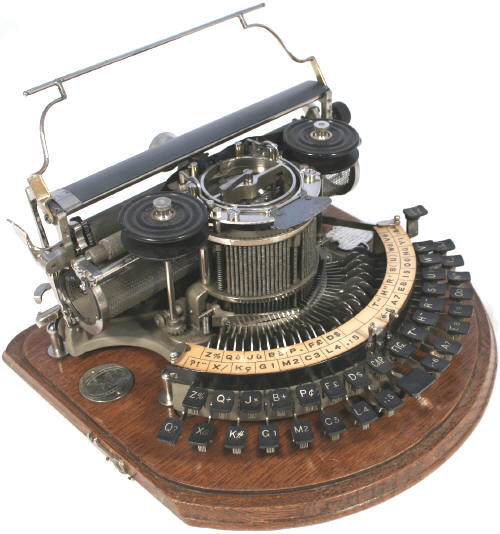
Old TypewriterAfter talking it over with my agent, researching, praying, and much pondering, I think I’ve had a change of heart. Turning my novel ideas into non-fiction is feasible. And I know successful writers are teachable and flexible. If I want to thrive in the writing world, I need to mirror those traits, and listen to those with voices of wisdom.

Down the writing road, I may change my mind or the market may shift, but at this point, why mess with success? I’d hate to have a shiny new object deflect me from the blessings I already have.

Do you think it’s wise to write fiction and non-fiction? Why or why not?


Loved, Chosen, and Writing (for the Forseeable Future) at 5 a.m.—A Lesson from Anne Lamott

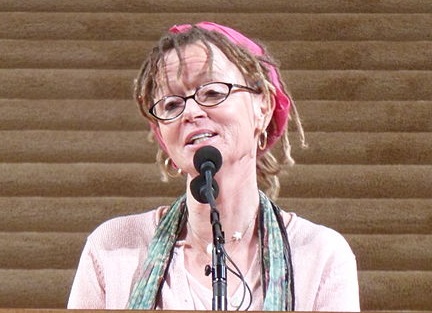
Anne-Lamott-2013-San-Francisco--Wikimedia Commons--ZboralskiI just returned from Calvin College’s Festival of Faith and Writing, featuring such diverse writers as Luci Shaw, Richard Foster, Rachel Held Evans, and Anne Lamott and offering sessions on everything from how to write a book proposal to self-publishing, writing about trauma to writing novels, writing children’s books to writing faithfully about sex. Some sessions were practical, others funny, some heady, some worshipful. All inspired and challenged me. Several offered strategies I’ve taken to heart and will pass on to my students.

The best advice, from Anne Lamott, was the simplest and hardly new or profound. She must have said it twenty times during a characteristically hilarious and solipsistic one-hour interview—which surged pell-mell in and out of her various addictions, the gift of desperation, her cellulite-pocked thighs, people she appreciates (those who give her even more cream for her coffee, for example) and those she avoids (e.g., those who claim you can’t have fear and faith simultaneously), her love of desserts and coffee with massive amounts of cream (Did I mention that already?), the interminably lost and sought jetliner on CNN in her hotel room, and the good news that we’re “loved and chosen” (a refrain I’m already aware of reiterated apropos to nothing that I could tell but nevertheless causing tears to start from my eyes each time)—and it was the same advice I’ve encountered whenever I’ve heard her talk or reread her wonderful book on writing, Bird by Bird. Still, like that loved and chosen refrain, it seized me anew each time she said it. It was this: All it takes to write is to sit down and do it.

She put forth several ancillary recommendations. That you can’t wait for your toddlers to start school or your teens to leave home. That you don’t need an office, just a door that closes. That you have to say no, nicely, to the dogs, cats, and kids at that door, who are attracted like heat-seeking missiles to your lap (or thighs or cellulite, I can’t remember). That all one needs—not only in writing but in everything (“Anything I know about anything,” she observed, “applies to everything else.”) is structure and discipline. That, for the past four years, she’s turned off her cellphone and written every day, at the same exact time (9 a.m.), no matter what.

“Give me an hour!” she kept demanding—as if she were our mom and we her teenage wastrels—and pointing out all the junk we waste our time on each day. Though I’ve written and revised and published five books, I still need this reminder, this goad to get after it.

“You’ve got an hour! Give me that hour!” she yelled, as though we would be writing just for her.

And truly, inspired as I was by that simple call to quit dallying, I really feel as though I’m writing, right now, for Anne alone.

Farmland_and_Airbus_Beluga_near_Cop_House_Farm_-_geograph_org_uk_-_446678I planned out that hour—or maybe two, since, as she said, you’ll really only get forty usable minutes out of an hour, only an hour and twenty minutes out of two—all the way back to Oklahoma. In the seats at my gate, on the tarmac waiting in vain to take off, back in those airport seats after deplaning because of weather in Chicago (Who knew you couldn’t take off on a runway perpendicular to the wind direction?), through the murky clouds over Illinois and Missouri and Arkansas, in the car snailing the empty roads at midnight with my cautious husband.

“I’m gonna write as soon as I get up,” I told him. “Before I run. Before I do any grading or reading. Get me up at five, when you get up, but don’t talk to me. Just give me my coffee and let me write.”

Don’t worry: I’m a morning person. And with our dogs living outdoors and daughters away at college, I can write in my non-office—the living room—without even the closeable door Lamott requires. If my gaze strays from my computer screen, I’ll see the sun turn the horizon pink. Every single day. At this rate, I’ll get my novel drafted before summer’s end and revised and sent off sometime before moving on, loved and chosen, to a heaven of no distractions from what I should be doing.