A Writer’s Life: The Waiting Room

Today I’d like to invite you to join me someplace most, if not all, writers are familiar with. Where’s that, you ask?

The Waiting Room.

Oh. My. Word. Your groans probably registered on the Richter scale. Stop it right now and come on in. Yeah, the Waiting Room is crowded. And the magazines are out-of-date. But we’re here to talk, not peruse the 2005 issue of Bowhunter magazine

If you’re a writer, the Waiting Room is unavoidable. Truth is, if you stay the course, you’ll make repeated trips to this room where the hands on the clock never seem to move and you languish forever, wondering when someone will call your name and say, “We’ll see you now.”

Aren’t I just the messenger of all things light and breezy today?

Why, you ask, why the Waiting Room? It’s such a waste of time.

Is it really? 

What can you learn while you wait? (Yes, I know you’d rather get seen and get out of here. But stick with me.)

  1.  Understand attitude is key. If I expect to wait then I avoid the “Woe is me” attitude — or at least succumb to fewer attacks of self-pity. If I get into my appointment on time or — gasp! — early, then I celebrate. Translation: No one is an overnight success. If some author tells you that they were, they’re lying. (You can tell them I said so.)
  2. Come prepared to wait. Do I want to waste time thumbing through magazines I’d never read even if I was stranded on a desert island? Translation: What are you doing while you wait for “the call”? Are you counting time or making time count by revising your manuscript, attending conferences, connecting with other writers — maybe even encouraging other writers?
  3. Realize everyone hates waiting. Medical professionals hate being behind schedule as much as you hate waiting. Translation: Editors wait too. And agents. And publishers. (Side note: Please, no comments with “waiting for my doctor” horror stories.  Not the point of this post. If you really need to vent, email me at beth@bethvogt.com. I’m married to a doctor. I can take it.)
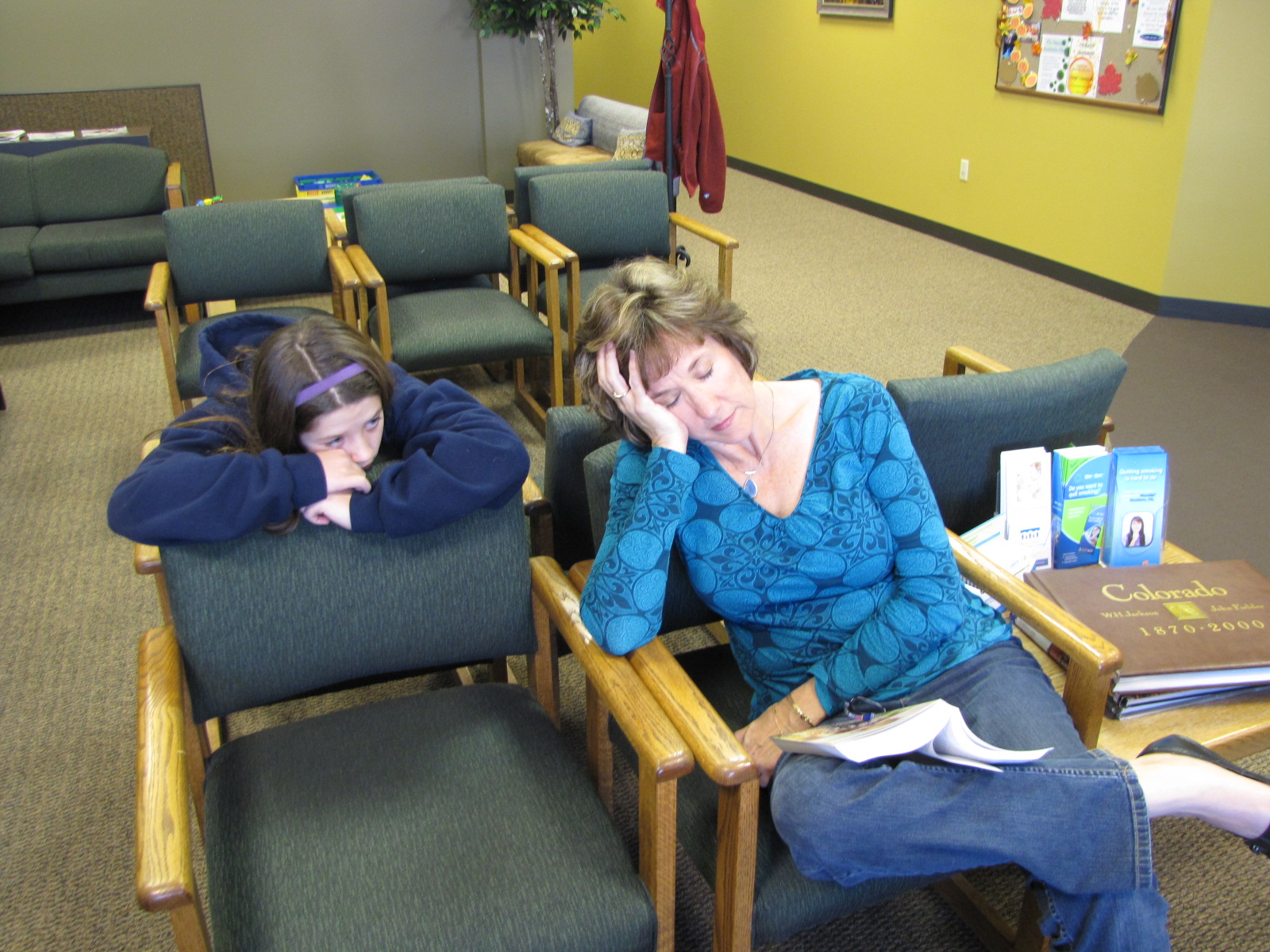
Time for me to sit back and see what y’all have to say about time spent in the Waiting Room. Tell me how you handle waiting for feedback from your critique group. Or from your agent. Or for the “sign here and would you like an advance with that?” phone call. How do you make waiting worthwhile?


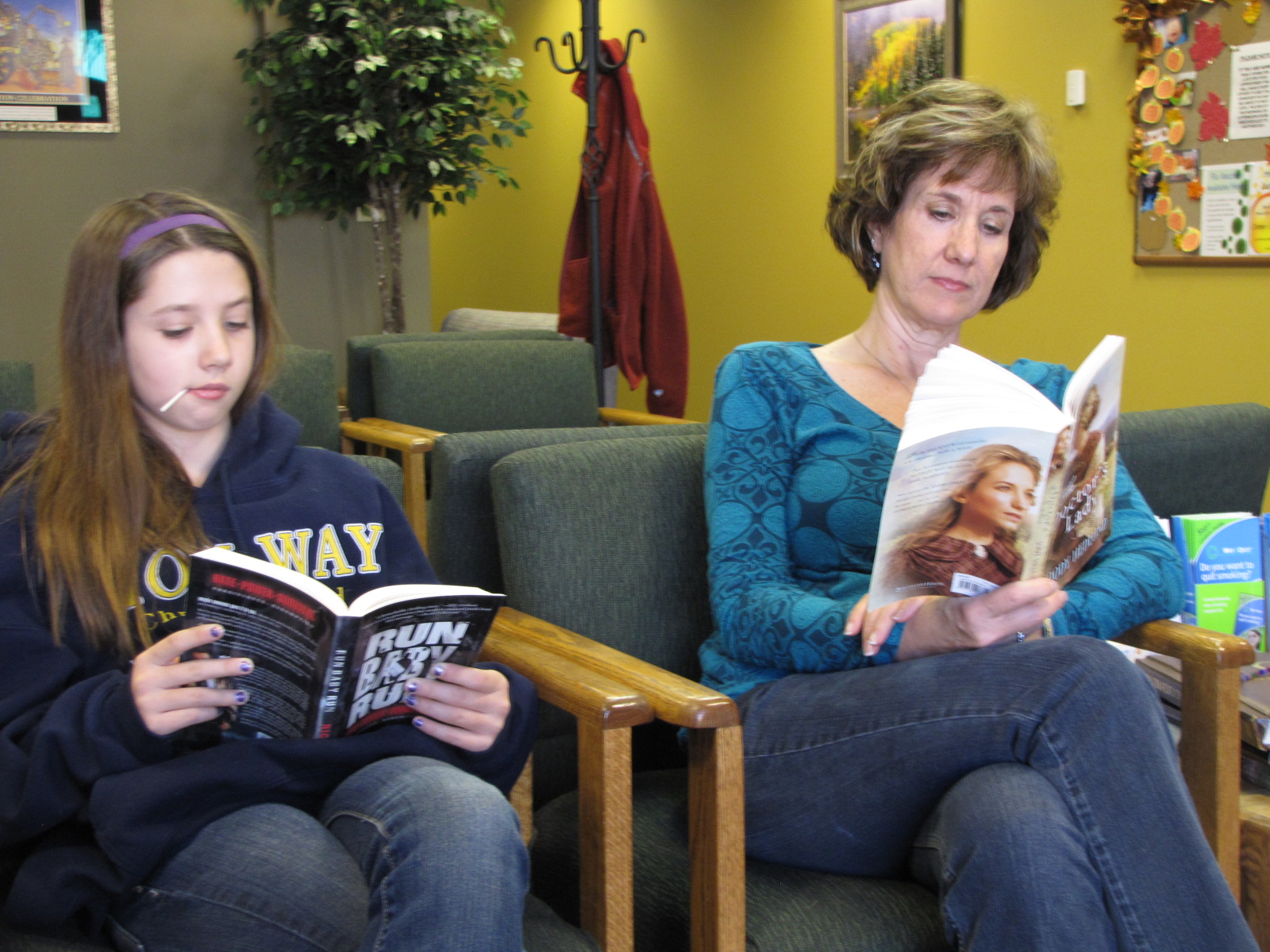
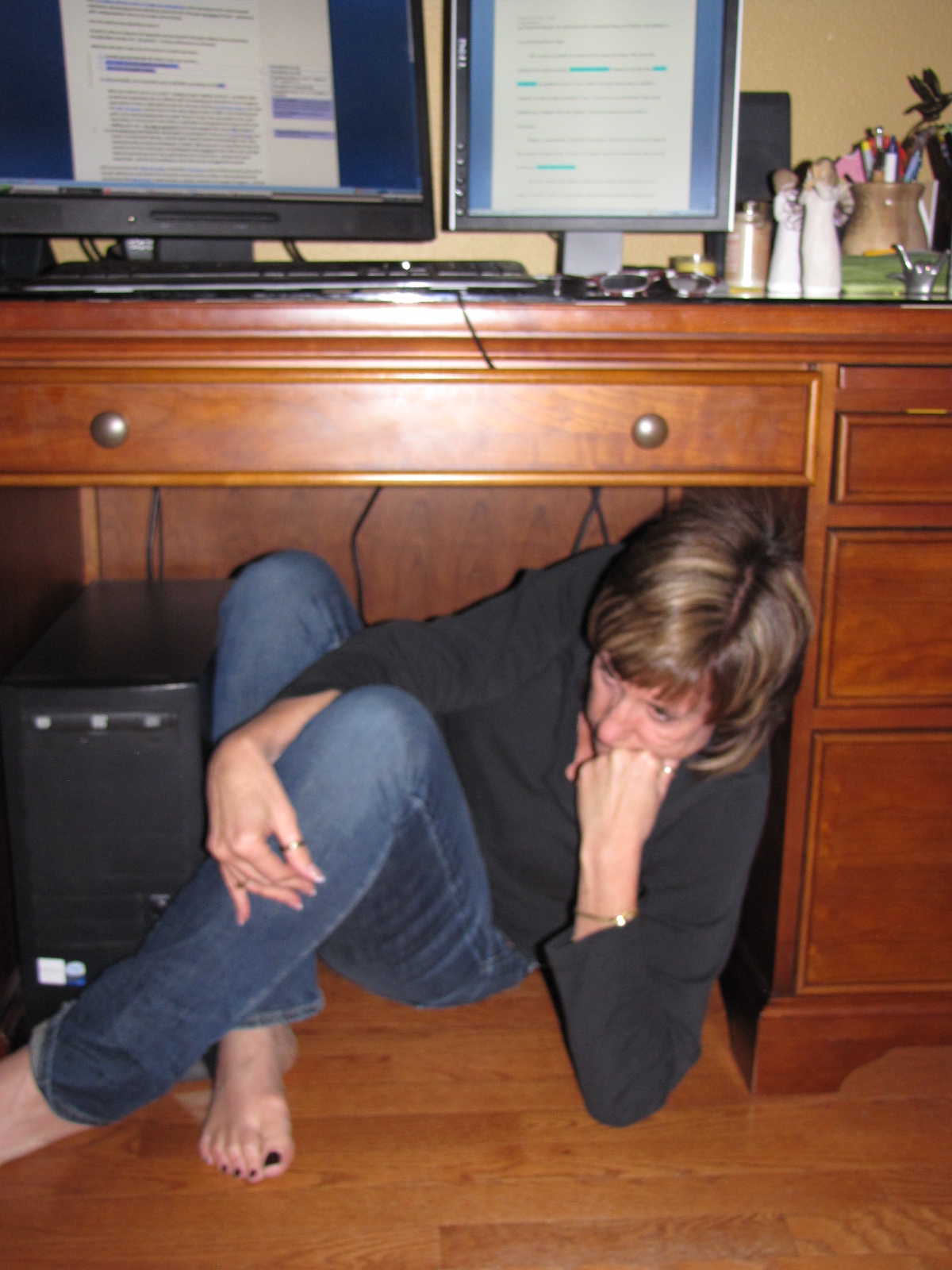
*Photo credit: That’s me and my daughter. In my husband’s waiting room. With a copy of author Jody Hedlund’s latest release, The Doctor’s Lady. The sleeping pose is for the sake of the column — not a statement on Jody’s writing. I loved reading The Doctor’s Lady!

Post Author: Beth K. Vogt

Beth K. Vogt is a non-fiction author and editor who said she’d never write fiction. She’s the wife of an air force physician (now in solo practice) who said she’d never marry a doctor—or anyone in the military. She’s a mom of four who said she’d never have kids. She’s discovered that God’s best often waits behind the doors marked “Never.” She writes contemporary romance because she believes there’s more to happily ever after than the fairy tales tell us.

Social Media – When Less is More

When I first joined Facebook I thought, “This is ridiculous. Who would ever do this?”

But I was told if I ever wanted to be considered by a book publisher, I better have an author platform. One of the foundational ways to build a platform is by using social media venues such as Facebook and Twitter.

So I grudgingly used my Facebook account. I logged in once a week to see what others were up to.  But then a weird thing happened. I discovered I loved social media. I made real friendships online and looked forward to hearing from my “peeps.” I enjoyed getting ideas and opinions from people all over the world. I loved knowing what people were thinking and talking about. I looked forward to laughing, crying, and praying with my online friends.

As soon as I mastered Facebook, I noticed authors talking about something called Twitter. Twitter seemed overwhelming so I read a few books about it:

*Twitter Revolution by Warren Whitlock and Deborah Micek. I wrote about it here

*Twitter Means Business by Julio Ojeda-Zapata You can order it here.

I learned that Twitter is very different from Facebook. Twitter is a powerful tool for specific purposes such as checking how snowy the roads near Vail are, what Judge Belvin Perry is ordering Casey Anthony’s jurors for lunch, discovering what the police are doing near I-70, talking out loud to politicians and celebrities, and telling companies about their bad (or good) service.

As I settled into my social media routine, I saw my heroes adding tens of thousands of friends, so I did likewise. I added and “friend-ed” everyone who crossed my path.

It makes sense. We all want to be part of the group like this little guy:

My friends and followers list grew, but I dreaded getting on my computer. I didn’t know whom I was talking to, and I felt like I was being spammed when I wanted to relate. So one day I deleted all 800 of my Twitter friends and started over.

I carefully and deliberately chose which friends I would follow (now less than 100) and paid little attention to who was following me. Every few months I clean out my Facebook account. I unfriend lurkers, spammers, and people who spew their message but never interact. One thing I’m proud of is that people I interact with on social media are not strangers, they are my friends. I have found several benefits to cutting back:

  • I am more eager to login to my Facebook and Twitter accounts.
  • I have built relationships with my online friends, so when my book gets published I won’t be a nameless face spamming everybody.
  • My friends and followers are more likely to pass my books, videos, and blog links to others.
  • I’m interacting with people who share my interests.
  • I’m filling a social need by relating instead of spamming. Research shows that people form communities on Facebook and Twitter in order to get social needs met.

More and more people, whose expertise I admire, are limiting the ways they interact on social media. As authors we are continually trying new marketing ideas, so we experiment, take risks, and try new things. I don’t know if the way I do social media is right for you…

Do you think more followers and friends are better? Why or Why Not?

The Publishing Biz: Will it Break You?

Photo: Bill Longshaw / FreeDigitalPhotos.net

Launch the Internet these days and you’ll find a deluge of opinions on what it takes to make it as a writer. You can glean expertise about search engine optimization, how to build a platform or leverage social media, garner advice on author branding, book promotion and networking, and find out what’s happening right this moment in the explosive world of ebooks. If the odds were against a writer back in the day, they really have their work cut out now.

You might tremble before the daunting writing, publishing and now marketing journey and wonder how you can possibly succeed. Do you look around and ask, “Are my writing dreams even relevant anymore?” Maybe you think…

  • With ebooks at everyone’s fingertips, the number of titles available has skyrocketed. There are simply too many books out there for any one author to garner much attention. Besides, you’ve missed the latest trend. Your chosen genre has been overdone. Editors have seen it all before and you have nothing new to offer.
  • The economy is still too scary, weak or unstable for you to venture into something so uncertain, and few authors earn enough to quite their day jobs anyway, so why bother?
  • Publishing houses aren’t taking many risks on new authors, and if they do, they aren’t investing in them the way they used to. The good old days are over, and while self-publishing is an option, you don’t have money to invest in it, let alone a website and SEO, and it’s all too complicated anyway.
  • Everyone else is better at social media than you. You’re not part of the ‘in’ social media networking crowd, and that train has already left the station without you—agents and publishers will take one look at your Klout score and break a nail trying to hit the ‘thanks, but no thanks’ button. You can’t possibly catch up.
  • You’re too utterly exhausted after working, volunteering, cooking, cleaning, carpooling, commuting, going to church, tweeting and generally living life to step it up in the writing and publishing game, especially to keep up with rules that seem to change everyday. If you thought you didn’t have the time before, you really don’t have the time now.
  • You don’t have a platform—you’re not even sure you know what a platform is. It probably takes too much time and effort to build one, and frankly, you’d rather stick a rusty fork in your eye than have to promote yourself anyway.
  • It’s easier to take a ‘wait and see’ approach. Industry changes may be a passing phase you can wait out—maybe when the kids are grown, you graduate or you retire. Eventually, the world will revert back to the way it was before, when writers had only to write and there was plenty of ozone left in the northern hemisphere.
  • Your old writing dream is in jeopardy, and you can’t come up with a new one you’re as passionate about, so you’re left to lurk about in a fog no one can lead you from with any certainty.

Maybe you believe some of this—maybe not, but the most likely reason you may fail to achieve your writing dreams is you will simply give them up. Any excuse will work. Pick one.

You can be paralyzed by the changes of today and uncertainty of tomorrow, or you can refuse to dwell on the reasons ‘why not’ and learn what works and what doesn’t from trial and error and from those working alongside you—those who keep putting themselves out there so others can keep dreaming.

What about you? Has the industry changed too much for the dream to appeal to you anymore? Or are you in it for better or worse?

Using Stolen Moments to Write

NaNoWriMo begins today. Around the world, millions of writers are pounding on their keys to produce a novel in 30 days.

Many writers aren’t like Richard Castle with styling offices and ability to write full-time. Most writers I know work full-time inside or outside the home, care for a family, have church responsibilities, act as the family chauffeur, battle dust bunnies from overtaking their homes, and try to squeeze in a decent night’s sleep.

Who has time to write? Well, many of them may not have time to write, but the majority of them MAKE the time to write.

I’m a stay-at-home-work-at-home-mom who owns and operates an in-home family childcare program. Not working isn’t an option. With my My Book Therapy responsibilities, book contracts, family and church commitments, life can be a bit crazy.

A schedule and stolen moments help me find time to write. Also, I’ve encouraged my family to help with housework, laundry and cooking. Plus I use my Crock Pot and bread machine a lot. I write in the evenings so Hubby runs errands and chauffeurs our son.

If you don’t have evenings to write, do you have 15 minutes in your day? The Fly Lady has a great site to help people get their homes and lives in order. One of her principles is you can do anything in 15 minutes … including writing.

I downloaded an egg timer for my computer. When I’m stuck on a scene or needing motivation, I set timer for 15 minutes and free write without editing. When I’m writing my rough drafts, I use my timer to increase my word count. After all, rough drafts are allowed to be rough.

If you are serious about your writing and want to make progress, enlist your family to help out. Delegate household duties, grab the timer and have everyone work for 15 minutes.

Another way to get some writing time is to ask your spouse to take your children for an hour or two each evening. The children and spouse will have a special bonding time and you will have time to write. Turn off the Internet and focus on your manuscript.

If you don’t have a spouse, consider doing a play date swap with a friend or neighbor. Ask a high school student to entertain your kids for an hour or so. Or write after your kids go to bed. If that won’t work, get up an hour earlier in the mornings. If you work outside the home, write during lunch. If you have to chauffeur your kids, take your laptop or a notebook and write while you’re waiting.

Set a daily writing goal and use stolen moments to build your word count. Remember, your first draft doesn’t need to be perfect.

Balancing life with work, family and writing can be a juggling act. Find what works for you. If you don’t take your writing time seriously, no one else will either.

**A bit of self-promotion: My debut novel, Lakeside Reunion, releases today! I’m having contests to promote my book. Visit my Lakeside Reunion Contest Page for more information. The token for this blog is a novel.

Your Turn: Are you participating in NaNoWriMo? How do you find time to write?

Police Work and Writing

For the past twenty years, I’ve worked as a 911 dispatcher. In the beginning of my career, I worked the graveyard shift at a busy California Bay Area police department. I cut my teeth on everything from stabbings to suicidal callers. My husband and I first met over a homicide. I dispatched him to the call; a drug deal gone bad. I know, not your average boy meets girl story.

Over my career, I’ve taken thousands of emergency calls and each one has molded and shaped my dark sense of humor and often cynical-quick-to-judge personality. After all, I get paid to judge in a matter of seconds, type-coding a call that will determine the response of police/fire/ambulance.

As an author, the road to publication twisted and shaped the writer I am as well. I can’t help but see clear parallels between a writer and police work.

It’s not always what it seems. A detective is trained to look for what the untrained eye doesn’t see—things like blood patterns, fingerprints, and previous cell phone activity. A writer’s path isn’t always an obvious three-step plan either. The craft must be studied, worked on, and almost never is how we dreamed it would turn out, with twists and turns taking you places you never thought you’d be. My two-page personal essay became a nonfiction book for moms—who knew?

Friends matter. Whether you’re the suspect or the victim of a crime, who you’ve associated with always comes into play. As a writer, who do you hang out with? Do you network with other writers/authors? Or, do you think your work is so good you’ll be miraculously discovered? If you truly believe this way, you couldn’t be more wrong. Trust me when I say: it’s only a matter of time before you’re a victim of un-success. Writing can be very solitary. Having someone come alongside who understands the ups and downs can make all the difference.

Word of mouth. Home invasions are almost always drug-related, a targeted place where the suspect has planned to regain their lost monies or steal drugs from someone they know. Occasionally, it’s a friend of a friend who bragged to the wrong person about their parents jewelry and non-belief in banks. As a writer, your reputation begins as soon as you share, “I’m a writer.” Once your words are published via blog, articles, or any other venue, your branding begins. Conferences, retreats, writer’s groups, and online relations are where your reputation is formed. Use every connection as an opportunity for helping other writers as well. I like to remind myself, no matter how well I write, I will never rise above the reputation my family, colleagues, and readers have of me.

Are you a victim?  I hate to break it to you…there aren’t as many victims as you think. Tough to hear? It’s true. The media loves to play on viewers emotions. As a writer, are you a victim? Do you suffer from itshouldbeme-syndrome? Do you believe every agent/publisher/editor just doesn’t understand your talent? Are you giving up the writer-ghost while complaining to everyone who will listen? Writer-victims aren’t as common as you’d like to think either. If your work is really that good and you are actively putting it in front of the right people, it will eventually be recognized. So, hang in there!

Writing and police work have a lot in common. After twenty years, my heart still races when I handle a hot call. There’s nothing like calming a woman who’s hiding from an intruder downstairs, encouraging someone to live another day, soothing a child who’s called an ambulance for their sick grandma, or the sound of a baby being born. The same can be said about writing. My heart still races when I submit an article, or speak before a crowd. There have been sleepless nights, anxious calls to writer-friends, and though my first published book is far from the New York Times best seller list—it’s been the ride of my life.

What about YOU? Does your writing journey have anything in common with your paying job?

A Writer’s Life: The Pit of Despair

Whenever I watch The Princess Bride, I skip the Pit of Despair segments. Popcorn, anyone? Maybe rewind to the Fire Swamp?

Sure, the Albino with the needs-to-cough-up-a-hairball voice is a bit of comedic relief before discovering our hero Westley is in the Pit of Despair. His future? Torture — attached to a life-sucking machine. His only escape? Death.

Am I the only one who skips these scenes?

As writers, there are days we are trapped in our personal Pit of Despair, without even a somewhat friendly Albino nearby. Life — our passion — is being sucked out of us, bit by bit.

What does Westley’s trip to the Pit teach us? Consider two truths:

  1. Truth # 1: Enemies get you into the Pit.
  2.  Truth # 2: Friends get you out of the Pit.

What about those enemies?
Inconceivable, isn’t it, how both success and failure dump us in the Pit.

When you succeed as a writer — land an agent, sign a contract — you think: Other people have expectations for me. What if I fail? Overloading yourself with the real or imaginary expectations of others tumble you into the Pit faster than the Dread Pirate Roberts can scale the Cliffs of Insanity.

And then there’s the slippery slope of failure: never attaining your goals, never quite grasping whatever spells “victory” for you. The root problem is the same: expectations. Fear you won’t meet others’ expectations or disappointment in yourself for not fulfilling your own. The bigger question? How do you navigate both success and failure?

At last! It’s time for the friends.
Westley didn’t rescue himself. The heroes? Fezzik and Inigo, who found a “mostly dead” Westley in the Pit. But that didn’t stop his friends from hauling his body out to go looking for a miracle.

When you can’t see the faintest hope of a miracle for the forest of despair surrounding your writing dreams, who searches for you? When you no longer believe in yourself, in your story, who believes in it for you? And — perhaps even more importantly — who do you go looking for when they’ve been dragged off into the Pit of Despair?

We’ve peered over the Cliffs of Insanity, survived the Fire Swamp, and now find ourselves at the Pit of Despair. Which have you found to be the greater enemy: success or failure? How have friends rescued you? Like Miracle Max, I believe it takes a miracle sometimes for changes to happen … so if you have any of those to share, please do!

For Fun: The Princess Bride 25th Anniversary cast reunion

Post Author: Beth K. Vogt

Beth K. Vogt is a non-fiction author and editor who said she’d never write fiction. She’s the wife of an air force physician (now in solo practice) who said she’d never marry a doctor—or anyone in the military. She’s a mom of four who said she’d never have kids. She’s discovered that God’s best often waits behind the doors marked “Never.” She writes contemporary romance because she believes there’s more to happily ever after than the fairy tales tell us.

First Contract Jitters

It wouldn’t happen to me.

At least not full-blown.

After all, I’d written for ten years, penned multiple novels, experienced a myriad of rejections letters, sold a bunch of articles, and met repeated free-lance deadlines.

I would NOT get the dreaded-first-contracted-book-jitters. Or writer’s block. I was a professional, just taking a next step in the industry.

Right?

You know what’s coming. My first book deal was contracted on a chapter and a synopsis. It was time to write to meet my first book deadline.

Only I needed to do more research. Read more widely within the genre.

I read 13 novellas in less than two weeks.

Obviously, it was becoming an addiction, all of this reading instead of writing.

I should quit—and would—as soon as I finished the 400 page novel that just arrived in the mail.

Then my friend brought me her collection of novellas to help with my research.

(Why do best friends feed addictions? Seriously!)

I had to write.

So I tackled every left-brained project I could find. I wrote non-fiction free-lance assignments, submitted proposals, started a devotional facebook page, and spent a bunch of time networking and marketing.

Which made my brain hurt, so I slipped away with a good book . . .

Renewed and with great resolve I went to bed excited for the morrow, when I would do nothing but write my first contracted novella.

I got up earlier than usual—not because I was eager to write, but due to the need to escape nightmares about inadequacy.

Bleary-eyed, I curled in my recliner, grabbed my journal and Bible, and prayed it through. The Lord reminded me of His promise ten years ago to lead me on the best pathway for my life, to guide me and watch over my writing journey (Psalm 32:8).

He asked if He’d done a good job so far. I said yes. He asked why I would think He would stop now. I said He wouldn’t. He promised to be with me.

Buoyed by God’s assurances for this new writing season I told my husband the whole wonderful story. Then promptly burst into tears.

The sweet man tried to hide his chuckles as he reminded me I was living my dream—that I could do this. Then he resorted to an illustration that good, non-fiction reading, left-brained, red-blooded husbands turn to: football.

Quoting Tim Tebow, the Bronco’s new wonder boy, my husband talked about going out there and doing what you love because you love it and because it is fun.

Oh, yeah.

This is what I love to do, this thing I’ve been avoiding for the past month. It’s fun.

No more fear! I’m going to get creative and let this story pour from my fingertips  . . .

Tomorrow.

(How about you? Got a “first contract jitters” story?)

Introvert Marketing in an Extrovert Market

My name is Olivia Newport and I am an introvert.

I’m not a hermit. Rich relationships nourish me, and my peeps keep me buoyant. Speaking, preaching, or leading a workshop do not scare me. But they take from me, rather than give to me.

At least 25 percent of the general population are introverts and charge up during time alone. Among writers, the percentage of introverts likely rises.

The rub comes because the rest of publishing runs on a 75 percent extrovert mindset. “Why Writers Have to Market.” “Ten Steps to Building Your Platform.” “Authors Must Be Speakers.” “How to Suck All the Readers in the World to Your Blog!” (Okay, I haven’t actually seen that last headline, but you know it’s a game winner.)

Um. Markets and platforms are places where hordes of people hang out. And since I don’t fuel my creative energy by hanging out with hordes of people … well, you see where this is going.

I do want to be a novelist. I do want to build an audience. I do want to be successful over the long haul.

My challenge is this: How can I accomplish these goals without feeling thrust into a 75 percent extrovert mindset that is counter-intuitive to who I am? I’m not talking about the work of learning new skills, including social media. We all have to do that. I’m talking about being able to meet readers out of the strength of my natural introversion, rather than being squeezed to set it aside in order to play the game.

I can’t turn myself into an extrovert. I don’t even want to pretend to be one for periods of time. It’s exhausting, and how does that help? As I got ready to launch a website and blog, I thought a lot about how to build an online presence based on my strengths, not on rules that are a foreign language to me.

• Be present. It’s not hard to find me. You find my name, you find me. I don’t spurn social media, and I don’t make it tricky to be cyber-friends.

• Seek connection. I like people. Really. My heart rejoices with those who rejoice and weeps with those who weep.

• Risk authenticity. I’m not perfect. I’m figuring life out as I live it. I love to go deep and share that experience with others doing the same.

• Build on consistency. I am a creature of habit and lists. I’m generally predictable. This will serve me well in an expanding author-reader universe.

• Celebrate being me. I’m not competing in that reality show, “She Who Dies With the Most Wins.” Embracing and celebrating the person God created me to be is the greatest value I offer to readers.

We all connect with readers by building on strengths. Being introverted is a different sort of strength than 75 percent of the population, but it serves me well because it’s my strength and I understand it.

Are you introverted or extroverted? How does that affect your experience of publishing?

How to Get Any Book Into Your Lap…Free!

Have you ever been in the situation of wanting to look up one item in a book, but the book is either expensive or obscure. Chances are you turn to your local library. Many people know about Interlibrary Loan (ILL) within their own library system, but what happens if your library system doesn’t carry a specific book?

In my last post I described how to get ahold of serious research in professional journals by accessing your library’s computer database. Today I want to describe how to get any book, from places all over the world, and have it delivered directly to your library branch?

The first time you do this it may seem tedious, but once you know how, it’s a breeze. I typically order about a dozen books a month this way. Your library system may vary, but here’s how my library does it:

  1. Bring up my library web site: Jefferson County Library
  2. Click on maroon-colored icon called “Research tools”
  3. This brings up:  “Subscription Databases A – Z” Click on this.
  4. In the Databases A to Z, click on “W” and choose “World Cat” or scroll down to “World Cat” Click link.
  5. Search for book. It is best to put several items in the search boxes. For instance, the book title and the author. Here I selected the title Seeking Peace and the author Mary Pipher. (I write about self-care and wanted to see how a bestselling author and psychotherapist burned out and subsequently learned to simplify her life.)
  6. When the world catalog finds your book, either print out the page, move it over to a dual monitor, or jot down the most important items: Publisher, year, and the OCLC number. (For Mary Pipher’s book the OCLC number is at the bottom of the page and is 233547957)
  7. Now go back to your library’s main screen. Choose the blue icon on the left side, “Find Library Books and More” – You will find a link called “Interlibrary Loan Request.” Double click. At the bottom of this page is a link called “ILL form for Books/AV Materials.” Click on that.
  8. Fill out the author, title of book, publisher/place/date, format (book, video, DVD), pick-up location (for me that is “Columbine Library”) and OCLC number.

*I don’t fill out the part about paying money for the request or the “cancel if not filled by date” information.

At the bottom of the page, I type my name and library card number.

Voila!

Almost any title from across the miles will be delivered right to my library. It takes about a week. If you find this confusing, go into your library and ask how you can use the World Catalog and Interlibrary Loan. Chances are your librarian has a bookmark with instructions already printed on them.

I’m curious, did you know you could do this?  What research tips do you have to offer writers? 

The Long View of Getting Published

Photo by Michael Hirst

There are two distinct parts to my career as an author. Part one, when I saw myself as more of a lone wolf and part two, when I finally started admitting I don’t know everything.

The second half where humility has played a lot bigger part has been more rewarding in every way, particularly financially and spiritually.

Funny little thing I’m learning about life is that when I stop trying to force my will and realize I may not get what I want but I can still be of service, more of what I wanted all along shows up. However, to head down that path the first few times took a lot of courage and hope because I didn’t have any personal proof. Fortunately, I had worn myself out trying things my way. I became willing.

To be an author, whether it’s as an independent or through the traditional venues takes more people and therefore a lot more willingness. The independent route sounds like it would be easier to stick to your own common sense and that would be more than enough, except for the occasional question. But publishing a book is a process that requires a lot of hands.

Besides, I was more arrogant than that anyway, running down the traditional path and still telling everyone how I saw things.

However, when I stopped listening for just the small kernel I wanted and expected to hear, dropped any agenda and not only took in the information but gave it time to sink in, things really began to move in a better direction. That opened things up even more.

What if I even followed through on some of the suggestions to see if other people who are actually the professionals in their slice of the publishing game were right? Perhaps my part in the entire process is to be a team player, be open to all of the information that’s coming in and just do what’s been suggested.

Some wrong turns are to be expected and even that’s okay because  the last tool I keep close by is the one that makes all of it okay.

I am powerless over the outcome but there is One who has His hand on everything, loves all of us beyond our ability to understand and has a plan that includes everyone. This is the most important part to me and makes it possible to relax and go back to the day I’m in when I’m worried about how book sales will go or if a book will get published at all.

The answer is, maybe it will, maybe it won’t.

In the past I couldn’t live with that answer so I tried harder to fix things. That just didn’t work and I wore out others as well as myself. Doors closed.

Now, I ask myself if I’ve done my part? Do I trust the professionals I’m working with on this book? What’s in front of me to do? How can I go be of service?

I know, all of that sounded really contrary to becoming published to me too, at first. But I had tried the lone wolf gig and only gotten mediocre results, at best.

I became willing to try a new tack. God is everything or God is nothing and I wanted, maybe even needed God to be everything so I started listening with a new ear. I asked for help and admitted when I didn’t know something. I grew more patient and less ‘helpful’ with suggestions. I did what was asked of me, on time and nothing more, allowing others to do their job without my interference. I became willing to change structure or style and see what happened.

And on the days when my anxiety still sits on my chest like an angry gorilla, I go pray, turn it all over to God and ask for peace of mind and heart. Then I get back to my day, do what’s right in front of me and keep going. As a result, more of my publishing life has fallen into place and my relationships in that area are a lot stronger.