When Writers Face a Constant Climb

Photo by Anna Langova

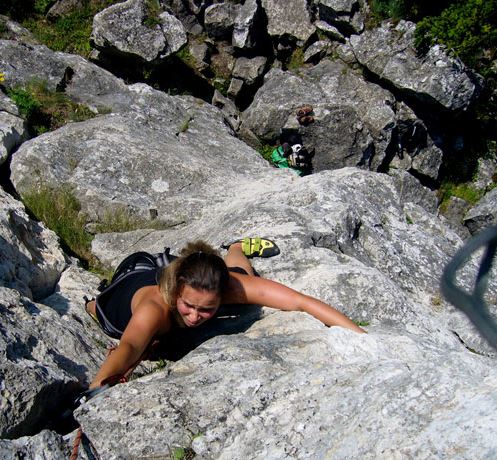
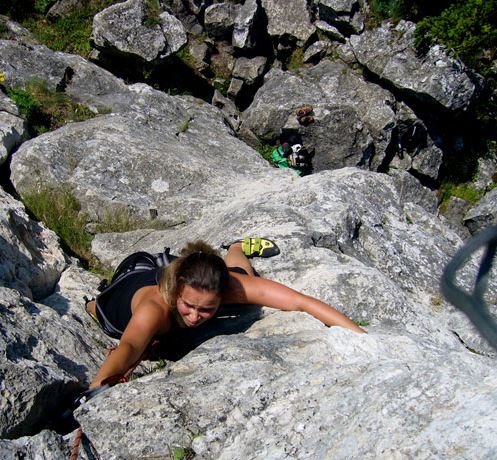
Sandstone boulders and harnesses and ropes, not really what I had envisioned when the new guy picked me up and we headed out for the afternoon—our first date together.

Girlie-girl me had somehow landed in a ragtop Jeep headed for some serious rock-climbing. Or so Mr. New Guy thought—what actually happened was girlie-girl watched some cute guy scale the side of a cliff, up, down, and sideways.

But getting to the top wasn’t his end-all plan. He seemed most challenged {and the proudest} when he slipped and then recovered. The catch and the readjustment seemed just as exciting to him as the time he stood at the top and waved high from the completed climb.

It’s been a few years since I sat in that ragtop and watched that guy climb. Seems I was about as interested in him as I was in climbing those rocks myself.

Why would we pull ourselves up the sheer face of something just so we can?

We do it more than we think, though, us writers. This writing for publication can be slow and hard. I have a {very thick} notebook full of rejections to prove it. Countless queries I thought would please never flew, never left their cage. And I mourned their loss. Made untold threats to quit, to lay down my pen.

Doubt can eclipse a budding hope if we allow.

But finally came my first assignment: a book review. I landed a column as a book reviewer, and my name held a place on a website that traveled the world. No matter there was no pay, I was writing. And I simply had to write.

Funny thing, though: that column landed me my first paid gig as a columnist for an established online magazine. With pay. This I celebrated. I framed a copy of the paycheck and then headed to my local electronics stores and nabbed a digital camera I’d had my eyes on for months.

From there, I secured an interview with a leading Christian author and sold that query to an international publication, and that one article led to contacts with other magazines and freelancing for the next few years. Meanwhile, my notebook of rejections grew thicker. Another brilliant idea shelved. Another dedicated period of grief. Another resolution to pack it up, find something else to do with my time.

Why do we allow fear and hurt to cloud our hope? To stall our dreams?

Looking back I realize that much like my rock-climbing friend from earlier years, my greatest sense of accomplishment came from those very moments I slipped, those critical steps I took to recover. I made my way to a writer’s conference where I could improve my craft, which led to securing an agent, which eventually led to a book contract, and that led me to my debut book. But there’s so much more to come. And to get there, I have to be willing to slide sideways when my quickdraws don’t connect just right, ready to race ahead when the space opens wide, or even to fall with grace when the fall comes {and they always come}.

There’s something that happens when we surrender to the process, when we climb for the sheer sake of the climb. I’m learning there is no end. If my sole focus was waving high from the top, I imagine I may be disappointed should I ever stand there. It’s been said before in countless ways, but in the life of a writer I’ve experienced it true, “the journey is the reward.”

Deeper Still: What setbacks have you faced on your writing journey? What readjustments have you made, or do you need to make in order to continue the climb?

 

Artist Sharpening Artist Series: Part One

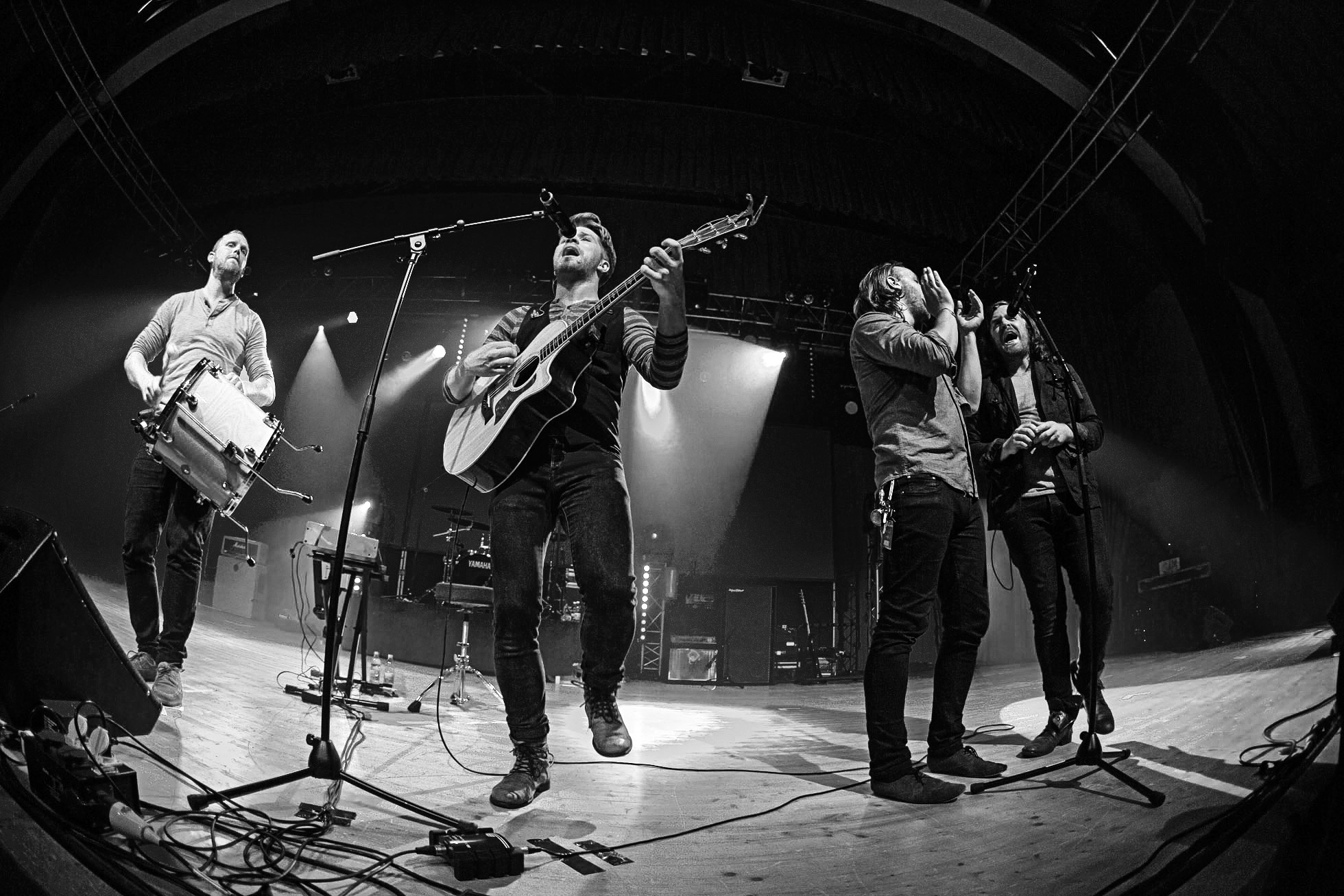
The City Harmonic, My God

(Please watch the video here when you get a chance.)

I admire singers and musicians. They can sing and I cannot. They can play instruments and I just stare at stringed things and suffer the fear of the unknown. Many of us here are storytellers, are we not? And songwriters, well, they just tell shorter stories. It makes us sort of brethren. Except they wear skinny jeans and shake their tushes, while we stay in our pajamas as long as possible and watch our ankles swell.

Skinny jeans, check!
Skinny jeans and tush-shaking all rolled into one.

Lately, I’ve discovered I need these Christian tush-shakers while I work things out in my head because more and more often, I find myself up against walls in my writing.

Take the song My God by The City Harmonic, for example. I really got into this song when I was at the gym one day, riding one of those accursed stationary bikes. Maybe it was because I had to suffer through a really hard bike seat, maybe because it’s a really good song, or maybe it was because I really needed it that day, but whatever it was, the song struck me in a multitude of ways.

I lift my eyes up,
in these days of trouble.
Will my help come from You?
And if I stumble,
will You pick me up?
What else could a father do?
Well, You know just where I’m going.
You made the open road.
So take my hand, Lord, and lead me home.”

Yes, God, I would like to ask You that: Will You pick me up if I stumble, if I fall, if I just generally suck at this writing thing? Oh yes, what else would a father do?

Oh, my God.
Oh, my God.
I lift my heart up,
whether it’s whole or broken,
good God I know You’re gonna work it out.
So on my heart beats
to a beat that I put my hope in
the love of my God pouring out.”

God, I have to be honest here. I’m already coming to the table broken, and writing . . . well, sometimes it feels like it requires things of me that I don’t think I have left. Oh, but, okay . . . I see . . .You’re gonna work it out.

Yeah
Oh, my God.
Oh, my God.
I will sing, sing, sing and You will be my song.
Yeah.

But, people’s ears hurt when I try that, so I think I’m going to write, write, write and You will be my page.

I’m gonna [write] it like it’s everything to me,
I’m gonna [write] it like the deep calling out to deep
I’m gonna [write] it like it’s all I’ve got
‘Cause all that I want is to [write] for the love of God.

I’m gonna [write] it like it’s everything to me,
I’m gonna [write] it like the deep calling out to deep.
I’m gonna [write] it like it’s all I’ve got
‘Cause all that I want is to [write, write, write].”

iPod shuffle: the poor man's iDevice.
iPod shuffle. It may be the poor man’s iDevice, but it packs a bunch of awesomeness on it for me.

And then there’s a clash of cymbals and the beat hastens. My iPod shuffle is cranked so loud that I don’t notice I’m singing. I don’t notice the RPMs on my exercise bike are over 100 or that everyone around is staring at me, but by goodness, I’m singing, singing, singing about writing, writing, writing. And the world is good and meaningful and suddenly I have strength.

All from one little song.

And then I wonder, can I make someone feel the same thing from my words? Hmm, it doesn’t really matter, does it? All that matters is we’re doing it for the love of God.

Thank you, The City Harmonic. You’ve sharpened me. I hope I can return the favor one day.

Ambition, Aspirations, and Obsession: Part One

Are you in a season of fresh aspirations?

WomanCliffWSSeveral years ago I had aspirations. (Or, perhaps it is more accurate to say, they had me.) I was obsessed. I’d stay up late at night, sadly, on my computer, surfing…dead relatives. That’s right, I had an Ancestry.com obsession. I aspired to know everything about all of the branches of my family tree. Soon I had more than 4000 strangers (and a few hundred names I actually knew) attached to my electronic tree, many with pictures and whole histories about their life. Fun and time consuming, but now it’s done.

After 20 years as an agent, I’ve seen literally thousands who have writing aspirations. It starts with an ambition, “Gee, I think I could write a book.” They give it legs by feeding their aspiration, “Wow, I really need to write this book, so I’d better learn how to do it—and then spend weeks doing it.” But oftentimes a good desire to write turns into an obsession, “I have to get this book done and in print if it’s the last thing I do.”

And oftentimes they throw God in the mix as Supreme Instigator.

“I’m so excited about this manuscript, it must be God’s will that I become a famous novelist. Therefore, I will do everything possible to make this God-given dream come true.”

Ambitions and aspirations can certainly be clues to God’s will for us, though ambition alone is not enough to discern God’s calling. My own history of aspirations has had mixed results, with joys and dangers along the way.

The Joys of Aspirations:

1. They Bring Energy.

I’ve got some aspirations about a new project/business I’m working on that will help my authors and, hopefully, help the Kingdom for years to come. As my wife Becky would attest, it’s brought me more energy and motivation about work than she’s seen in a long time. I love being an agent, but with the changes happening in publishing, I’ve been restless. I’ve seen too many great books go unpublished because some publishers are concerned about the lack of social networking tribes in an author’s portfolio. I aspire to do something about that (more on that in a later post).

2. They Bring Focus.

The Apostle Paul had ambitions and aspirations. “…This one thing I do, forgetting what is in the past, I press ahead to the goal of the upward call…”. He wanted to live in the moment and not be hamstrung by his past: a helpful goal that brought focus to his day-to-day life. One of his other aspirations was “…to see Rome…”. He eventually did, and was able to preach the Gospel to likely hundreds.

3. They Bring Fruit.

Aspirations to write books gave me hope that perhaps my life could count for something; that my words on paper could outlive me. That’s what books do. They allow God to use our stories and life lessons in ways that bless others. And with digital books, our stories could live forever on Amazon and other platforms. Granted, they might be ranked at four million, but at least our books are there!

4. They Bring Passion.

About 20 years ago when I was writing as a hobby and working a day job, my routines were to get up at 5 a.m. and write for two hours before work. Then after the kids were in bed, I’d write for another hour or two. That’s what aspirations do; they give us so much passion that we’d rather not sleep.

Next time I’ll discuss some of the dangers of aspirations. What about you? How does having dreams and aspirations affect you in a positive way?

Don’t Quit Your Day Job

Writing is one of those creative aspirations that typically accompanies another salaried job. Few can sustain a living simply from writing. If you ever start to feel down about not being able to make ends meet via your writing career, don’t fret. You are in good company. Here are just a few famous authors and the jobs they maintained in order to pay the bills:

Large group of diversity workers peopleJ.D. Salinger was employed as the entertainment director on the H.M.S Kungsholm, a Swedish luxury liner.

Stephen King was a janitor, as well as a high school teacher.

William Faulkner went to Ole Miss for three semesters, then dropped out and became the school’s postmaster.

John Steinbeck ran a fish hatchery near Lake Tahoe. He would also give tours of the facility.

Harper Lee was a ticket agent for Eastern Airlines.

Jack London was an “oyster pirate.” During the night, he would steal oysters from the oyster beds  of the most successful farmers and then sell them.

If these famous writers had to have other means of making a living, then we shouldn’t consider ourselves immune. In fact, it is precisely these day jobs that often fuel our creativity, providing content for stories to make them more realistic.

Some authors are able to find jobs that support their writing. If you can find a way for your job to complement and sustain your writing, then so much the better. Perhaps you are a chef and like to write about restaurants. Maybe you are a nurse who writes about life in the medical field. Keep a diary of your daily experiences and the emotions they elicit (happy, sad, mad, surprise, fear, love) as each can similarly move your audience in the future. People enjoy writing that is insightful and allows them to visit places they wouldn’t have known about otherwise. Isn’t that part of the fun, to enjoy vicarious adventures? So, as a writer who often lives in the career world, why not incorporate subject matter expertise into your writing? It will bring a three dimensional quality to each story.

Maybe you won’t give up your day job because it’s a significant part of your life and who you are. Did you know Wallace Stevens declined a prestigious professorship at Harvard because he didn’t want to leave his career (forty years in the making) with an indemnity company? Getting paid for writing is not always steady and consistent. You may have great book sales in August from a successful marketing push, and then watch sales decline in September. Maybe you sell one story and have to wait for years until selling another one. With creative careers, it is prudent to wait until making two or three times the salary of your day job before taking the plunge. Why? Because you will probably no longer have an employer who is helping to share or pay the expenses of benefits, such as health insurance, company profit sharing or a 401(k) match. Many employees do not adequately count the value they should be contributing to their current employer, so be sure and calculate the indirect earnings of any and all company perks (even gym memberships, mileage reimbursement, car allowance, et cetera).

It is the easiest thing in the world to allow the burst of enthusiasm from a great day in writing overshadow your career as a banker, doctor, lawyer, or teacher. There’s nothing like getting rewarded for what you love to do. If you can, enjoy what you do as much as possible, so it can feed and sustain your writing life.

What do you do as a day job?

With writing, how do you maintain a work / life balance?

Promotional Items: The Good and Bad

I recently returned from the ACFW conference held in Indianapolis. This is an annual gathering of the largest membered group of Christian fiction authors. It’s a great time to connect with fellow writers and hope some of the writing genius from authors like Dan Walsh, Tosca Lee, James Scott Bell, and Frank Peretti infuses life into my writing cells.

Promo1Most conferences have a “freebie” table where writers are allowed to leave promotional items to get the word out about their product. This year I thought I’d give you my take on them. The good and the bad.

Think of a promotional item with a goal in mind. What do you want it to do for you? Consider the return on your investment and what you hope to achieve. I think most people view a promotional item as a chance for exposure. Most marketing types will tell you it takes six-ten exposures for someone to buy your product. So a good promotional item is something a person will keep and look at over and over.

I’ve determined that giving away bookmarks is not a good idea. EVERY author/writer does this and last year when I had bookmarks I ended up taking most of them home. They are not unusual enough anymore and with the advent of e-readers I think many do not need them anymore either.

One way bookmarks could work is if you are a very popular, well-known author and they are signed. But, sigh, that is not me. Yet.

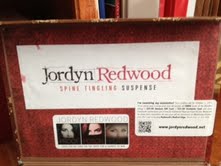
RedwoodNewsletterQRMy goal was to get people to subscribe to my forthcoming newsletter. I gave out full-size Hershey Bars and packs of gum with the stickers you see on the first photo. The sticker includes this QR code that links to a newsletter sign-up form where I’m giving away a prize worth over $75.00. It includes all three books of my Bloodline trilogy, a $25.00 Amazon gift card, a $25.00 Starbucks gift card and some fun Halloween items (yes, this is still happening, so sign up!) and goes on until October 1st, 2013.

I brought 108 chocolate bars (okay, I did eat ONE) and 36 packs of gum. I didn’t have to bring any home, which was great. People were interested enough to pick them up but, thus far, I’ve only gotten about six new newsletter subscribers, making it a very expensive venture with few results. Perhaps the QR code is not intuitive for people yet.

Other promotional items and my thoughts.

promo2 promo3 promo4 promo5 promo6 promo71. Luggage Tag: This is a good idea because not only do you use it but also other people along the way can see it.

2. Small button flashlights for key chains: I’m iffy on these. The writing on one is hard to read and the light is weak. They are fun to have but I don’t know if I would use them.

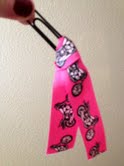
3. Ribbon bookmark: I’m personally not a fan. I am a no-wrinkle-on-the-pages kind of girl and putting a large plastic paper clip on pages would wrinkle them. Plus, it was not very intuitive to me what it was at first because it was attached to a business card.

4. Pack of sticky notes: This was given out by a publisher. Nice, as most authors love office supplies.

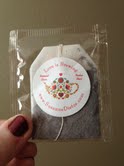
5. A bag of tea: This one I liked because I’m a tea lover. I think this would also be more economical than what I did, as mine ran about 50-60 cents apiece. I think it’s a good tie-in for some genres (romance, cozy mystery, historical set in England) but not so much for suspense. It might not work for my books.

6. Grippie lid opener: Someone can post in the comments what the real name of this is. I like this one for its durability. It’s something I’ll keep on hand and use and therefore will expose me to this author’s name multiple times.

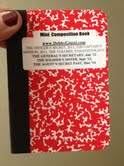
7. Small composition notebook: This one I’m actually giving a gold star and I’ll tell you why. I still have the one from last year in my purse. Every time I pull it out, I see that author’s name. I actually looked into doing this myself but they run (at the cheapest) about $1.00 apiece and that was too spendy for me.

What about you? Which promotional items do you like? Which do you think you’d actually pick up and keep? What have you used as a promotional item and did you appreciate the return on investment?

Why Do You Want to Write a Book?

voice matters2I love words. Slices of words on my tongue satisfy me like a sweet, icy watermelon on a sweaty July day. Whether I twist those words into colorful quotes, mash a couple of them together to create my own new word, or string just enough of them into countless paragraphs that eventually produce a book, I. Love. Words.

It took me a few years to realize I’m different that way—not everyone shares my passion. Few people consider their office or library a haven like I do, a place of refuge where shelves of categorically arranged books permeate the air with the faint mist of paper and ink.

Chances are, you’re somewhat similar to me. Yes, I suspect I’m in good company as I share today with you. We writers with lofty dreams, we have a way of finding each other. As an often insecure tribe who spends the majority of our days writing and waiting, vacillating between confidence and fear, we need the support of each other on this sometimes lonely and highly competitive journey.

It’s not new news: the publishing industry is shrinking. Larger publishers have nabbed smaller ones, and some have simply closed their doors. E-readers have reshaped the way consumers think about, and purchase, books. As a result, today’s publisher tends to seek new authors with the lowest risk.

Here’s the good news: God is bigger than statistics.

Publishers still need new authors; I imagine publishers will always want a well-rounded catalog of books to offer booksellers. While, yes, the best-selling authors sometimes carry the majority of sales, booksellers are usually on the lookout for “What’s new?”

This newness, though? I’ve discovered it costs us. Many hours of learning the industry, honing the craft, and most importantly, uncovering our unique voices.

Only you can determine if it’s worth the sacrifice; it’s the same choice I recently had to make. You see, I have a book releasing in a couple of weeks, When A Woman Finds Her Voice, and I wrote this book during a very difficult season. Many days, the morning sun rose right over the rim of my keyboard. In the only quiet time available to me, I would tuck away most of the night pleading for this heart-message to come. {I write about sensitive topics that today’s Christian women face, and that requires an unwavering authenticity that for me can only come in the stillness.}

I wonder what you’re willing to invest. The time it takes to pen the words—even if the book never sells? The sacrifice of certain relationships that might be put on hold while you pursue your dream? Your own reputation ?

Your turn: Why this book? Why are you willing to give this slice of time and energy? Is the investment worth it to you? I’d love to hear why!

Seven No Nonsense Book Launch Tips for Broke Authors

Seven no nonsense book launch tips


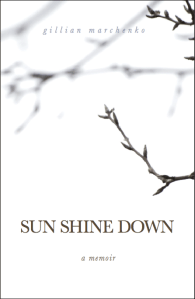
Sun Shine DownI am launching a book.

My memoir, Sun Shine Down, published at the end of August with T. S. Poetry Press. Eeek!

As a broke, green as the grass in mid-July first time author, I tackled the daunting assignment of launching a book like any other able-minded individual in North America.

I googled ‘book launch.’

In .02 seconds, reputable results-driven marketing and publicity firms jumped into my line of vision. These people surely could launch my book into the stratosphere!

But after some number crunching and a realistic talk with my husband about where hiring a publicist falls in the needs of a family of six (braces, soccer, therapy, FOOD), I conceded. We could not hire help for Sun Shine Down.

These days, whether we sign with a big publisher, a small press, or self-publish, we bear much of the responsibility for launching our own books. And it’s hard work.

If you, too, are a broke new author, here are seven no-nonsense book-launching tips:

1) Plan ahead

If you wait to plan your book launch until your book is out, you’re toast. Plan ahead. Start six months before you are to publish. Research, and consider elements of a book launch you will utilize.

2) Launch your book online

Social media is a marketing ocean. You’ve got Facebook, Twitter, Pinterest, Instagram … Where do you spend your time online? How can you introduce your book in those venues? With Amazon stomping on the book industry, it is a mistake not to market online.

3) Launch your book offline

Is a book party right for you? I’m hosting a party at a bar down the street from my house. I’m doing it on a Monday (because the venue is free then), providing appetizers, and using evites and Facebook events to publicize. Extra tip: Don’t call your gathering a book signing. Call it a book party. Who doesn’t love a good party?

4) Don’t spam people to death with your book

Not everyone is excited to hear about your book all day every day. Post about your book (especially on your Author Fan Page–don’t have one? Um, get going), but don’t post several times a day. It just makes you look full of yourself. The trick is fun, cool content, and looking like you’re not trying that hard even when you are.

4) Create a Facebook launch team

In an effort to build buzz about Sun Shine Down, I invited Facebook friends to join a super secret launch group. I offered perks for joining ( a free PDF advanced copy of the memoir, a thank you on the blog, access to a secret group, and interaction with the author) and requirements (help promote for five weeks, post about the book on your blog, etc.). My secret group has been the highlight of promotion so far. Why? Because relationships are being strengthened and we are having fun! It is also a great way to ensure Amazon reviews once the book is published (make it a requirement).  Read this post to see how I did it. 

5) Get help!

OK, I know that I sound like I am contradicting myself. But next time (God willing), I will hire someone or ask a friend to assist with some promotion. I’m talking about someone to help with a couple time consuming tasks and who is affordable (as opposed to a publicist who would do everything and is expensive). I’m talking a flat rate per month to run a blog tour or help with the launch group. I’d like not to have that pressure, and I am finding out with this book that there are virtual assistants and others who could fit this description. *Note: I LOVE publicists, so If I get to that point in my career when I can hire one, I probably will.

6) Create a new email address to send out official book launch news

I simply created a new Gmail account with the name of my book and merged it with my current email account so that when I send out press releases and other book emails, it looks official (instead of the author sending them, which she is 🙂 ).

7) Set expectations low

This is my Eeyore personality coming out, but I suggest you set your expectations low. Then you’ll be pleasantly surprised when something remarkable happens. Not an Eeyore? More a Tigger? OK, then expect like crazy. We are all different. In my experience, though, the people I thought would help publicize and raise excitement about Sun Shine Down haven’t. I did have one or two wild cards, individuals I knew for a short time long ago who have become cheerleaders and promoters complete with pom- poms and cardboard signs.

Here’s to successful book launches, and to many more hours with our butts in chairs, getting books written so that we can, gasp, go through the nonsense of launching again and again!

Important Question for Christian Writers

English: Posthumous official presidential port... President John F. Kennedy inspired American patriotism in his inaugural address: “Ask not what your country can do for you—ask what you can do for your country.”

As a Christian writer, I’ve asked myself a similar question at times: What can I do for God?

I’ve tried to do the things that I thought pleased God, but my good deeds never seemed to be enough when compared to the standards set before me.

So, I sought answers to my question from biblical examples of those who sought God’s approval and blessings.

King David experienced a change of focus when he sought spiritual counsel concerning his desire to please God by building a house for Him (2 Sam. 7:2). But God planned to build a house for David and establish his kingdom, and He chose David’s son to build a house for His Name.

The Lord declares to you that the Lord himself will establish a house for you … I will raise up your offspring to succeed you, … He is the one who will build a house for my Name …  Your house and your kingdom will endure forever before me; your throne will be established forever’ (11-16).

Humbled by God’s blessings, David received his inheritance with gratitude (18-24).

Jesus’ disciples also wanted to please God. And when they asked Jesus to show them the way to heaven, “Jesus answered, ‘I am the way and the truth and the life. No one comes to the Father except through me’” (Jn. 14:6).

What can we do for God that will please Him?

Accept God’s gift of eternal life. When we focus on our religious activities and good works, we overlook God’s promised gift of eternal life through His Son, Jesus. “For God so loved the world that he gave his one and only Son, that whoever believes in him shall not perish but have eternal life” (Jn. 3:16).

“For it is by grace you have been saved, through faith—and this is not from yourselves, it is the gift of God—not by works, so that no one can boast” (Eph. 2:8 NIV).

Seek God first. Matthew 6 encourages us to seek God first every day. As we observe God at work around us, He promises to reveal His plans for us.

Steep your life in God-reality, God-initiative, God-provisions. Don’t worry about missing out. You’ll find all your everyday human concerns will be met.

Give your entire attention to what God is doing right now, and don’t get worked up about what may or may not happen tomorrow. God will help you deal with whatever hard things come up when the time comes. (Mt. 6:33-34 MSG)

Focus on God’s blessings. God also promises His spiritual inheritance to all Christ-followers.

… When you believed, you were marked in him with a seal, the promised Holy Spirit, who is a deposit guaranteeing our inheritance until the redemption of those who are God’s possession—to the praise of his glory. (Eph. 1:13-14 NIV)

As I choose to focus on God and His blessings, my motivation for serving Him changes. Plus, I no longer depend upon the approval of others, and I avoid prideful boasting, a major stumbling block for Christian writers.

Therefore, since we are surrounded by such a great cloud of witnesses, let us throw off everything that hinders and the sin that so easily entangles. And let us run with perseverance the race marked out for us, fixing our eyes on Jesus, the pioneer and perfecter of faith. (Heb. 12:1-2)

What important questions do you ask yourself as a Christian writer? 

Puppies, Unicorns and Dolphin-Shaped Balloons

notes-md

Have you heard of the term bait-and-switch? Yep. This is one of them, and for good cause. If the title had read “3 Reasons to Outline,” would you seriously have stayed tuned? Not only is the topic of outlining boring, it often causes big hivey welts to break out on some people. So if you need to slug back a few gulps of Benadryl, go for it, and let’s move forward with…

3 REASONS TO OUTLINE

1. To keep from crashing head first into the lack of confidence wall.

Yes, you can write an entire novel without drafting an outline, but the chances of losing steam and curling into the fetal position about midway through are pretty high. What you thought was a plot screeches to a halt. Characters wander around like zombies on steroids. Your narrative is a flaming train wreck of twisted words. Reaching this state of mind has a way of sucking all the confidence marrow from your bones. This is where an outline comes in handy. Think of it as a safety net and/or anti-zombie mega-gun. When you hit midway in your story, you can reach out and grab the outline rope to pull yourself up to the grand summit of a finale.

2. So you know where you’re going.

I’m not a huge map fan. I can’t fold the dang things. I know. I know. There’s this great new invention called MapQuest. Yeah. That’d be great if I had a smart phone—which I don’t. Even so, there have been a few family vacations where I’ve been awfully thankful for a map. That’s what your outline is. Writing a story is a lot like going on a road trip. Sure you can throw your bags in the car and hope for the best, but what happens when you hit construction? Or worse…road closed? That’s when a map is your best friend. Same thing with a meandering story. An outline will keep you on track to end up where you wanted to go.

3. It works out the kinks.

Don’t get me wrong. Writing an outline is not a magic pill that takes you to happy writer land (but if you could market that, you’d make scads of money.) Planning out the major scenes ahead of time, thinking through all the what-if-that-happens scenarios, straightens out your plot so you’ll be less likely to have to rewrite unnecessary chapters.

Convinced yet that outlining is the greatest thing ever? I wouldn’t be, either. Outlining sounds about as much fun as scrubbing the toilet—outlining as in Roman Numerals and sub-points and all that analytical falderal. I say it’s time to start thinking outside that no-fun box and reinvent the outline.

Newsflash: there’s no law that says you have to write a text-on-screen outline.

Maybe you’re a Pinterest type of person who creates story boards. That counts. Perhaps you love the smell of dry erase markers and get off on mind mapping a tale on a large whiteboard. Shoot, I even know some writers who adore 3M sticky notes and plan out a novel by decorating a wall with their scenes. Go ahead and get creative. That’s what fiction is about, folks.

One parting thought to shoot down the scare factor of outlining. You have my permission to outline only chunks at a time. If scribbling down the entire story totally freaks you out, just do the first third, then take a break and write the first chapter. Before you end the first third, however, you should plan the next third. Savvy?

Outlining does not have to steal the joy from your writing. Turn it around to enhance the joy of your writing…and keep from having a nervous breakdown halfway through.

What about you? Are you fans of the outline or more pantsers types?

Write to be Relevant

Twelve years ago, tragedy struck our nation. For the second time in United States history, we experienced a day that “lives in infamy,” a day we were attacked on our own soil. From across our country, people came together from every religious, ethnic, and cultural background. The walls fell for a few short weeks between liberals and conservatives, and we stood united in the face of great threat.

Screen Shot 2013-09-04 at 1.16.12 PM

So many years later, many have forgotten the pain they experienced that day, but they are reminded through the documentaries, television shows, and news broadcasts. Flags will fly and people will remember where they were on 9/11.

The news will make much of the event that marked this day twelve years ago. Why? Because people want to know. They will take to the internet and read articles and more new stories. They will remember the valiant plane crew and cheer their heroism. They’ll remember the firefighters and first responders who bravely ran into the towers as they crashed.

As writers, our bread and butter is anticipating what our audience wants. Where are the holes in the market? What’s doing well? What isn’t? Judge the attitudes and mindsets of people. Teen fantasy sells well because those that buy it want to escape reality. The same could be said for many Amish fiction readers.

Know who you are writing for. Let’s be honest. Most of us would like to say that our audience is everyone from 16 to 95, but that’s not realistic. While you hope that those in that age range will read your books, attempt to tailor it to a certain group within that and then market hard. I am a young adult who understands the heart, habits, and hang ups of my generation. I can tailor my novels to my age group. However, I also want to make it relatable to every age group, so I create characters that every group can somehow identify with.

At a mentoring clinic I attended, one of my mentors, a very successful author, looked at me and said, “Kariss, your books perfectly describe your generation’s desire to not simply DO church but to BE the church. You have a lot to learn from those who have gone before, but my generation could learn a lot from your generation by reading this book.” Why? Because at one point, this man was my age. His children are my age. His grandchildren will be my age. It’s still relevant and relatable to him.

We’ve been at war since I was 13. But as a result, I’ve come to value the brave men and women who serve our country and protect our freedom. It’s affected the way I write. It’s even bled into my characters as I researched and created courageous Navy SEALs. I live in an age of everyday heroes who are seldom recognized. 9/11 is relevant to me today, but it also shaped my teen years. It sent my friends into the service and combat. While the media markets this day for other reasons, I choose to remember. And in my writing, I make these heroes front and center, because no matter the day, they are relevant. Now that’s something to market.