Overachieving Your Platform: Best of the Water Cooler Series Book #2!

overachieving-your-platform-coverMany years ago, a good friend went into a coma after giving birth. She was on life support for nearly four months. We all prayed and wondered if she would pull through to see her baby girl and live a full life.

By her side was her husband. Every day he was at the hospital talking with doctors and nurses, making sure medication was properly being administered, asking questions . . . basically, being every doctor’s worst nightmare when it came to patient care. But you know, on several occasions, he insisted on something that actually saved his wife’s life. The third leading cause of death in America is medical care accidents and misdiagnoses. He needed to care for his wife because if he didn’t, the worst could happen.

I mention this story because I think it can be illustrative of some of the realities of book publishing today. Sometimes, your book is the one on life support, often from the moment of publication. Standing by are publishers and PR folks who are tasked and paid to keep your book alive. They’re busy, they have other patients (authors), and are generally overworked and understaffed.

The point is you cannot leave your book’s marketing and PR ONLY in the hands of publishers. They’ll do their best (usually), but they’re not perfect. And sadly, they have the 80/20 principle that is always screaming at them from the higher-ups. In publishing, it’s true: 80 percent of the money goes to 20 percent of the books. It’s a reality that won’t change, so we have to learn to deal with it.

So what should you do, then, as the author standing by your baby, trying to keep it alive?

You’ve got to tend to it diligently.

With your publisher: ask questions, say thank you a lot (gift cards and flowers are nice) when they do a job well done, give them ideas, don’t mention a problem unless you have a solution, tell them what you’ll do to help, keep track of everyone who helps (radio stations, bloggers, author friends). Work WITH them as much as they will let you.

What else can you do?

Well, we at the Water Cooler have just released a book that will help answer that question. Overachieving Your Platform: 95 Ideas to Embrace Your Inner Sales Marketing Genius is now available from FaithHappenings Publishers, and it offers the tools you need to break out and connect with large audiences. Adapted from the best writing of the WordServe Water Cooler, these doable, practical and affordable ideas will transform your platform and expand your audience if you put them into practice. No, you can’t do them all. But you can certainly go through this book with your highlighter and mark everything you actually could do. Then make a plan. What will you do during your first month from publication, second month, third? Write the plan out . . . and then work it.

Publishers, agents, and retailers agree: you’re only as good as your last book. So if your last book flops in the marketplace, it may very well indeed be your last book!

Don’t let that happen. Stay on guard by your book for the first six months to a year after launch, and you’re far more likely to get that second book contract. You may even get a royalty check.

I’m so proud of all of the authors who contributed to Overachieving Your Platform. They’ve done the hard work in the trenches and have learned from their successes and failures. All they know they’ve shared with you.

Grab a copy today—and take that first step toward creating a platform and brand that will serve you for the rest of your writing career.

Excelling-at-the-Craft-of-Writing-CoverAnd if you haven’t checked out the first book in the series, Excelling at the Craft of Writing: 101 Ways to Move Your Prose to the Next Level, make sure to do that as well. Craft and marketing go hand in hand when it comes to a writing career—you won’t find success unless you’ve got both!

This post was adapted from the Introduction of Overachieving Your Platform: 95 Ideas to Embrace Your Inner Sales Marketing Genius (available now!).

Crowd Source Marketing

finger-769300_1280There’s an old adage in marketing that says in order to get a consumer to pull the trigger and buy something, they have to hear about the product three times. There was a time when the blueprint to accomplish that was pretty straightforward. Get reviews from newspapers or magazines and get interviewed on television or radio. Then, go make public appearances at bookstores or book fairs or local meetings, and don’t forget to keep writing.

None of those were easy to accomplish and they all took a lot of work to hit the magic three, but at least there was a path to follow that thousands of authors from decades past had taken with some success.

Times have changed. Not only have they changed, they keep changing at an ever-increasing pace.

The internet opened up the world and made it so much easier for authors to reach the public directly. That’s the good news. The flip side is there are hundreds of different ways to do it and a lot of them are really good, but may not be right for you.

So, the goal becomes finding the right tools for your genre and your personality and staying up to date about everything that’s new, while still finding time to write, and then have a life.

This is where just a little organization can funnel the hive mind of social media down to the essentials. Look for groups, particularly on Facebook, that are not only devoted to marketing books but are also in your genre. If you’re in traditional publishing, include that on your checklist. If you’re going the indie route, make sure the group is too.

A few other things to add to your checklist are:

  • The group is devoted most of the time to marketing – not selling, not writing
  • It’s invitation-only, so that it’s a safe place to share and there’s some control over the postings
  • There’s a monitor who shows trolls (people who complain or bully) the door and kicks them out of the group
  • Active members who are sharing information and are willing to answer questions – lots of questions
  • Be one of those people and share when you can – admit when you don’t know enough to add to the conversation. In other words, participate.

Some of the benefits you can reap from joining together are:

  • Doing cross-promotions with others in your genre. There’s power in numbers.
  • Getting a heads up about a new site that’s working for someone. And getting a thumbs down for a site that would only waste your time and your dollars.
  • Sharing each other’s ads or promotions on each other’s social media sites. Again, it’s that power in numbers.
  • Gaining a realistic view of how well you’re doing. It’s the equivalent of your water cooler.
  • Getting applause when things go well and getting some inspirational chitchat when they don’t.
  • Testing out new blurbs for your book or, if you’re indie, testing out new covers and getting early feedback.

Everything is easier when we work in cooperation with others and come together as a team, building on the information, adding in a post to what’s already there. That’s the definition of crowd sourcing.

Since I’ve found my own peeps I’ve been able to course correct a lot of mistakes I didn’t know I was even making and I’ve come up with a streamlined ad campaign that is even more in line with my budget. Best of all, though, I’m having a lot more fun sharing ideas and cheering on my fellow authors.

The 15-Minute Writer: Book Marketing in Life’s Margins

woman writer
Photo by Bench Accounting via Unsplash.com.

We writers wear many hats these days. In addition to writing proposals, queries, and manuscripts, we’re expected to market and promote our books through social media, speaking, radio/television interviews, and book-related events. Whew! What’s a busy author to do?

First, don’t get too overwhelmed. No one can do everything, so take that expectation off your shoulders. Take deep breaths. Now…don’t you feel better? Let’s do our part, and leave the rest in the hands of the Author of our life stories.

Second, after you write it but before your book releases, experiment with different marketing ideas to find out what you enjoy and are good at naturally—Facebook parties? Speaking engagements? Library visits?—and concentrate on those things. The fun you experience will come through, and you’ll sell more books (and even if you don’t, you’ll have more joy. And who doesn’t want that?).

Third, pray for wisdom, discipline, and creativity. After all, God gave us the idea and the opportunity to write a book, and He cares about the people who will read the message we’re sharing.

Finally, clear a few minutes in your schedule and write “marketing” on your calendar in a small window of time. This way, you’ll do a little bit every day. (It’s like the old question, How do you eat an elephant? One bite at a time!)

To help you get started, here are a few book marketing tasks that take 15 or 20 minutes, tops (just make sure each is related in some way—via a hashtag, link, or text—to the volume you’re promoting):

  • Write a short blog post
  • Draft a newsletter for your email list
  • Brainstorm a free resource to offer your list
  • Update a social media profile to reflect your new release details
  • Write a Facebook status or Twitter update
  • Take an Instagram picture and upload it
  • Read a blog post on another author’s site and comment on it (thanks to Michele Niefert for this idea)

    A photo by Alejandro Escamilla. unsplash.com/photos/N7XodRrbzS0
    Picture by Alejandro Escamilla via Unsplash.com.
  • Rate/review a similar book you’ve read on one of the major bookseller’s sites
  • Ask friends on Facebook or Twitter to review your book for you
  • Share another author’s book, which is related in some way to yours, on a social media platform
  • Update your website or blog in some way
  • Draft a query letter to a magazine on a subject related to your book
  • Ask other bloggers to review your book (Elizabeth Evans shared this tip with me)
  • Create an image on Canva or PicMonkey with a reviewer’s blurb on it and Tweet it (a terrific idea from journalist and author Simran Sethi)
  • Write a thank-you note to a book reviewer, librarian or bookseller
  • Follow-up with a meeting planner or editor you pitched but haven’t heard back from
  • Set up an Eventbrite page for a future workshop or seminar you’ll lead on the book topic
  • Read a book marketing article on line or in The Writer, Poets and Writers or Writer’s Digest

Now it’s your turn: share in the comments. What are your favorite—or most effective—quick marketing tasks?

“I Want to Write a Book”: Five First Steps For Aspiring Writers

When folks contact me because they want to write a book, especially someone who hasn’t been writing, I’m often pessimistic. I want to be able to encourage them, but I know this:  An agent or publisher needs to see that a communicator is reaching an audience. So what’s a first-time writer to do?

1. WRITE

Write an article. Online magazines usually have writer’s guidelines available at their sites. (Also google-able)

Pitch articles to magazines that are already reaching the audience who will read your book. If you don’t know what publications those are, ask among your friends on social media: “Moms, what blogs do you read?” “Business people, what magazines do you read?”

Your pitch to an editor—explaining what you want to write, how it will serve his/her audience, and why you’re the best person to write it—needs a hook. No editor will respond well to a pitch from you offering to write on “parenting,” but if they might be interested if your hook is, “What I Learned About Parenting During My Time in Prison.” Give your pitch a strong hook.

Having a number of articles that appear in print or online communicates to an agent or publisher that you’re reaching audiences.

2. SPEAK

Drum up speaking gigs. Ask folks you know to help you find venues where you can share the message you’re passionate about. Start by speaking for free to build your resume.

Speaking builds your audience and helps you hone your message.

skyscraper-1482851_960_720

3. BUILD

Build a website. Do not pass go, do not collect $200.  Before you pitch one article or seek one speaking gig, build a simple site to let others know who you are and what you’re about. Include experience and endorsements to give editors, agents, organizers, and publishers confidence that you have something to say and that others want to hear it.

A website legitimizes your credibility as a communicator.

4. GROW

Grow your audience. Beyond building your website, be intentional about your online presence. If blogging feels manageable—and it might not!—consider blogging regularly. Guest post on other writers’ blogs. Post quotes or memes on social mediate that relate to your message. Don’t always be self-promoting, though: share relevant content, from other worthwhile sources, with your followers.

Providing valuable content builds your audience.

5. LEARN

Attend a writer’s conference. Even if you’ve never considered it, the chance to grow in your craft and network with other writers and folks in the publishing industry will serve you well.


Bottom line: If you’re not willing to start building with one or more of these building blocks, it’s unlikely that an agent or publisher will consider the book you’re holding in your heart.

The exception, of course, is if you are: the President of the United States, the MVP of the NBA, or someone whose face has graced the cover of People magazine. If you are any of these, disregard this post. The rest of us, though, need to be hustling to build an audience.

Your future agent or publisher will thank you.

Reflect: Which one of these 5 made you balk? How willing/unwilling are you to move forward on any of these? What can you learn from your response?

How I boosted my book to 30x more people

ebookI finally bit the bullet. I boosted a post on Facebook.

For years, I’ve seen that annoying little message you get on your author page about paying to boost your posts. Because I’m cheap (and still suspicious of social media’s REAL intent, i.e. who needs to know what I buy, who I connect with, and what I like? Creepy…), I refused to give it a try. If my books can’t make it on their own merits, so be it – I’ll be content with small audiences, extremely limited financial reward, and the personal gratification that I haven’t caved to crass commercialism.

And then last month after I started getting consistent raves about my new thriller “Heaven’s Gate,” I thought, “What the heck. It’s only $20.”

Actually, it ended up being $60, since I decided if I was going to experiment, I wanted to see what a week of boosted posts could do rather than one day, which is what $20 will buy. Knowing that most buyers need to be exposed to a product seven times before they buy (do you know the Rule of Seven?), I figured one day of boosting was throwing away cash, but seven days might just convert into some sales. I can now tell you, without reservation, that $60 worth of boosting on Facebook can go a long way in giving your book exposure and building your audience, and now I can’t wait to give my other books the same treatment.

Here are the numbers from my week-long experiment:

  1. Organic reach peaked at 305 on Day 7, while paid reach was 9045. That’s 30x more people reached than my normal posting! Not only that, but thanks to my OCD tendencies, I checked one last time on Day 10 (remember I only paid for 7 days of boosting) and was happy to see a new total of 9432. The post was still being shared after my paid boosting! Score!
  2. I monitored my book’s print and ebook rankings on my amazon Author Central page (you do have one of these, right?) for the boosting’s duration. By Day 6, my ebook ranking had reached 924 in the Paranormal category after starting on Day 1 at 3366; the biggest jump was from Day 1 to Day 2, which tells me that first burst of posting made an impact that powered the rest of the week. Recalling the Rule of Seven and the impact of repeated impressions, though, I looked again on Day 18, only to find my ebook ranking better than ever at 831!
  3. As for print, my book moved from its initial 76,331 ranking to 8535 on Day 5. Clearly, somebody was paying attention.

Even knowing that rankings are a superficial measure (rankings don’t equal sale units), I decided that post boosting may not be such a bad idea for marketing after all. While the actual sales numbers are still in question, I know for a fact that more people have seen my book’s cover thanks to post boosting than would have otherwise. And that’s one step closer to buying my book.

Have you tried Facebook post boosting? What was your experience?

And the Tweet goes on…

Red HotA few months ago, I enthused in this space about a book I’d read at my agent’s suggestion. Now I’m going to give you a follow-up, because reading Red Hot Internet Publicity has truly changed my marketing game; unlike a lot of books that sound great and helpful while I’m reading them, RHIP is proving itself to be one of those books that truly make a difference in my career. In other words, its tips WORK and you can actually DO them.

(Or am I the only person on earth who finds it difficult to implement ‘great ideas’ that use apps I can’t understand, or require more financial investment when my writing income is already in the red, or simply involve too many steps to even remember?)

This is what I’ve accomplished since my post “Learning New Marketing Tricks” appeared here two months ago: I’ve more than doubled my Twitter followers from 217 to 500+ by discovering new audiences on this one social network, and my exposure (impressions) has increased tenfold!

twitter-bird-light-bgs.pngThe route I’ve taken involves the RHIP suggestion to engage in group chats, which has introduced me to new contacts with similar interests. Even just a few Tweets back and forth produce new followers, and sometimes that generates ideas for writing posts on other networks. Perhaps even more significant is my new habit of scrolling every day through the topics that are currently trending on Twitter. I find a few to which I can contribute original Tweets, and then comment on others in that stream. Again, it only takes a few minutes, but it always generates new followers.

Finally, I’m insistent on using hashtags with every Tweet I make, and the more hashtags, the more likely it is that I’ll reach into new markets. Before I started focusing on Twitter, my tweeting impact was dismal – maybe making only a couple hundred impressions (read that as ‘your name showing up in the Twitter universe’) a week. These days, I’m getting a thousand impressions a day – that’s a lot of times my name is showing up in the Twitter stream, and that connects me to large groups of people I might otherwise not have encountered. Some of those people have now subscribed to my newsletter and bought my books; by following them back, I’ve found more threads of conversation and topics in which I can engage. Throughout it all, I constantly remind myself of my brand – of my unique voice – and make sure my Tweets reflect that. So far, I’m delighted with the results.

Hourglass --- Image by © Royalty-Free/Corbis
Hourglass — Image by © Royalty-Free/Corbis

So delighted, in fact, that I’m thinking I should double my time on Twitter…from 30 minutes a day to 60 minutes.

That’s right – 30 minutes a day have yielded me a breakthrough in exposure, and since getting my name and brand ‘out there’ is so important for making sales, those 30 minutes pack more of a marketing wallop than any other 30-minute marketing I can do.

Isn’t it great when something you try really works?

How to make your readers SUPERfans!

supermanWhen you have a book published – be it in print or ebook – you want to get as much publicity as possible to sell copies, right?
Right!

Do your fans know this?

Well, yes, I think they do.

You THINK they do?

Here’s my suggestion: tell them you need their help to generate that publicity. You need their word-of-mouth to help your book get launched amidst the thousands of books that are available.

You need to give them the 3 Rs of superfans: Read, Review, and maybe most importantly, Rave!

With the launch of my newest suspense novel, Heaven’s Gate, I put together a launch team of thirty readers who agreed to read and post a review on amazon.com and whatever other social networks they had, along with any word-of-mouth recommendations they might be able to give. Like many writers, I’m not especially fond of online marketing because it takes a lot of my time, but the fact is, writers in the 21st century need to cultivate their presence on it. (I, personally, have had varying success with different networks, but I continue to learn and work at it because I’ve seen its value at different times. Let’s face it, if there’s a gathering of readers anywhere – even online – don’t you think an author would be remiss to ignore it?) What I’ve discovered since my book debuted last month, however, has added another piece to my formula of reading and reviewing: you need readers to RAVE about a book to influence others to buy.

So far, maybe this seems evident to you, but this next comment might catch your attention: I learned that you need to tell your readers what to write. I don’t mean give them a script – you  want their honest reaction. But what you need to do is empower your readers to write raving reviews, which result from two things: an awesome reading experience (which you have crafted with your book!) and a vocabulary that will reinforce what you want them to say.

Simply suggest key words you’d like your reviewers to use.

At first, I felt odd suggesting words to my readers to use in constructing their reviews. Then I realized that key words are…well…key. Keys, actually, to triggering the all-important call-to-action that every author needs to make to potential readers: You Need To Buy This Book Now. And guess what? Your reviewers are often very grateful to have your suggestions, because they want to write a strong review for you, but are often lacking in promotional experience and don’t know how to best help you with their review. I asked my reviewers to use the words suspense, supernatural, Archangels series, faith and science, String theory, fast ride, and thriller. They did, and as a result, the reviews for Heaven’s Gate present a consistent rave of being a book you can’t put down, which has cued new readers to order the book.ebook

Remember, your fans want you to succeed. Making it easier for them to help you is the least you can do!


Trends in Book Discovery

infographic-v2

What is publishing all about these days?

  • Writing?
  • Editing?
  • Packaging?
  • Posting an ebook?

Nope. None of the above.

It’s about FINDING READERS!

The loss of retail, magazines, religion sections in newspapers… the discoverability factor has greatly decreased. Which is why publishers are so dependent on authors to find readers (through author tribes) and on their ability to social network their way to a best seller. Which, in case you haven’t already experienced, happens about .01% of the time.

So when I saw some data about my favorite topic—FINDING READERS—I thought you ought to see it.

The following is based on data compiled by the Penguin Random House consumer insights team, which polled more than 40,000 readers about their reading and buying choices.

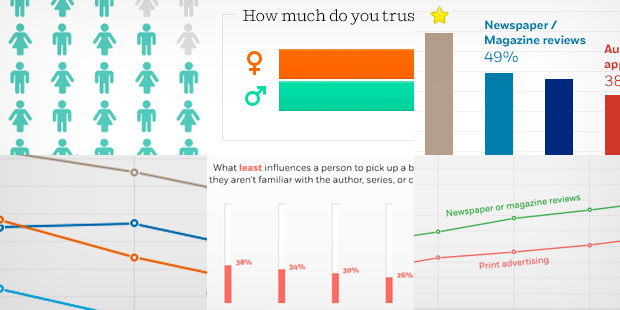
  • When asked what is most influential to readers when deciding what book to read next, 81% said recommendations from friends and family. Word of mouth, whether about movies, agents, or book sales, is always the key deal.
  • How do readers discover books? 70% said they use Goodreads; 49% said newspaper/magazine reviews; 46% said Facebook; 38% said author interviews/appearances; 37% said blog reviews; 23% said print ads; 15% said Twitter; and 14% said another form of social media. I’m wondering if the 40,000 readers they polled were from Goodreads. Still, this was more eye-opening than I would have guessed.
  • The survey found that as readers age, blogs and social media become less relevant as a way to discover books. Among survey participants under the age of 40, more than 80% use Goodreads and more than 60% read blog or web reviews. This steadily decreases with age; for readers in their 50s, 75% use Goodreads and 40% read blog and web reviews; for those in their 70s, the numbers drop to under 60% for Goodreads and only 20% for blog and web reviews. I guess we realize with age that there isn’t much time to read all of those books we bought but haven’t read, so we don’t need anyone else telling us what to read.
  • Conversely, print reviews and advertisements become more relevant with age. For readers under 40, 40% read newspaper and magazine reviews; for those in their 50s, the number is closer to 60%, and for those over 70, the number who read newspaper and magazine reviews is 70%. Print advertising follows a similar trajectory, with 20% of those under 40 relying on print ads to discover books, as opposed to 30% of those in their 50s and nearly 50% of those in their 70s. It must be the fact that there are pictures and not very many words. Easier on the eyes.
  • When it comes to gender, women are more likely than men to trust recommendations from friends and family (79% of women trust the recommendations, while only 66% of men do). The same is true of recommendations from Goodreads, 70% of which women trust, compared to only 57% of men. Men don’t gravitate toward asking for directions when driving, and evidently on book buying. What’s wrong with us?
  • Men are, however, more likely to read newspaper and magazine reviews; 54% of men trust such reviews, as compared to 49% of women. When it comes to print advertising, 26% of men trust it compared to 23% of women.
  • When asked what most influences them to pick up a book if they are not familiar with the author or series, readers said that they are likely to do so if they like the subject (88%), read a good book review (87%), or get a friend’s recommendation (86%). Slightly less influential are reading an excerpt (76%) or an online review (76%). Least influential are the recommendations of a salesperson (38%); the publisher’s reputation (34%); seeing an ad (30%), recommendation by media/personality (26%); and needing a book for school or work (25%).

As Mark Twain once lamented, “There are lies, damn lies, and statistics.” While I applaud Penguin Random House for spending the money on this survey, some of which was eye-opening, I’m not sure what it all means for authors except they will be even more encouraged to do their own marketing than ever.

Here is the one truth that everyone agrees with when it comes to author marketing: email addresses.

If you have them, you’re golden. How many? 5,000 is nice, 10,000 is better. Time to check out MailChimp, time to offer free stuff, time to really focus your brand and what felt need you’re meeting, and time to become an expert in direct mail to your audience.

Build Your Platform and Expand Your Reach… with FaithHappenings.com

Business card back

Building a platform is essential for writers today. Publishers are busier than ever, and they have less resources to devote to helping authors spread the word about their books, speaking events, and tours. Even more difficult, agents and publishers are often unwilling to take on new writers who don’t already have an established platform, social media presence, and dedicated followers. So what’s a writer to do?

FaithHappenings.com has the answer.

FaithHappenings.com is an online Christian resource with 454 local websites serving more than 31,000 cities and towns. It offers tailored, faith-enriching content for members. Along with a few dozen other benefits—both locally and nationally—it connects people of faith to information about books, blogs, speaking events, and other resources that interest them most. As a writer or speaker, it will allow you to connect with people specifically interested in your genre, subject, or brand!

Just what can FaithHappenings.com offer you?

On FaithHappenings.com You Can…

  1. List yourself as a speaker both locally and regionally, for free! FaithHappenings allows you to highlight your speaking in the local areas where you have upcoming events, targeting people who live there through requested emails. We also link to your author website, driving people back to your site.
  2. Announce upcoming book signings in your local area for free! Information about book signings and other author events are emailed out to members who have requested to be notified of new book releases and book signings near them. Emails go out weekly, and members will also find your events by going to their local FaithHappenings page and checking out the Events Calendar.
  3. List your books—both traditionally and self-published—in up to five genre categories. These book listings will then be promoted to members across the country who have requested to hear about new books in your genre.
  4. Announce special e-book promotions the day they happen. E-book promos are sent out to our members via email and listed on the site daily! The more people who hear about your e-book deal, the more sales you’re likely to see.
  5. Build your blog traffic by posting your blog on FaithHappenings.com. You can then be listed as a “Featured Blogger” on our Home Page.
  6. Post a Top-10 List from your book! If you can create it, FH Daily—our page of daily inspiration, humor, encouragement, and current events—will post the content and link to your book (and it stays on our site forever). Content is king when it comes to generating buzz for your book, and posts on FH Daily are easily shareable via Facebook, Twitter, Pinterest, and more.
  7. Be a highlighted “Author Interview.” FH Daily runs author interviews several times a week. Readers can learn more about you, and links will connect them to your website and your book’s buy page. Just email fhdaily@faithhappenings.com to see if you qualify.
  8. Create more awareness for your book with advertising! An ad on the global site or on FH Daily is affordable for any author.
  9. As a free member yourself, you can receive e-mail announcements for any book in more than 70 genres.

What are you waiting for? Get started today by signing up in your local area to become a member at www.faithhappenings.com.

For more information about the benefits of FaithHappenings.com for writers and speakers, click here.


Learning new marketing tricks

dog shaking handsI am living proof that even old dogs can learn new tricks.

Except that I’m not a dog and the tricks I’m referring to don’t have to do with “shake” and “roll over.”

As an author who came to the book publishing game in her mid-fifties, I realized I had to embrace the internet and social media marketing if I was going to play in the marketplace. As a result, I’ve read a lot of books over the past few years about online marketing and tried to apply that knowledge. But the book I’m finding the most instructional and helpful is Red Hot Internet Publicity because it gives you simple ideas you can implement easily and see immediate results.

twitter-bird-light-bgs.pngFor instance, I’ve never quite been sure how to leverage my Twitter activity into growing my audience; twice-daily tweets and random retweets of those I follow can only do so much in attracting engagement when you consider the enormity of the Twitter universe and its competing attractions. After taking just one tip from RHIP – participating in a group chat sponsored by one of my influential Twitter contacts – I picked up five new followers and at least one immediate book order. “Gee, this really works!” I thought. (Well, duh – the book’s title is Red Hot Internet Publicity, not Mediocre Marketing Online.) As a result, I’m now devoting effort to finding chats EVERY DAY hosted by key influencers in my book topic areas and being sure to participate with tweets and retweets. Yes, I know – it’s called a social network, and that means you’re supposed to be interacting with others, but somehow, actually “chatting” online had seemed a waste of time. No more.

facebook_circle_color-128Likewise, thanks to the book’s advice, I’m streamlining my Facebook involvement to make my time on it more productive. Sure, I’d read before that you need to have your marketing message in front of you every time you post, but I’d gotten lazy. After reviewing my message and tightening its focus (another recommendation from the book), I’ve been more vigilant about making EVERY post count with a comment that somehow reflects that message. The result has already yielded me new followers on my author page at Birder Murder Mama, which had stalled out in the last three months.

Those are just two of the ideas that have already made a difference for me in internet marketing. Being the perennial student that I am, I made a list from each chapter in RHIP of items to try out. Fortunately, I’m gearing up for a book release in May, so the timing to fire up my social media marketing is perfect, and I’m finding lots of opportunities to practice what I’m learning. And that – immediate practice of what I’m learning – is key. Too often, my ideas sit in a file for that magic “sometime” when I’ll get to it. But thanks to the simple presentation of RHIP, AND the timely suggestion from my agent to download and read this new book, my magic “sometime” is right now.

I guess my new trick is “shake” after all – shake up your marketing and see what happens!