Writing Life Survivor Tips

Photo/KarenJordanHow do you endure setbacks in your writing life? If you’ve embraced writing for publication, you’ve probably faced discouraging obstacles in your journey.

I’ve also faced a few stumbling blocks in other areas of my life, such as my health. After every health or family crisis, I struggle to get back on track with my exercising and walking program.

I discovered my desperate need for exercise after a minor foot injury last summer. As I climbed the very first hill on an asphalt trail near my home, my heart raced. I resisted the temptation to sit down at first. And by the time I made it to the top of that hill, I felt like I’d been walking over an hour. As I plodded on, in pain, the trail leveled. But I continued to struggle with each new hill.

Since I carried my camera, I paused several times to capture an interesting shot along the way. I only intended to walk for about 30 minutes. But when I checked the time, I discovered an hour had passed.

I learned some things about myself on the walking trail that apply to the other areas of my life, including my writing life.

  1. Recognize limitations and needs. I must allow myself the freedom to take breaks when I need them. I can cause more damage if I don’t stay off my feet with a foot injury. And in the waiting rooms of life, rest often provides what I really need the most.
  2. Keep going. Don’t quit when the journey gets tough. I need to remind myself of that truth, when the walking trail or the pace of my writing efforts becomes difficult.
  3. Set goals. It helps to have daily goals, even if I miss the mark or go beyond my goal at the end of the day or the project. When I planned to walk 30 minutes, I discovered that I could endure for an hour walk. If I forget to set some measurable goals in my writing life, I fail to recognize my progress.
  4. Enjoy the journey. When I walk, taking my camera along to capture a few of the scenes helps me enjoy the sights along the way and forget about the effort it takes to go the distance. In my writing life, connecting with other writers brings new friendships, insights, opportunities, and encouragement. Plus, choosing my topics and commitments carefully engages my creativity and serves as a motivating force when the writing process becomes overwhelming or difficult.
  5. Reward yourself along the way. The benefits from my walks and my writing life enhance other parts of my life. Of course, as my health improves, other areas of my life benefit, too. Also, my new photography interest contributes to our family albums, and my nature shots add some great content for my blog posts. My writing successes also increase my self-confidence and encourage me to keep going when the journey makes me weary.

What helps you survive your writing life when the journey gets difficult?

The Emerging Story

In third grade, I won a writing contest with my short story, Monica’s Broken Arm. It was my first indication that I might be good at what I loved most: writing and storytelling.

As I grew as a writer and a young woman, I explored many genres and disciplines. But one thread wove through all my efforts and experiments:

God, please give me a story to tell. I don’t want to write a beach novel, a book that women will take with them for mindless reading on their summer vacations.  I want to write something with meaning, something that matters.  I want to write something that will build community, something that will bring people together to know each other more.

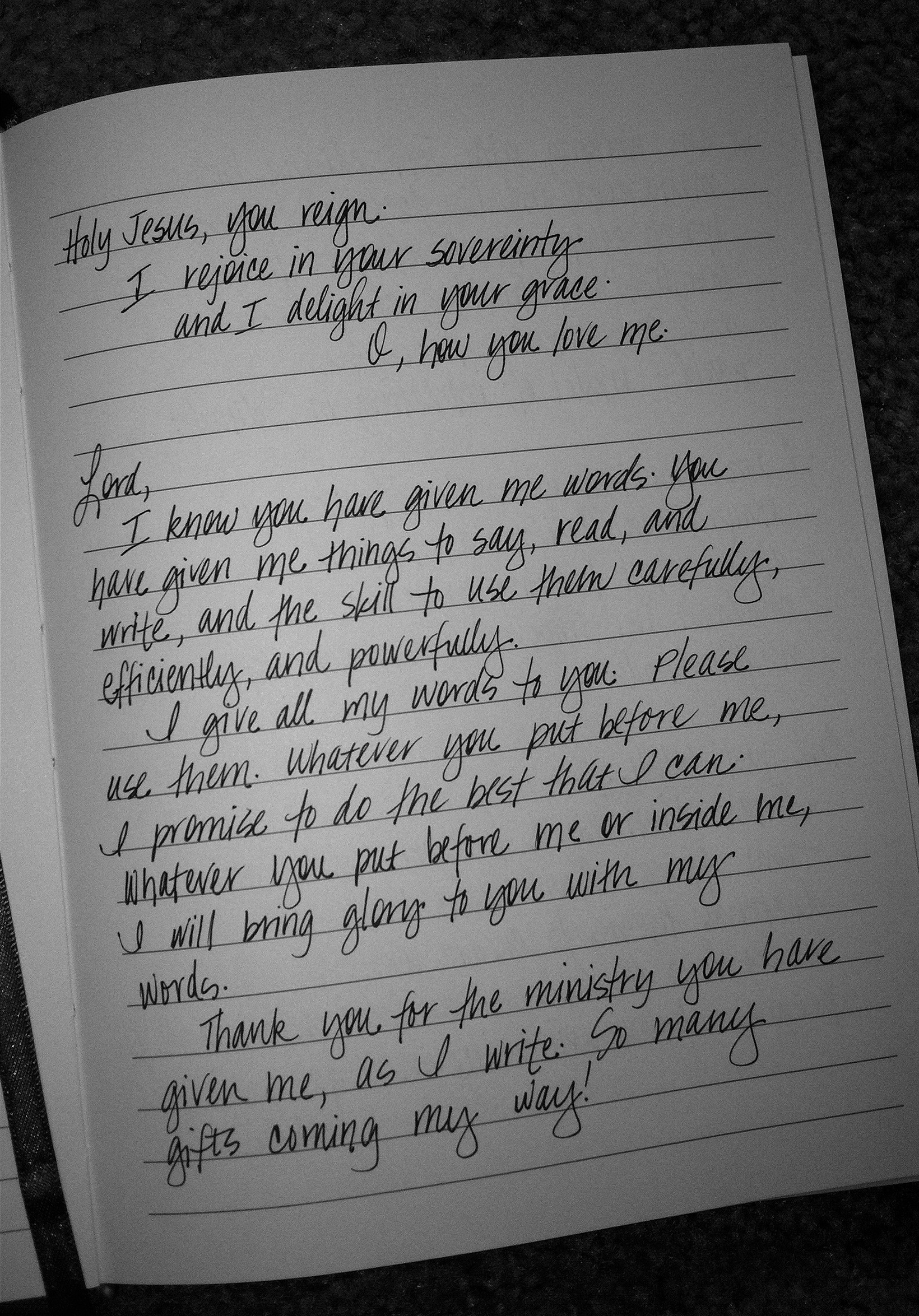
Recently, I found this page from my journal, December 2009. Here is what I wrote:

“Holy Jesus, you reign. I rejoice in your sovereignty and I delight in your grace. O, how you love me. Lord, I know you have given me words. You have given me things to say, read, and write, and the skill to use them carefully, efficiently, and productively. I give all my words to you. Please use them. Whatever you put before me, I promise to do the best that I can. Whatever you put before me or inside me, I will bring glory to you with my words. Thank you for the ministry you have given me, as I write.”

One year later, my husband died, tragically and suddenly, two days before Christmas. Overnight, I became a widowed single mom of two little boys who were not yet in kindergarten.

In this rupture of my world, a story emerged.

Yes, it is a story of grief, loss, single parenting, and deepest heartache, but this is also a story of hope, bonding, laughter, overcoming the worst, and getting up again the next morning.

Certainly this isn’t the story I intended to tell, and I won’t say that God allowed my husband’s life to end so my prayers could be answered. But I do wonder if perhaps it happened the other way around: God planted the desire in my heart, so that when such tragedy struck my family, I would know how to respond: to keep writing. In the horrible days, the easier ones, the loneliest nights, and always in honesty.

Robb used to say, “She’s going to be a successful author, and I’m going to retire early.”

Well, the plan looks different than we thought, but it still happened as he said. He retired early. And now I’m writing books.

In my words, may people find hope, grace, courage, and the tools to walk with someone through the valley of greatest tragedy to the sunshine on the other side.

As I asked him, God has given me a story to tell. How is he using your gifts and answering your prayers in ways you had not expected?
For more of Tricia’s story, please visit her at www.tricialottwilliford.com.

Marketing with Integrity: 5 Tips On What Not To Do

http://www.stockfreeimages.com/

Most writers prefer to focus on craft instead of marketing. But let’s face it. These days, authors need a platform to jump from in the publishing world. Without flexing the mammoth muscle of the internet, our publishing goals may not materialize.

Humph.

I’m new in the business. I’ve written a memoir about having a baby with Down syndrome while living as a missionary in Ukraine. I’ve landed an agent. I now participate in the shaky step of pitching my project to editors.

And I’ve already committed marketing blunders.

Here are 5 tips on WHAT NOT TO DO in marketing.  

1. Don’t use your kids to get ‘likes.’ 

After my amazing agent Sarah Joy Freese encouraged me to attract more likes on my Facebook Fan page, I went a little nuts. I hosted a giveaway on my blog in exchange for Facebook likes and Twitter followers. I then convinced my four children to write and perform a “likes rap” video. They were cute. It was fun. It killed an afternoon at our house.

Giveaways and videos are great marketing tools. But I went overboard. I posted the video, and re-posted, and re-posted until my kids were even tired of watching themselves perform. My idea morphed into a “look at me” festival until a friend sent me a gentle message saying, “Really, Gillian? This isn’t you.”

2. Don’t spam.

Spam is no longer just canned pork.

According to About.com, “Spam is any unsolicited commercial advertisement distributed online.” If you post links repeatedly on social media without engaging in community and conversation, you may be considered a spammer and people are going to find you annoying.

3. Don’t just ask. Give.

It is better to give than to receive. Let’s face it. People don’t care about us. Readers want a takeaway. They want perspective, a lighter mood, encouragement, escape.

In marketing, it is essential to give. Share links. Retweet. Interview people on your blog. Ask questions on your Facebook page. My writing tribe is best formed through reciprocal interaction and authentic interest.

4. Don’t market without a plan.

My marketing blunders have stemmed from too much excitement and lack of preparation. At first, I had no marketing plan. It’s difficult to have integrity at high-speed. Now, I try to step back and see the big picture. What marketing strategies will best utilize my schedule, gifts, and goals? I am no longer allowed to dream up an idea and run with it before a time of reflection, planning, and prayer.

5. Don’t forget to write.

Marketing pursuits easily swallow work hours. When my time is not structured, I blog, tweet, update statuses, and read about marketing. But I might not write.

Thus enters the need for limits. Some writers allow a half hour in the morning and again at night. Others (insert ME!) require a little extra help. Turning off the internet is a great tip. Author Media, a website dedicated to help writers build their platforms, has a post providing seven apps that assist a writer’s occasional lack of self-control.

What’s your marketing strategy? Do you have a blunder you’d like to share? Where are your boundaries when it comes to marketing integrity?

And would you like to use my children in a rap video? If so, contact me. (God’s still working on me.)

WordServe News: June 2012

Exciting things have been happening at WordServe Literary!

On the final post of each month you’ll find a list of Water Cooler contributors’ books releasing in the upcoming month along with a recap of WordServe client news from the current month.

New Releases

Will Davis, Enough, Revell (Agent: Greg Johnson)

******************************************************************************

Katie Ganshert, Wildflowers From Winter, WaterBrook Press (Agent: Rachelle Gardner)

******************************************************************************

Ken Gire, Relentless Pursuit, Bethany House Publishers (Agent: Greg Johnson)

******************************************************************************


Lisa Jordan, Lakeside Family, Love Inspired (Agent: Rachelle Gardner)

******************************************************************************


Maureen Lang, Bees in the Butterfly Garden, Tyndale House Publishers (Agent: Rachelle Gardner)

******************************************************************************


Kathi Lipp, Praying God’s Word for Your Husband, Revell (Agent: Rachelle Gardner)

******************************************************************************


Gilbert Morris, The River Rose, B&H Publishing Group (Agent: Greg Johnson)

******************************************************************************

Jordyn Redwood, Proof, Kregel Publishers (Agent: Greg Johnson)

******************************************************************************

Beth Vogt, Wish You Were Here, Howard Publishers (Agent: Rachelle Gardner)

******************************************************************************

Karen Witemeyer, Short-Straw Bride, Bethany House Publishers (Agent: Rachelle Gardner)

******************************************************************************


Mike Yorkey, Tim Tebow, Barbour Publishers (Agent: Greg Johnson)

******************************************************************************

Mike Yorkey, Linspired (Kids Edition, too), Barbour Publishers (Agent: Greg Johnson)

******************************************************************************

New WordServe Clients

Caesar Kalinowski is one of the thought leaders in the missional church movement and a trainer and founder of the Soma Communities in the Tacoma, Wash, area. (Agent: Greg Johnson)

Gillian Marchenko is a small town girl from Michigan who has spent the majority of her married life in big cities: first Kiev, Ukraine and now Chicago, Illinois where she lives with her husband, Sergei, and their four daughters. Gillian writes and speaks about parenthood, stumbling faith, adoption, and special needs. Gillian has written a memoir about the birth of her third daughter, Polly, and her diagnosis of Down syndrome in the former Soviet Union. Her writing has appeared in MomSense Magazine, EFCA TODAY, Four Cornered Universe, CHICAGO PARENT, Story Bleed, and CHICAGO SPECIAL PARENT. Check out Gillian’s website at www.gillianmarchenko.com. (Agent: Sarah Joy Freese)

Laurie Polich-Short, veteran youth speaker and author, is making the leap to adult non-fiction for women. (Agent: Greg Johnson)

New Contracts

Marcus Brotherton signed with Zondervan Publishing House to collaborate and write DiscipleShift with pastors and authors Jim Putman and Bob Harrington. The book will be the lead book for the April 2013 Exponential Conference. (Agent: Greg Johnson)

Julie Cantrell has signed with David C. Cook for two more untitled novels. (Agent: Greg Johnson)

Jan Drexler, a debut author, has signed a contract with Harlequin’s Love Inspired line of Christian fiction for her Amish book Love Bears All Things. With her Anabaptist upbringing and ancestral ties to the Amish church, Jan brings a unique understanding of Amish traditions, doctrine, and theology to her writing. Her ancestors were among the first Amish immigrants to Pennsylvania, fleeing intense religious persecution in Europe in the 17th century, and then continued west, arriving in northern Indiana in the mid-1800’s. Their experiences are the basis for her stories. Jan holds a B.A. in English with a Creative Writing Emphasis from Kalamazoo College in Michigan. She lives with her husband and two of her four children in the Black Hills of South Dakota. (Agent: Barbara Scott)

Pamela Binnings Ewen, an award-winning fiction author, signed a contract with B&H Publishing Group for the second edition of her non-fiction apologetics book titled Faith on Trial: Would the Testimony of Matthew, Mark, Luke, and John Stand Up in Court? The first edition of Faith on Trial was published in 1999 and was listed on many best-seller lists and even used as a textbook at Yale University in a course on Law and Religion. Pamela practiced law for twenty-five years in Houston before retiring in 2004 to write full time. (Agent: Barbara Scott)

Denver Pastor Michael Hidalgo signed with IVP for two books. The first is called Unlost, a book about stopping our search for God and standing still long enough for Him to find us. The second book is untitled. (Agent: Greg Johnson)

Amanda Jenkins recently signed a contract with Tyndale House Publishers for her memoir tentatively titled Confessions of a Raging Perfectionist. Before life as a homemaker and mother of four, Amanda worked in sales and marketing for a number of Christian retailers, as well as in visual communications and advertising. She spent ten years in L.A. alongside her film-making husband Dallas Jenkins, son of bestselling author Jerry Jenkins. Amanda attended Northwestern Bible College and graduated with a degree in Biblical Studies and Communications. She has taught Bible studies for women of all ages for the past fourteen years and is passionate about communicating truth in a culturally relevant and humorous way. (Agent: Barbara Scott)

Our own Becky Johnson and her daughter, Rachel Randolph, have signed a two-book contract with Zondervan Publishing House. The first book will mirror the title of their food blog, We Laugh, We Cry, We Cook.  It’s a book of vignettes about mother-daughter life up to and after the birth of Rachel’s first child.  The second book is tentatively titled Getting Momma Fit, Getting Daughter Relaxed. (Agent: Greg Johnson)

Jerry and Carolyn Parr signed with Tyndale House Publishers to write their memoir. Jerry was a Secret Service Agent for 25 years. Jerry was the agent who pushed Ronald Reagan into the limo after he was shot by John Hinckley and then made the decision to immediately go the hospital, a decision that saved the President’s life. After retiring, he went to seminary, and he and his wife spent more than 15 years serving the poor and homeless of Washington D.C. (Agent: Greg Johnson)

Debut author Amy Sorrells signed a two-book contract with David C. Cook. Her first novel is tentatively titled Canary Song and was the winner of the recent Women of Faith writing contest under the title of Comfort and Salvation. As well as an author, Amy is currently a registered nurse for Indiana University Health North Hospital in Carmel, Indiana. Her professional writing has been featured in numerous national journals. She lives with her husband, three boys, and three golden retrievers in central Indiana.  (Agent: Barbara Scott)

Mike Yorkey and Jesse Florea have signed with Barbour Publishers to do a shorter book on New York Yankees future Hall of Fame closer Mariano Rivera. (Agent: Greg Johnson)

Mike Yorkey signed with Barbour Publishers to write a “Playing with Purpose” book on a broad range of NFL stars. (Agent: Greg Johnson)

Mike Yorkey signed with Harper Collins Publishers as the collaborator for the Eric LeGrand story that will be published this fall. Eric was the Rutgers University football player who suffered a spinal cord injury and yet has inspired millions with his courage. (Agent: Greg Johnson)

What We’re Celebrating!!

Jordyn Redwood received a starred review from Library Journal for her debut medical thriller Proof. Their Verdict: Strong writing, terrific plot twists, and a great premise make this debut medical thriller a must-read. Recommend it to fans of Richard L. Mabry and Robin Cook.

Dave Runyon was featured in the June 2012 issue of Christianity Today. It highlights Dave’s work in the Arvada, Colo., area pulling churches together to be better neighbors. His book, written with Arvada pastor Jay Pathak, The Art of Neighboring, will be releasing in August. (www.artofneighboring.com)

Karen Witemeyer’s book Short-Straw Bride was #14 on the CBA Fiction list for July (May sales).

What can we help you celebrate?

Writing Life: Facing a Spiritual Battle

Have you ever been annoyed about someone else’s bad attitude? Then later, you look into the mirror and think, That’s me!

How do we abandon destructive attitudes and thoughts?

The other day, I found myself at my wit’s end—in one of those brutal, self-deprecating moods. I felt depressed and frustrated about being isolated in my home office, even though I needed solitude to work on my writing projects.

Through the years, I’ve struggled with the seclusion that being a writer brings. And often my frame of mind distracts me or tempts me to go back into the workplace for more social interaction and close relationships.

A spiritual battle. This particular day, I decided to pray about how to win this battle, instead of dismissing it. I knew it was a spiritual battle—an attack from the enemy of my soul—trying to discourage me. So, I decided to revisit a familiar passage in the Bible.

I thumbed over to Philippians 4:8, “Finally, brothers, whatever is true, whatever is noble, whatever is right, whatever is pure, whatever is lovely, whatever is admirable—if anything is excellent or praiseworthy—think about such things” (NIV).

As I read the passage, my mind focused on the word “lovely,” and I wondered, How on earth can I find something “lovely” to think about? I wasn’t feeling “lovely,” and nothing around me seemed “lovely” either. But I continued to focus on the scripture, even questioning God’s purpose in leading me to this specific verse.

A way of escape. Struggling with my angst, I carted my portable office outside to our backyard patio (a benefit of working from home). I hoped this scripture could possibly help me refocus—away from my negative thoughts.

As I sat down to read again, a rustle in the branches of our Bradford pear tree distracted me. Two squirrels, playing tag, tumbled from the tree and scampered up the wooden fence, as a large blue jay drove them from his territory.

I enjoyed God’s creation, surprised at nature’s battle right there in my own backyard. The leaves rustled in the breeze, and the sun peeked through the branches, casting moving shadows. Surrounded by shades of green, I settled into my lawn chair.

Lovely. I thought, “This” is lovely!

A lovely thought. The word “lovely” swept across my mind again like a stirring wind. In a sudden and unexpected way, a calm settled in on me, and everything seemed right with me once again.

Then, blessed by the “lovely” moment—bathed in the shades of green and focused on God’s Word—I returned to the peace and solitude of my office to begin my next writing project.

How do you win the spiritual battles in your writing life?

//

Memories Are Made of…This?

linkchronicle.blogspot.com

Four years ago, after my first mystery novel hit the bookstores, I acquired a new job title: Doer of Whatever It Takes to Get This Book in Front of the Public So It Will Sell. Most of the time, it was a pretty cool job. I researched marketing possibilities, called up bookstore owners, scheduled book signing dates, talked to media contacts, went to book signings, drank bottled water, chatted with readers, and, in general, had fun.

Sometimes, though, it was less fun than other days.

Sometimes, it was almost depressing, as in “what in the world am I doing here being a struggling author when I could be home getting the laundry done and feeling like a productive member of the human race?”

Thankfully, most of those days are behind me now, but to reassure new authors that we all have bad days, I’d like to share two of my less-than-bright moments.

Scene: Bookstore signing

I spend an hour and a half at a table in a mall outside a bookstore. The place is mobbed – not with readers frantic to buy my book, but with adults and kids participating in a fun run to benefit the children’s hospital in town. At my table, I get lots of attention, though. The two most frequent questions I get are: “Where is a bathroom?” and “Is there some place around here where we can get something to drink?” Being the helpful person I am, I point people in the direction of the former and offer the others some of my bottled water.

Okay, so it’s not my most glamorous moment as an author.

Scene: At the local television studio before my appearance on the morning show:

“You’re not allergic to dogs, are you?” a nice young intern asks me before he opens the door to the green room, where I’ll wait for my turn on the show.

“How big are the dogs?” I ask, since I don’t do well with big dogs in open spaces, let alone big dogs in small windowless rooms where they can slobber all over you while you cringe in abject misery on a hard plastic chair.

“They’re little,” he says.

“No, I’m not allergic,” I tell him, and he ushers me into the room.

The intern is right, the dogs are little. Really little. They are also dressed up in Halloween costumes. One is a shark, one is a pumpkin, a Chihuahua is wearing a blonde wig and red dress, and another tiny dog has on Snow White’s signature blue vest and yellow skirt.

“Who’s the Chihuahua?” I ask.

“Marilyn Monroe,” the handler answers.

I give myself a mental head slap. Of course it’s Marilyn Monroe. What was I thinking?

I’ll tell you what I’m thinking. I’m thinking I’m waiting to be interviewed about my novel with a bunch of dogs dressed up for Halloween. I’m thinking I’m going to fire my publicist, except that I’m my publicist.

Some moments really are better as memories…

Care to share some of your moments (bright or not)?

~”Only a loser, and this is the VERY first rule of novel writing, wears what they wear on their author photo on the back of the book to their very first book signing” (Brad Meltzer).~

Sergio: A Memoir from My Writing Life

My writing life continues to take me to places that I never dreamed possible. A few years ago, I decided to go back to college to pursue a degree in writing. And my academic journey gave me the opportunity to study a second language in another country.

In Spain, I learned more than just the language—I learned about their culture, their history, and the every day life of the people there. I also learned things about myself and human nature. Plus, this experience provided numerous stories to share, like this one about my young friend, Sergio.

One of my best language teachers proved to be a five-year-old boy named Sergio, the grandson of my hostess, Beni.

Sergio would sit with me every day at the kitchen table, after the others had finished their meals and retreated to watch television. He enjoyed pretending to be my teacher.

Child Teacher. As Sergio picked up each piece of fruit, one-by-one, from the ceramic bowl on the kitchen table, he would hold it up and wait for me to say the name of the fruit in Spanish. If I didn’t respond fast enough, he would look at me with his big brown eyes and teach me the appropriate word.

“Me-lo-co-tón,” Sergio said slowly, as he held up a peach and waited for me to repeat after him. And after I responded, he would flash his bright smile, clap his hands, and applaud, “¡Qué bien!” [Great!]

Then, Sergio would grab another piece of fruit and continue to quiz me, until he thought I had mastered each Spanish word. When he grabbed a banana, I would always laugh as I responded, “Ba-na-na.” [Sergio didn’t know we used some of the same words in English.]

I bought Sergio candy and toys to express my gratitude to him. One day, I gave him the mini-flashlight that I carried in my purse from home. As he ran to show his mother, he danced around the apartment snapping the light off and on.

Sergio reminded me of my own grandson, Miles, who was just a few years older. And Sergio helped me fend off being homesick, as I interacted with him.

Adult Student. In studying Spanish as an adult, I experienced both humiliation and judgment. My host family often seemed very impatient that I had not mastered their language. And since I was somewhat shy, the looks they exchanged when I tried to speak in their tongue embarrassed me. They would sigh heavily and roll their eyes. Then they would speak slowly with raised voices as they repeated phrases toward me.

I felt ignorant when I couldn’t find the words to express what I wanted to say. But Sergio always responded to me with patience and kindness. He helped me because he wanted to be with me, and we both enjoyed our time together.

Life-long Learner. I suppose I was too stubborn to give up on my goal of becoming bilingual during my studies in Spain, even with the difficulties I faced. I now appreciate the Hispanic population in my own community and the struggles they encounter in a country where most people do not understand their native language.

I discovered some surprises about myself in my efforts to learn another language. My husband, Dan, became more aware of my weaknesses than anyone. I’m sure he’ll never forget the night he walked into our family room at midnight and found me on our carpeted floor in a fetal position—crying because I had received a “B” in a conversational Spanish class.

I laugh when I think of that moment now. But at the time, I didn’t see the humor in the situation. Learning a new language proved to be one of the most humbling and difficult experiences of my life. But it gave me insight into teaching others to write, and I later became a writing instructor. In fact, I discovered that learning to write is much like learning a second language–but that’s another subject for a future post.

And in spite of the hardships and disappointments I encountered during my language school experience in Spain, my most memorable and effective teachable moments came with my young friend, Sergio.

Where has your writing journey taken you?

Confessions of a Rhetorical Rapist

Before I ever published anything, I wrote mostly for myself. As an outlet for new discoveries about God or myself or the world. Or a place to struggle through matters of faith or relationships or parenting and work through past traumas. Sometimes, I wrote to vent.

I wrote in short, lots of things I was unlikely to say openly. Not secrets, exactly, but still things that might upset people if they knew. My mother’s brain tumor back when I was a teenager and my parents’ subsequent divorce and the lingering dysfunctions it caused in my family, for example. Or my early marriage struggles with my mother-in-law.

Writing was a way to move troubling matters out of the part of my brain that wakes in the night and worries into a more neutral medium where I could store them, reconsider them, ponder them in my heart.

In any case, when I assembled my first batch of writings for publication, I found I had a job before me: to somehow unsay things that might upset the people I wrote about.

From my publisher’s perspective, it was a legal matter. Although libel—misrepresenting the truth with malicious intent—is hard to prove, invasion of privacy is not. And I was amazed to discover how often I invaded others’ privacy in the stories that make up my memoirs. A friend’s cancer journey mentioned in one of my essays, for example, and a funny conversation about faith I had with a blind man I met on a bus became privacy right minefields.

My editor said I had three choices: cut the offending material, get releases from the people I was writing about, or alter names and details to make them unrecognizable. For that first book I used mostly the first two strategies—reluctantly, I must admit, and complaining all the way. This is ridiculous! How can this be necessary?…

If you can figure out a way to cut out the problematic part and still get your point across, that’s probably the best solution. Also the most painful. But cutting generally improves writing. (This blog post started out 1000 words longer, and, trust me, it’s better this way.) As my husband likes to point out, no one ever leaves church saying, “Boy, that was a great sermon—just wish it had lasted half an hour longer!”

The second solution—getting releases—was the most repugnant to me. Lots of work composing release letters, getting them signed, going to the post office! (I generally avoid all work that involves a post office.) Worse: The person might, after all that work, say no. Worst of all: They’d know I had invaded their privacy. Kind of like rhetorical rape, when you think about it. And I’d know they knew. And we’d all feel bad about it.

Surprisingly enough, everyone I asked said yes, although one person wanted to remain nameless. The guy on the bus, though—whose business card I found in my bag later, which enabled me to contact him—stipulated that I had to use both his names to be sure people recognized him. People are frequently flattered to make it into someone’s book.

Nowadays, I use mostly the third solution: changing names and details. I avoid a lot of topics from the get-go that I think may upset people. But then, if I absolutely need to tell some story that has potentially sensitive material in it, I give those involved new names and professions and hometowns and often a sex change operation.

Bottom line it’s illegal—not to mention a potential violation of the Golden Rule—to play fast and loose with others’ laundry. (Was that a mixed metaphor?) But avoiding it is no big deal.

How have you had to revise your writing in order to respect others’ privacy?

Memoir Makes It Better

5 ways practicing memoir will improve both writer and writing.

There is fiction, and there is nonfiction; then somewhere in between lies memoir, their mutant spawn.

The last decade or so has been a heyday of sorts for memoir. Much of what makes the genre appealing to readers is that it combines the artfulness of fiction with the real-life validity of non-fiction. It’s the refined, literary version of reality TV.

But what appeals to memoir readers is often the same thing that confounds memoir writers. To piece together a good memoir, the tenets of fiction must be employed within the constraints of non-fiction. Likewise, the aims of non-fiction must be achieved through elements of fiction.

Still, this blurring of lines is precisely what makes memoir a worthy and worthwhile effort for any writer. Here are a few of the lessons you might find yourself picking up in the practice:

1. You Aren’t So Wonderful

In a world of bad characters and good ones, most of us would seat ourselves in the “good” group. But memoir might suggest we are being too generous in this. Try turning yourself into a protagonist: take a recent conflict in your life and record what your thoughts, actions, and interactions were in it. Leave out your motives and intentions, and instead write what actually happened. How did you respond when given a backhanded compliment, when annoyed in the check-out lane, when cut off in traffic, when insulted or demoted or hurt? Write it honestly.

I thought of myself as a capable and accomplished person, more or less—a kind one too, until I had to become a character in my memoir. The character-me was not nearly so magnanimous as the “me” that I had perceived myself to be. Seeing my unedited self on paper was startling. There was far more sin and selfishness than I would’ve been willing to admit. But that awareness made me better: more repentant, less proud, more forgiving, less afraid of making mistakes. I became newly grateful for what I have been given because I could see like never before that I don’t deserve it. And grateful is a great place from which any writer can start.

2. Characters are Complicated

Walk a mile in somebody’s shoes, as the saying goes. Real people have real complexities; this is impossible to ignore when writing memoir because the subjects you’re writing about are displaying their complexities all the time, from head to toe. Let this be a lesson. The people in your stories will be stronger subjects if you’re willing to appreciate nuance and even paradox in them. That means creating/presenting subjects who have dimension: likeable and unlikeable qualities, consistencies and inconsistencies, weaknesses and strengths alike.

3. Story Is Good

Setting, plot, characters, conflict, rising action, falling action, dialogue. Fiction writers tend to be experienced in weaving together these elements in their writing, while many non-fiction writers spend little time developing their story muscle. The result is often a non-fiction writer with a profound writing weakness: four parts tell for every one part show. Take a crack at memoir, and you’ll see that story can make a point on its own. Events and truths don’t necessarily require further explanation from an omniscient author voice. When the story you’re telling is complete, resolution is already there.

4. Reality is Simple

To keep things fair, here’s one for the fiction folks. You have zero limitations on the creativity you can bring to your story lines, which is likely why the rest of us so thoroughly enjoy your work. But memoir can remind you that most happenings in life are not extraordinary, at least not at first glance. While it can be tempting to rely on spectacular details to move your story along, often that’s an easy way out. It might take more effort and more practice in writing to instead craft a more plausible storyline that has every bit as much resonance.

5. “Interesting” is Necessary

But it should also be said that spectacular things resonate spectacularly. Few people will want to read your work if nothing in it drums up any interest. Far too often we let ourselves settle for an existence that is boring and wimpy. Ask yourself: In the last year, have I changed? Have I pursued something? Have I discovered something? Have I been part of something that matters?

We are creatures made in the image of a bold, reckless, zealous God, the One whose story grips people and sets their lives on an entirely new course. If there is nothing in your life that seems worth writing about, let memoir be an alarm that wakes you up to live bravely. Chase after something. Commit to something. Let go of something. Be moved to action. Give generously. Receive graciously. Love with tenacity. Or write some memoir, if you dare.

Five Ways to Handle Stress in Your Writing Process

Are you overwhelmed with stress in your writing life? The book of Lamentations offers a clear word on how to deal with stress. “When life is heavy and hard to take, go off by yourself. Enter the silence. Bow in prayer. Don’t ask questions: Wait for hope to appear” (Lam. 3:28-29 MSG).

1. Go off by yourself. Solitude often seems impossible for me, even with an “empty nest.” But Jesus knew the importance of spending time alone with His Father. When He needed to listen, He would pull away from everyone. Matthew 14 says that after Jesus fed the 5,000, He “climbed the mountain so he could be by himself and pray. He stayed there alone, late into the night” (23).

2. Enter the silence. When we seek God in silence, often the accuser (Rev. 12:10) tries to distract us with fear, like in the story of Hannah (1 Samuel 1). Hanna’s husband had two wives—talk about stress! And her husband’s other wife taunted her year after year, blaming and accusing God for Hannah’s inability to conceive children. Then, when Hannah prayed, her spiritual leader misunderstood her. “Hannah was praying in her heart, silently. Her lips moved, but no sound was heard. Eli jumped to the conclusion that she was drunk” (13).

3. Bow in prayer. Prayer can be as natural as talking with a good friend or as intimate as sharing a secret whisper. It can occur any time of day, no matter where you are or what you are doing. God promises that if we call on His Name, He’ll listen. “And if we’re confident that he’s listening, we know that what we’ve asked for is as good as ours” (1 John 5:15).

4. Don’t ask questions. My questions often interfere with my communication with God—I’m talking, instead of listening. When Jesus taught His disciples, He asked them on several occasions, “Are you listening to this? Really listening?” (Matt.11:15).

5. Wait for hope to appear. Waiting rooms seem to bring out the worst in me, like my impatience or frustration. But waiting does not have to be hopeless. The psalmist speaks of “waiting” in Psalm 40, “I waited and waited and waited for God. At last he looked; finally he listened. He lifted me out of the ditch, pulled me from deep mud. He stood me up on a solid rock to make sure I wouldn’t slip” (1-2 MSG).

Reflection: Matthew 6:30-34 advises, “Give your entire attention to what God is doing right now, and don’t get worked up about what may or may not happen tomorrow. God will help you deal with whatever hard things come up when the time comes” (MSG).

So, remember, “When life is heavy and hard to take, go off by yourself. Enter the silence. Bow in prayer. Don’t ask questions: Wait for hope to appear” (Lam. 3:28-29 MSG).

Photo/KarenJordan

What helps you handle the stressful times in your writing life?