Overwhelmed by Your “To Do” List?

Photo/KarenJordan

“Liberty means responsibility. That is why most men dread it” (George Bernard Shaw).

Buried beneath a mountain of paperwork? Paralyzed by some impending deadlines? Dreaming of a week on the beach?

I considered a “real job” until I read the job description: “Ability to work independently and multitask.”

I love to work independently. But I tend to hyperfocus most of the time. And I struggle with multitasking all of the time. So, I passed on that job opportunity.

I’m not so sure multitasking works well for my daughter Tara, either. She seems frustrated at times when I call as she prepares dinner—holding a screaming baby, listening to a whining preschooler, dealing with two squabbling little boys, and talking on the phone, all at the same time.

I can’t even concentrate on my writing projects at times with dishes in the sink or a hamper of dirty laundry waiting on me. And if the phone rings, I lose focus completely. Then, when I start worrying about all the details of my life, writer’s block paralyzes me.

Revelation. I woke up early one morning overwhelmed with my “to do” list. So, I decided to take an early morning walk at sunrise.

As I walked down the street toward the lake, the view of the sunrise surprised me. And I forgot about all of my worries as I soaked in the beauty of the dawn. I tried to capture the moment with my camera.

After pausing a few minutes to admire the view, I continued my walk. Most mornings, I enjoy listening to the sounds of nature as I walk the trails near my home. But since I took another route to the lake, I decided to listen to my favorite radio station.

Imagine my delight as I encountered the lyrics to “Light Up the Sky” by the Afters: “You light up the sky to show me that you are with me ….”.

In an interview with cbn.com, Matt Fuqua, vocalist/guitarist for the Afters, says, “The story behind Light Up the Sky is a part of the story of all of us … [It’s] a picture of what it looks like when you make it through [a] really challenging time, and you look back and see how God was using all of those things for good and that you were never alone.”

Reflection. God drew my attention to the majesty of His creation as I observed the heavenly canopy of the sunrise reflected on Lake Cortez, glowing through the trees near my home the next morning.

Did God light up the sky to show me that He was with me?

I couldn’t deny it. He opened my eyes, and I could see evidence of His Presence all around me.


How has God revealed Himself to you?

Photo/KarenJordan
YouTube/theaftersvideos (“Light Up the Sky” by The Afters)

 

Marketing Lessons From My Dog

bulldog wearing eyeglasses sleeping over a good novelAlthough my dog knows nothing about online social media, she is a rich inspiration for me when it comes to marketing. Here are the lessons I’m learning from her as I spend this season promoting my humorous memoir, Saved by Gracie, about my life with a four-pawed family member.

1. Persistence pays off. Gracie gets a fresh whiff of ground squirrel in one of the numerous holes in the hillside we walk every day, and for the next three days, she smashes her big nose into that same hole when we pass by. By the fourth day, she tries another approach and begins digging furiously to find the critter she knows is somewhere down there. So far, no squirrel, but she’s produced a mound of fresh dirt to play with. My take-away: keep working a lead until you get what you’re after, or until your work yields other opportunities. It worked for me last week: after a month of trying to get some events press from the alumni office of my alma mater, I tried another approach – I contacted the university’s social media manager, who offered to post and share my events. I knew there was help somewhere, and I found it! And now I have a productive contact in my resource file for future reference. Opossum22. Instead of dancing around an idea, grab it and run with it. Gracie finds an opossum on the edge of our backyard and circles, unsure what to do with it. I try to get her away from the furry ball, but we continue to dance around it until she finally snatches it up in her mouth and tears off for the front yard. She drops it along the way, I snag her collar, and take her into the house. Gracie is unharmed, and the opossum wanders back into the woods. My take-away: be bold and see what develops. I always wondered if there was value in an author book tour, so I decided to put one together myself for Saved by Gracie. It forced me to reach out to new venues and contacts in places I’d never approached, expanding my network of resources and readers. And since I traveled to places where I have family, I got free housing and a chance to visit, too. More importantly, I’ve learned the details that go into a book tour, creating a template for the next time around. (And the book tour didn’t bite me, either.) CC Cookie and Gracie 0533. Take a break. Gracie takes a nap after our morning jog, but by afternoon, she’s eager to go back outside and do it again. My take-away: recharging is just as important as working hard. Like many authors, my to-do lists are long and ever-growing. I have to make myself take breaks, but when I find myself away from my lists, my mind runs free, generating fresh ideas and perspectives. By the time I’m back at work, I’ve got new creative energy to pour into my projects. Which leads me to conclude that whoever said “you can’t teach an old dog new tricks” clearly wasn’t an author. Or at least, not one who sold books…

Watch Your Words: A Mother’s Day Reflection from Nature

Photo/KarenJordan

Understand this, my dear brothers and sisters: You must all be quick to listen, slow to speak, and slow to get angry.  (James 1:9 NLT).

I glanced up the hill behind our home, and I had eye contact with a doe as she watched over her fawn. As I continued to water my wilting tomato plants on my wooden deck, the doe stepped closer to check my reaction to her movements.

I remained painfully still while watering my plants. Any sudden movement from me would have caused the doe and her fawn to scamper beyond my sight.

A few minutes later, I turned my head to redirect my hose toward another plant. When I looked back up, I saw the deer walking quietly away from me, grazing on the grass and plucking leaves from the low-hanging branches.

Without any words, I understood this message from nature, loud and clear, “We feel safe here if you don’t make any sudden moves to threaten us.”

Reality check. As I observed the doe and her fawn, I recalled a recent conflict with my daughter Tara, mother of five children.

How many times have I chased away my children with my impulsive words or quick temper? Too many to count.

Without outlining the nitty-gritty details of my personal life, I’ll “plead the Fifth Amendment” here—on the grounds that my answer may be self-humiliating.

Good word. So, I’ll just quote the wisdom of the Bible.

And now a word to you parents. Don’t keep on scolding and nagging your children, making them angry and resentful. Rather, bring them up with the loving discipline the Lord himself approves, with suggestions and godly advice. (Eph. 6:4 LB)

Am I cautious with my movements and reactions as I relate to my own children and grandchildren? I’m working on that one.

After I expressed my concerns and expectations to my daughter about a situation with one of her children, I regretted my hasty response and unsolicited advice. So, I offered a heartfelt apology, hoping and praying for her forgiveness. I realized that my emotional reactions often bring unintended consequences.

Reflection. Sometimes our silence speaks more clearly than our words. I know my voice can scare away an animal or bird, but sometimes I forget that just one inappropriate word can also repel a child, friend, or loved one.

We often use our written and spoken words to express our thoughts and feelings. But at times, we fail to guard our choice of words or listen to others. As a writer, I know the importance of editing my words. But often, I forget to consider the power of my spoken words, and I fail to be quick to listen, slow to speak, and slow to get angry. (Jms. 1:9 NLT)

When the doe appeared in my backyard again, I knew to be quiet. Opening a squeaky door or stepping on the dry, parched leaves would propel her to run to a safer place with her fawn.

As I watched the doe scamper away with her young a few minutes later, I thanked God for the lessons He sends me in nature for my own family and for my writing life. I offered a prayer of thanksgiving for being exposed to His truth expressed in nature and in my everyday life. Then, I asked Him to help me release my children and all of my expectations once again.

What concerns and expectations do you hope to release to God? 

Don’t Write to Heal and Other Truths about Writing from Affliction

_MG_9992

Dear writers, don’t we know already that we are to write into our darkest moments? My writing students have heard me say this 1000 ways: Enter the forest, dive into the wreck, face your toothy, hot-breathed dragons, open the closet, hold hands with your enemies, etc. We may remain silent in the midst of them, but at some point we must write. We must steward the afflictions God has granted us. Patricia Hampl reminds us why: “We do not, after all, simply have experience; we are entrusted with it. We must do something—make something—with it. A story, we sense, is the only possible habitation for the burden of our witnessing.” Dan Allender, in “Forgetting to Remember: How We Run From Our Stories,” tells us what happens when we ignore the hard events in our lives: “Forgetting is a wager we all make on a daily basis and it exacts a terrible price. The price of forgetting is a life of repetition, an insincere way of relating, a loss of self.”

How then do we begin to write from within our afflictions? And how might the practice and the disciplines of writing offer a means of shaping our suffering into meaning for both writer and reader? Forgive the brevity and oversimplification, but here’s what NOT to do and why:

1. Don’t write to heal. Really. Our therapeutic culture urges us to write into our pain as a means of self-healing. Newsweek’s article, “Our Era of Dirty Laundry: Do Tell-All Memoirs Really Heal?” rightly questions this cultural assumption. One friend assumed I wrote my most recent book, Forgiving Our Fathers and Mothers: Finding Freedom from Hate and Hurt primarily as a means of self-healing. Not so. Writing into our pain can be hellish at times. Know that returning to re-live an experience with language and full consciousness is sometimes worse than the original event. Recognize that writing into affliction brings its own affliction. And even more importantly, recognize that when we are predisposed to heal ourselves, we will not be fully honest in the writing. Healing will likely and eventually come, but only as we engage with the hardest truths.

noah pulling in skiff in storm

2. Don’t write to redeem, to turn inexplicable pain into sense and salvation. We want to bring beauty from ashes. We want to make suffering redemptive to prove its worth. But this is God’s work, not ours. Our first responsibility is to be true to what was, to witness honestly to what happened. Our job is not to bring beauty out of suffering but to bring understanding out of suffering. Poet Alan Shapiro argues that “…the job of art is to generate beauty out of suffering, but in such a way that doesn’t prettify or falsify the suffering.”

smiling old woman with cigarette

3. Don’t write for yourself alone. This is not just about you. You are working to translate suffering to the shared page. Buechner reminds us of the universality we should be striving for: “…all our stories are in the end one story, one vast story about being human, being together, being here. Does the story point beyond itself? Does it mean something? What is the truth of this interminable, sprawling story we all of us share? Either life is holy with meaning, or life doesn’t mean a damn thing.” One of the greatest compliments I have heard from the book and the telling of my own story is, “You told my story.” Writing begins in the self but should consciously move us beyond ourselves, to place our story into the larger stories around us, and ultimately, into the grand story that God is writing. The most powerful work comes from a “self that renders the world,” as Hampl has said—not just the self that renders the self.

W-larger-hands-holding-bookglobe

Life is holy with meaning. Pain is holy with meaning. Don’t miss it. I pray for you the strength and faith and wisdom to begin to enter those hard places and to translate your afflictions onto the pages we share—for the good of All.

How have you been able to translate your suffering into your writing?

Frozen in Time: Writing and Healing

Photo/LeahSchultzHealing … is change from a singular self, frozen in time by a moment of unspeakable experience, to a more fluid, more narratively able, more socially integrated self. (Writing and Healing, Charles Anderson & Marian M. MacCurdy)

These words challenged my heart. Am I “frozen in time”?

The writing process helps me work through the painful trauma of my “unspeakable” experiences. It enables me to view my story from a more objective viewpoint, melting my frozen numbness, offering me hope beyond the icy boundaries of emotional bondage.

Helpful process. When I write about traumatic events, I often sense fear closing in on me like the twisted, frozen branches of a tree—wrapping its bone-chilling claws around me, choking the inspiration right out of me.

When I work on certain writing projects—like my book proposals—I freeze. I can’t control my thoughts, and chaos emerges, stealing my creative energy and organizational skills.

I try to forget some things for fear of stirring up painful memories, but they resurface when I least expect them. Often something unrelated triggers a memory—like a smell, a song, a picture, a person, or a place. Then, panic sets in again. And I freeze from the memory, unable to cope, until I regain control of my thoughts and reactions.

Healing narratives. Sometimes I‘m not sure how to begin composing my healing narratives. But I know the writing process will bring restoration. So I just start writing, even if I don’t know where the process will take me.

Do you fear writing certain projects? Are the stories too painful to consider? Do you fear the memories will trigger hidden emotional scars? Can we escape being “frozen in time”? Yes!

Hopeful vision. I long to write my stories without fear of a panic attack rooted in painful memories. But sometimes the writing process seems impossible. Luke 1:37 promises, “… nothing is impossible with God” (NLT).

I’ve observed the power of writing and healing as a writing instructor. Many students seem compelled, like I am, to write their own gut-wrenching narratives. And many of those writers come out of their secret hiding places, free from their emotional bondage. They experience change and healing—“to a more fluid, more narratively able, more socially integrated self.” And they begin to live new stories, delivered from their “frozen in time” memories.

As I write my healing narratives, I pray that I have the faith and courage to tell the stories that matter most and encourage others to experience the power of writing and healing.

What stories have you written that have brought healing to you and others?

Photo/LeahSchultz

Tell Your Story

Tell Your Story

Each year thousands of folks descend on the tiny town of Jonesborough, Tennessee, for the National Storytelling Festival. Tucked in these southern Appalachian hills, the International Storytelling Center hosts storytellers and attendees from throughout the country for exciting performances.

What New Orleans is to jazz… Jonesborough is to storytelling.
 Los Angeles Times

Watching this unfold for many years now, I’m seeing how the crowds gather, yes, for the exceptional story-telling, but I believe for more than that. More as in the exponential healing power that story holds.

There’s just something about story that somehow makes our lives better, easier to live.

As writers, we understand this, how the greatest stories of all time evolve from a raging internal conflict. As writers, we can also use this. I don’t mean “use” as in “cheapen,” I mean “use” as in put to good use, aligning with God’s purpose.

We live in a self-aware generation that craves authenticity and real connections with writers who are willing to share raw and real, willing to share the story of overcoming, yes, but also the backstory. Today’s generation wants real hope, seeded in Truth, from folks who have been there.

We can use our stories to make a difference.

I’m passionate about this, believing we’re part of a selfishly divine design. Our stories hold the potential to unlock hardened {or even hopeless} hearts, our personal experiences serving as a point of reference for others in similar places.

Consider the Israelites—an intimidating Jordan River standing between them and God’s future, the imposing waters (seemingly) blocking God’s promise. Remember how God successfully led Joshua and his people through those waters? We know this story because God called them to establish a memorial. He had them return to the trouble-spot {that very place they thought they would never endure} to gather twelve stones to mark the occasion of His divine deliverance. These twelve stones served as an invitation for a future generation {including us}.

“In the future, when you are asked, ‘what does this mean?’ God said, “tell them the story (Joshua 4).”

He meant the whole story. The storyteller was required to be careful and exact. To share the intricate details and not change one single word. The Israelites story of deliverance began in back-breaking bondage as slaves to the Egyptians. The oppression was as much a part of their story as the victory, the pain as important as the healing, and God wanted their children, and their children’s children, and all future generations to know that.

Will we do this, ground our legacies through the power of authentic story?

Oh, that our epitaph would read what was said of King David. “David served God’s purpose in his own generation, then he died (Acts 13:36 ESV).” Yes, God has a purpose. And I pray that by the time I arrive at my grave I’ve lived out mine, that you will have lived out yours, and the same can be written about us.

Everyone has a story. It’s time to tell yours.

Deeper Still: Do you ever feel stuck in the “in-between”? This stalled out place somewhere between the joy of using your story to make a difference and the daily to-do’s of parenting, a busy career, or even a fear of failure? What is one step you can take today to move you closer to using your story?

(Photo: Shanyn Silinski)

Failure to Freedom

DSC_0486Last year I flew with my co-writer and friend, Dena Dyer, to Indiana for a television interview. The Harvest Show interviewed us about our newly released book Wounded Women of the Bible. This was my first television interview and I had no idea what to expect. The night before, Dena and I walked through thoughts and questions, so I felt ready and prepared.

Our host helped us feel comfortable in every way. Once I stepped onto the platform, beneath the lights and cameras, I sank like a marshmallow in the heat of the sun. Someone should have blindfolded me or thrown a towel over the monitors.  I didn’t like my appearance on camera and fidgeted too much. I had too many pillows behind my back and stuck out like a sore thumb. Dena sat proper and polished while I sat like a huge lump on the couch. I smacked my lips and swallowed hard. I even needed a trip to the bathroom.

Dena’s eyes and beautiful smile said, “Stop fidgeting.” Confession: My thoughts not hers. I looked around for a brown paper bag, feeling I might hyperventilate, but then came the questions. I knew these stories. I spent twelve months writing about these particular wounded women in the Bible. I could share in-depth thoughts and notes on each one. I was ready.

The host said, “Tell me about Ichabod.”  Ichabod who? I completely froze. Blank. Nothing. Empty. I grasped at something to say. I couldn’t gather my thoughts or remember that Eli was Ichabod’s father-in-law. As if an eternity, a long pause of silence fell. I had no idea what came out of my mouth after that moment. Before long it was over and I drooped off the stage. Needless to say, I wasn’t pleased with my first television interview, but so grateful to have had the experience.

After Dena left the hotel to fly home, something hit me – I felt despair, inadequacy, and insufficiency. I would be lying if I said tears weren’t involved in that moment of self-pity. While packing, I turned the television on and flipped through the channels to find something to cheer my mood. I stopped on a well-known female pastor. The first words out of her mouth were, “Listen! God uses people all the time who have no idea what they’re doing!”

My heart leaped and the words slapped me in the face – starting with “Listen!” Leave it to God to reach through our self-pity and grab hold of our collars. I was reminded that life is full of experiences and God uses “the least of these.” If I hadn’t heard those words that day, I may have carried my feelings of despair (among others) home, placed them on a shelf, and allowed them to identify my character and abilities. God recognized my “stinkin’ thinkin'” (as my friend says) and burst forward with one bold statement: “He uses people all the time who have no idea what they’re doing.”

Sometimes we have those frozen cloud crowding moments when our mind appears broken. God understands and desires to free us of anything the enemy may hold over our heads. All we have to do is be willing to step into Him and God will teach, grow, and strengthen us, even when we feel like we have no idea what we’re doing. God takes our offerings and uses them for His glory.

One other word of affirmation from God came when my husband, who is one of two men on Sheila Walsh’s launch team for her new book, shared a story she wrote. In her book, Sheila shares a story of one particular television interview. My mouth dropped as it mirrored mine! (But you’ll have to wait and read the story when her book comes out). As if what God shared through the television wasn’t enough, He said, “You see, Tina, even the big girls start out in similar places.”

Let me encourage you to never give up, push through those feelings of failure, and move forward with God at your side. God turns our failures into faith walks when we trust He can use every part of what we offer Him. May this year be the beginning of great things, especially allowing God to free you, and you freeing yourself, from any past failures.

A new dawn awaits.

???????????????????????????????


Reflections from a Songbird

Photo/KarenJordan

When you have seen one ant, one bird, one tree, you have not seen them all. (E. O. Wilson) 

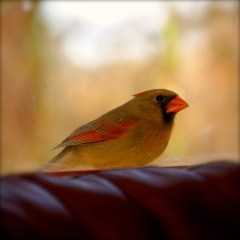
“Silly bird! Why are you pecking on the window?”

“She’s defending her territory,” my husband Dan surmised.

We watched in amazement as the female cardinal, fooled by her own image, continued to swoop down—over and over again—attacking her reflection in the window.

Dan snickered. “I know you’ll find a story here.” Then, he closed his eyes and dozed off in front of the TV.

I turned my attention back to my laptop and whined, “I’ve got to get this blog post written.”

Dan mumbled from his recliner, “Why don’t you give yourself a break?”

I agreed under my breath. “I AM taking a break! I’m sitting here with you, watching a movie.”

I needed rest. But I stared at my never-ending “to do” list. I felt the pressure of some impending writing deadlines and speaking commitments, along with our holiday plans. The weight of my schedule and expectations pushed me beyond my comfort zone.

Dan interrupted my thoughts. “I’m just saying, you’ve had a lot on your plate lately.”

“Thanks for the reminder,” I grumbled. I took a deep breath, trying to focus on my project and forget about my failures and limitations.

My head ached. My heart fluttered. I felt short of breath. Oh, no—not another panic attack! Red flag!

I closed my eyes. Focus on breathing. Inhale. Exhale. REST. Remember, “ … The Lord is near. Do not be anxious about anything …” (Phil. 4:5-6 NIV).

How do I NOT be anxious? “ … in every situation, by prayer and petition, with thanksgiving, present your requests to God” (6-7).

Like the songbird, I continued to attack my own image, focusing on my worries instead of the truth revealed in the mirror of God’s Word.

Anyone who listens to the word but does not do what it says is like someone who looks at his face in a mirror and, after looking at himself, goes away and immediately forgets what he looks like (Jms 1:23 NIV).

I took another deep breath and exhaled. “That’s enough!”

“What … what did I do?” Dan muttered in his sleep.

Realizing that Dan thought I was fussing at him, I sighed. “I’m just talking to that crazy bird.”

I turned again to face the songbird, still flapping and responding to her reflection. “Silly bird!”

What experiences have you had in beating yourself up lately?

Photo/KarenJordan
YouTube/KarenJordan

The Loss of Words

Fountain pen over Script1 John: 1-5. In the beginning was the Word, and the Word was with God, and the Word was God. He was in the beginning with God; all things were made through him, and without him was not anything made that was made. In him was life, and the life was the light of men. The light shines in the darkness, and the darkness has not overcome it.

I have to confess, I’m fascinated by words. How we use them. How we use them against each other. Pro-life. Pro-abortion. Pro-choice. Each of these words casts the same issue in a totally different light.

I also have great wonder about how God chose to communicate with us, which I believe happens in two ways–through the written word and through creation. Whether or not you believe that is a whole other discussion.

When I write a book, I choose words carefully. I imagine God being the same way. Not wasting anything. The words, phrases, paragraphs, and chapters of the Bible have multiple layers of meaning. Enough layers to satisfy a reader for longer than one human lifetime.

This Christmas, I find myself pondering 1John and how Jesus Christ was referred to as the Word. I think of how words bring enlightenment. Then I think about how the use of our words is changing.

As an author, I’ve been concerned about the loss of words, even though there seems to be more words than ever before. Texts. FB posts. Blog posts. The number of books that are now available through publishing (in all formats) is greater than at any time in history.

But are they meaningful words? Do they have the same impact as the Bible passage above?

We don’t write anymore. Not in the form of handwritten notes, anyway. And what we do write is abbreviated with little context. I wonder what our children will show their grandchildren. Once e-mail accounts are deleted, those messages are lost. Do you print out e-mails, texts, etc., and archive them?

I know I don’t.

So I wonder, a lot, about the meaning and context of our words and what will be lost in this technological age. Handwritten love letters. Diaries. Journals. I doubt even this blog post will survive me.

Often, we don’t think about the impact of a loved one, a job, or an event until it is gone. I’m amazed how people strive to communicate even when they can’t physically speak. Sign language. Speaking with the use of computers.

What if you couldn’t speak anymore? What if there never had been the Bible? How do you think God would have communicated with creation about Himself?

Glenn Beck is a polarizing character. I totally get that. I’m not a fan of everything he says but this is a powerful message to ponder. It’s a written monologue delivered on large postcards because, for a period of time, Glenn couldn’t speak and it caused him to think of what he had spoken in the past. If you want to avoid his political message, you can stop viewing the video after about 3 minutes.

But consider the loss of words and what you can do to maintain an actual pen-to-paper history. Remember this Christmas the impact of how God chose to communicate with us–with words.

John 3:16. For God so loved the world that he gave his only Son, that whoever believes in him should not perish but have eternal life.

Every day, I think about losing our written words. Do you?

Have a Merry Christmas.