Simple and Sincere

Novel readers and children share a common characteristic.  Both have a nose for sincerity. If they catch the faintest whiff of guile or disingenuousness, you’ve lost them.

In writing and teaching children, you must be sincere.

I pondered this when I watched a videotape of my first grade music students. They sang about falling leaves, and the excitement in my voice as I guided them was obvious. Their faces and singing voices reflected my enthusiasm.

Watching the tape reinforced my suspicion: students respond to me because I love their songs. Though I’ve sung opera and studied the classics, I haven’t lost my taste for the simple things. I find simple truth in “Shoo, Fly” and simple beauty in “All night, all day, angels watching over me, my Lord.”

When I sing the songs of childhood, I believe them in the most hidden labyrinth of my soul. They resonate with me, and not because they’re “cute”. Fun, certainly. Entertaining, beyond a doubt. But if a song smacks of cuteness, I refuse to sing it. My students are too precious to patronize. They deserve simple, powerful songs that convey joy, truth, and beauty.

So do readers. They deserve a story we believe in, one that conveys truth, joy, or beauty, and preferably all three. They won’t be pandered to. They will respond to a book that burns its way out of us with tears, smiles, excitement, pain, or revelation. They will sense the engine of passion behind each line, in the subtle rhythm of a story we had to write. That doesn’t mean they’ll love the story. But if we tap into that rhythm, they might continue reading until the last page, until the last chord fades.

Honest, uncontrived passion. That’s what students and readers crave.

Did you ever try to write a book that didn’t resonate with you? Did you keep at it until it did, or did you scrap it and move on to a new project?

Using a Plot Board to Plot Your Novel

Way back in Mid-August, I posted here about how a Plot First Novelist Builds Character(s). I admitted to being a plot-first writer and a dedicated ‘Plotter.’ Boy howdy, if you want to divide a room full of novelists quicker’n Shergar won the Derby, ask who is a plotter and who is a ‘pantser.’

But, though novelists fall mostly into two camps, each side often wonders about how the other manages to write books using their method. I thought I’d give you a peek into my plotting method.

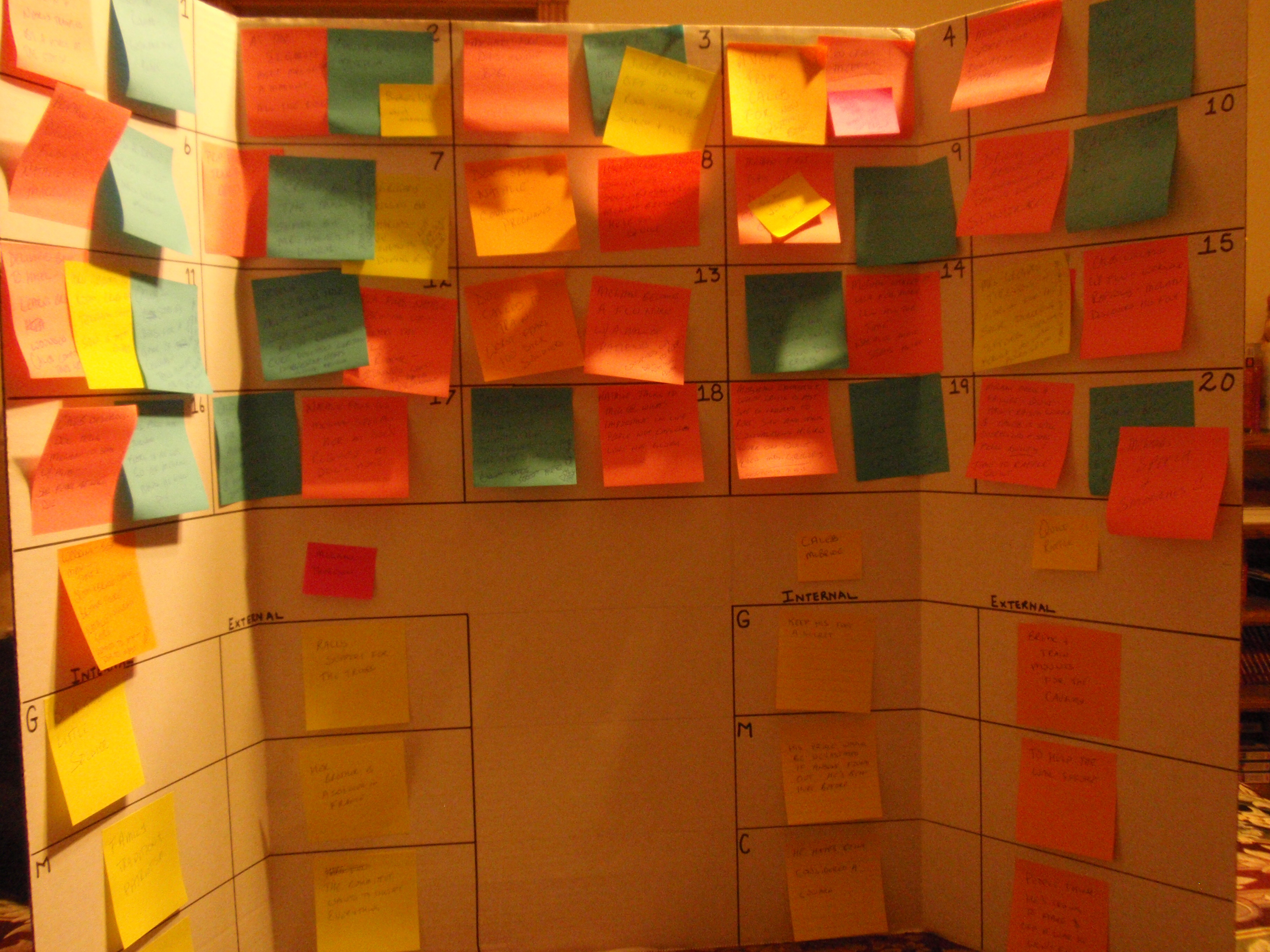
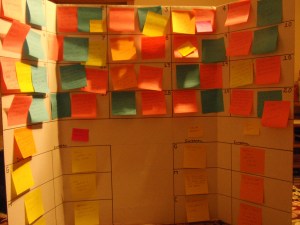
I use a plot board. I first came across this idea on the Seekerville blog where a guest had a photograph of her own plot board. Since I’m a visual person, I glommed onto the idea and created a board of my own to see if it would work for me too.

And it sure does! There are so many things I love about using my plot board. The plot board allows me to see at a glance how many scenes I have, who is the point-of-view character, and the characters’ Goals, Motivations, & Conflicts. It forces me to write out, however briefly, the internal and external goals of the characters and really think about what it is I’m trying to say with the story. Oh, and I get to play with post-it notes. 🙂

One other thing I love is that it’s easy-peasy to change your mind about something. You just move the post-it to a new place or throw it away and write out a new one. I found this particularly appealing, especially since I tend to change my mind a lot while plotting.

The top half of my plot board is divided into 20 equal sections and numbered across the rows. Each of the numbered boxes represents a chapter in the story.  (Twenty is just a starting point. I lengthen or shorten the story based upon what is needed. But there is only room for about 20 boxes on the plot board. If I need more, I have to scrunch things and overlap.)The bottom half is divided into two parts with six equal sections in each part. These are for the characters.

Prior to writing anything out for the plot board, I’ve researched, ruminated, and spent days and weeks reading and thinking about the story. I’ve got a few high points of the plot in my head, and I have a fair idea of setting, time period, etc. I have a rudimentary idea of the characters, too. This pre-plotting prep is necessary for me. If I dive into plotting too early, before the story has had a chance to marinate in my subconscious, I find myself staring at the blank plot board the same way I stare at a blank screen if I haven’t plotted beforehand.

When it comes time to begin filling in my plot board, I start at the bottom of the board with the two six-chambered grids. On each side, one column is labeled External, and one is labeled Internal. This is where I put the Goals, Motivations, and the Conflicts for each of the two main characters. Since I write romance, this means the hero and the heroine. What do they want, why do they want it, and what is keeping them from getting it? I decide what personality types my characters are (click on the first link in this post to see how I do that) and start plotting the story.

 
Then I grab my smallest post-its, about 1.5 x 1 inch. I write the major plot points out and stick them to a notebook page. (Things like Avalanche hits Train, or Finds Out He’s Adopted.) As fast as the ideas come to me, I jot them down, keeping it brief and fairly broad. When I think I’ve got the big ideas of the story set down, I start arranging them on the plot board. I keep them in chronological order, but I don’t sweat too much whether they are in their final position or not. I know it’s probably going to change as I go. When I have the bones of the story down, I start making logical connections with scenes. What has to happen in order to get the character from major plot point one to major plot point two?  I use the next larger size post-it for these in various colors. Pink for the heroine’s POV and blue for the hero’s. Orange, yellow, purple, chartreuse…those are for secondary characters’ POV scenes. By color coding the post its, I can see at a glance if I’ve kept a good balance of his/her scenes and if I’ve lost anyone in the shuffle.
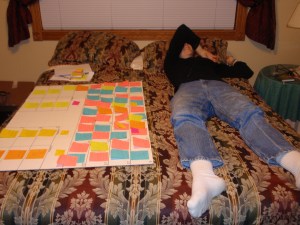
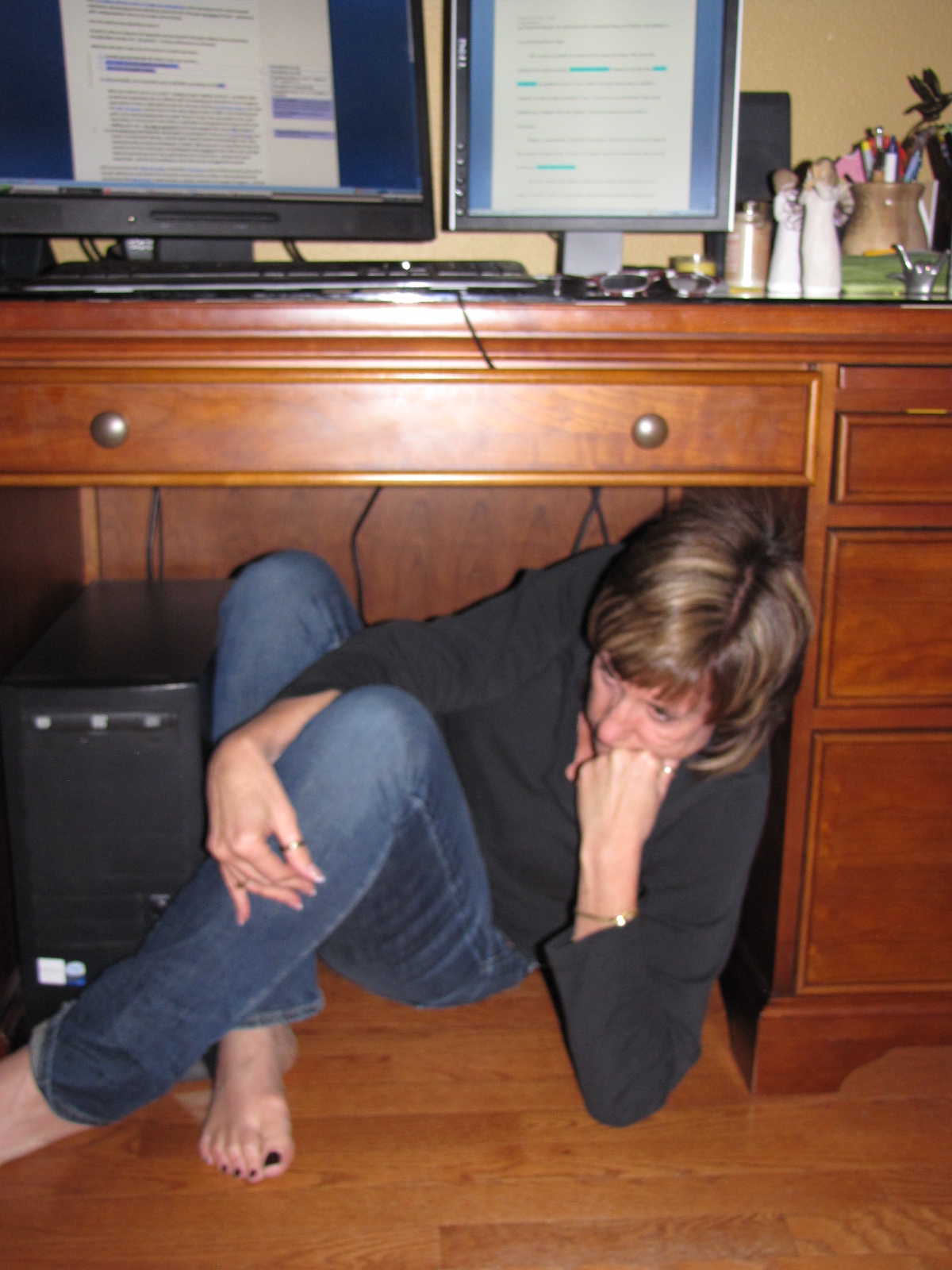
One thing I mustn’t forget to mention is that the whole time I’m doing this, I’m talking. Usually to my daughter. (When we finished plotting the last novel, she crashed on her bed and I had to take a picture.) By talking it out and letting someone not as familiar with the story ask “Why?” kinds of questions, I minimize the plot holes as much as I can up front. My daughter is great at this, and I plot much better and quicker when she’s involved in the process.

When I get all the scenes filled in, I tell the story once more aloud, making sure I have it the way I want it. Then I use the plot board to type out a chapter-by-chapter, scene-by-scene synopsis, including what I want to accomplish in each scene. I know without a doubt that when I have that road map in my mind and in my hands, I write much faster than if I’m feeling my way around with no idea where I’m supposed to be going.

So there you have it. My plotting system. It works for me, and it’s been tweaked and refined each time I go through the process of plotting a new story. I hope you can glean something that will help you.

Question for you: Plotter or Pantser? Does the thought of using a plot board excite you or make you want to run screaming to the nearest bag of chocolate chips?

Post Author: Erica Vetsch

Erica Vetsch is a transplanted Kansan now residing in Minnesota. She loves history and reading, and is blessed to be able to combine the two by writing historical fiction set in the American West. Whenever she’s not following flights of fancy in her fictional world, she’s the company bookkeeper for the family lumber business, mother of two terrific teens, wife to a man who is her total opposite and soul-mate, and avid museum patron.

A Writer’s Life: The Waiting Room

Today I’d like to invite you to join me someplace most, if not all, writers are familiar with. Where’s that, you ask?

The Waiting Room.

Oh. My. Word. Your groans probably registered on the Richter scale. Stop it right now and come on in. Yeah, the Waiting Room is crowded. And the magazines are out-of-date. But we’re here to talk, not peruse the 2005 issue of Bowhunter magazine

If you’re a writer, the Waiting Room is unavoidable. Truth is, if you stay the course, you’ll make repeated trips to this room where the hands on the clock never seem to move and you languish forever, wondering when someone will call your name and say, “We’ll see you now.”

Aren’t I just the messenger of all things light and breezy today?

Why, you ask, why the Waiting Room? It’s such a waste of time.

Is it really? 

What can you learn while you wait? (Yes, I know you’d rather get seen and get out of here. But stick with me.)

  1.  Understand attitude is key. If I expect to wait then I avoid the “Woe is me” attitude — or at least succumb to fewer attacks of self-pity. If I get into my appointment on time or — gasp! — early, then I celebrate. Translation: No one is an overnight success. If some author tells you that they were, they’re lying. (You can tell them I said so.)
  2. Come prepared to wait. Do I want to waste time thumbing through magazines I’d never read even if I was stranded on a desert island? Translation: What are you doing while you wait for “the call”? Are you counting time or making time count by revising your manuscript, attending conferences, connecting with other writers — maybe even encouraging other writers?
  3. Realize everyone hates waiting. Medical professionals hate being behind schedule as much as you hate waiting. Translation: Editors wait too. And agents. And publishers. (Side note: Please, no comments with “waiting for my doctor” horror stories.  Not the point of this post. If you really need to vent, email me at beth@bethvogt.com. I’m married to a doctor. I can take it.)

Time for me to sit back and see what y’all have to say about time spent in the Waiting Room. Tell me how you handle waiting for feedback from your critique group. Or from your agent. Or for the “sign here and would you like an advance with that?” phone call. How do you make waiting worthwhile?


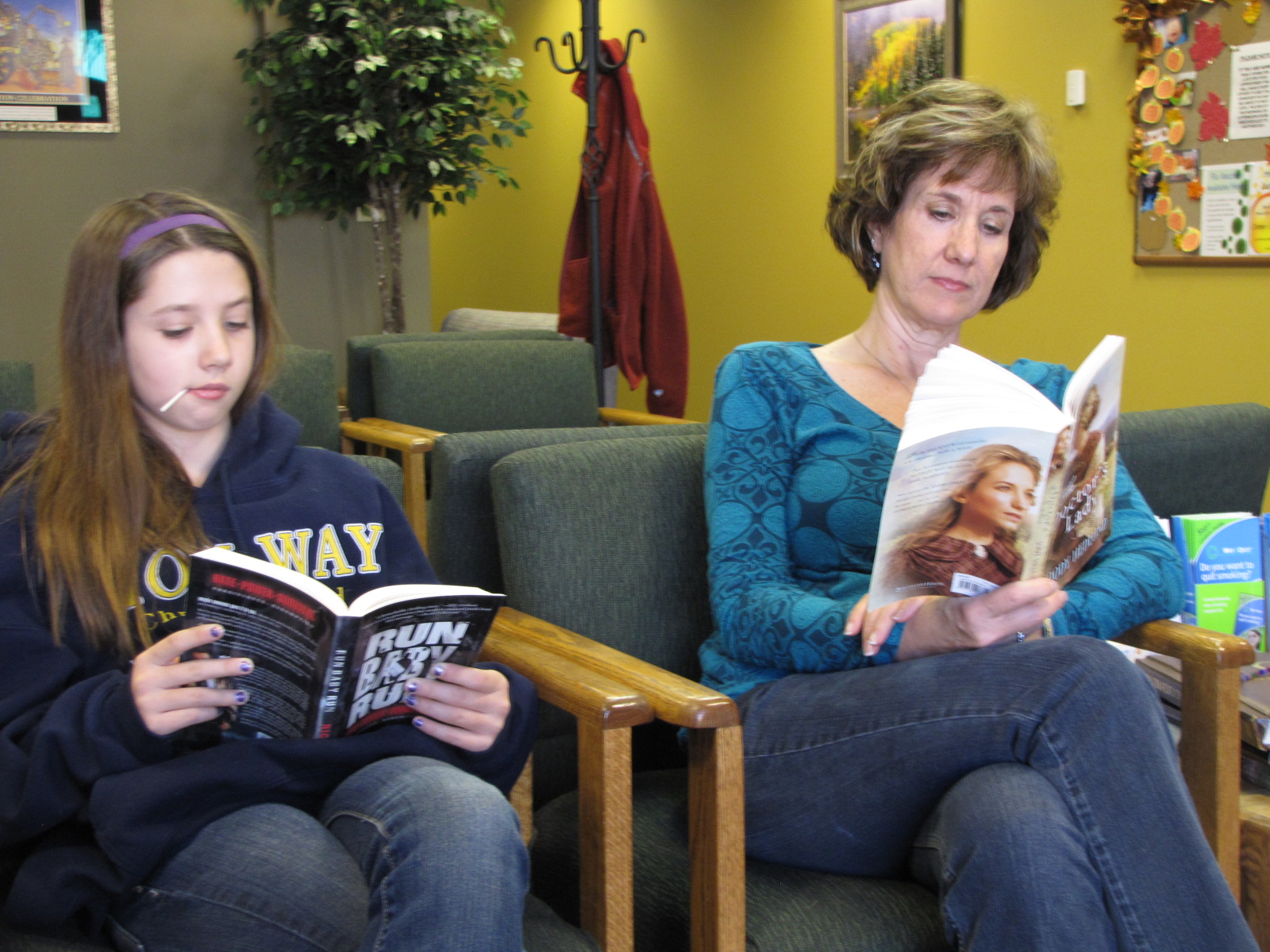
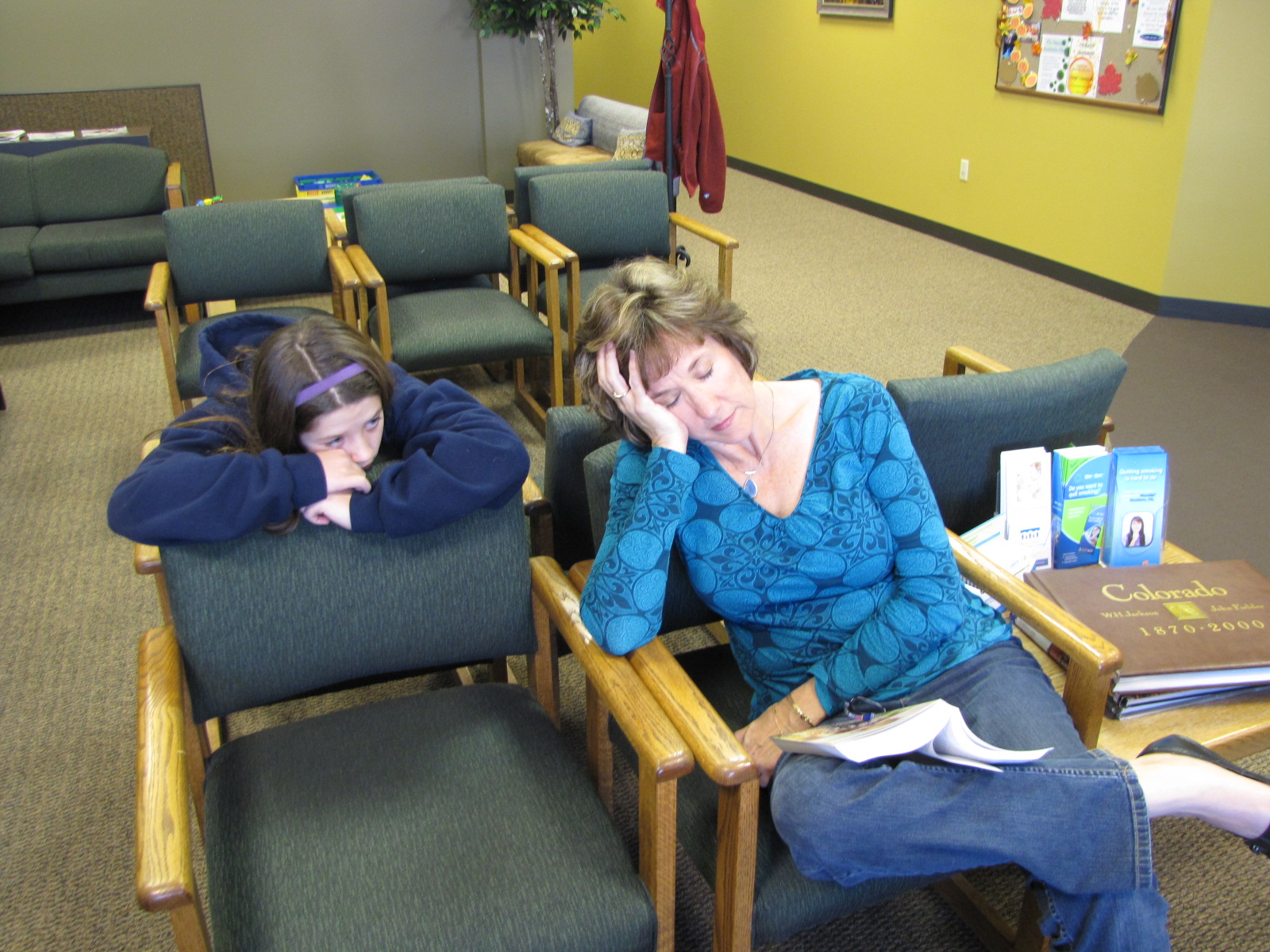
*Photo credit: That’s me and my daughter. In my husband’s waiting room. With a copy of author Jody Hedlund’s latest release, The Doctor’s Lady. The sleeping pose is for the sake of the column — not a statement on Jody’s writing. I loved reading The Doctor’s Lady!

Post Author: Beth K. Vogt

Beth K. Vogt is a non-fiction author and editor who said she’d never write fiction. She’s the wife of an air force physician (now in solo practice) who said she’d never marry a doctor—or anyone in the military. She’s a mom of four who said she’d never have kids. She’s discovered that God’s best often waits behind the doors marked “Never.” She writes contemporary romance because she believes there’s more to happily ever after than the fairy tales tell us.

Using Stolen Moments to Write

NaNoWriMo begins today. Around the world, millions of writers are pounding on their keys to produce a novel in 30 days.

Many writers aren’t like Richard Castle with styling offices and ability to write full-time. Most writers I know work full-time inside or outside the home, care for a family, have church responsibilities, act as the family chauffeur, battle dust bunnies from overtaking their homes, and try to squeeze in a decent night’s sleep.

Who has time to write? Well, many of them may not have time to write, but the majority of them MAKE the time to write.

I’m a stay-at-home-work-at-home-mom who owns and operates an in-home family childcare program. Not working isn’t an option. With my My Book Therapy responsibilities, book contracts, family and church commitments, life can be a bit crazy.

A schedule and stolen moments help me find time to write. Also, I’ve encouraged my family to help with housework, laundry and cooking. Plus I use my Crock Pot and bread machine a lot. I write in the evenings so Hubby runs errands and chauffeurs our son.

If you don’t have evenings to write, do you have 15 minutes in your day? The Fly Lady has a great site to help people get their homes and lives in order. One of her principles is you can do anything in 15 minutes … including writing.

I downloaded an egg timer for my computer. When I’m stuck on a scene or needing motivation, I set timer for 15 minutes and free write without editing. When I’m writing my rough drafts, I use my timer to increase my word count. After all, rough drafts are allowed to be rough.

If you are serious about your writing and want to make progress, enlist your family to help out. Delegate household duties, grab the timer and have everyone work for 15 minutes.

Another way to get some writing time is to ask your spouse to take your children for an hour or two each evening. The children and spouse will have a special bonding time and you will have time to write. Turn off the Internet and focus on your manuscript.

If you don’t have a spouse, consider doing a play date swap with a friend or neighbor. Ask a high school student to entertain your kids for an hour or so. Or write after your kids go to bed. If that won’t work, get up an hour earlier in the mornings. If you work outside the home, write during lunch. If you have to chauffeur your kids, take your laptop or a notebook and write while you’re waiting.

Set a daily writing goal and use stolen moments to build your word count. Remember, your first draft doesn’t need to be perfect.

Balancing life with work, family and writing can be a juggling act. Find what works for you. If you don’t take your writing time seriously, no one else will either.

**A bit of self-promotion: My debut novel, Lakeside Reunion, releases today! I’m having contests to promote my book. Visit my Lakeside Reunion Contest Page for more information. The token for this blog is a novel.

Your Turn: Are you participating in NaNoWriMo? How do you find time to write?

A Writer’s Life: The Pit of Despair

Whenever I watch The Princess Bride, I skip the Pit of Despair segments. Popcorn, anyone? Maybe rewind to the Fire Swamp?

Sure, the Albino with the needs-to-cough-up-a-hairball voice is a bit of comedic relief before discovering our hero Westley is in the Pit of Despair. His future? Torture — attached to a life-sucking machine. His only escape? Death.

Am I the only one who skips these scenes?

As writers, there are days we are trapped in our personal Pit of Despair, without even a somewhat friendly Albino nearby. Life — our passion — is being sucked out of us, bit by bit.

What does Westley’s trip to the Pit teach us? Consider two truths:

  1. Truth # 1: Enemies get you into the Pit.
  2.  Truth # 2: Friends get you out of the Pit.

What about those enemies?
Inconceivable, isn’t it, how both success and failure dump us in the Pit.

When you succeed as a writer — land an agent, sign a contract — you think: Other people have expectations for me. What if I fail? Overloading yourself with the real or imaginary expectations of others tumble you into the Pit faster than the Dread Pirate Roberts can scale the Cliffs of Insanity.

And then there’s the slippery slope of failure: never attaining your goals, never quite grasping whatever spells “victory” for you. The root problem is the same: expectations. Fear you won’t meet others’ expectations or disappointment in yourself for not fulfilling your own. The bigger question? How do you navigate both success and failure?

At last! It’s time for the friends.
Westley didn’t rescue himself. The heroes? Fezzik and Inigo, who found a “mostly dead” Westley in the Pit. But that didn’t stop his friends from hauling his body out to go looking for a miracle.

When you can’t see the faintest hope of a miracle for the forest of despair surrounding your writing dreams, who searches for you? When you no longer believe in yourself, in your story, who believes in it for you? And — perhaps even more importantly — who do you go looking for when they’ve been dragged off into the Pit of Despair?

We’ve peered over the Cliffs of Insanity, survived the Fire Swamp, and now find ourselves at the Pit of Despair. Which have you found to be the greater enemy: success or failure? How have friends rescued you? Like Miracle Max, I believe it takes a miracle sometimes for changes to happen … so if you have any of those to share, please do!

For Fun: The Princess Bride 25th Anniversary cast reunion

Post Author: Beth K. Vogt

Beth K. Vogt is a non-fiction author and editor who said she’d never write fiction. She’s the wife of an air force physician (now in solo practice) who said she’d never marry a doctor—or anyone in the military. She’s a mom of four who said she’d never have kids. She’s discovered that God’s best often waits behind the doors marked “Never.” She writes contemporary romance because she believes there’s more to happily ever after than the fairy tales tell us.

First Contract Jitters

It wouldn’t happen to me.

At least not full-blown.

After all, I’d written for ten years, penned multiple novels, experienced a myriad of rejections letters, sold a bunch of articles, and met repeated free-lance deadlines.

I would NOT get the dreaded-first-contracted-book-jitters. Or writer’s block. I was a professional, just taking a next step in the industry.

Right?

You know what’s coming. My first book deal was contracted on a chapter and a synopsis. It was time to write to meet my first book deadline.

Only I needed to do more research. Read more widely within the genre.

I read 13 novellas in less than two weeks.

Obviously, it was becoming an addiction, all of this reading instead of writing.

I should quit—and would—as soon as I finished the 400 page novel that just arrived in the mail.

Then my friend brought me her collection of novellas to help with my research.

(Why do best friends feed addictions? Seriously!)

I had to write.

So I tackled every left-brained project I could find. I wrote non-fiction free-lance assignments, submitted proposals, started a devotional facebook page, and spent a bunch of time networking and marketing.

Which made my brain hurt, so I slipped away with a good book . . .

Renewed and with great resolve I went to bed excited for the morrow, when I would do nothing but write my first contracted novella.

I got up earlier than usual—not because I was eager to write, but due to the need to escape nightmares about inadequacy.

Bleary-eyed, I curled in my recliner, grabbed my journal and Bible, and prayed it through. The Lord reminded me of His promise ten years ago to lead me on the best pathway for my life, to guide me and watch over my writing journey (Psalm 32:8).

He asked if He’d done a good job so far. I said yes. He asked why I would think He would stop now. I said He wouldn’t. He promised to be with me.

Buoyed by God’s assurances for this new writing season I told my husband the whole wonderful story. Then promptly burst into tears.

The sweet man tried to hide his chuckles as he reminded me I was living my dream—that I could do this. Then he resorted to an illustration that good, non-fiction reading, left-brained, red-blooded husbands turn to: football.

Quoting Tim Tebow, the Bronco’s new wonder boy, my husband talked about going out there and doing what you love because you love it and because it is fun.

Oh, yeah.

This is what I love to do, this thing I’ve been avoiding for the past month. It’s fun.

No more fear! I’m going to get creative and let this story pour from my fingertips  . . .

Tomorrow.

(How about you? Got a “first contract jitters” story?)

Guest Blogger: Emily Rodmell for Love Inspired Historical

I’m excited to welcome a special guest to the WordServe Water Cooler–Emily Rodmell, associate editor for Love Inspired, Love Inspired Suspense and Love Inspired Historical. She also coordinates the lines’ continuity series. You can find her online at Twitter @EmilyRodmell or at Harlequin.com.

Good morning Wordserve Water Cooler. My name is Emily Rodmell, and I’m here today to chat with you all about a great opportunity for historical romance authors.

As associate editor for Harlequin’s Love Inspired lines, I get to work on inspirational contemporary romance, romantic suspense and historical romance. And it’s the Love Inspired Historical line that I’m here to talk about today.

Love Inspired Historical is a line dedicated to Christian historical romance from any time period before World War II. It started publishing two books a month in 2008, and early this year we doubled the amount of books we put out each month to four. That’s great news for historical romance readers, but it’s also great news for historical romance writers because it means that we need double the amount of authors. Since the expansion, we’ve welcomed around 20 new authors to the group, and we still have room for more.

If you love the days of old, we’d love to see a submission from you. We’re looking for great, emotional love stories set in a variety of settings and time periods. We always welcome Western stories, but we’d also love to see settings such as Biblical, Regency, Amish, Scottish, missionary and other unique eras that you’re passionate about. Make your characters relatable and your plots unpredictable. While we all know that the hero and heroine end up together in a romance novel, it’s the journey to that happily ever after that’s the fun part. Also, make sure your characters have something keeping them apart that they must overcome. Conflict, both internal and external, is vital to a successful romance.

We’re open to both published and unpublished authors. If you’re a published romance author, we accept a submission of a proposal (synopsis and three chapters). If you’re unpublished in romance, start with a query letter and synopsis, but make sure to have a full manuscript ready to send should we request it. I’m also open to submissions for our other two lines: Love Inspired and Love Inspired Suspense. You can mail your queries to my attention at 233 Broadway, Ste. 1001 New York, NY 10279 or have your agents get in touch.

Your Turn: We’re eager to see what you come up with. I’ll be around today to answer any questions you’d like to ask about writing for Love Inspired Historical.

How to Get Any Book Into Your Lap…Free!

Have you ever been in the situation of wanting to look up one item in a book, but the book is either expensive or obscure. Chances are you turn to your local library. Many people know about Interlibrary Loan (ILL) within their own library system, but what happens if your library system doesn’t carry a specific book?

In my last post I described how to get ahold of serious research in professional journals by accessing your library’s computer database. Today I want to describe how to get any book, from places all over the world, and have it delivered directly to your library branch?

The first time you do this it may seem tedious, but once you know how, it’s a breeze. I typically order about a dozen books a month this way. Your library system may vary, but here’s how my library does it:

  1. Bring up my library web site: Jefferson County Library
  2. Click on maroon-colored icon called “Research tools”
  3. This brings up:  “Subscription Databases A – Z” Click on this.
  4. In the Databases A to Z, click on “W” and choose “World Cat” or scroll down to “World Cat” Click link.
  5. Search for book. It is best to put several items in the search boxes. For instance, the book title and the author. Here I selected the title Seeking Peace and the author Mary Pipher. (I write about self-care and wanted to see how a bestselling author and psychotherapist burned out and subsequently learned to simplify her life.)
  6. When the world catalog finds your book, either print out the page, move it over to a dual monitor, or jot down the most important items: Publisher, year, and the OCLC number. (For Mary Pipher’s book the OCLC number is at the bottom of the page and is 233547957)
  7. Now go back to your library’s main screen. Choose the blue icon on the left side, “Find Library Books and More” – You will find a link called “Interlibrary Loan Request.” Double click. At the bottom of this page is a link called “ILL form for Books/AV Materials.” Click on that.
  8. Fill out the author, title of book, publisher/place/date, format (book, video, DVD), pick-up location (for me that is “Columbine Library”) and OCLC number.

*I don’t fill out the part about paying money for the request or the “cancel if not filled by date” information.

At the bottom of the page, I type my name and library card number.

Voila!

Almost any title from across the miles will be delivered right to my library. It takes about a week. If you find this confusing, go into your library and ask how you can use the World Catalog and Interlibrary Loan. Chances are your librarian has a bookmark with instructions already printed on them.

I’m curious, did you know you could do this?  What research tips do you have to offer writers? 

The Long View of Getting Published

Photo by Michael Hirst

There are two distinct parts to my career as an author. Part one, when I saw myself as more of a lone wolf and part two, when I finally started admitting I don’t know everything.

The second half where humility has played a lot bigger part has been more rewarding in every way, particularly financially and spiritually.

Funny little thing I’m learning about life is that when I stop trying to force my will and realize I may not get what I want but I can still be of service, more of what I wanted all along shows up. However, to head down that path the first few times took a lot of courage and hope because I didn’t have any personal proof. Fortunately, I had worn myself out trying things my way. I became willing.

To be an author, whether it’s as an independent or through the traditional venues takes more people and therefore a lot more willingness. The independent route sounds like it would be easier to stick to your own common sense and that would be more than enough, except for the occasional question. But publishing a book is a process that requires a lot of hands.

Besides, I was more arrogant than that anyway, running down the traditional path and still telling everyone how I saw things.

However, when I stopped listening for just the small kernel I wanted and expected to hear, dropped any agenda and not only took in the information but gave it time to sink in, things really began to move in a better direction. That opened things up even more.

What if I even followed through on some of the suggestions to see if other people who are actually the professionals in their slice of the publishing game were right? Perhaps my part in the entire process is to be a team player, be open to all of the information that’s coming in and just do what’s been suggested.

Some wrong turns are to be expected and even that’s okay because  the last tool I keep close by is the one that makes all of it okay.

I am powerless over the outcome but there is One who has His hand on everything, loves all of us beyond our ability to understand and has a plan that includes everyone. This is the most important part to me and makes it possible to relax and go back to the day I’m in when I’m worried about how book sales will go or if a book will get published at all.

The answer is, maybe it will, maybe it won’t.

In the past I couldn’t live with that answer so I tried harder to fix things. That just didn’t work and I wore out others as well as myself. Doors closed.

Now, I ask myself if I’ve done my part? Do I trust the professionals I’m working with on this book? What’s in front of me to do? How can I go be of service?

I know, all of that sounded really contrary to becoming published to me too, at first. But I had tried the lone wolf gig and only gotten mediocre results, at best.

I became willing to try a new tack. God is everything or God is nothing and I wanted, maybe even needed God to be everything so I started listening with a new ear. I asked for help and admitted when I didn’t know something. I grew more patient and less ‘helpful’ with suggestions. I did what was asked of me, on time and nothing more, allowing others to do their job without my interference. I became willing to change structure or style and see what happened.

And on the days when my anxiety still sits on my chest like an angry gorilla, I go pray, turn it all over to God and ask for peace of mind and heart. Then I get back to my day, do what’s right in front of me and keep going. As a result, more of my publishing life has fallen into place and my relationships in that area are a lot stronger.

Creative Marketing – Try Something New

Marketing. The dreaded M word that makes introverted authors like me shudder. It’s a good thing I am contracted with a major publisher. They’ll take care of all that marketing stuff, right?

Pop! Say goodbye to that delusional bubble.

Even though I’ve been blessed with a fabulous marketing and sales team, I’m not immune to the pressure of marketing my books. Publishing is a partnership, and I’m expected to market as much or more than my publisher. After all, they have an entire catalog of new releases to sell. I have only my own.

So when I first waded into the marketing waters, I looked around to see what other authors were doing and followed their example. I had my website professionally designed, I got involved in Facebook and Goodreads, I set up guest blog appearances and interviews to correlate with my release dates, I had a launch party, I offered giveaways and hosted contests, I handed out bookmarks, did book signings, and spoke to groups any time I was asked.

Did any of it make a difference? I think so. It’s nearly impossible to measure the impact of marketing, but occasionally I’ll get reader feedback from someone who mentions that they found my books because of an interview I did on a particular blog, or that they bought my previous books after winning my latest one in a drawing and enjoyed it so much they wanted to read more from me. These little glimmers give me hope.

But now that I’ve gained a year of experience, it’s time to branch out from the crowd. It’s time to aim my creativity brain cells not just at my WIP but at my marketing as well. So when it came time to launch my third novel this spring, I decided to try something new. Something that would engage readers on a more personal level and hopefully entice new ones to give my book a try. I sponsored a fan fiction contest.

I write historical romance, and knowing that romance readers live for happy endings, I thought to give them a chance to create their own. I can’t tell you how many times as a reader or movie watcher I have mentally re-written an ending or continued the story in my mind, imagining how the characters’ lives would play out. I thought it would be fun to give my readers the same opportunity.

Now in To Win Her Heart, my main characters had a very satisfying happy ending, but the secondary love story was left with a little more ambiguity. Therefore, the fan fiction contest challenged readers to create an epilogue specifically for secondary characters Chloe and Duncan. I enticed readers with generous prizes like a $40 gift card from Amazon, an autographed book of their choice from my list, and the privilege of having their winning entry displayed on my website for all to see and enjoy.

I advertised in my newsletter, on Facebook, and in blog posts on sites that catered to writers. I was hoping to snag some readers from the writing crowd who might not usually read historical romance or who hadn’t tried my books before, but who were interested in competing for my prizes.

To Win Her Heart released May 1st so I ran the contest through the end of June. I didn’t have a flood of entries, but I ended up with a wonderful collection of about a dozen epilogues to choose from. More valuable than the number of entries, though, was the amount of personal interaction with readers this contest produced. I even had one lady say that she didn’t realize how powerful a marketing tool the contest was for her until she found herself in a bookstore buying my book just because she wanted to enter my contest. I’m hoping others experienced the same sensation even if they ended up not entering.

In the end, there’s no telling how many actual sales this contest generated, but I’m hoping the effects will continue to ripple. The lady who won has her epilogue on my site, and she’s no doubt sharing that story with all her friends. The quality of her writing was wonderful, and she captured my characters so well, that I was proud to display her work and to point other readers to it as bonus material.

Whether or not this attempt at marketing generated many sales, I’m glad I did it. It was fun to try something different and to interact with readers in a new way. It gave my stale marketing practices a much needed shot in the arm, and I would gladly do it again.

Question for You: What is the most inventive marketing strategy you’ve ever employed or seen employed? What marketing ideas have you toyed with that you’d like to try? What have you seen other authors do that caused you to find yourself in the bookstore buying their book?

To see the winning entry, visit the fan fiction page of my website at: http://www.karenwitemeyer.com