
Every author seems to have a different idea of what “success” in their field means to him or her. For some, selling at least five thousand (in Canada) or ten thousand (in the States) books, thereby qualifying them to claim the lofty title of “Bestselling Author” is the goal on which they set their sights. For others, maybe it’s a hundred thousand copies, or a million.
For some, it isn’t about the numbers, but about awards. But which award is the one that will make them feel as though they have finally arrived? Is it the Carol? The Christie? The Pulitzer? I’ve noticed several big-name authors who have won awards in the past entering the contests again, so maybe one award isn’t enough. What, then, is the magic number?
Or maybe it’s a certain amount of positive feedback, a sufficient number of glowing reviews on Amazon or Goodreads, recognition at conferences or even on the streets, enough followers on social media.
You see the problem. Success is a wildly ambiguous and deeply personal concept. Chasing that elusive label can be and, I suspect, is in most cases, a discouraging, disheartening, and depressing endeavor. The intended audience for our work can be mind-numbingly uncooperative when it comes to providing us with the accolades, reviews, purchases, and general awestruck-ness in our presence that would finally push us up to that mountain peak we are continually scrambling to reach. So too, for that matter, can agents, publishers, editors, and judges of contests.

A month ago I posted on this site about my love-hate relationship with Christian writing awards. I have to admit I am coming down a little harder on the side of love these days as my books are currently finalists for five awards. Am I encouraged? Definitely. Am I grateful, honored, and excited? Absolutely. Am I able to bring myself to claim that I am now a successful author as a result of these affirmations? Not even close.
So what is the solution? To continue to blindly stumble along, attempting to achieve some random number of readers or books sold or reviews in order to feel that I am now a success? Or is it possible that I, as a Christian author, need to look at the whole success thing from an entirely different perspective? If so, the perspective that is inevitably the best one to try to view things from is that of Jesus. During his time on earth, Jesus said some radical, countercultural things about success. He suggested that “making it to the top” in the eyes of the world was not only a poor measure of success, but could, in fact, be considered spiritually detrimental because it is those who are the least in the eyes of the world who are the greatest in the Kingdom of God.
Not that we should refuse to work hard or strive for excellence. Quite the contrary. Working diligently and doing our best honors God. The difference is in the motivation. The Bible teachers that everything we do should be done as to the Lord, and not unto man. By that standard, our success cannot truly be measured by sales, awards, or accolades bestowed on us by other human beings.
For an author who believes, then, success can only be defined by whether or not our work accomplishes the purpose God has for it. So here, in my humble opinion, are seven steps to follow in order to be guaranteed success in your writing:
1) Listen for and receive the words God has for you to write
2) Study the craft so that you can write those words in a way that honors the one who gave them to you
3) Humbly accept feedback and editing that makes the work better and stronger
4) Pray about the best platform for your work to appear on
5) When the story or teaching God has given you does come out in written form and become available to others, seek His guidance as to the best way to use the resources of time, money, and connections he has gifted you with in order to market and promote that work
6) Pray that God’s will may be done through the words you have written
7) Leave the results to him
If I follow the above steps and don’t find success in the eyes of the world—however I or other people may define that—I can still trust that the plans God has for my work have been or will be fulfilled, whether or not he ever reveals those plans to me. And I can let go of all my strivings, and rest in the sure and certain knowledge that my work is a resounding success.
 Remember all those things you were going to do this year to update and enhance your online presence, like upload recent photos, add new publication credits, revise your bio? With 2017 approaching the half-way point, here’s a checklist to remind you to take the time now to tackle that list and mark off the tasks. Not only will it make you look active and engaged, but many social media platforms automatically post to your networks the changes you make to your profile, which means you get a boost in exposure. And that’s always a score for a writer…as long as it’s good exposure, that is!





 I remember when my pulse quickened and my heart thumped at the thought of “making it” as a writer. The first time I gingerly brushed the soft cover of my first book, flicked through its pristine pages, I felt awed. The young girl inside of me, who’d always dreamed of seeing her name on a book, shed a happy tear.
 3. The writing life is not a solitary endeavor. It takes a team to successfully publish. Critique groups, writing peers, or advance readers help us delve deeper into our subject matter, and pick up on flaws we often miss. Agents, publishers, and editors polish our projects and help promote them to reach a bigger audience. Readers become fans who sometimes become friends — if we are so blessed.
 I’m still working on all of these areas in my own writing, and anticipate the need to keep them in mind until the day I type my very last word. I don’t simply want to write, I want to use my words well.
 I think every published author wishes they could go back in time to whisper in their younger self’s ear. Doing so would certainly save volumes of time and energy. I’m sure five years from now, I’d wish for the opportunity to tell today’s me something I need to know right now.
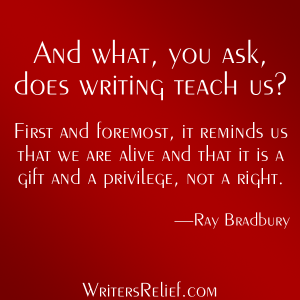 Read as much as you can. Phrases such as, “Great writers are great readers,” hold a wealth of truth. The more we study, the more prepared we are to succeed. Reading teaches us the subliminal art of sentence flow, heart tugs, and scene staging. It also shows us what to avoid, as we learn from the mistakes of others. It’s the best motivator I know.
 Set time-stamped writing goals. I’ve really let this one slip lately, and my work is showing it. But my One Word is Reset, so I am resetting my goals. The difference between a dream and a goal is a measurement. So my refreshed writing goals include a minimum of 5,000 words per week. This reasonable number allows for flexibility, while pushing me beyond a normal comfort zone. It’s doable.
 I can write until my fingers are numb. I can start writing at dawn’s break, pushing until the wee hours of the next morn, but if I am not inspired, it’s all for nothing. My personal inspiration come from prayer, provision, and praise for my Maker. He’s the one who gifted and called me. This is my most powerful secret.
 A few years ago, I got the oddest suggestion I’d ever heard from an editor: write a few scenes between my novel’s characters that I wasn’t going to include in my final manuscript.
 I have a love-hate relationship with book reviews.
 And then there is the flip side of my love-hate relationship with book reviews.
 There’s an old adage in marketing that says in order to get a consumer to pull the trigger and buy something, they have to hear about the product three times. There was a time when the blueprint to accomplish that was pretty straightforward. Get reviews from newspapers or magazines and get interviewed on television or radio. Then, go make public appearances at bookstores or book fairs or local meetings, and don’t forget to keep writing.
 WordServe Water Cooler