Loaves, Fish, and Writers

Late in the afternoon the twelve came to him and said, “Send the crowd away so they can go to the surrounding villages and countryside and find food and lodging, because we are in a remote place here.” 

He replied,  “You give them something to eat.” 

They answered, “We have only five loaves of bread and two fish—unless we go and buy food for all this crowd.”  (About five thousand men were there.)

But he said to his disciples, “Have them sit down in groups of about fifty each.”  The disciples did so, and everybody sat down. Taking the five loaves and the two fish and looking up to heaven, he gave thanks and broke them. Then he gave them to the disciples to set before the people. They all ate and were satisfied, and the disciples picked up twelve basketfuls of broken pieces that were left over.  Luke 9:12 – 17

Give it up

Poking at God about what I could cook for you today, he flipped this sizzling little fish story onto my brain plate.

Eyes scrunched on “impossibility” rather than on the Master of limitless capability, it’s easy for us writers to be disciple-like and condescend to natural-mindedness.

The crowds aren’t growing less hungry, aren’t inching any closer to food. Cloistered in the middle of nowhere, fatigued and famished, the beloved twelve scratch their heads before Jesus speaks: “Give the people something to eat.”

As we shake our heads at our scanty drizzle of words, Christ tells us the same: “Give the people something to eat. Don’t worry about sparse resources or small beginnings. If I’m in it, as sure as the heavens, you can make a difference.”

“Give them something to eat.” 

Thrust in this love-test, the apostle John records a different angle in sharing Philip’s retort: “Eight months’ wages would not buy enough bread for each one to have a bite.” Andrew speaks up. “Here’s a boy with five small barley loaves and two small fish, but how far will they go among so many?”

No matter how measly, how un-supersized our flounderings, if God calls us to serve fresh truth in a word-stir, if he speaks the royal “ok,” we step up.

Notice how Jesus dishes up faith-stretching instructions to the disciples. Directing five thousand people to sit in groups of fifty is no small potatoes. It takes time and sweat. Just like advancing in writing.

And so we lift our minuscule loaves and fish, and give thanks.

Give Thanks

Wouldn’t you give your lunch to see the puzzled looks on those hungry faces when Jesus raises his bitty snacks to give thanks?

Thanksgiving flows from a posture of humility. The soul bends low, acknowledging our Sovereign Source, his power, ability, and desire to provide.

Jesus gives thanks and his fingers rip the bread. I wonder if he considers how his flesh will soon be broken to feed many.

Writers know about brokenness, the heart-deep pain-sap that drives and feeds our meanderings. With battle scars, we give thanks to the living Word who uses our words and wounds to paint blood-colored pictures of grace.

No matter how few or many we touch, we give thanks for the opportunity. Chosen conduits of hope, we’re blessed to be a blessing. Our words, charged with Spirit-power, awaken God-hunger. They sustain and multiply life!

Whenever we naturally live out thankfulness, we display God’s bigness to a hungry, watching world. We become more than wishful thinkers about remote possibilities.  We reveal supernatural expectancy. This is how the world sees truth in us as we step up to our dream.

Expect Much

“It will take a miracle to get published!” We say it like miracles are viruses when they’re more likely God’s favorite pastimes.

Food in hand, Jesus says thanks because he expects the miracle. He prays and “looks to heaven.” He isn’t focused on his stomach, the food, or the crowd, but on his Father, the source.

The more we fix our eyes on God, the more we see miracles. The more we see miracles, the more we look for them in him.

“Your will be done on earth as it is in heaven. Give us this day our daily bread…” God’s prayer transcends the “me,” and rests on “us,” because we, in the body, are one, and because love necessitates caring for those outside ourselves.

If we want to use our love gift to nourish souls, we can expect God’s provision to match his call. I haven’t forgotten that we can also expect spiritual warfare (perhaps even intensified tests from a rattled enemy), but ultimately mercy triumphs over Satan’s thievery. God promises to give us everything we need to win!

This gift, this impervious spawning of words, isn’t an instant dinner miracle; rather, it’s a progressive one, a long-term partnership with Chef Jesus.

Part of the miracle involves staying with the process. If God says, “Get everything and everybody in place,” that’s what we do. We plunge in for the long run, expecting to produce sweet fruits like patience and perseverance. Likewise, we expect readers, writers, characters, and observers to be transformed by our faithfulness.

We’re Christ-followers, sojourners on the cusp of miracles. In the course of our collective, out-of-this-world writer-journeys, we can expect nothing less than God cooking up his best.

Bon appetit!

“For I know the plans I have for you,” declares the Lord, “plans to prosper you and not to harm you, plans to give you a hope and a future.” Jeremiah 29:11. 

Do You Need to Schmooze an Editor or Agent?

I’ve attended over 7 writers conferences since walking the road of an author. One thing I’ve come to observe at these conferences is they way we interact with one another.

Editors and agents are seen as the gate keepers to our dreams. They are the ones who will accept our book and validate our work.

Janalyn Voigt and I at Northwest Christian Wrtiers Renewal

This is sort of true and sort of not. Editors and agents will let you know if your work is ready. They’ll let you know what you need to work on. They do not hold your dreams. You do.

Having our work published will not validate us. Only Jesus can do this. Don’t fall into the trap of thinking your worth is measured by a contract and sales figures.

I’ve seen some writers completely crushed when an editor/agent declined on their pitch. I’ve been one of them. Jesus gently reminded me that He is my agent. And He’s yours if you’re willing to give your writing over to Him.

I don’t mean He will do everything. We still have to hone our craft, build our platform, and continue learning.

At conferences, I’ve seen editors and agents hunted down by well-meaning enthusiastic authors. They couldn’t get an appointment with the agent/editor they wanted, so they stalk them at meal times, breaks, in line at the bathroom….

I’ve had some wonderful chats with editors/agents at meals and in the hallways. But I’ve also seen a weary trapped look in their gaze.

We should never become so focused on what other people can do for us and our careers that we forget they are people and children of God first and foremost.

Take the time to ask them how they’re enjoying the conference. Chat them up like you would meeting someone at a neighborhood barbecue. Take the time to get to know them a little. They’ll eventually turn the conversation towards writing. After all, they’re there to discover great writers.

Even if they turn your project down, they’ll remember a friendly person. Later, circumstances may be different and your project will be the one. You can never go wrong investing in people and relationships.

You should spend some time schmoozing at conferences. Just make sure you’re doing it for the right reasons. If we look at every person and situation with the attitude of how we can help them, instead of how they can help us, we’ll get much further.

Have you ever made new friends at a conference? How have you helped someone else and had it benefit you unexpectedly?

Crafting a Writing Goal

Book Proposal Image

Words aspiring writers want to hear.

“Send me a proposal on your idea.”

When it happened for me, at a writers conference, I first went off to a private place and cried happy tears. Then reality set in.

I hadn’t written a thing. I only had an abstract idea, a desire to write, and a nudge from God. The publisher didn’t offer any guidance on how to format a book proposal; he simply told me to send one.

When I got home, I got to work. The situation called for a marriage between prayer and practical actions. Shortly after I said, “Amen,” inspiration hit.

I wrote my goal on a piece of lined notebook paper. “I Will Read 100 Books on the Craft and Business of Writing.”

I practiced while I studied. It took me almost two years to accomplish the task, but when I finished the one hundredth book, I was able to look back and see the transformation in my work. Only then did I gather enough courage to submit a few queries for articles. And though there were rejections, there was also success.

Article Queries

After focusing on the craft of writing, I invested in the business of writing. If I wanted to author books, I needed help. I networked with other professionals and listened to their advice. I attended more conferences. I hired an editor to critque my work. And I continued reading beyond my first 100 books.

Michael Hyatt
How to Write a Winning Book Proposal

I wanted to create a stellar proposal. After gleaning the best information, I practiced on my first topic numerous times. By the time I ran across Michael Hyatt’s e-books on Writing a Winning Book Proposal for fiction and non-fiction, I was ready to finalize my project.

It took another year before I harvested any fruit from my labors, but harvest I did. WordServe Literary signed me based on that original topic. The hard work of crafting a writing goal and meeting it helped my agent sell my first book, scheduled for release in 2013.

I’ve now lost count of the number of writing books I’ve read. But there are a few I refer back to time and again:

10. On Writing Well — William Zinsser

9. Story — Robert McKee

8. The Art of War for Writers — James Scott Bell

7. Bird by Bird — Anne Lamott

6. Stein on Writing — Sol Stein

5. Writing Down the Bones — Natalie Goldberg

4. Self-Editing for Fiction Writers — Renni Browne & Dave King

3. Finding Your Voice — Les Edgerton

2. Writing for Story — Jon Franklin

1. Screenplay — Syd Field

I’m a lifetime learner. Without the help of many willing to share what they learned through their books, I probably wouldn’t be writing today.

What are your goals, and what are you doing to meet them?

Is a Backlash Coming?

This may be more honest than a long-time agent should admit, but I have a lot more questions and not as many answers these days about where the book industry is going. As I talk with other agents, most of us are having banner years. More deals. More money. More ongoing royalties being paid out. After our three-year downturn, we’re all enjoying the upturn.

What gives?

Haven’t we all been told that e-readers, self-publishing and social networking were going to spell the end to traditional publishing? That quality literary partners (good agents) would soon be a thing of the past? That anyone could make a mint by self-pub’ing their 20,000 word “books” or their 5,000 word articles, or 200,000 word personal family sagas. All they really needed was a thousand or more Facebook friends and 5,000 to 50,000 Twitter followers. If they had a daily blog with 4,000 subscribers, then self-publishing that book they wanted out NOW instead of a year from now would be like printing money.

I love to read all of the prognostications about the end of publishing as we know it . . . almost as much as hearing about what day the world will end (which means, not very much). We have end-time prophets and we have “end of publishing” prophets.  Both, if they play their words and products right, are making a lot of money and scaring a lot of people.

Yes, the publishing industry is going through some major transitions. But where will this ultimately lead us—not 2 years from now, but 10 or 20 years from now? Is anyone’s crystal ball really so good that they KNOW physical books will go the way or the 8-track tape or be a luxury few can afford?

Are we dealing with fads that may come and go or true culture change that alters not only what platform we read our books on, but how and when and why we buy them?

How many e-readers are being purchased by new buyers versus those repeat buyers who are already hooked on them and have now bought 2, 3 or 4? Will e-readers be affordable enough to catch on overseas?

Do people with e-readers actually buy more books because they’re cheaper?  If so, how is this bad for publishing as long as the royalty structure is fair and the author is rewarded?

Why is it that (depending on which report or blog you read) overall only mass market books and a few genres of hard cover are going down in sales and not print books as a whole? In many categories, e-book sales going up doesn’t always translate across the board to print book sales going down.  People are still buying print books and printers are finding cheaper ways of printing them—faster.

Will the medical profession be treating more carpel tunnel and more eye strain because of e-readers? Will our necks and brains and fingers and forearms be able to handle the constant movements needed to be plugged into phones and e-readers and notebooks 8 to 12 hours a day? If not, then what?

Do people really want to read whole books on their phone? Music, yes. Books….?

Are readers of books so dumb that they won’t be able to tell how qualitatively different books published by traditional publishers are than self-published books that have slap-dash covers, design and editing?

Was the movie the end of books? Was TV the end of movies in theaters? Was I-Tunes the end of people wanting new music? Are e-readers the end of people wanting to read and buy whole (and physical) books?

How many social networking platforms can one person with a family and a job actually keep up on? And will there be a social networking backlash in the coming years?

How many books are bought through someone reviewing or mentioning a book from a Facebook or Pinterest account, versus actual word of mouth, face to face?

Will people start rebelling against social media and want to engage in actual relationships again? If so, how will people find out about good books again?

Will Amazon’s takeover of the world survive their politics? Or will people of all walks and faiths make sure one distributor doesn’t corner the market?

In the meantime, as I’m finding some of these answers, I’m still excited about finding new voices with great stories and great messages. I still love seeing great authors with strong sales continue to grow in their reach. I’m still privileged to work with professional editors who add value to a book’s content and improve the author’s overall work. I’m still convinced that “distribution is your destiny,” and that publishers add huge value to the overall sales of books because of their distribution networks.

And as you can read, I have lots of unanswered questions. What about you? What are the questions you’re wondering about as it relates to the long-term future of publishing and/or your career?

Fear, Hit the Road!

Admit it. You’re scared.

No matter how many times you’ve been published, no matter how many awards you’ve won, no matter how many manuscripts you have finished and waiting in your files, no matter if you’ve never let any of your writing see the light of day…in the far reaches of your mind there’s a voice screaming, “What in the world do you think you’re doing?!?!?!?”

You know, if you let it, fear and panic will freeze you in your tracks.

What do you do with it? Ignore it? Hope it will go away? Tell yourself the next step on the road to publication will finally silence it?

What are we so afraid of, anyway?

We’re afraid someone is going to find out we’re a poser. The little dog is going to pull back the curtain and everyone will see who we really are…and that person is just me.

Not Agatha Christie, or Shakespeare, or Dickens. Not Beverly Lewis, or J.K. Rowling, or Gilbert Morris…

just me.

I’m not a writer. Who do I think I am?

Eventually, someone is going to expose me, and then where will I be?

On my way back to Kansas in an old balloon.

What do we do about it?

Some of us try to build up that flimsy curtain. We think if we write better, faster, switch genres, get the right agent, the right editor, the curtain will withstand prying eyes. We become desperate, frantic in our efforts to be good enough to withstand the pressure when we’re finally found out.

But what should we do?

Have I not commanded you? Be strong and courageous. Do not be frightened, and do not be dismayed, for the LORD your God is with you wherever you go.

Joshua 1:9 ESV

Joshua was in a pickle. He had enjoyed some success as the military leader of Israel, but Moses was always there to stand between him and God. Moses was the one who knew what he was doing, who talked to God face to face, who always knew the next step to take.

But now Moses was gone. You can imagine Joshua’s panic. He was supposed to lead these people now?

He had been given the mantle of responsibility, and he had no choice. Read the first nine verses of Joshua again.

What has God called us to be? Most of us reading this blog have felt that hand on our shoulder, that irresistible whisper, that compelling urge to express in words the truths God has laid on our hearts to convey.

We have no choice. We must write.

Three times in these nine verses, the Lord tells Joshua, “Be strong and courageous.” It isn’t an option, it’s a command.

“Have I not commanded you?”

It isn’t a choice.

We don’t have a choice, either. If God has commanded us to act, we must act.

Fear has no place here. It has no foothold.

And we won’t be alone.

“Be strong and courageous. Do not be frightened and do not be dismayed…”

Why?

“…for the Lord your God is with you wherever you go.”

Fear, hit the road. I’m no poser, I’m the writer God has called me to be.


Surviving the Summer and Social Media

Let’s talk about how hard it is to get things done right now. Ugh!! Personally, I have been battling getting things done because I am so busy with summer activities, or the heat makes me lethargic (and it’s been a HOT one). For those of you writers who are also parents, your life is especially tricky because the kids are out of school. I just got back from the Pine Ridge Indian Reservation, and I am late with this post. Summer can dish out some unexpected adventures. Remember to be prepared. Learn from me, and I am sorry to those who are a victim of my summer.

Summer in Pine Ridge
photo by Amanda Jensen Photography

I decided to make a list of my best tricks for making summer social media survivable.

First.

Schedule whatever you can ahead of time. Block off time to work for a few hours on social media, and do yourself a favor if you are living in Denver: find the nearest icebox with Wi-Fi and work there. Seriously, take time out and work in a isolated place where you can knock a BUNCH of work out.

Schedule your Facebook posts. Did you notice that with the latest update you can schedule and date your posts? It’s kind of the coolest thing ever!

Second.

GUEST BLOG!! Ask people to blog for you, and you should extend the same courtesy to others. This is the best way to skip a little and give a little. The best thing about guest blogging is that you are able to cross-market with some of your author friends/co-conspirators.

Third.

Take advantage of being outside.  You can take some epic pictures with Instagram and use them in your future blog posts.  Be creative and take trips that could be relative to your blogs.  Strategize.  (If you missed my blog about how to use Instagram, find it here.)

Summer in Telluride

Fourth.

Remember that people are not on Social Media quite as much in the summer.  The times that trend are a little bit different depending on your target audience.  More people are on later at night.  Try some test posts to see what time you are getting the best feed back.

Fifth.

Make sure you have all your accounts linked.  Tools like this plug-in make things easier. Link your Twitter to Facebook and your blog to both.

I hope you all survive the heat and have many summer adventures the next month.

What is your best trick to survive the summer? What makes social media easier when you are busy?

Thoughts on Publishing: What Would the Wright Brothers Do?

“If we worked on the assumption that

what is accepted as true really is true,

then there would be little hope for advance.”

~Orville Wright

A lot of hoopla surrounds the publishing industry, these days more than ever. In the midst of the business, it’s easy to forget the original dream and heart of the artist.

This is not a new phenomenon.

Nor is it unique to the publishing industry.

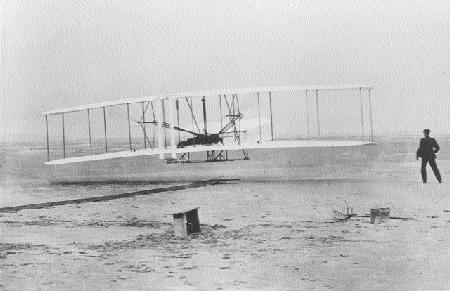
Take the Wright brothers, for example. I wonder if Orville and Wilbur had today’s airplane industry in mind when they first sketched out their dream to fly. I assume they were two wildly imaginative, brilliant brothers who had a knack for ingenuity, and who simply wanted to feel their feet leave the ground. Who simply wanted to fill their lungs with air free from the heavy, constant pull of gravity.

Sure, they must’ve been pleased to see the initial progress of their invention, how flight began to morph into bigger, stronger vehicles which allowed others to feel weightless freedom, too.

But what would they think now?

Of the pushing and shoving and security detail in airports? Of gunfire, like rain pouring from silver wings? Of hijackings? Of crashes? Of bankrupt airlines? Of their beautiful, wooden machine used as weapons of mass destruction on 9/11 nearly a century after liftoff?

Of course, modern-day airplanes are still a marvel. Their massive engines bring orphans into the arms of adoptive parents; soldiers into the embrace of waiting wives and newborns; food to the starving; medicine to the dying; peace to the war-torn; relief to the hopeless.

All of these things–the good and the bad–began with a dream which lolled around the hearts of two gangly boys for years, and which eventually tamed the winds on a lonely, sandy beach.

And so it is with the publishing business. A single page of script begins as it did with the Wright brothers, with a small dream in a great, big heart. From there, the dream takes flight. And after that, it becomes a part of the industry–an industry which carries words to distant places.

Some stories give life and hope.

Others tear down and destroy.

Much ado is made over the various branches of publishing: self, electronic, traditional, mainstream, Christian, small press, large press, and on and on and on. I suppose this is not new. But the industry is merely a vehicle for syntax to take flight.

Our job as authors is to keep the original dream alive, despite commercialism, competition, money, and what all the writing blogs say.

If you’re an author (like me) who follows Jesus, our job carries the even weightier responsibilities of strengthening, encouraging, and comforting. As Christ-followers, we must choose building up over being edgy for the sake of being edgy. We must choose loving accurately over nosediving into the murky waters of what itching ears would have us say.

Write brave, yes.

After all, neither flying nor faith are safe.

But write with prayer, precision, and while feeling the weight of the cross on our wrist.

*************

“The desire to fly is an idea handed down to us by our ancestors who, in their grueling travels across trackless lands in prehistoric times, looked enviously on the birds soaring freely through space, at full speed, above all obstacles, on the infinite highway of the air.”

~Orville Wright

*************

What about you?

How do you stay true to your dreams and the truth you long to pen upon blank pages?

How have the Wright brothers (re)impacted you today?

Social Media Numbers: How Many Friends and Followers Are Enough?

Many Faces Numbers are everywhere. They count my blog followers, posts viewed, tweets tweeted, and comments made. Social sites record my friendships and display which and how many of my friends like my updates. To find a total calculation of my online worth, I have only to check my klout score. A writer can also count reviews, rankings, and sales figures. Numbers these days sometimes seem more important than people.

Is it just me, or has the entire connecting and networking world collectively reverted to one huge high school popularity contest?

In the Biblical book of 2 Samuel, King David directed that his fighting men be counted. Joab, the army commander, urged him to reconsider. David overruled Joab, even when his army commanders protested, too.  Why did they object? Perhaps they understood David’s motive as pride, the very sin that catapulted Lucifer from heaven.

David would listen to no one, and so 800,000 able-bodied men in Israel and 500,000 in Judah were enumerated. When David received the report, his conscience smote him, but it was too late to take back his sin. In the plague that followed, 70,000 of David’s people died as punishment for his sin and also for Israel’s rebellion against God.

Does this mean that keeping track of statistics is wrong? Yes, and no. Remember that at other times in the Bible, God directed the people to be counted. Knowing your numbers can be a useful tool, but pride in numbers does not please God.  He wants us to look to His strength and not our own. He’s the same God who cut the huge army Gideon gathered down to size just to prove that victory would come not from human might but from the hand of God (Judges 7).

Once my pastor lifted my small daughter into his arms and pointed out to the congregation that it was her birthday and she was now four. She turned an unblinking stare on him. “I am not a number.” Her pronouncement, spoken with conviction, reached to the back of the church. While the congregation laughed, my face heated, and I sank down in my seat. Now I wonder if my preschooler wasn’t onto something many adults fail to understand.

I am not a number, and neither are you.

God’s Goodness in the Rearview Mirror

What a strange sticker, I thought to myself as I glanced at the rear window of a small car sitting in the lane next to me at a red light. At first glance, the sign was illegible because the words were backwards. The sticker had been applied on the inside of the window rather than the outside, as it was designed to be displayed. But as I focused more intently on the words and read in reverse, I realized the sign read, “God is Always Good.”

For a moment, I wondered why the petite, middle-aged woman driving the car would have applied the sticker improperly. Surely she recognized that other drivers would have a difficult time reading the awkwardly displayed sign. But as I gave the scenario more thought, I realized she hadn’t applied that sign to her window for other drivers. She had placed the sign there for herself. It was positioned slightly off center so it could be seen (and easily read) every time she glanced into her rearview mirror.

I felt an immediate sense of kinship with this unknown woman. I too have experienced seasons in my life when I needed visual reminders of God’s goodness. I taped “[God] works out everything in conformity with the purpose of His will” (Ephesians 1:11) on the dashboard of my car when I received a letter from yet another publishing house saying, “Your study is well written, but we aren’t accepting new Bible study authors at this time.” I wrote “Taste and see that the Lord is good” (Psalm 34:8) on my bathroom mirror when my heart was broken over a tragic loss. I’ve even written Scripture passages on my hands when I was feeling particularly down or discouraged.  

As the traffic light changed from red to green and we drove in different directions, I lifted up a prayer for this mysterious woman who chooses to keep God’s goodness ever present in her rearview mirror. I would imagine her focus upon the goodness of our God will give her the strength she needs to make her way through whatever challenges she encounters on the road of life.

You may not want to paste a sign on the rear window of your car, but during seasons of disappointment or trial, I encourage you to write Scripture that testifies to God’s goodness and faithfulness in prominent places around your home, in your car, or at your workplace. You’ll find greater strength and courage for whatever lies ahead in your writing journey.

What passages of Scripture encourage you most when you are feeling discouraged?

The 15-Minute Writer (part two): 5 Ways to Get Organized

(Read part one of the series here.)

Are you having trouble writing because you can’t see past the piles of books, Post-it notes, and paper on your desk?

Trust me, I’ve been there. I’m a pile-r by nature, a fact that has frustrated my  husband–and me!–more than once.

If you have limited time to write, though, getting organized is absolutely essential. After all, you don’t want to waste precious minutes you’ve scheduled for writing on finding lost items–or clearing your messy desk.

So here are my top five organizing tips for busy writers:

1. First, figure out your organizing personality. For example, don’t try to use notebooks if you’re not a notebook person. If you love technology and abhor piles of paper, go paperless. Hate Google calendar? Admit it! Don’t try to fit yourself into someone else’s mode. It doesn’t work in the long run. If you’re visual, you might need a big bulletin board or calendar on the wall in your writing area.

2. Set up a system you’ll want to use regularly. Why spend time on something if you’re going to dread it? If you love bright colors, use them in your file folders.  Play your favorite CDs when you’re going through receipts—or watch a funny movie while you’re organizing your calendar and notebook.

3. “Backwards plan.” I learned this handy phrase when my husband took a church administration course during seminary. It’s been invaluable for both of us. Here’s a short explanation of the BP process: Take a deadline (or set one for yourself) and mark it on your calendar. Then take all the tasks you’ll need to complete in order to meet the deadline—interviews, outlining, writing a rough draft, revising—and decide how much time you’ll likely need to complete each one. Then plan backwards, setting yourself mini-deadlines.

4. Set aside a few minutes of each writing session for de-cluttering. You need time to delete old material, back-up files, tame paper piles, recycle books, and throw out trash–or you’ll be on the way to auditioning for Hoarders. Once you’ve gotten organized, five minutes a day is do-able and will go a long way toward keeping your desk, computer, and writing space organized. Believe me, once you make this a habit, you’ll be glad you did!

5.Use OmmWriter. (Thanks to writer Duane Scott for this fabulous tip!) He said, “It blocks out all distractions (email, social media, chat messages, etc…) and provides you with a completely white screen with only a blinking cursor. It also offers different peaceful backgrounds and music to accompany your writing. Another great feature: you can set it to have a manual typewriter sound effect when you type.” The cost for all this? A one-time fee of $4.99.”

Your turn: what are your most effective organizational strategies? I’d love to hear them!