Stranglers or Wranglers? The Super Power of Encouragement

One of my all time favorite books, one that influenced both my writing style and my outlook on life, is A Touch of Wonder by Arthur Gordon. Gordon’s stellar writing peppered “Guidepost Magazine” with inspiration for decades. I remember happening upon the book in a seaside store, then finding a perfect spot on the beach to relax where, over the next two days, I read it from cover to cover. As the ocean waves rolled in the distance, I felt uplifted by true story after story filled with humor, struggle, love, and courage.
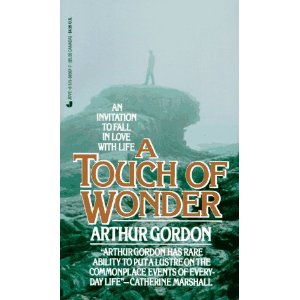
In one memorable chapter, Mr. Gordon told a story that created such an “Ah-ha of the Heart” for me that it helped form my basic writing philosophy. He wrote of a friend who belonged to a club at the University of Wisconsin many years ago. It was composed of several talented writers, all brilliant young men. They would each read their prose aloud, then take turns dissecting and criticizing each others’ writing so fiercely, they dubbed their writing group “The Stranglers.”

On the same campus, a group of women formed a writing group, calling themselves “The Wranglers.” But instead of dousing one another with criticism, they spent most of their time encouraging one another. They all left the meetings feeling inspired in their writing journey.

Twenty years after these two groups met, some interesting results were found. For all the brilliance of the writers who made up “The Stranglers,” not one member achieved any kind of literary reputation. “The Wranglers,” on the other hand, produced a half-dozen successful writers, including the Pulitzer Prize winning author of The Yearling, Marjorie K. Rawlings.

From this story I drew two convictions:

1. When choosing a writers’ group (or any support group for that matter), make sure that they lead with a positive spirit. Sure, you want honest feedback, but this can be done with grace in an atmosphere of encouragement. If the group has spiraled into nit-picking negativity, get thee to another group. That is, if you value your future as a writer.

2. Secondly, when you edit someone else’s writing, it is often automatic to skip the good writing and correct what is wrong, like the proverbial teacher with a red pen.  Because I accept this is how my editing brain works, I usually go through a writer’s chapter or manuscript or a proposal twice. The first time I highlight what needs to be changed to make it better. And then, I go back through and put smiley faces on the parts I like the best. You would not believe how writers love those smiley faces and how they make any critique go down easier.

In a little post-script to this story, I searched and found an address for Arthur Gordon, who was at the time quite up in years (he died in 2002 at 89), then wrote him a fan letter. He wrote me back on an old manual typewriter, saying how much he appreciated the bucket of encouragement, that this sort of reader feedback was fuel for his writing soul. I realized in that moment that no matter how old or accomplished a writer is, inside we’re all a little insecure and in need of positive feedback. A part of us is forever the child, giddy over a star or a sticker from the teacher.

So it behooves us to be positive and kind to each other in our critique. Not only does it make the writing life more fun, but in the long run, it also makes it more prolific and profitable.

What sorts of critique groups have you experienced? How did they make you feel? What kind of critique encourages you to excellence without throwing you into a depressing writer’s block?

The Best Advice I (finally!) ‘Got’

I always hated it when writing instructors told me to 1) write what you know, and 2) follow a formula.  How, I wondered, could I write what I knew when I didn’t know anything interesting, and when the only formulas I remembered were from high school math class? I was pretty sure that wasn’t going to be much help in writing anything other than a final math exam.

Now, having finally decoded those two pieces of cryptic advice in the course of my own writing career development, I have only two words to share with would-be novelists: read and outline.

Read books (all kinds!), but also read everything you can get your hands on: newspapers, magazines, the backs of cereal boxes, newsletters, church bulletins. I even read vanity license plates, which inspired me to give one of my series characters distinctive car plates that have played into more than one mystery plot!

The purpose of all that reading is twofold: 1) you accumulate a storehouse of information about the world; and 2) you never know what word, image, or idea will catch fire in your writing process.  Reading feeds you with new material – like ongoing brainstorming.

As for reading books in all genres, I find it’s a great way to broaden my experience. I may not be an expert on scuba-diving or anti-matter research, or know one end of a knitting needle from the other, but if I’ve read about it, I at least have some familiarity with it. And if it might fit into something I’m writing, I can go back for more reading or research.

It wasn’t until I figured this out – that I didn’t have to be an expert about something to write it into a story – that I finally really understood why my teachers insisted you had to ‘write what you know.’ Write what you know – not necessarily what you yourself have experienced. What a relief to know I didn’t have to commit a murder to write about one!

The most important thing I ever did when I was writing my first novel, however, was to outline. And I’m not referring to the outline of my book, either (though I do work from a rough outline when I write). The outline that I found most helpful was the outline I made of my favorite author’s best-seller.

Yes, you read that right – I outlined a book by my favorite author.

It was a tedious task, to be sure, but by the time I finished that chapter-by-chapter outline, I knew more about pacing and plot development than I had ever learned from any teacher or class. My secret was to use a different color marker for each subplot, so that by the end, I had a notebook in which I could visually trace how story threads flowed together and how the notorious ‘red herrings’ of successful plots operated. Deconstructing a best-selling novel taught me how to write my own ‘formula.’

What are you reading/outlining today?

Finding Rest in a Storm

For you are my hiding place; you protect me from trouble. You surround me with songs of victory. (Psalm 32:7 NLT)

As the autumn winds whispered through our oak trees, dropping the leaves across our yard, my husband Dan mentioned that we probably wouldn’t see any squirrels playing in the trees that day. “In fact, if the wind is blowing when you want to go squirrel hunting in our area, you might as well stay home,” he said. “A squirrel will not move far from his nest on windy days, so you’ll have a hard time bagging any.”

Squirrels. A squirrel knows when he needs to be still and rest—not because he’s tired, but because that is when he is most vulnerable to predators. When the wind is blowing, a squirrel can’t hear the other sounds around him—his instincts are blurred by the wind-tossed branches and leaves rustling.

Dan said the same rule applies to deer hunting in our part of the state. Deer tend to not move around much when they cannot use their God-given senses to protect them from predators.

Storms. I continue to learn spiritual lessons like this one from nature. When a storm is blowing all around me, I need to be still and wait. It can be dangerous to sail into a storm.

I’ve lived in Texas and Arkansas all my life, and we’ve survived many storms—tornados and hurricanes. It’s difficult to prepare for any kind of storm. I’ve run away from hurricanes, and I’ve hidden in our “safe place” during a tornado. But I’ve learned that I can’t stop storms from coming my way.

Shelter. How can I apply this truth to my writing life? I hope to remember this truth the next time that I face serious setbacksparalyzing problemschaotic confusion, or even aggravating attitudes. I can’t stop them. But I can choose to find a safe hiding place.

Learning to find a place of rest in the storms of life isn’t always easy. I’m tempted to keep trying to protect myself. But once again, God reminds me that He is my true refuge during the storms of life. And I’ve found His Shelter to be a great place to rest.

Where do you find shelter on a stormy day?

10 Kooky Tips On How To Write A Book

My writing nook at home. Don’t be fooled, it looks Pier One, but really, it’s a hodgepodge of thrift store and Craigslist.

I receive emails from people asking how to write a book.

I have written a book but I haven’t actually published it (yet, God give me patience and faith).

So when I am asked, it feels a bit like someone asking a person coloring a picture in a Strawberry Shortcake coloring book how to paint a still life.

Here are 10 kooky tips that popped into my head about writing a book if you absolutely don’t know how to start:

1) Start with a dangerously low self-esteem

This is vital. If you don’t, you may not be able to handle getting knocked off the height of your perch daily from rejection. It’s much easier to begin writing from the depths of despair.

2) If you have kids, get a lock for your bedroom door

My reasoning is two-fold: 1) my bedroom is where I write, and 2) my bedroom is where I cry when I am convinced that I cannot write, and it seems to upset the children when I cry uncontrollably.

3) YOU PROBABLY NEED TO ACTUALLY ENJOY WRITING

Or at least be able to stomach it, if you want to embark on a long project. Seriously, in order to write a book, you have to spend countless hours writing, which may stop you right there. Luckily for me, I love to write and see where it takes me. I also love to sit!

4) Make sure your writing desk has an economy size box of Kleenex.

I cry when I write. I cry over a beautiful sentence (both other people’s and my own). I cry over the fact that I can’t spell. I cry about God’s work in my life rendered on the page.

5) Listen to Papa Hemingway

I talk about Hemingway often, but I believe the goal is one true sentence.

Sometimes sentences string together perfectly and send shivers up my spine. One true sentence is the payback for locking yourself in your room to write.

6) Read books

Readers usually make good writers. Some of my favorite books include “To Kill a Mockingbird” by Harper Lee, “Les Misérables” by Victor Hugo, “Traveling Mercies” by Anne Lamott, and “Twilight” by Stephanie Meyer. (I’m just kidding about Twilight. Sorry, not a teen vampire fan.)

Read books on craft. For memoir, I love Vivian Gornick’s “The Situation and the Story” and Anne Lamott’s “Bird by Bird.”

7) Join a writing class

Most writing classes will require submissions and offer critique. This forces you to write. For years, I attended a memoir workshop in Chicago.

8) Buy business cards on-line and slap “writer” under your name

Call yourself a writer.

Even if you don’t have anything published, if you write, you are a writer. You may not be an author until you are published, but by golly, you are a writer. Put it out there! (And if you buy 250 business cards and have no one to give them to, the kids love to make up card games with them.)

9) Call or text or email people who love you, often

Writing is solitary. You show up and put words on paper and wonder if you actually have anything of value to offer the world. Call your mom, or your best friend, or Joe, the creepy guy at Starbucks who saw you writing one day and gave you his business card. Call anyone who loves you (OK, maybe not Joe) and ask for encouragement. You need cheerleaders. Buy pompoms and pass them out to friends.

10) Don’t write for attention

Believe me, an easier route for attention would be to hold up a Seven Eleven.

What’s your advice about writing a book?


2012 Writers and Readers Reach Out

Over the years I’ve challenged my readers at All Things Southern to join me in an annual benefit for the less fortunate. We’ve done everything from drilling wells in Africa with Life Today to partnering with World Vision to buy chickens and goats for needy families around the world.

Last year I became fixated with the exponential power represented by the fellow writers I meet in my travels. Knowing these wordsmiths all had a circle of readers that enjoy his or her work and interact with them via their websites, blogs, Facebook and Twitter, I wondered what we might accomplish by combining our individual platforms and multiplying our efforts. The dream led me to launch Writers and Readers Reach Out. The positive results fueled my desire to do more. For the second year, I’m asking writers and readers to embark with me on 30 Days of Thankfulness to coincide with the season of Thanksgiving.

I was in the planning stages of the drive and personally burdened by what I was learning about human trafficking when I read Passport through Darkness, by Kimberly L. Smith.  I knew immediately that Make Way Partners, the organization that Kimberly and her husbanded founded, should be the recipient of this year’s efforts. Make Way Partners works with individuals, churches, and organizations to help prevent and combat the evil of human trafficking and all forms of modern-day oppression.

If you’ll take the time to read just a few of the real-life stories on Kimberly’s blog of women and children who Make Way Partners has rescued from slavery, and for whom they provide long-term care, I believe you’ll want to participate in this beautiful journey of restoration.

Eight years ago, Kimberly began chartering small mission planes to fly her into the war zone where U.S. sanctions and Islamic regimes rendered thousands of orphans unadoptable. Providing food and opening a first-grade school in a lawless land with no other educational systems, MWP partnered with an indigenous leader to rescue and care for these most vulnerable orphans. Year-by-year, they have added a new grade to their school. Now, graduating eighth grade, the orphans of MWP have more education than many current leaders of their nation.  It is time to build a high school, making it possible to raise up the next generation of educated Christian leaders who will stop the cycle of violence and slavery.

Read about a few of these amazing students and the complete high school proposal here: http://kimberlylsmithblog.blogspot.com/2012/10/battle-cry-by-guest-blogger-matt-mcgowen.html

The quotes scattered here are those of the late Helen Keller.  Inviting Ms. Keller to share this journey with writers and readers feels right, for it was the power of a word written in the palm of her hand that unlocked Ms. Keller’s heart and mind and subsequently impacted untold lives around the world!

As readers and writers, no one knows the value of education better than we. Let’s dream big and build a high school for the world’s most vulnerable orphans!

Thirty days of thankfulness. It’s not a long time, but it’s a perfect time to join hands and do something grand, together. ~Shellie Rushing Tomlinson

Details for participating authors:

~Writers and Readers 30 Days of Thankfulness begins Nov.1st, 2012

~Each author posts the drive and invites his or her readers to join the effort.

~Participating authors and their websites will be credited and hyperlinked
on Kimberly L. Smith’s author site as well as the MWP blog and Facebook page. The Make Way Partners community is 15,000 strong, representing all 50 states and 10 countries. Kimberly will be blogging about Readers and Writers Reach Out and encouraging her supporters to read works from authors who are of the same mind and passionate to support the same things they care about.

(Authors, please contact audreym@makewaypartners.org if you would like to participate.  Please email Audrey with your name, blog site, Facebook page, website, or any other acknowledgement that you would like to use for your readers to track this opportunity.)

~Each author will be supplied with a button to use on your website, blog, Facebook wall, etc., linked to the donation button at Make Way Parners. You’ll notice the donation form has the following field: “How did you learn about Make Way Partners?” The software can easily track the efforts of individual authors by having the reader respond in that field with the shortened name of our drive and the author’s name. Example: WritersandReaders,authorJohnSmith

*The individual author will have access to how much he or she has personally raised but all other records will be private. There will be no public competition. At the end of the 30 days, we will publically announce the grand total raised, thanking all participating authors.”

Suggestions for participating authors:

~Please feel free to copy and paste this blog post directly, or use your own words to share the story.

~Instead of asking readers for a certain dollar amount, we respectfully suggest asking them to consider the weight of the subject. What would we be willing to do or give if it were our children and grandchildren being bought and sold?

~Strictly optional: On my personal blog, I enjoy having a giveaway in conjunction with the drive. Everyone who donates get entered in the drawing for a signed book, t-shirt, DVD, or anything else I decide to put in a goody bag. Last year I contacted one of my radio sponsors who gladly donated an Ipad for the giveaway! This idea might work for authors who don’t have a radio show, but do have a store or business in their area that would like to participate by sponsoring the author’s drive. In addition, Make Way Partners will give a free copy of Passport through Darkness to every donor.

~Keep the drive before your readers through your own platform during the thirty day focus, aiming to blog about it at least once a week and discuss it frequently via social media.

~Use your media contacts to schedule interviews to talk about Writers and Readers Reach Out 2012. If we can make use of your contacts but you’re unable to donate the interview time, please contact me. It may be that Kimberly or I, if not another of our participating authors, would be able to fill in.

~When twittering or pinning this drive please use hashtags #WritersandReaders2012 or #WR2012. Thank you!

Hugs, Shellie Rushing Tomlinson (twitter @shelliet)

http://www.allthingssouthern.com

This is your donate button:

Simply save the .gif to your desktop and insert it into your posts. The direct link you will be pointing to should be: https://app.etapestry.com/hosted/MakeWayPartners/OnlineDonation.html  

***UPDATE– Yes, bloggers are welcome and encouraged to participate, too.  Also, I’d like to thank LITFUSE Publicity Group for donating publicity efforts.

The 15-Minute Writer (Part 3): Building Your Platform

Platform building has become all-important in the publishing world. And how do you build a platform? One plank at a time.

That’s why I tell writers with day jobs and moms with kids NOT to wait until they have more time to pursue their dreams. You can write, build your platform and get published–one small step at a time.

When I started taking my writing seriously, I had a baby and a husband in full-time ministry–and no family nearby to provide free babysitting. So I wrote during my son’s nap times. After Jordan outgrew his naps, I enrolled him in our church’s “Mother’s Day Out” program two days a week, and used those times to write.

When my second son was born, I repeated the process–though things did get a bit trickier! I’ve also written during lunch hours, backstage in a dressing room while waiting to perform at a theater, during birthday parties (not my own kids’, though!), on Saturdays/Sundays, and late at night.

*But NEVER in the early mornings. Some things are just insane.*

One plank a time, I’ve pursued this crazy/wonderful calling God placed on my life, building a career and a platform. It’s a roller-coaster, of course–lots of rejection for every acceptance–but I wouldn’t trade it for anything.

[I’m also aware that my husband is entirely supportive, and for those authors who don’t have an encouraging spouse, my heart goes out to you. You’ll have to be even more creative and deliberate about finding time to write. But please, don’t give up!]

My own story makes me passionate about helping other writers (especially moms) hone their craft.

Say you have a precious fifteen or thirty minutes a day to write. Divide those segments into writing, market research, and promotion/marketing. Then use your allotted time three days out of the week to write; two days to do market research; and one day to market (giving yourself one day off).

Here are a few sample ways to build your platform, fifteen or thirty minutes at a time:

  • Post a new picture or status update on your Facebook author page and “like” a few other people’s posts while you’re signed in as the author.
  • Tweet from your Twitter account and RT/respond to a few tweets from friends.
  • Update LinkedIn (I do this automatically by linking my Twitter feed to my LinkedIn profile, so when I tweet, my LI account gets updated, too).
  • Write a rough draft of a blog post.
  • Pin a link and photo from a former blog post on Pinterest. (Careful! Pinterest is addicting–might I suggest a timer?!)
  • Read a blog post (or two) and comment on it.
  • Read a portion of a book on marketing and promotion. Highlight your favorite ideas, and bookmark the page to come back to.
  • Read about a conference you’re interested in, and mark the dates on your calendar.
  • Sign up for a conference, online course, or in-person class.
  • Write a rough draft of a query to an agent or editor.
  • Edit a query you’ve previously drafted.
  • Compose a cover letter for a query or manuscript.
  • Email friends about your newest published piece and ask them to share it with friends, if they’re so inclined.
  • Email an author friend to ask advice or feedback.
  • Offer feedback and advice to someone “greener” than you.

Now it’s YOUR turn. What are your strategies and ideas for platform building, one board at at time?

(Read part one and part two of the series.)

Ever-Increasing Returns

Publishing a book is an adventure. Part of that adventure is engaging with the people you meet along the journey. Some of those people will serve in a capacity of enlightenment and support. They provide assistance for you at different turns. It could be marketing assistance, subject matter expertise, best practices, or networking to find the sensei you seek. Lest we forget, the best adventures usually require planning behind the scenes. The book writing adventure entails hours of constant editing and agonizing over the right words.  There is nothing glamorous about this part of the journey – it’s the grunt work that makes everything else possible.

Adventures are often taken solely for adventure’s sake.  Sometimes you return with treasure, but not always. Upon attending my first literary workshop, I found it a bit daunting to learn that only 5% of writers actually make a living from their writing. Anyone who has ever penned a book knows how challenging it can be. If there is no monetary value in the experiment of publishing a book, why should the author continue up the mountain? The author goes on because it’s a labor of love. There are other ways to get compensated from writing a book. The total compensation package is comprised of much more than money. Opportunities to help others appear continuously and if you find such experiences rewarding, your pockets will be continuously lined with gold.

One of my favorite movies is Rex Pickett’s Sideways. Through Twitter marketing I stumbled upon Rex’s profile and discovered Sideways has been adapted for the stage. I saw Sideways the Play in Santa Monica and was able to meet Rex, who has been an inspiration ever since. Tweeting has been valuable in other ways, too. By building relationships with authors, readers and bloggers, writers gain a greater scope of influence and increased credibility. Nothing is more valuable than that.

There are countless ways to spread the wealth of knowledge acquired on the writing journey. By researching the process of formatting a novel into an audiobook, I became acquainted with www.acx.com. This fluid website is a hub for authors to connect with actors that do voice-over work. Authors can connect with actors in a number of ways. One is to upload some material so that any interested actor can audition for the ‘role’ of narrating the content. One actress auditioned to be my book narrator within twenty-four hours of uploading sample pages. Hearing her try out for the voice of my protagonist was an incredible experience. Authors can also take the more active approach of searching for a specific kind of voice. If there is a need for a young woman with a French accent, you can search your ideal parameters to find actors and make them offers. You have options of payment, one being a 50/50 royalty share. Going through this exercise made me think of a friend who is always looking for voice-over work. I was able to inform him of ACX, and he is probably getting his account set up with them as we speak. Some of the actors are listed to make $200.00-$400.00 per completed hour of work. For those with golden pipes, it appears to be a very good opportunity. My friend’s enthusiasm and delight over engaging with ACX was better than selling fifty books. My ability to help him was a direct result of being on the journey.

Many opportunities in the form of people will appear on the path during your publishing adventure. The lifetime value of these helpers, guardians, luminaries, and assistants will not always be evident at first. Some may help you indirectly with constructive feedback you don’t want to hear but know you need. In turn, you will be able to help others as well. You will encourage them to believe that they can do what you have done. Some will even thank you for your contribution to the written word. For those who are able to take a creative mindset in terms of total compensation, there will always be a deep blue ocean of  ever- increasing rewards.

In what non-monetary ways have you found the writing journey rewarding?

Report from ACFW’s Silent Auction

T-Shirts were a popular item this year.

I’ve had the privilege of coordinating the Silent Auction for the ACFW conference for the past several years. All proceeds from 2012 go to the scholarship fund for the conference in 2013.

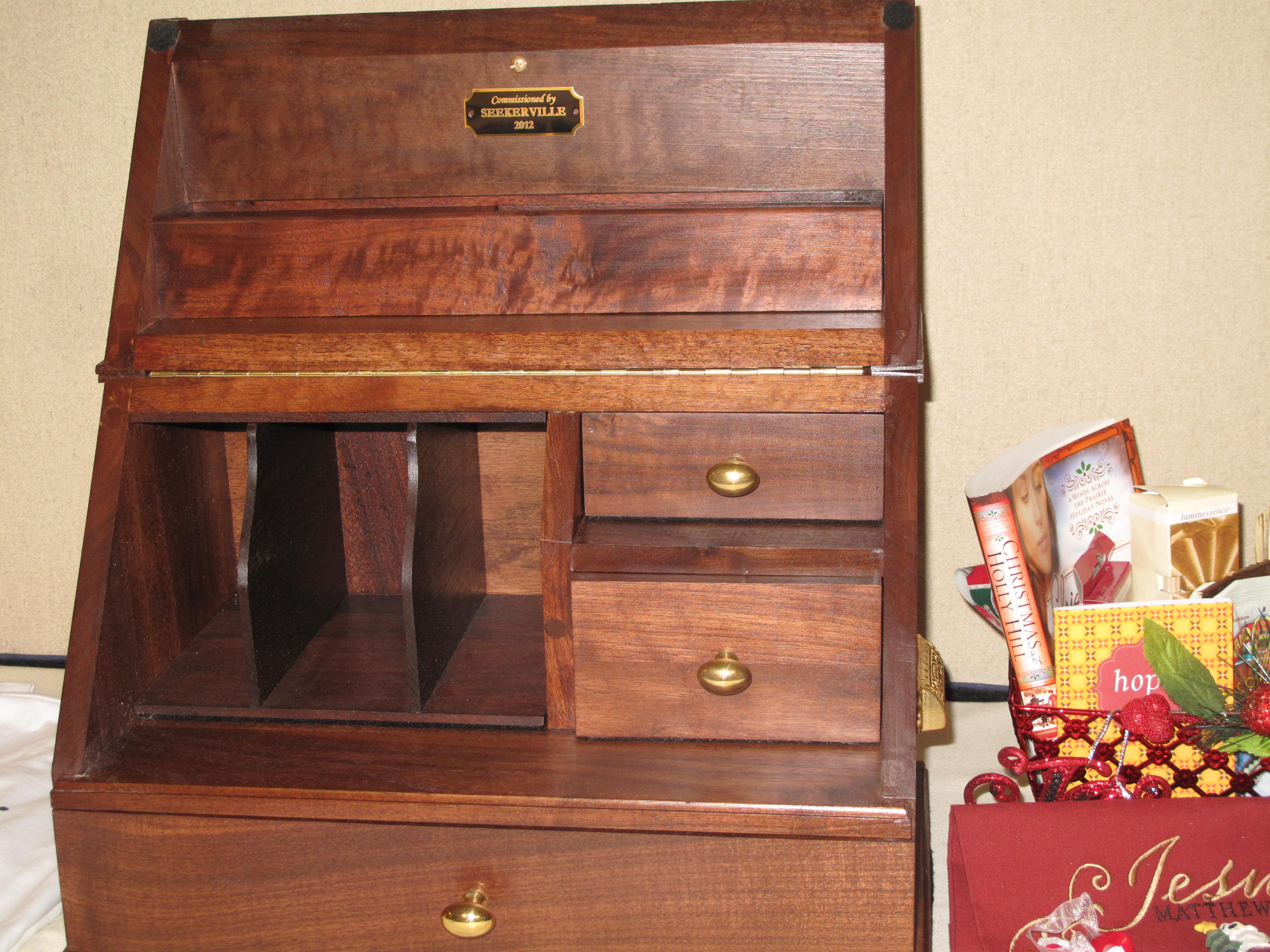
Awesome Handmade Desktop Secretary

The wooden pieces above and below were handcrafted by Gary Harders of South Dakota.

Handcrafted Duck Call

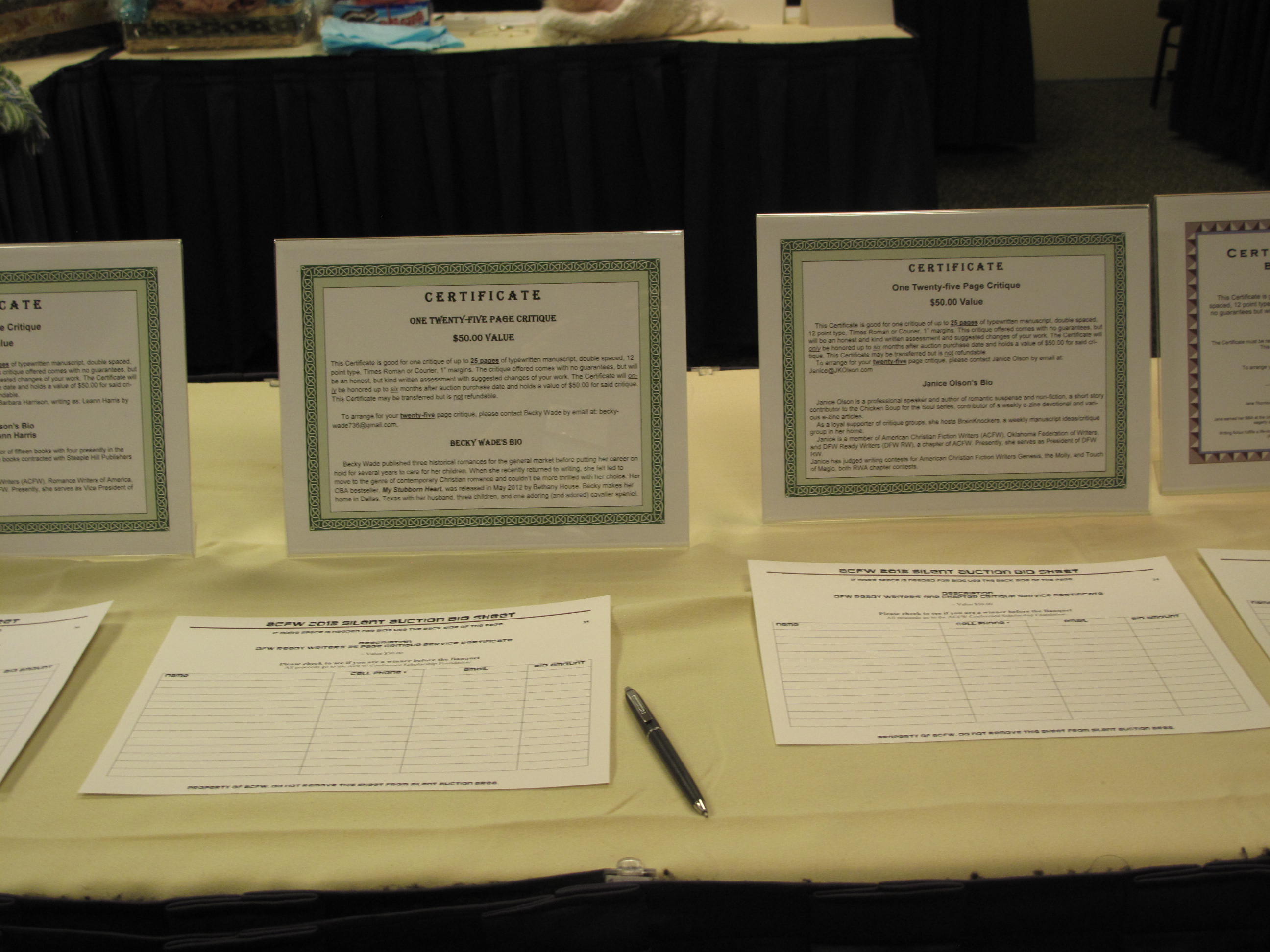
Gift Certificates were offered for Kim Sawyer’s B&B, other vacation spots, critiques, E-book formatting, book trailer, private coaching, and much, much more.

Service Certificates were snapped up by savvy writers.

Specially designed and hand crafted items poured into the bookstore. (I realized too late that the picture of the lovely hand crafted jewelry did not turn out.)

One of a kind afghans show our ACFW Members talent.

Over 50 items were offered by our generous ACFW members.

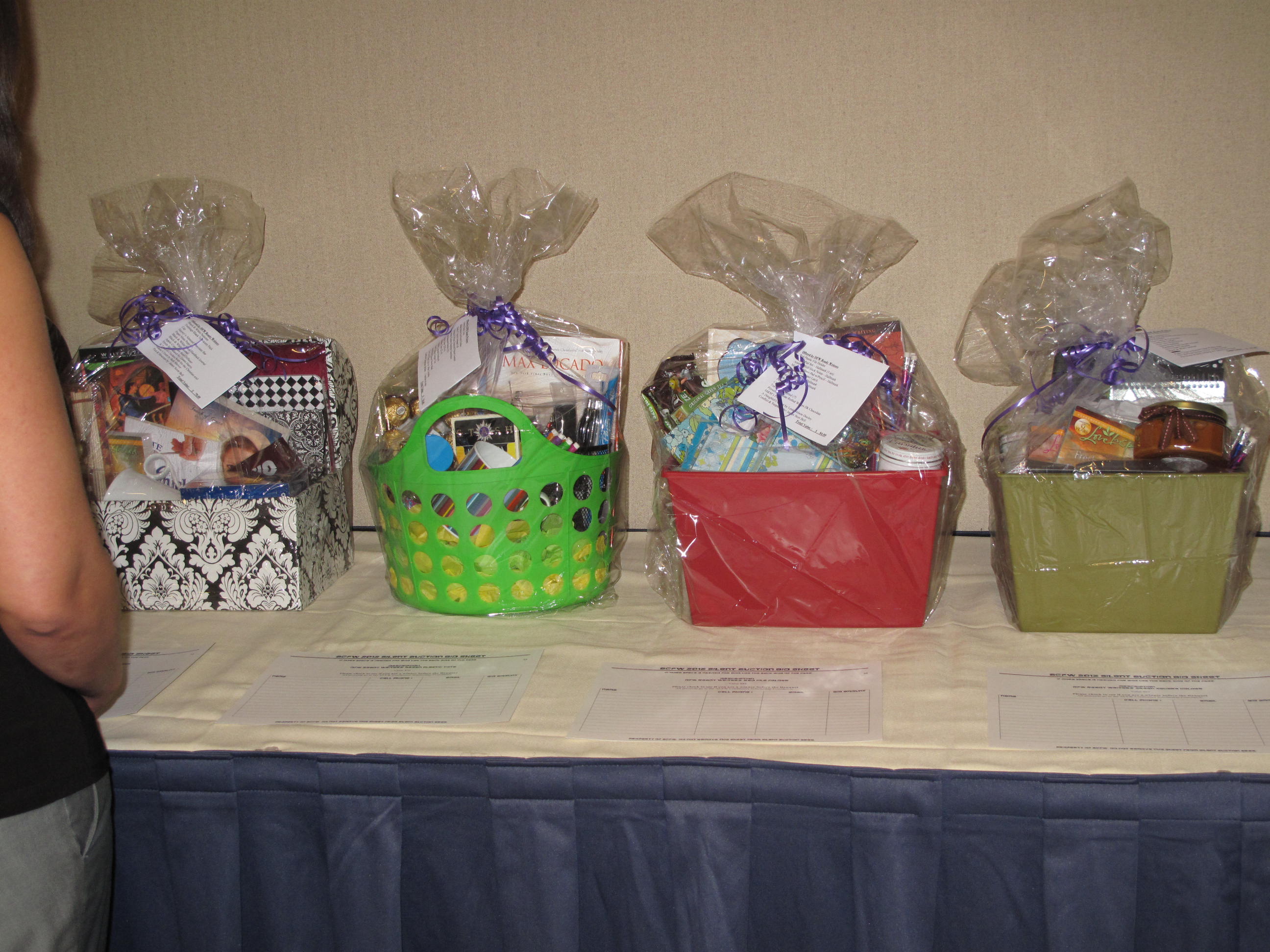
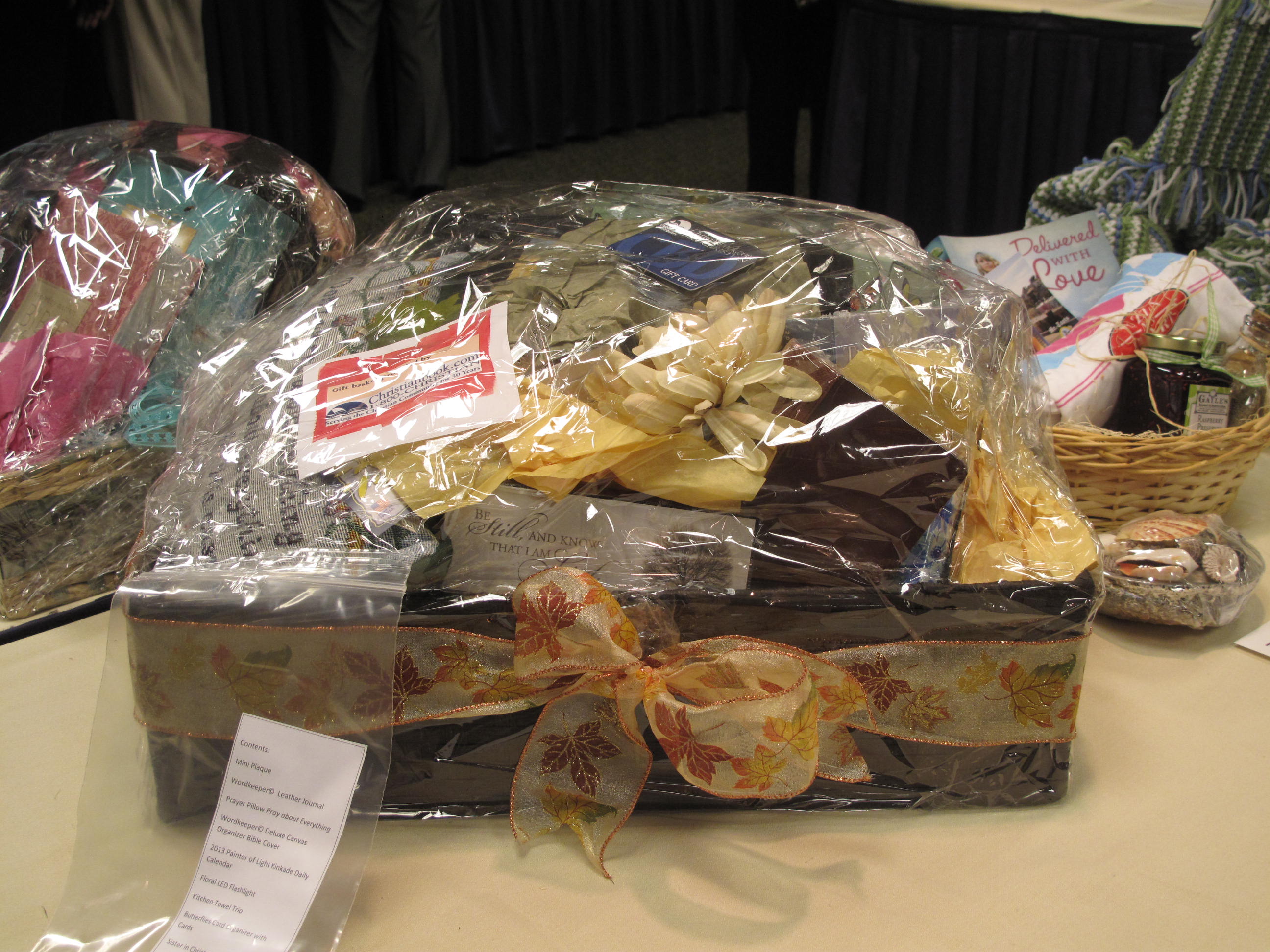
Assorted baskets of goodies.

Big baskets, little baskets.

Something for everyone

EMMA GRACE

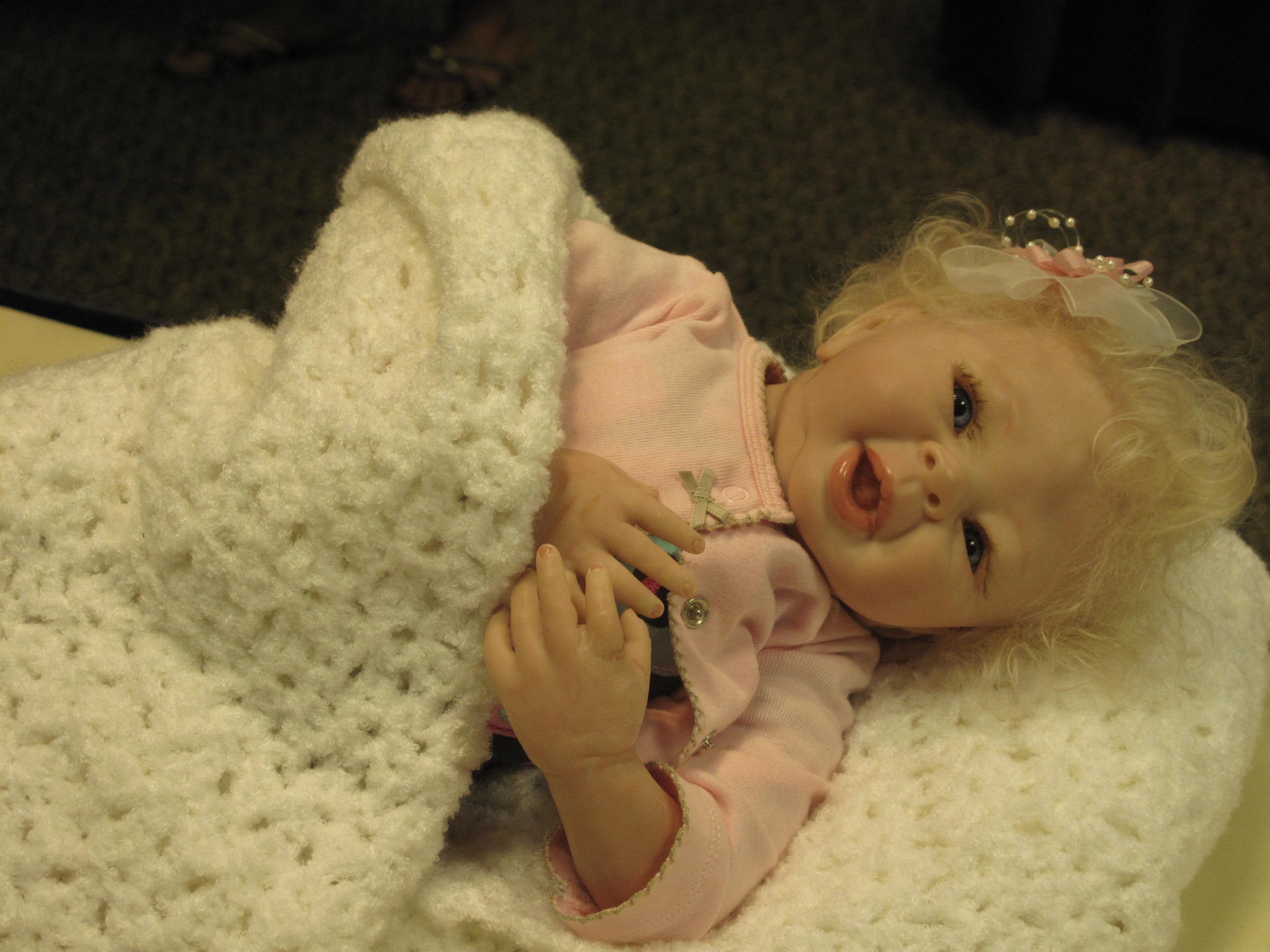
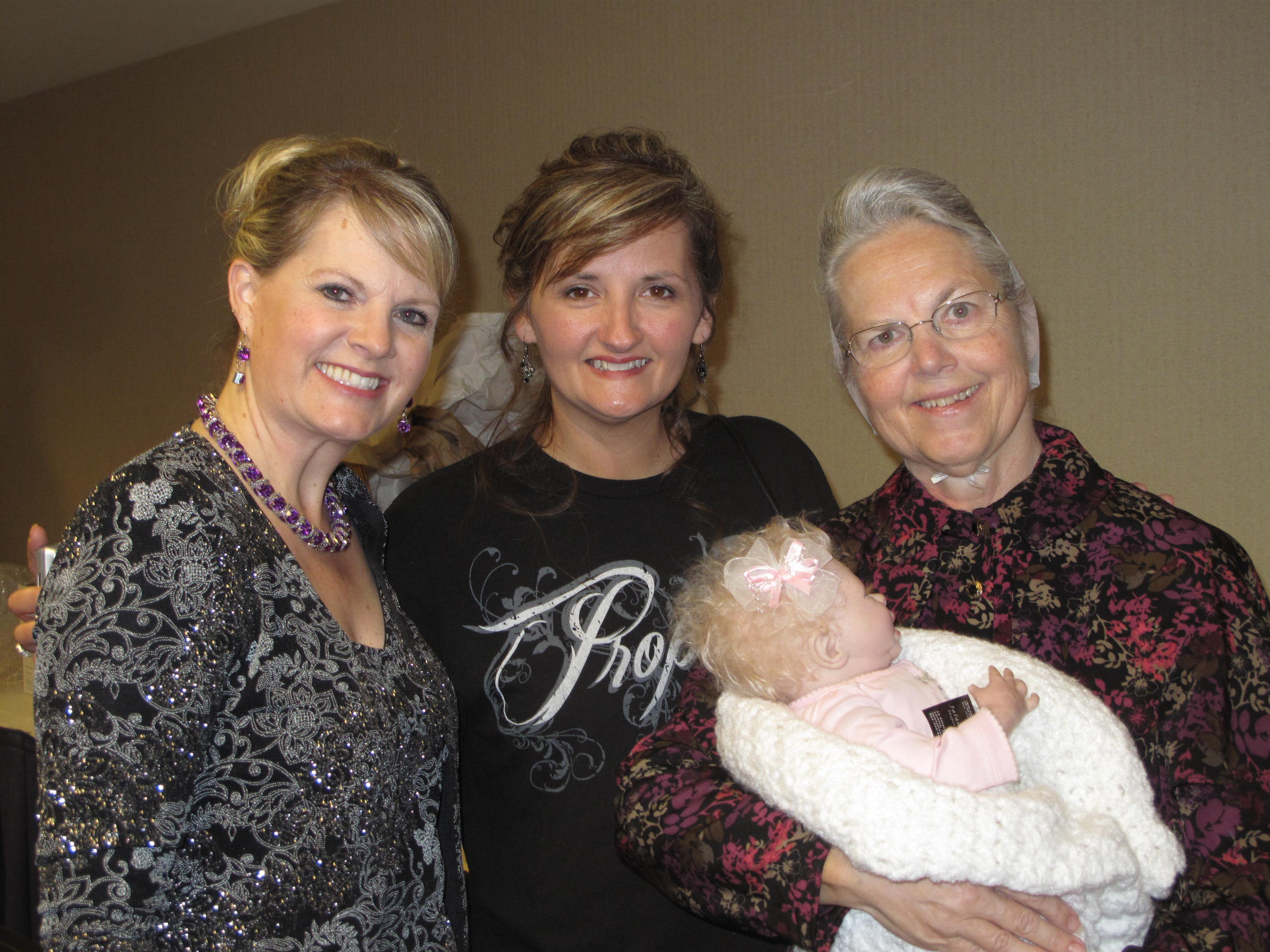
"Emma Grace"I still can’t get over this one. Janna Franklin, the lady in the middle created this lovely lifelike baby. Kim Sawyer out bid all of us with her first bid. I just mentioned that if I felt I could justify it to Husband (after bidding on several other items) I would out bid her.

After the banquet Kim came and paid for her purchase and placed “Emma Grace” in my arms. I call that SHARING THE LOVE.

Behind the Gate

Santa Anita Horse Racing
Behind the Gate

Nostrils flare, eyes bug, while clouds of dust rise from impatient hooves. The feisty thoroughbred bends her regal head in a failed attempt to nudge the gate open. Her hot-blooded demeanor quiets as the Jockey calmly holds her reins and whispers gentle encouragement.

The bell rings. The gate lifts. And she shoots out like a pent-up cannon ball. Her spirited gait promises bold results. Her agile movements belie powerful muscles, honed to skilled perfection. At the right moment, and at the Jockey’s urge, she extends her stride in the home stretch. Her eyes fixate on the finish line before her, ears attuned to her Master’s call, and the two blend into one. Her nose touches invisible tape.

This paints an image of the Christian writer’s life. Like thoroughbreds, we are designed to run the race set before us.

But sometimes, our impatience grows as we wait behind the gate to run our God-ordained course. We assume we’re ready, yet our Trainer holds the gate’s release until our maturity is complete.

Training Thoroughbred Horses, by Preston M. Burch, offers tips that mirror undeniable patterns in the way God trains us for Christian writing.

  • Burch said, “Owners set thoroughbreds apart, before birth, to be racers. Carefully crafted breeding is designed to create a winning horse.” Just as horse owners carefully consider which mare and stud to breed, our Creator planned our DNA with qualities uniquely designed to make us writers.
  • “Successful training of any thoroughbred starts with a quiet lead pony that walks in front of the young yearling as they circle round and round.” We need wise influence. The Lord sends mentors who walk in front of us. Often, we must circle back to a place visited before. In hindsight, we see the need to round similar circumstances, until walking in God’s direction becomes second nature.

    Horse Training Round and Round
    You Must Circle Round and Round
  • “After they learn to follow quietly as a good follower, then they are allowed to trot.” Our enthusiasm often makes the pre-requisite to follow first easy to miss.
  • “Proof of advancement comes with ability to figure-eight trot by the pressure of reins on the neck, versus the pull of a bit on their mouth.” Pressure creates character. First, by the surprise grind of teeth against metal when someone tells us our words run rampant. Over time, we learn to respond to a gentle tug on the neck — where it takes less pressure to generate a pattern of grace, diversity, and style in our sentences.
  • “Once bridle-wise training is accomplished, next comes jogging, and then cantering. The horse continues to be accompanied by the pony to this point. By this time they should be fit and well-behaved.” Here, our writing muscles are small, but growing. Diversity improves with practice, but like the thoroughbred, we still need guiding influence.
  • “If you try to hurry them onto the track before they know what the bridle is for, they are hard to control and will easily hurt themselves, another horse, or a boy.” Our desire to race can drive us to foolishness. Believing we are ready too soon, we break for the track. In our uncontrolled urge to publish, we can hurt ourselves and others.
Jockey Encouragement
And You’re Off

You and I are God’s thoroughbreds. Jesus is our Trainer, and the Holy Spirit is our Jockey. Waiting behind the gate is hard, but with perseverance the day will come for us to run the track laid out especially for us.

When we are fully prepared, the gate will lift. The crowd will roar. The air will surge with electricity. The bell will ring. And then…you’re off!

Are you waiting for a gate removal so you can launch?

Writing Life Survivor Tips

Photo/KarenJordanHow do you endure setbacks in your writing life? If you’ve embraced writing for publication, you’ve probably faced discouraging obstacles in your journey.

I’ve also faced a few stumbling blocks in other areas of my life, such as my health. After every health or family crisis, I struggle to get back on track with my exercising and walking program.

I discovered my desperate need for exercise after a minor foot injury last summer. As I climbed the very first hill on an asphalt trail near my home, my heart raced. I resisted the temptation to sit down at first. And by the time I made it to the top of that hill, I felt like I’d been walking over an hour. As I plodded on, in pain, the trail leveled. But I continued to struggle with each new hill.

Since I carried my camera, I paused several times to capture an interesting shot along the way. I only intended to walk for about 30 minutes. But when I checked the time, I discovered an hour had passed.

I learned some things about myself on the walking trail that apply to the other areas of my life, including my writing life.

  1. Recognize limitations and needs. I must allow myself the freedom to take breaks when I need them. I can cause more damage if I don’t stay off my feet with a foot injury. And in the waiting rooms of life, rest often provides what I really need the most.
  2. Keep going. Don’t quit when the journey gets tough. I need to remind myself of that truth, when the walking trail or the pace of my writing efforts becomes difficult.
  3. Set goals. It helps to have daily goals, even if I miss the mark or go beyond my goal at the end of the day or the project. When I planned to walk 30 minutes, I discovered that I could endure for an hour walk. If I forget to set some measurable goals in my writing life, I fail to recognize my progress.
  4. Enjoy the journey. When I walk, taking my camera along to capture a few of the scenes helps me enjoy the sights along the way and forget about the effort it takes to go the distance. In my writing life, connecting with other writers brings new friendships, insights, opportunities, and encouragement. Plus, choosing my topics and commitments carefully engages my creativity and serves as a motivating force when the writing process becomes overwhelming or difficult.
  5. Reward yourself along the way. The benefits from my walks and my writing life enhance other parts of my life. Of course, as my health improves, other areas of my life benefit, too. Also, my new photography interest contributes to our family albums, and my nature shots add some great content for my blog posts. My writing successes also increase my self-confidence and encourage me to keep going when the journey makes me weary.

What helps you survive your writing life when the journey gets difficult?