And God Said . . .

maypoproadside flowersLast month, inspired by a woman at a conference whose phone told her where we could get a hotdog, I decided to replace my dinosaur of a cellphone.

My daughters were delighted. They soon had me instagramming photos of their dogs, whom they rarely get to see, being off at college and internships much of the year. Before long, I was posting all the time: my garden’s amazing abundance this summer, pies about to go in the oven, snakes and spotted fawns and wildflowers I see on my runs.

Then, a visiting former student and I entered into a psalm-memorizing pact, and she downloaded a Bible app onto my phone that she said would help me, and soon I was listening to scripture as I ran, the voice of God booming forth from the net pouch I wear on my stomach—I hate earphones—to the astonishment of cattle, dogs, horses, and the occasional human passersby.

Almost immediately, I ditched the psalms for the gospels and soon settled on John—now esoteric, now fatherly—as my favorite voice. On one long run, I listened to everything we have of John’s writing. His three odd little letters I’d never paid much attention to before (one addressed to a woman, who knew?!) His gospel, with its baffling beginning:

In the beginning was the Word, and the Word was with God, and the Word was God. He was in the beginning with God. All things were made through him, and without him was not any thing made that was made. (Genesis 1.1-3 ESV)

And Revelation, for me always an unsettling narrative, in which heaven seems such a strange and off-putting place.

Listening to John’s whole opus read aloud in one go was transformative for me. His wise, kind voice pulled everything together in a new way: the creation, the fall, Jesus’ life on Earth, the struggles and successes and sheer realness of the early church—so recognizably the church of today—and the resolution of everything in the end.

After my run, I stood sweating in my driveway and listened to the beginning of Genesis and had new thoughts about it all. The creation was a work of words:

“And God said . . . And God said . . . And God said . . . And God said . . . And God said . . . And God said . . . Then God said . . .” (Genesis 1.3, 6, 9, 11, 14, 20, 26 ESV).

God spoke everything into being. And speaking being a communal act, involving a speaker and a listener, God would have been speaking to someone. So, not only the Spirit hovering over the waters but the Son—or, as John calls him, “the Word”—was present. And, if John is right that the world was created through Jesus, a narrative of the conversation preceding the creation might have had Jesus speaking with his Father, making suggestions, perhaps coming up with the whole idea.

volunteer arugulaI imagined it so:

“Hey, Dad, let’s make a world swarming with swarms of creatures—live creatures like us. And in it, a beautiful garden full of people just like us that we can love, and they can love us back, just as you love me and I love you.”

And the Father, besotted with love for his Son and surely impressed by his good ideas, spoke, the very words from his mouth giving flesh and movement and life to the words of the Son.

running shadowI didn’t let myself think about what happened afterwards—when, as John tells it, Jesus “came to his own, and his own people did not receive him” (John 1.12 ESV). It was too horrifying. Instead, I stood there in the driveway, teary-eyed about that unwritten conversation into we’ve been invited, not only as people made in God’s image but, the more so, as Word-mongers—God-lovers in the business of inviting still others into the same conversation.

What a responsibility.

What a delight!

10 Ideas for Tension Filled Writing

It was 10:30 at night. Not just any night, but the night before school started. Not just any night-before-school, but my first day of my first year back teaching high school full-time after a decade spent home being a full-time mother to my four precious blessings.

StressedOutWomanI was supposed to be in bed, but instead, I was on the front porch, armed with Rid spray, Rid gel, Rid comb and Rid shampoo angrily picking nits out of my second-born’s hair. She was sobbing. I was sobbing, too. Tears ran down my face making my nose itch. Even my kneecaps (recently shaved, I might add) itched at the mere thought of those hideous creatures.

Arriving home late from a city council meeting, my police chief husband discovered us thusly sobbing, picking and spraying. Without saying a word, he went inside, changed and took over the flashlight holding as we shampooed, checked and double checked until the wee hours of the morning. I flopped into bed exhausted and angry. Why hadn’t my daughter’s friend noticed this illegal immigration into her hair while on a mission trip sooner? Why had my daughter had a sleepover two nights prior, thus accidentally inviting them into our home? How could any of this work out for the best? Surely I would never last an entire school day on four hours of sleep!

That same week, both bathrooms sprung leaks causing a waterfall in my office and falling drywall in the laundry room. I attended Open House with my skirt caught in the back of my belt. My husband kept later-than-usual hours with murder suspects, stabbing suspects and hit-and-run accidents. Wasps made their home under our porch and the upstairs air-conditioning went out. I was hot, tired, cranky and spent my days in fearful waiting for the next plague to strike.

What does this have to do with writing? Nothing. And everything. For it gave me ideas for those times when the ill-timed equivalent of lice arrive on your scene!

1. Remember that the best plots involve conflict, action and drama. If everything in life went according to plan, it would make a boring book. Nobody would read past page two.

2. When life falls apart around you it often provides a forced clarity. Priorities become real. We are reminded that God is as necessary as breath. We invite Him into our lives and into our writing.

3. Every irritating situation has its flip side. Look for the humor and use it to make an unusual tweak in a character or an unique twist in your story line.

4. Listen to real life dialogue and take notes in your head (as if you’re not doing this already!) Sometimes what is being said in response makes a great jumping point for dialogue in your novel or a superb illustration in your non-fiction work.

5. Most likely, you didn’t expire from the stress of these multiple irritations, and your character won’t either. Rather, they can grow, change and develop. It can be a point of humor or a highlight of your character’s movement toward your desired ending.

6. What scriptures, friends, or soothing rituals helped you to cope? Might your characters borrow some of them for their problem pages?

7. Taking a walk or a laughter break can help alleviate stress. Send your character on an imaginary walk, or take note cards outside with you on a real walk and see what happens. Let your characters talk to you about what’s going on in their lives. What tickles your characters’ funny bones?

8. Was there a nemesis involved in your frustrating situation? Maybe this can be a starting point for a quirky or irritating companion to your main character. What did people say about your week/day of crisis that got on your last nerve? Serve it up on the page and make it fit your story.

9. A clump of events or disaster in your character’s life can likewise point him or her to a God who is very real and present. Recall the touch points in your frustrations that made you reach out to Him almost in spite of your determination to be angry or bitter.

10. If you’re stuck in a louse-y situation just now, either in your personal life or in your life between the pages– remember, just as chapters end, this too shall pass. If you’ll likely laugh about it later, try to laugh now. Almost everything, sooner or later, makes its way into the writing craft!

Coming Out of the Wilderness

Denabutterfly1The last half-decade has been full of changes for our little family. Stressors included the death of several friends, unwanted job changes for both my husband and I, health challenges, and a total of four moves in five years. We’ve bought and sold three houses (well, we bought three houses…one is yet to sell, so we’re renting it out). Finally, both my dad and my father-in-law underwent major heart surgery within a few months.

Whew. It makes me tired just reading that . . . let alone living it.

To add to the chaos, my writing career stalled. Ideas I felt were timely were turned down again and again, although my previous editors loved several of them and went to bat for me. I prayed, cried, doubted, and wondered what God was up to. He provided income through work for hire projects, magazine and editing work, and I was thankful. However, I longed to write books again.

I didn’t want to turn my back on God because I felt like I didn’t deserve my circumstances. I longed to be obedient, even in the difficulties. I prayed continually for strength, and I kept seeking Him . . . even when He seemed very, very quiet on the subject of when (or if) we might be done with the “desert” we were in.

Wanna know something? Every time I cried out to Him, He answered. Sometimes He reminded me of a Scripture passage that ministered profoundly to me. Songs came on the radio which seemed to have been written just for my situation. Friends and family members called, texted and emailed me at perfect moments, when I couldn’t seem to take another step or cry another tear. He was faithful. So, so faithful.

Two years ago, my friend Tina called me with a book idea, and I knew in an instant that we were meant to collaborate on that project together. Greg Johnson agreed to represent us, and (in a first for me), we actually had two offers on the project.

WoundedWomenIt came out this month, and my heart is full. Though the process of putting the book together was emotionally draining, it was a pleasure to write with such a kindred spirit. I couldn’t be more excited about the finished product (thanks, Kregel!).  Everything I’ve lived through, in publishing and life, has prepared me for Wounded Women of the Bible: Finding Hope When Life Hurts.

Six  months ago, God led my husband into full-time ministry and moved us back to a place we love. It feels as if we are finally coming out of the wilderness and into an oasis. We are grateful beyond words. And we can see in hindsight that He’d been honing and refining us all along to minister more effectively to hurting people.

Friend, are you suffering today? Do you wonder if God has something against you? And do you fear that you’ll ever feel joy again?In-Gods-economy-our

Oh, I’ve been there. My heart aches for you. But this I know: the path He has you on may seem lonely, and you might not feel His presence. But He hasn’t left.

He is up to something, even when we can’t see it. Until then, trust Him with your wounded places, for one day, they will become ministry spaces.

He promises.

Are You A Hypocrite?

Have you ever been in church, or on-line reading blog posts, or just conversing with a good friend when something they said just is like a dagger to your heart with how much truth it speaks? Love those times . . . sometimes.

WarriorDash3
Me trying to be less hypocritical about fitness! Warrior Dash 2013.

As a Christian, I am tired of being called a hypocrite. There’s been a story floating around Facebook (cannot verify its veracity) about a new minister that dressed as a homeless person and attended his own services in this disguise. The post laments how no one came up to speak to him or welcome him in any way and then the minister, in this outfit, goes up to the pulpit and gives a sermon on– well, you get my drift.

Then there is comment after comment about “This is exactly why I left the church!”– even one from my own relative.

Honestly, it makes me mad because I think two things.

Did said I’m-dressed-up-as-a-homeless-man-minister actually offer to shake anyone’s hand? Did he take an initiative, despite his dress, to get to know a few people? And those that use this example as the reason they left their own church– why aren’t you out there greeting people? Be the change you want to see.

I feel like I do try and live what is taught on Sunday. But then a sermon came up about being a hypocrite and I was in the beginning stages of rolling off a barrage of thoughts like the ones above until the minister said this:

“Hypocrisy lives between what you believe and what you do.”

Well, now . . . ouch.

It dawned on me that hypocrisy doesn’t just apply to aspects of the Christian life but to all aspects of our life. For years I said, “I want to be published.” but what was I really doing to accomplish it? That gap between my words and my action is hypocrisy.

These words hit home most for me in the area of weight loss. About three years ago, I saw a photo of myself and it was like a very bright spotlight on the lie I had led myself to believe. I knew I was a little fluffy– but not obese by any means.

Everything changed when I saw that photo. A dagger right into my heart. I couldn’t deny the truth anymore. Well, of course, I could but I knew I never wanted to see another photo like that . . . ever.

So I started on a wellness path . . . very slowly. It’s taken me about three years to lose forty pounds but I’m not quite there yet. Quite honestly, I should be at my goal weight. I have plenty of excuses why– or what we call “reasons” when we’re living in hypocrisy. Some of them sound very good and reasonable but they’re really not.

I’m trying to decrease my “reasons” and increase my actions. I don’t want to be viewed as a hypocrite. I want people to believe that I’m going to do what I say I’m going to do.

What about you? In what area of your life are you being hypocritical? Where is the gap between what you say you’re going to do and your actions? Is it spiritual (I’m going to pray more), or professional (I’m going to start my novel– maybe tomorrow!) or physical (I want to be a size six.)

How do you plan to change it?

And yes, all my ranting about the church above was being hypocritical, too. I have lots of self discovery in process.

Facing Your Fears as a Writer

Photo/TaraRoss

Write down for the coming generation what the Lord has done, so that people not yet born will praise him. (Ps. 102:18 GNT)

I’m always looking for ways to encourage people to tell the stories that matter most. As a writing instructor, I’ve often observed the need for others to tell their stories.

Passing along our faith and family stories helps us make sense of some of the crucial issues that we face in life. When Christians begin telling the stories that matter most, lives change and hearts heal.

But fear silences the voices of many Christians, preventing them from telling their stories. And if you’ve considered writing for publication for any length of time at all, you’ve probably faced the emotion of fear in your work. Many obstacles keep us from telling our stories—personal insecurities, writer’s block, or a variety of excuses.

Excuses. I can think of so many examples through the years when I just sat back and waited on someone else to do something that I knew I needed to do myself. And I can always come up with an excuse about why I can’t do something.

Before my own children became independent, I often reminded them, “Delayed obedience is disobedience.” I never wanted Adam and Tara to be afraid of me, but I knew delayed obedience might be dangerous and harmful at times. But even though my instructions were motivated out of my love and concern for them, they often resisted. Yet I persisted in my discipline. I prayed that they would learn obedience as children, so they would obey God and their God-given authorities as adults.

I even offer myself excuses now, when I don’t want to do something, like making my bed. What does it matter if my husband Dan does that? It’s his bed, too! And our unmade bed obviously bothers him more than it does me anyway.

But what about the things that God calls me to do? What kind of excuses do I use to attempt to justify my disobedience?

  • That’s not my “gift.”
  • I’m not trained to do that.
  • What do I have to say?
  • I’m not a “good” speaker (writer, teacher, blogger … whatever).

Insecurities. As I searched the Bible to try to find some answers to my problem of fear, I discovered that I was in good company.

In fact, when God called Moses to lead His people out of bondage, “ … Moses protested to God, ‘Who am I to appear before Pharaoh? Who am I to lead the people of Israel out of Egypt?’” (Ex. 3:11 NLT).

Moses knew that this assignment was way out of his area of expertise and experience. And Moses knew that he couldn’t do this impossible task in his own strength or with his limited wisdom. But his awareness of his own limitations proved to be one of Moses’ greatest leadership qualities. It forced him to become totally dependent upon God.

Do you think that God was shocked by Moses’ questions and concerns? I don’t.

Promises. In fact, God responded to Moses with the assurance of His presence, not His judgment. “God answered, ‘I will be with you’” (3:12).

I don’t believe that my questions surprise God, either. God still promises to always be with us today. “… And be sure of this: I am with you always, even to the end of the age” (Mt. 28:20).

And He also promises to provide all that we need to do what He calls us to do.

“And I am certain that God, who began the good work within you, will continue his work until it is finally finished … ” (Phil. 1:6).

What’s keeping you from telling the stories that matter most to you?

Photo/TaraRoss
YouTube/JoshWilsonVEVO (“I Refuse”)

Consider the Source: How Reviews Reflect Our Experience

I recently read an account of a celebrity and her young daughter which captured the concept of feedback from a unique perspective. Having completed a Google search, the daughter was troubled to find that strangers were saying all kinds of things about her famous mother, both positive and negative. The mother told her daughter that when people make those kind of comments, the feedback is based on their own individual experiences. Therefore, when people provide comments, they are typically talking about themselves, whether they realize it or not.

What an epiphany, and what a great way to see feedback (like reviews) in a completely different light. People are a product of their own experiences, strung together like pearls over the course of a lifetime. If art imitates life, then reviews of art imitate the reviewer‘s life. Reviewers respond to reading material based on their own individual experiences. When people read books, they view them through their own filters which have been carefully created over their entire lives. These filters can be likened to stained glass windows. The color of the light shining through a stained glass window is contingent upon the color of the glass.  The light is reflected through the filter of their own experience.

Reviews heart book

If you are a writer, reviews are vital to your career. Although positive, warm, glowing reviews are wonderful and make us feel good, constructive feedback is helpful. Of course, no one is thrilled to get a bad review, but most people are actually quite gracious. They are typically honest, genuine and simply expressing the opinion of their own experience. The good news is that people who write scathing reviews are few and far between. However, even bad reviews can yield good things. Having a disparate personality review your material gives you a 360 degree glance that you may never have considered. If a review says that a book skims over the best parts; that means the parts they found most interesting. Do they have a point? Are they right? Is there a way to take that feedback, take it to heart and learn for the next time? Probably.

Let’s say you have a book available on Amazon and Goodreads. You may find that you have very different reviews on those websites. The Goodreads reviewers may have higher expectations as a literary community. If you feel a bit down about a review, check out some of the feedback for many of the classics (The Sun Also Rises, Catcher In the Rye, To Kill A Mockingbird, The Great Gatsby, to name a few). These works that have been part of the literary canon for years are still subject to scrutiny – and that’s okay. There are books out there that some will say are too controversial, and that others will say are not controversial enough. You can’t win over all of them, but you can still learn from all of them.

Pay attention to the words in the reviews: “I found this book to be a bit slow.” “I thought this book was going to be funny, but it’s not my kind of humor.” “I prefer stories that take place in present day as opposed to historical fiction.” This is why finding the appropriate audience for your work is so important. The audience will automatically be more open and enthusiastic to the material if their filter resonates with your own. 

In conclusion, when a person writes a review, they are often writing about themselves and their own life experiences. Keeping that in mind may make all the difference for your own development, as well as remind you to maintain some perspective about your next constructive review.

What are your thoughts on book reviews and reviewers?

Just Ask

The other day, while waiting on the phone before a live radio interview about my latest book, I prayed from my computer screen the Psalm that I had assigned myself as part of a memorization project a friend and I had embarked on. Our goal was not to memorize all the Psalms—that would be too hard—but just to acquaint ourselves with the gist of each one and memorize a favorite verse. Mine, from Psalm 2, was verse 7, in which the unspecified psalmist says, “I will proclaim the Lord’s decree: He said to me, ‘You are my son; today I have become your father’” (Psalm 2:7 NIV).

Interviews stress me. There’s no predicting what the host will ask. Sometimes they haven’t read the book, so I spend the whole interview trying to untangle what it’s really about from what the host thinks it’s about based on the title or cover material. Other times, they’ve read the book but have specific questions about parts of the book I’ve forgotten. Add to that the time constraints! A typical radio interview lasts only ten or fifteen minutes, including breaks for commercials and station identification. Invariably there’s a final question that begins, “In the thirty seconds before we break, can you explain …”

The worst part of radio interviews is that I’m very picky about how I say what I say—which is why I’m a writer and not a speaker. As a writer, you can revise your thoughts, or delete them entirely. In an interview, you’re committed to whatever crazy business emerges from your mouth in the moment.

Or maybe an even worse part of radio interviews is my general antipathy to self-promotion. Why can’t I just write, I wail inwardly, and leave that part of the publishing process to someone else?

To calm myself, I imagined the Father actually speaking the words of the Psalm to me: “You’re my daughter; today I have become your father.”

Frank Weston Benson--My Daughter Elizabeth
F. W. Benson–My Daughter Elizabeth

What a thrilling thought! The God of all creation as my actual parent.

When I got to God’s invitation in the very next line, though, I faltered: “Ask me, and I will make the nations your inheritance, the ends of the earth your possession.”

Whoa, I thought. The Bible notes must be right. The unidentified “I” of the passage must be David or some Davidic king or even Jesus himself. Anyone but me.

“But you write books,” I sensed or imagined the Father saying. “Just ask. I’ll give you nations of readers.”

Asking for that was too awful to imagine—however much I might want it. I couldn’t pray the words, not even in the secrecy of my mind.

Just then, the radio host’s voice intervened. Ten minutes later, I hung up.

I was still thinking, That went okay. I didn’t embarrass myself that badly, when the host called back to thank me personally.

“I’m sure people everywhere have said this,” she said, “but your books really minister to me.”

People everywhere. Answers to my prayers rarely come so immediately or unambiguously. Or maybe they do, but I return so quickly to not expecting God to respond that I don’t notice when he does. Or maybe I don’t really dare to pray with abandon—and thereby reveal to my own Father what’s really in my heart.

I Told You So

IMG_38701_edited-1

Some of the most well meaning people told me to wait to write until I get older. No way a twenty-something can write what people want to read. You don’t have enough real world experience. This is a pipe dream.

The reality of writing a book is that this is a tough job, tough business, and not everyone succeeds. So often the people in our lives have the best intentions as they quietly attempt to redirect us. They don’t want us to be disappointed, experience the sting of failure, or struggle through pain induced by rejection.

Thank goodness the Lord has different plans. I’m thankful for those who attempted to redirect me. I’m thankful for the countless friends and family members who consistently encouraged me. Both groups helped me trust the Lord more. I imagine Him smiling down with a little chuckle and saying, “I told you so.”

I am under qualified in life experience, but I serve a big God. If fisherman can become world changers, so can I. I love what the apostles say in Acts 4:20, “As for us, we cannot help speaking about what we have seen and heard.” So let’s turn that into writing advice:

1)   Write what you know.

I know the heart of young adults to make a difference and dream big. I know the pitfalls that come with learning this adult life. I know the struggles of my parents to raise kids and find a new dynamic with adult children. I know my grandparents’ joy as they pour into us and take the “friend and counselor” role because they’ve already done the parent thing.

I know the south. I know Texas. I understand different personality dynamics. I know how girls think. With a younger brother, I’ve been around guys enough to know how they react and respond.

Bam. I can take all that and craft characters, scenes, problems, and story lines. Imagination takes care of the rest.

2)   Write what you want to learn.

In the course of writing my first book, I wanted to learn more about the SEALs, Haiti, and living in the deep south. (Yep, my brain is random.) So I set my book in Alabama with a trip to Haiti and a Navy SEAL love interest. I might recommend starting out with something slightly more familiar for a first novel, but I rarely pick the easy avenue when I start a project. So here we are!

I traveled to Haiti, made friends with a SEAL, and peppered my Alabama friend with questions and requests for pictures. I worked to become an expert. I’m still a long way from perfection, but I can now speak with a working knowledge on these topics.

3)   Write from your passions.

Three things impact my writing heavily:

– Characters that dream big

– Life as an adventure

– Hope that is found in Christ

I believe we serve a big God who loves to do big things with everyday people. I believe every day is an adventure crafted by the Master Storyteller. And I believe every story ends with hope because of Christ. Forget this post-modern idea that you live and die and that’s it. We were created for something more, and my stories wrestle through hard issues that don’t always end perfectly but always end with Christ. With that fueling me, passion informs every word I write.

I don’t have to understand life, the universe, and everything. I understand my world and snapshots of the world around me. I write what I know. I write what I want to learn, and in doing so, my world expands to fuel my next novel. I write what I’m passionate about, which changes and grows constantly.

Now, I’m telling you that you can do it. You can achieve your writing dream. There were many moments when I doubted this dream would come true. But if the Lord has called, He will bring it to pass. Keep writing. Keep growing. Keep networking.

One of these days, when you get that first contract in the mail, know that you heard it here first: I told you so!

The Writing Life: A Super Balancing Act

I’ll let you in on a little secretI’m a tad imbalanced. My family might use the word ‘super stressed’, my husband, at times, ‘super crazy’. It’s okay, because I know they love me, and it’s true, I do have a tendency to take things on…in excess. I used to attribute it to the expectation that modern women have superhuman abilities to scale relationships, home, health, career, and all their future hopes and dreams in a single bound, but that’s a cop out. The world has figured out we’re mere mortals, and I’m fairly certain I’ve got my priorities and goals straight most of the time. I’ve come to realize it’s more about me wanting to feel in control. I want to manage all my needs and wants with those superhuman powers. I want to do it all, and I want it done now (or, better yet, yesterday).

Image courtesy of Jeroen van Oostrom/freedigitalphotos.net

I think a lot of writers may secretly be like this. They’ll try to crank out the first draft of a novel with the speed of a silver bullet. They’ll read a seven-book series in as many days. They’ll manage their day job like a star reporter at the Daily Planet, and still make time for their secret (writing) identity. They’ll devote themselves to the needs of their family, friends, and home with the efficiency of an evil genius plotting the destruction of Metropolis (but with better intent, I hope). They’ll pretty much do anything they put their mind to, as long as they focus on it maniacally. As in…like a maniac.

Hey, at least we give it our all, right?

Image courtesy of Elwood W. McKay III/freedigitalphotos.net

I’ll keep telling myself that. Meanwhile, failure to achieve balance among the important things in life can become our own personal kryptonite.

Are those of us plagued with this plight destined to live lives of extremes, or will we ever find a nicely balanced, happily-ever-after?

As I think about this, Colossians 3:23-24 comes to mind: “Whatever you do, work at it with all your heart, as working for the Lord, not for human masters, since you know that you will receive an inheritance from the Lord as a reward. It is the Lord Christ you are serving.” 

I wonder, if I stop and remind myself why I’m doing something, will it help me be more selective? If I’d focus on doing some of the same things, but for the right reasons…not for my own vanity or because I feel pressured into it, not because I fear stopping will keep me from ever starting again, not because I’m told it’s what successful people do, and not because it’s supposed to define who I am, would I be more present in the moment? Would there be more joy in the work I undertake? Would I be a happier person overall?

Just maybe it will help me keep the bigger, digitally formatted, wide-screen, blockbuster motion picture in mind. And that, to me, is more powerful than a locomotive.

What about you? How do you stay balanced when you start to feel overwhelmed by the commitment you make as a writer?

Three Requirements for Christian Writers to Consider

Photo/KarenJordan

… The right word at the right time—beautiful! (Prov. 15:23 MSG).

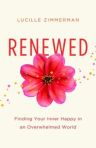
I opened the book package at my mailbox and read the title, Renewed: Finding Your Inner Happy in an Overwhelming World

Renewed. I need to read this book today, I mused. 

But my “to do” list interrupted my daydream of relaxing in my recliner, enjoying a tall glass of iced tea, and reading Renewedby WordServe author, Lucille Zimmerman.

Renewed

I placed my copy of Renewed on the end table next to my chair and revisited my checklist. Speaking engagement? Check. Four Bible studies for newsmagazine? Four checks. Blog post? Maybe tomorrow. Three book proposals? Question mark. Post for WordServe Water Cooler? Oops. Just breathe … I guess the book proposals go on hold again. Drat.

Responsibilities. After a few minutes of brainstorming about my WordServe post, the phone rang. “Mom, do you have two large suitcases that the boys can borrow for next week?”

Next week? I cringed with this pressing reminder of my commitment to keep my youngest two grandchildren in Texas, while my daughter attended church camp with two of her older boys.

Requirements. When I return to my computer, I’m drawn to Renewed again, desperate for a word of encouragement and a sense of renewal. As I read the first chapter on self-care, Renewed offered the exact words that I needed for that moment. Later, a reference to Micah 6:8  reminded me of a question that I had failed to ask earlier as I struggled with my other commitments.

And what does the Lord require of you? To act justly and to love mercy and to walk humbly with your God. (NIV)

Did I read that right? Only three requirements? 

  1. To act justly.
  2. To love mercy.
  3. To walk humbly with God.

Maybe I should check out another translation. 

But he’s already made it plain how to live, what to do, what God is looking for in men and women. It’s quite simple: Do what is fair and just to your neighbor, be compassionate and loyal in your love, and don’t take yourself too seriously—take God seriously. (MSG)

Relief. I breathed a sign of relief, as I read the answer again. Then, I whispered a prayer of thanks to God for the healing power of His Word, the encouragement of my writing friends, and the gift of His call to be a writer.

In all my prayers for all of you, I always pray with joy because of your partnership in the gospel from the first day until now, being confident of this, that he who began a good work in you will carry it on to completion until the day of Christ Jesus. (Phil 1:4).

Lord, give us the courage to listen and obey Your Word.


Photo/KarenJordan

YouTube/CastingCrowns (Courageous)

What recent encouragement have you received from God’s Word or gleaned from another writer’s work?