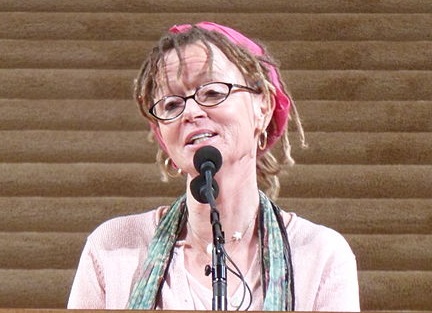
Loved, Chosen, and Writing (for the Forseeable Future) at 5 a.m.—A Lesson from Anne Lamott

Anne-Lamott-2013-San-Francisco--Wikimedia Commons--ZboralskiI just returned from Calvin College’s Festival of Faith and Writing, featuring such diverse writers as Luci Shaw, Richard Foster, Rachel Held Evans, and Anne Lamott and offering sessions on everything from how to write a book proposal to self-publishing, writing about trauma to writing novels, writing children’s books to writing faithfully about sex. Some sessions were practical, others funny, some heady, some worshipful. All inspired and challenged me. Several offered strategies I’ve taken to heart and will pass on to my students.

The best advice, from Anne Lamott, was the simplest and hardly new or profound. She must have said it twenty times during a characteristically hilarious and solipsistic one-hour interview—which surged pell-mell in and out of her various addictions, the gift of desperation, her cellulite-pocked thighs, people she appreciates (those who give her even more cream for her coffee, for example) and those she avoids (e.g., those who claim you can’t have fear and faith simultaneously), her love of desserts and coffee with massive amounts of cream (Did I mention that already?), the interminably lost and sought jetliner on CNN in her hotel room, and the good news that we’re “loved and chosen” (a refrain I’m already aware of reiterated apropos to nothing that I could tell but nevertheless causing tears to start from my eyes each time)—and it was the same advice I’ve encountered whenever I’ve heard her talk or reread her wonderful book on writing, Bird by Bird. Still, like that loved and chosen refrain, it seized me anew each time she said it. It was this: All it takes to write is to sit down and do it.

She put forth several ancillary recommendations. That you can’t wait for your toddlers to start school or your teens to leave home. That you don’t need an office, just a door that closes. That you have to say no, nicely, to the dogs, cats, and kids at that door, who are attracted like heat-seeking missiles to your lap (or thighs or cellulite, I can’t remember). That all one needs—not only in writing but in everything (“Anything I know about anything,” she observed, “applies to everything else.”) is structure and discipline. That, for the past four years, she’s turned off her cellphone and written every day, at the same exact time (9 a.m.), no matter what.

“Give me an hour!” she kept demanding—as if she were our mom and we her teenage wastrels—and pointing out all the junk we waste our time on each day. Though I’ve written and revised and published five books, I still need this reminder, this goad to get after it.

“You’ve got an hour! Give me that hour!” she yelled, as though we would be writing just for her.

And truly, inspired as I was by that simple call to quit dallying, I really feel as though I’m writing, right now, for Anne alone.

Farmland_and_Airbus_Beluga_near_Cop_House_Farm_-_geograph_org_uk_-_446678I planned out that hour—or maybe two, since, as she said, you’ll really only get forty usable minutes out of an hour, only an hour and twenty minutes out of two—all the way back to Oklahoma. In the seats at my gate, on the tarmac waiting in vain to take off, back in those airport seats after deplaning because of weather in Chicago (Who knew you couldn’t take off on a runway perpendicular to the wind direction?), through the murky clouds over Illinois and Missouri and Arkansas, in the car snailing the empty roads at midnight with my cautious husband.

“I’m gonna write as soon as I get up,” I told him. “Before I run. Before I do any grading or reading. Get me up at five, when you get up, but don’t talk to me. Just give me my coffee and let me write.”

Don’t worry: I’m a morning person. And with our dogs living outdoors and daughters away at college, I can write in my non-office—the living room—without even the closeable door Lamott requires. If my gaze strays from my computer screen, I’ll see the sun turn the horizon pink. Every single day. At this rate, I’ll get my novel drafted before summer’s end and revised and sent off sometime before moving on, loved and chosen, to a heaven of no distractions from what I should be doing.


Why Should I Go to a Writer’s Conference?

I believe there are three compelling reasons to go to a writer’s conference and as many, or more, conference “genres” to choose from.

Mount Hermon Azalea
Mount Hermon Azalea
  • You will dwell with a community of writers. The benefit is not only the chance to meet other people who think like you, but you will gain affirmation, encouragement and support. Perhaps you will meet a Facebook friend or an online writer’s loop member face to face for the first time and a lasting friendship blossoms. Or you might sit next to someone at dinner   who writes in your genre or lives nearby and a friend and/or critique partner is found. “A generous man will prosper, he who refreshes others will himself be refreshed.” Proverbs 11:25.
  • There is no better place to learn the writing craft. Most conferences will have an ???????????????????????????????array of workshops and tracks for every level of writer, whether you only have a vague idea about what you want to write or you have a whole drawer full of manuscripts. You can learn specifics about the publishing world from editors and agents and gain insight to what each is looking for. And you can learn from authors who have found success and are generous in sharing what they have learned along the way. “For wisdom will come into your heart, and knowledge will be pleasant to your soul, discretion will watch over you, understanding will guard you.” Proverbs 2:10-11
  • You will have the opportunity to make an appointment with an agent, editor or mentoring author. Beyond learning, building relationships is really the core and the blessing of writer’s conferences. Editors and agents are very interested in finding excellent writers who they enjoy on a personal level as well. The ability to work together is almost as important as your ability to write. If the thought of sitting down
    A meeting waiting to happen.
    A meeting waiting to happen.

    and chatting with an industry professional fills you with anxiety, say a prayer, take a breath, and know that the person you are talking to is interested in what you have to say and wants you to succeed. One of the biggest blessings I have found at conferences of any size, is that those who are there to instruct have a big heart for what they do, and are glad you are there. “Be strong and courageous. Do not fear or be in dread of them, for it is the Lord your God who goes with you. He will not leave you or forsake you.” Deuteronomy 31:6

There are many conferences to choose from, Christian and secular. And there are many good secular conferences so don’t be afraid to attend and be a light to the world. But if you desire to write for the Christian market, you really need to also attend Christian conferences. I like to break them down by size, and each has its benefits. I’ve attended the Romance Writers of America conference (this July it’s in San Antonio!) and a plus is meeting with the Faith, Hope and Love Chapter.

  • The small, weekend workshop. You can usually find one of these close to where you live, and they often are the best place to dip your toe in the water, or your pen into
    Beachside 2011      The Weight of Words
    Beachside 2011 The Weight of Words

    the ink. Especially great for newbie writers. and also those who write because they love to, but don’t necessarily aspire to be traditionally published. Choose one that is lakeside, beachside, or mountaintop for an extra dose of inspiration! My favorite is Bob Welch’s Beachside Writers with Jane Kirkpatrick. They are a dynamic duo and the weekend offers a unique blend of learning the craft and practicing your writing skills. It’s on the Oregon coast in Yachats, and I try to go as often as possible.

  • Regional conferences. Once again, most likely you won’t have to travel far to find a writer’s conference that is still small but offers much to the writer who wants the chance to meet editors from publishing houses and magazines, agents, librarians, freelance editors, and multi-published authors who enjoy “giving back” and sharing techniques or writing methods they’ve learned along their journey. Most likely there will be an amazing keynote speaker. I have just returned from the Mount Hermon
    Mount Hermon Check-In
    Mount Hermon Check-In

    Christian Writer’s Conference in Santa Cruz, CA. Author and speaker Glenna Salsbury was the inspiring keynoter this year and next year Author Robin Gunn will be speaking. The campus is in the redwoods, with dogwood and azalea in bloom, and I can’t imagine a more beautiful spot to be inspired to write. The sense of being among a community of writers is awesome, and as you drink in the beauty and tranquility you can’t help but experience God’s presence. And  the Oregon Christian Writer’s Conference has fantastic conferences ranging from one-day to a full four-day conference in Portland with keynote speakers such as Author Jane Kirkpatrick, Allen Arnold of Ransomed Heart Ministries and Author Dan Walsh.

  • National conferences. This is where you will find a compendium of knowledge about all aspects of the writing world. It’s most likely located at a conference hotel and
    Enjoying friends at ACFW
    Enjoying friends at ACFW

    maybe only occasionally near you. But it’s worth the time and effort to attend. The pace might seem hectic and you will literally fall into bed each night, but you will come home filled with enthusiasm to finish the book or start the next one! My favorite one is the American Christian Fiction Writer’s Conference, held this year in beautiful St. Louis, MO, with keynote speaker, Author Lauraine Snelling. The conference dates this year are September 25 – 27th. And remember, if you feel overwhelmed, there is always a chapel or prayer room arranged at ACFW with Brandilyn Collins and volunteers there to pray with you and/or beside you.

I’d love to know if you have attended a conference or if you are planning on attending one in the future. Which are your personal favorites? Why? If you’re attending one for the first time what do you look forward to the most? What do you fear?

The Mountain Crumbling Power of Persistence

There isn’t anything much more intimidating to a writer than a blank page.

An empty file.Untitled

A blinking cursor.

And a deadline.

Somehow, in the next three or six months you have to pull eighty to ninety thousand words out of your head and throw them into some semblance of order.

And do it well.

 What is the one key thing that will get you to that goal?

Some people depend on speed to get them through to the finish line. They can pour words on the page in writing spurts that make my head spin. They can write an entire novella in a week. Or a novel in a month.

Other people depend on their muse – writing only when it strikes. They may write for four hours one day, and not again until three days later when they find the idea for the next scene.

Some people depend on catching what little time they can out of their busy schedule. Five minutes here, twenty minutes there….

Whatever your writing style, there is one key ingredient you need to have:

Persistence

Persistence is that drip, drip, drip of water

          seeping into solid granite.

                      One by one the words come.

                                    Relentlessly.

Persistence doesn’t let life interrupt the commitment.

If you have a life that likes to intrude on your writing (and who doesn’t?), make time when the little ones are asleep, or when everyone is out of the house, or when someone else can care for things at home for an hour while you grab solitude at the coffee shop.

Before my children graduated from our homeschool, I rose an hour earlier than they did and wrote. I would write seven hundred fifty to one thousand words a day while they slept.

Persistence protects the writing time.

Turn off the text and tweet messages. Don’t answer your phone. Close the internet browser. Don’t answer the door. Set a timer, and don’t do anything but write until that timer goes off.

I set my timer for twenty-five minutes. When it goes off, I change the laundry, or let the dog out, or check my email, and after five minutes, I set the timer again.

Persistence forms a habit.

If possible, write in the same place at the same time each day. Write for the same amount of time each day. Aim for the same word count each day. Day by day, day after day, builds habit.

Have you discovered the joy of habit? One thousand words a day, five days a week, will give you 250,000 words in a year.

Two hundred fifty thousand words in one year.

How many books is that? In my world of writing for Love Inspired Historical, that’s three books, and a bit more.

That’s the kind of output agents and editors love.

 Will you make persistence a key weapon in your writing arsenal?

39 Cathedral Spires

 It is the relentless power that can split boulders and crumble mountains.

The Curse And Gift of Being Called to Write

giftThere are days you totally get Jeremiah. He decides not to speak anymore, but the words burn like a fire shut up in his bones (Jeremiah 20:9). Even when you can’t write, the words burn inside, don’t they?

How often have you wished you were just normal? On those days where you’re trying to fit it all in: a full day of work, a kid’s basketball game, dinner and laundry, and somehow you’re supposed to find writing time too? There’s the agony of staring at a blank page and watching your book drop in Amazon rankings.

You’ve even decided to quit. Often. Finally, a friend or spouse tells you to stop tormenting yourself. “You’re a writer,” they say. “You know you’re not really going to quit writing. You always come back to it.”

So, if you can’t walk away from writing, isn’t it time to look at it from another perspective? “I suggest you learn to write not with blood and fear,” Jane Yolen writes, “but with joy. It’s a personal choice.”

And there is joy, lots of it.

First, you were chosen. Like Jeremiah, before you were in the womb, God chose you. Whether you started writing as soon as you could hold a pencil or didn’t begin writing until some life event pulled you to it later on, whether writing holds financial success for you or not, being a writer is a role you were personally designed for by your Creator. If that isn’t joy, I don’t know what is.

And then there’s what drew you to writing in the first place: the thrill of a coherent story coming together at last with characters who walk off the page; that zone, where reality falls away and you’re virtually swimming in your story world; and words become so sharp and real, you’d swear you could taste them.

You were the one blessed with heightened senses and the words to go with them. So while your walking partner says, “Oh, isn’t that pretty?” you see how the thick tree cover on the forest trail washes the sunlight green, and how the Spanish moss drapes from the tree limbs like ornaments. You have words to describe the warm breeze rippling across your face and how the coos of a mourning dove bring the summer evening alive.

You have the privilege of exploring and enfleshing ideas (ideas, by the way, you almost certainly would never have come to unless you’d spent day in and day out with your fingers on the keyboard). Writing brings the joy of discovering new worlds.

And when you’re done, and the book is published, you receive emails saying things like, “I read your book and was so moved by it, I turned back to page one and read it again.” Wow, you think, did I actually create something that could do that?

You did, because you were blessed. In spite of the tortuous days of staring at a blank page, and wondering how a person can be pulled in so many directions without being ripped apart, you were given a beautiful and multilayered gift by God when He called you to write. It’s a gift you love to give back to Him, and when you’re having a thorny writing day or month, you need to remind yourself of that.

Embracing Your True Identity as a Writer

Photo/KarenJordanAs I watch my grandsons, Ethan and Zach, make silly faces dressed in their costumes, I realize how much I act like them.

At times, I pretend to be someone else, wearing a mask to disguise my true identity.

Masked crusaders. Zach and Ethan often pretend to be superheroes with superhuman powers, fighting against crime or evil. But even though they enjoy their make-believe world for a while, they soon shed their costumes. Bored with one adventure, they put on other outfits–such as pirate costumes–and search for a hidden treasure or sail off to conquer another ship. Later, they may be fully decked out in their new football or soccer uniforms.

True identity. As a writer, when I masquerade as somebody or something else, I tend to lose my focus on reality. And with this cover-up, I sometimes unintentionally deny my true identity.

I may be tempted to hide behind a cloak of self-confidence, trying to compensate for my weaknesses and failures. Or I try to put on another mask to temporarily gain acceptance and approval.

Self-deception. My self-deception always directs me down the wrong path, leading me down a new road. And I find myself in places that I never intended to go. When I choose an identity that God never expects me to wear, I make regrettable mistakes and commitments. And I focus on my faults, instead of my blessings.

I’ve tried on the masks of SuperMom, SuperNonnie, SuperWife, SuperTeacher, and even SuperWriter. And I’ve suffered from stress and burnout. Then, I feel like a SuperNobody. When I try to become any of those super-characters in my own strength–instead of depending upon God for direction and strength–I fail miserably.

As I continue my journey as a writer, I pray that I will embrace my true identity and remember who I really am “in Christ” (Eph. 1:3-14). As a Christ-follower, I am unconditionally accepted and loved by God because of what Christ did, not because of what I can do for Him or for others.

101031.gkids copyI also plan to model my faith and beliefs for my grandchildren, so they will also know when to put their masks and costumes away and discover their own identities “in Christ.”

What has helped you find your true identify as a writer?

Photos/KarenJordan

5 Ways to Drive an Editor Crazy

13761150586648bAs an aspiring writer, I thought editors had horns on their head and pitchforks perched beside their desks. After all, they sent me form “no thanks” letters after I’d slaved over an obviously brilliant manuscript. They ignored my letters and phone calls, and seemed to take joy in waiting months before replying to my oh-so-urgent emails.

Now, as both a seasoned writer and an editor for a large faith-based website, I’ve learned that editors are people, too. We love finding new voices to publish, and we try to be gentle when doling out rejections. Sure, we have our quirks, and we make mistakes. But mostly, we’re word-loving, gentle souls who find joy in a well-placed modifier.

When provoked, however, we can lose our literary minds. Several habits don’t just rub us the wrong way—they make us want to run down the street while still in our bathrobes, shouting Weird Al’s “White and Nerdy” until we puke.

Here’s how you can speed that process along:

1) Treat Guidelines as Optional.

      Don’t bother reading writing guidelines; don’t even visit websites or read back issues of magazines. Send a totally inappropriate submission. In your cover letter, tell the editor that while you’ve never taken the time to familiarize yourself with their publication, you’re sure that your work is perfect for them. file3781288474089

       2) Respond viciously to rejection letters.

      When you receive a letter stating that “your submission doesn’t meet our current needs,” fire off a hateful email, chastising the editor for his lack of taste. Even better: use bad language and post your vitriolic thoughts all over social media. (This habit works well if you never want to see your work in print. Those bridges are so pretty when they burn!)

      3) Never turn in an assignment by the deadline.

Deadlines aren’t set in stone; therefore, ask for repeated extensions, paying no attention to the panicked tone of your editor’s responses. Don’t worry that you are one of several dozen moving parts in the publishing of a website, magazine or compilation book. Take all the time you want—the world does, in fact, revolve around you.

       4) Take up all your editor’s time.

Ask repeated questions about the contract or terms of your publishing agreement. Don’t get an agent or other professionals to weigh in on your questions. Don’t network with other writers so that you can learn from their experiences. Pester the editor with texts (preferably to her personal cell phone, if you can dig up the number) about when your piece will be printed, how many readers you’ll get, etc.

And finally:

5) Refuse to accept changes in your manuscript.

Since you have received your talent from God, treat every word as His direct quote. Don’t let an editor make changes to your beautiful masterpiece. Fight over each letter and punctuation mark. Don’t choose your battles. Take offense at questions. Die on every single hill.

Now, if you’ll excuse me, I have a nasty email to delete…and I need to look up the lyrics to a certain parody song.

Help! My Life’s a Tilt-a-Whirl and I Wanna Get Off!

I watched the pink and orange eventide rise behind the bare-limbed trees lining our backyard.

The day was gone again.

Lost in a shuffle of orthodontist and doctor appointments, car pooling, awkward schedule changes due to the weather (again), blog posts and interview questions due yesterday, and a hopelessly floundering manuscript, life felt like a tilt-a-whirl and I wanted to get off.

How in the world could I keep the pace my life was going? How could I meet everyone’s expectations? How could I make sure I was being a mother and a wife first?

Through Me, I heard Abba whisper.

I’d recently forced myself to become diligent about reading the Bible again, after “forgetting” to make it a daily habit despite the five Bible applications on my smart phone and the three hard copies in a dust-covered stack on my bedside table.

No wonder I felt lost.

No wonder I felt like I couldn’t do it anymore.

I can’t.

Be still, He whispered again. Anything is possible through Me.

I can’t.

But God can.

IMG_0785Obviously He’s not going to write the blog posts for me. He’s not going to drive my kids to the orthodontist. He’s not going to bathe the five nonagenarians at the hospital for me during my nursing shifts.

But His power, through my heart staying centered on Him, can be made perfect.

And I can rest, knowing everything in His will to be done, will be done.

Eventually.

Writers or not, we all have times we feel lost and overwhelmed, insufficient and incapable. But if we keep our eyes on Him, He will renew our hearts. He will accomplish infinitely more than we can ask for or imagine (Eph. 3:20).

And best of all, we can rest in His peace.

 “Let the peace of Christ keep you in tune with each other, in step with each other. None of this going off and doing your own thing. And cultivate thankfulness. Let the Word of Christ … have the run of the house. Give it plenty of room in your lives. Instruct and direct one another using good common sense. And sing, sing your hearts out to God! Let every detail in your lives—words, actions, whatever—be done in the name of the Master, Jesus, thanking God the Father every step of the way.”

Colossians 3:15-17 (TMV)

Travel to Write, Write to Travel

“The world is a book, and those who do not travel read only a page.” St. Augustine

I’m an Irish girl, both by heart and by blood. As a teenager, I remember dreaming of visiting Ireland and Scotland and seeing the hallowed halls of my ancestors’ castles. The idea is more romanticized than real – the Lynch castle in Ireland is now a bank and the Chisholm castle in Scotland is a renovated weekend getaway.

Kariss - IrelandAs a kid, I loved studying the old folk tales, imaginative stories of the tricks and heroism of the wee folk. I grew up on a steady dose of faith and fairy tales. One nursed my convictions, the other my creativity. Three years ago, my dream came true. I spent three weeks on the British Isles. I didn’t see any of the wee folk, though I walked through the fairy gardens at Blarney Castle.

But this rainy tour wasn’t the beginning of my adventures. The travel bug bit me in middle school, and since then I’ve tried to visit new states and new countries, fascinated by the culture. Nothing stimulates my creative side more than exploring new sights, scents, and scenery.

Over the years, I’ve learned this serves me in my writing. All the sensory details, the tiny quirks, the cultural differences influence my settings and characters. I’m learning to identify different textures, not just what they look like but how they feel. I identify different scents with different people and memories. Color takes on vibrancy all its own, enhancing character features, scenery, and what the character experiences.

My travel stimulation reached new heights when I visited Haiti a couple of years ago. I had written and finished my first book, Shaken, which is partially set in Haiti around the time of the earthquake. I researched, talked to those who experienced the earthquake and those who visited before and after, and watched documentaries and the news. But when I finally had the chance to experience this tiny island for myself, I walked away changed with a perspective that enhanced the editing of Shaken.

Kariss - HaitiI remember the stifling humidity and heat as I stepped off the plane. Haitian men stood waiting in the small hangar where they tried to take our luggage off the conveyor belt and then quickly exit to the street as we chased them, hoping we would pay them to get our luggage back. While corralling our luggage was a challenge, I silently cheered their ingenuity and resourcefulness in a poverty-ridden city.

I caught my first glimpse of Port-au-Prince as I hopped in the back of a pick-up and gripped the seat as we played chicken on a two-lane highway, winding past people walking less than two feet from the side of the road. An old man bathed in plain view. Women balanced enormous baskets or jugs on their heads as their daughters trailed behind them with smaller cargo. The air reeked of garbage and burning plastic. Plastic bags that used to hold water littered the street.

Kids ran past in oversized American hand-me-down clothes or no clothes at all. Buses called tap-taps, that looked like a skittle pack blew up, wove in and out of traffic, people hanging onto the back of the cab. The people are down-to-earth and friendly. Those that work, work hard, and the kids are curious and intelligent.

ShakenWhile travel shows me the differences in this wide world, it also shows me the similarities. I noticed that the cement block homes on this tiny island resembled the colored homes in Ireland. I learned that cultures are not as different as we think, that people are people, no matter where you go. I learned to look at the human condition, the driving motivations behind actions, the heart, the hurt, the dreams.

Travel shapes my writing. Haiti certainly shaped Shaken, and adventures I had years ago in Ukraine shaped a few scenes in Shadowed, book two in the Heart of a Warrior series.

So, let the travel bug bite hard, and choose one new city, state, or country to visit each year. What places, people groups, or cultures have influenced your stories?

The Power of Story

When our children were much younger, the grocery store in our town went through a major renovation. The store was beautiful when it was done, and the parent company wanted to advertise the new look. The chain had a spokesman who appeared in all their commercials back then – one of those friendly, helpful, cheerful guys you’d love to have for your next door neighbor. So, of course, he had to be part of the grand re-opening of this store in our small town.

Except he wasn’t there in person.

He was a giant cutout on the roof of the building. And he moved.

As I sat in our van in the parking lot one night with our four children, waiting for my husband as he dashed into the store for something, that giant face appeared over the edge of the building. And disappeared. And appeared again.

My younger boys – ages two and three – were frightened to the point of tears.

004 b

“Who is that, Mommy?”

“Where did he go?”

“Will he come down here?”

By the time we got home, they were in a state of panic. No explanation about pictures with machines to make them move would satisfy them. That man was a monster who was going to come down off the roof of the grocery store, and THEN what would we do?

That’s how the stories began.

Every night I told the boys the same story. It was about the “up-down boy” (that’s what they called him). He couldn’t go up and down anymore because the machine was broken and needed to be repaired. The store manager called Batman to save the day, but Batman couldn’t fix the problem by himself, so he asked Benjamin and Michael to help him.

003

In the story, the boys went up on the roof with Batman and helped him fix the machine that made the up-down boy move, saving the day. They were heroes.

I told that story every night for months after the up-down boy had moved on to another store opening. The boys were even disappointed when he left – a big change from their fear the first time they saw him.

That experience brought home the fact that stories have power. They have power to heal emotions, to inspire, to encourage. They have the power to help little boys understand that a cardboard cutout isn’t alive. The power to turn frightened children into heroes.

Do your stories have that power? Do they inspire your readers? Point them to the Truth? Encourage them to do great things for Christ?

We writers have been given a gift. Our gratitude for that gift inspires us to use it for Him.

001

Don’t Write to Heal and Other Truths about Writing from Affliction

_MG_9992

Dear writers, don’t we know already that we are to write into our darkest moments? My writing students have heard me say this 1000 ways: Enter the forest, dive into the wreck, face your toothy, hot-breathed dragons, open the closet, hold hands with your enemies, etc. We may remain silent in the midst of them, but at some point we must write. We must steward the afflictions God has granted us. Patricia Hampl reminds us why: “We do not, after all, simply have experience; we are entrusted with it. We must do something—make something—with it. A story, we sense, is the only possible habitation for the burden of our witnessing.” Dan Allender, in “Forgetting to Remember: How We Run From Our Stories,” tells us what happens when we ignore the hard events in our lives: “Forgetting is a wager we all make on a daily basis and it exacts a terrible price. The price of forgetting is a life of repetition, an insincere way of relating, a loss of self.”

How then do we begin to write from within our afflictions? And how might the practice and the disciplines of writing offer a means of shaping our suffering into meaning for both writer and reader? Forgive the brevity and oversimplification, but here’s what NOT to do and why:

1. Don’t write to heal. Really. Our therapeutic culture urges us to write into our pain as a means of self-healing. Newsweek’s article, “Our Era of Dirty Laundry: Do Tell-All Memoirs Really Heal?” rightly questions this cultural assumption. One friend assumed I wrote my most recent book, Forgiving Our Fathers and Mothers: Finding Freedom from Hate and Hurt primarily as a means of self-healing. Not so. Writing into our pain can be hellish at times. Know that returning to re-live an experience with language and full consciousness is sometimes worse than the original event. Recognize that writing into affliction brings its own affliction. And even more importantly, recognize that when we are predisposed to heal ourselves, we will not be fully honest in the writing. Healing will likely and eventually come, but only as we engage with the hardest truths.

noah pulling in skiff in storm

2. Don’t write to redeem, to turn inexplicable pain into sense and salvation. We want to bring beauty from ashes. We want to make suffering redemptive to prove its worth. But this is God’s work, not ours. Our first responsibility is to be true to what was, to witness honestly to what happened. Our job is not to bring beauty out of suffering but to bring understanding out of suffering. Poet Alan Shapiro argues that “…the job of art is to generate beauty out of suffering, but in such a way that doesn’t prettify or falsify the suffering.”

smiling old woman with cigarette

3. Don’t write for yourself alone. This is not just about you. You are working to translate suffering to the shared page. Buechner reminds us of the universality we should be striving for: “…all our stories are in the end one story, one vast story about being human, being together, being here. Does the story point beyond itself? Does it mean something? What is the truth of this interminable, sprawling story we all of us share? Either life is holy with meaning, or life doesn’t mean a damn thing.” One of the greatest compliments I have heard from the book and the telling of my own story is, “You told my story.” Writing begins in the self but should consciously move us beyond ourselves, to place our story into the larger stories around us, and ultimately, into the grand story that God is writing. The most powerful work comes from a “self that renders the world,” as Hampl has said—not just the self that renders the self.

W-larger-hands-holding-bookglobe

Life is holy with meaning. Pain is holy with meaning. Don’t miss it. I pray for you the strength and faith and wisdom to begin to enter those hard places and to translate your afflictions onto the pages we share—for the good of All.

How have you been able to translate your suffering into your writing?