Looking for Direction and Peace?

Photo/KarenJordan

Overwhelmed? Drifting above the landscape of your work like a hot air balloon?

Lost your sense of direction? Fear your approaching deadlines?

Searching for answers. When life seems overwhelming, it forces us to look for answers and direction. And it’s important to know where to seek help.

At times, I’m tempted to rely on guidance and encouragement from the resources the world offers me, like the evening news. Instead, it breeds confusion and discouragement, revealing more signs of the ultimate demise of our culture and way of life.

In Matthew 24, Jesus described signs of the end times. And His disciples asked, “Tell us … when will this happen, and what will be the sign of your coming and of the end of the age?” (Matt. 24: 3 NIV)

Jesus explained that He didn’t know when the end would come—only His Father knew the answer to that question (36). But He encouraged His disciples to always be ready (44).

How can we “be ready”? Most of the time, I can’t keep up with the pace of my life, much less worry about the future—especially the last days.

Jesus offered a story to encourage His disciples to focus on the things that matter most. He described a servant who had neglected his responsibilities during his master’s absence, as if he expected him never to return. But when the master returned, he held the servant responsible for his disobedience and disrespect.

Facing the truth. Once again, the mirror of God’s Word forces us to look at ourselves—not to shame us, but to confront us with the truth.

Am I living as if He’s not coming back? What responsibilities am I neglecting?

When I come to my senses and examine God’s Word, I’m reminded, “Instead, be concerned above everything else with the Kingdom of God and with what he requires of you, and he will provide you with all these other things” (Matt. 6:33 GNT).

What does God require of me? Am I taking care of the things that He’s entrusted to me? My home? Spouse? Children? Relationships? Work? Gifts or talents?

As I examine this verse in The Message Bible, I find the specific direction I need.

Steep your life in God-reality, God-initiative, God-provisions. Don’t worry about missing out. You’ll find all your everyday human concerns will be met.

Give your entire attention to what God is doing right now, and don’t get worked up about what may or may not happen tomorrow. God will help you deal with whatever hard things come up when the time comes. (Mt. 6:33-34 MSG).

Practicing our faith. How can I focus on God’s presence, guidance, and provision? Once again, I turn to God’s Word for help.

Jesus, help me to discern Your presence, guidance, and provision. What do I need to focus on right now? Give me the courage and strength to trust you with my future and to listen and obey Your Word. Amen.

What do you need to give your attention to right now? Where do you sense God’s presence, guidance, and provision in your life?


The Making of a Masterpiece

In every block of marble I see a statue as plain as though it stood before me, shaped and perfect in attitude and action. I have only to hew away the rough walls that imprison the lovely apparition to reveal it to the other eyes as mine see it.” Michelangelo

I’ve spent the past month living as a hermit while I finished a manuscript. (Insert sigh of relief here.) I spent countless hours after my day job writing and fine-tuning every detail. Some days, I couldn’t wait to share the story with the world. Other days? All I saw were flaws, flaws that sent me running to fast food and the newest Netflix series while I processed what to do next.

That’s one of the many fun aspects of writing, though, isn’t it? I’m making the manuscript, but in the process, the Lord is making me. As my character wrestles through a growth point, I wrestle with it, too. Often what my character is learning is a lesson the Lord has spent months instilling in my own heart. From the overflow of my heart to the page…I think the story of The David illustrates this perfectly.

In the late 1400s, a group called the Operai provided blocks of marble for several prominent sculptors and artisans to create twelve statues of characters from the Old Testament. Work began on The David in 1464 but after initial carving, the piece was abandoned to the elements for twenty-five years. Then Michelangelo begged the Operai to allow him to complete The David. For three years, he carved the statue, shaving away the damaged parts and shaping features in great detail.

Kariss Lynch creating a writing masterpiece

If you hate history, I hope you stuck with me because none of that is the reason I love The David statue. Michelangelo took a wrecked, abandoned piece of marble and he turned it into a MASTERPIECE. Where everyone else saw a useless block, he saw potential and beauty, a story waiting to unfold.

I think the writing process is a lot like this. A story idea with little initial substance becomes a piece of art with a lot of effort. Over time, the author chips away the unnecessary and ugly pieces until a beautiful story is left.

I believe that’s what Jesus does with the author as he/she writes. Just as Michelangelo labored over The David and you labor over your manuscript, so the Lord labors over you, writer friend. He is in the process of creating a masterpiece that lasts for eternity, and he wants to do that with your writing, too.

Yours is a message of truth and hope. As you identify impurities and polish your writing to perfection, know the Lord wants to do that with you. He wants your voice for his glory. Sometimes the polishing and chipping are painful. With every bit you allow him to remove, you enable him to speak more clearly through you.

Keep chipping away at that novel while the Lord chips away at the excess around your heart. The beauty becomes more evident with every fallen piece.

Enjoying Life

For the record, there is no eleventh merritt, john FINAL19commandment that says: “Thou shalt not enjoy life.” Nor does God ever say, “My plan for you is to be miserable on earth until you arrive in heaven.” What the Bible does say is that God richly provides us with everything for our enjoyment.” (I Timothy 6:17b) In other words, God has given us an amazing world to enjoy—so what’s holding us back from living a life that’s deeply satisfying?


A major misconception we must debunk is that when you become a Christian, you are required to give up much of what you find satisfying and your fun is over. Truth is, God maximizes our ability to enjoy life and gives us unlimited freedom to live the most fulfilling lives possible. If there is any sin in this, it is in our reluctance to consider how God can raise the quality of our lives to new levels of fulfillment and joy.

For Reflection: What false limitations have you imposed on your God-given freedom to enjoy life? How do you think living life with God could serve to elevate your satisfaction and joy?

Previously published on John Merritt’s blog.

Drag Ugly Into the Light

There’s this song, Empty Me by Chris Sligh.  The lyrics strip me down every time I play it…

“I’ve had just enough of the spotlight
when it burns bright
to see how it gets in the blood
and I’ve tasted my share
of the sweet life
and the wild ride
and found a little
is not quite enough.
I know how I can stray
and how fast my heart could change.”

It’s not that I’ve seen that much of the spotlight, just enough of it to identify with Chris’ words– to know how quickly man’s approval can become addictive.

I think you get those lyrics, too. You may not have occupied a platform or a stage, but you’ve done something at some point well enough to elicit praise. You wrote, sang, photographed, cooked, helped, coached, nursed or gave. Add to the list until you see yourself, but whatever was produced from your efforts was recognized and appreciated — and it sat well with you.

We give ourselves to man’s approval like a dog to a belly rub. And just like our pets nudge us when our attention strays and our hands grow still, we can find ourselves stretching for the next pat on the head.

At least, I can.

Allow me to swallow hard and go all first person. It’s painfully embarrassing to admit key stroke by public key stroke that I like a “You go, girl” as much as the next person, but it’s worth dragging it into the light because that part of me stands in opposition to the approval I most long to hear.

Well done, my good and faithful servant.

crossspotlight

I can’t reconcile the two.  They’re light and dark, flesh and spirit.

On my own I can’t even see when I’ve slipped from worshiping the I Am to the age-old battle of recognize me.  The Lover of My Soul has to call me out.  Always He gives me the option of admitting and submitting, relenting and repenting, but once I do He moves tenderly and purposefully. Under His skilled hands, the lesser things of this life are cut away and my sore hearts beats with new passion.

This last pass under His sweet healing knife came as I was preparing speeches for several upcoming events. I was moving along at a pretty good clip when I found a Rock in my road. Color me stunned when God slipped in without any fanfare and showed me that I was going about my preparations with a desire to “do well” at these events.

Do well? Whatever does that mean but to do well so I won’t be embarrassed, so I’ll be approved, to ensure further opportunities– for me…

Father and I have had quite a day. I think I know what He wants me to do and say. Oh, the speeches aren’t totally wrapped up or set in stone. God knows He is welcome to pull them and start all over should He choose, and that’s the sweetest place on earth to be.

See, there’s another line I adore from Chris’ song,

Everything’s a lesser thing compared to You.

And so, I pull all of this ugliness out into the can’t take it back written world because if I don’t know anything else, I know this: My ugly can’t survive in the Light of Who He is but a yielded spirit thrives there.

I will always appreciate a kind word from you, but I aim to live on His for they are spirit and they are life.

All that said, this coming weekend I’ll be ministering with Dr. Joneal Kirby, known as The Heart Mom, the women of A&E’s Duck Dynasty, and a host of other exceptional speakers and worship leaders at the Inaugural Heart to Home Conference in Monroe, LA! I would appreciate your prayer support. Oh, and it’s not too late for you to secure a ticket and join us. Or, if you can’t make the trip physically, you individually or your church group can participate in the simulcast. All of the details can be found here.

Hugs, Shellie

Can you share one of your “uglier” moments in this business that Father has had you drag into the light?

Refusing the Writer’s Call

Refusal of the call questis a common element of great stories, fictional or historical. The hero is called to a quest, but, initially, he balks. He says, whether through word or deed, “I’m not big enough for this task.” Or maybe just, “I’ve got better things to do than sacrifice myself for that.”

From Jonah getting on a ship sailing in the opposite direction of Nineveh to Bilbo Baggins telling Gandalf that all he wants is a nice tidy hobbit house with tea served on time, heroes have been trying to escape the call since mankind has been telling stories around the fireside. And for just as long, the stories have been winning the hero over to the adventure.

Why? Few of us see ourselves as heroes. We know we’re not up to the task, whatever the task is, and we’re right. We’re not big enough, strong enough, brilliant enough or good enough for the task at hand. And yet, deep in our souls, we know God made us for more than having our tea on time.

In all good stories, the hero finally accepts the call. After trying to outrationalize his call, Dietrich Bonhoeffer takes on the role of hero as he boards what is likely the last ship home to Nazi Germany, a ship that takes him ultimately to his death.

Having been elected to archbishop because he is quiet and conservative, expecting to make no waves in an El Salvador on the brink of civil war, Oscar Romero finally accepts that he must speak out, as he stands over the bodies of two murdered priests.

Paul accepts what he must do as God calls his name in a flash of heavenly light.

Little Samuel answers God on the third call in his small child’s voice: “Speak, for your servant is listening.”  Not knowing, of course, that he was accepting a lifetime mantle as prophet.

We writers refuse our call, too. Sitting down at the computer and typing out a page is such a small thing, right? It’s tiny in comparison to the heroes that have been written about. And yet, it feels daunting.

There’s the courage it takes to face a fresh scene. Will it be beautiful or fall flat? It’s as if it’s a test of everything inside you.

And there’s the courage it takes to call yourself a writer. The voices are insistent. How many times have you told yourself that you should just concentrate on being a parent, give your talents to your church and your job, and live a peaceful, ordinary life? You don’t have time for this story? Or more likely, you’re not talented enough for the story you want to write?

But if God made you to write, you’re going to be restless until you do. You can play the role of Jonah, and get on the ship going in the opposite direction and fight it out with the big fish. Or you can accept that being brilliant and big-hearted enough for the story is not what’s at stake. If God made you for this writing quest, he’s planning on equipping you as you go. Sit down at your computer and get started.

Revising Aloud

Tihamér_Margitay_Exciting_story“Reading aloud,” I’m always telling my writing students, “is the best way to revise.”

I encourage them—sometimes require them—to find read-aloud partners or start writing groups in which they take turns reading their work aloud.

“Hearing your sentences spoken lets you know whether they’re clear and natural-sounding—whether someone actually could speak them,” I explain. “And it doesn’t work to read to an empty room. You need a warm body, a listener, to complete the communication. Speaking is, after all, a collaborative act.”

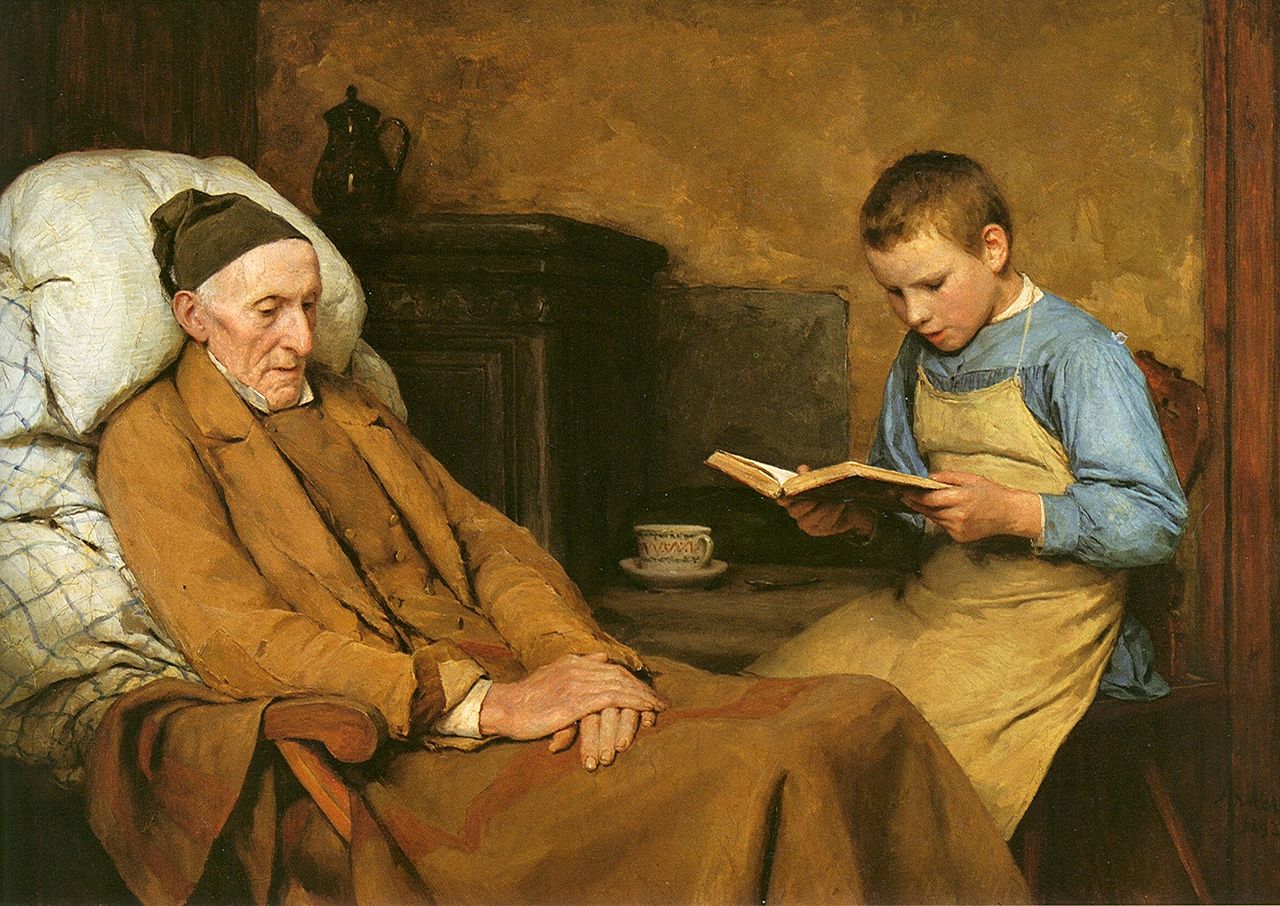
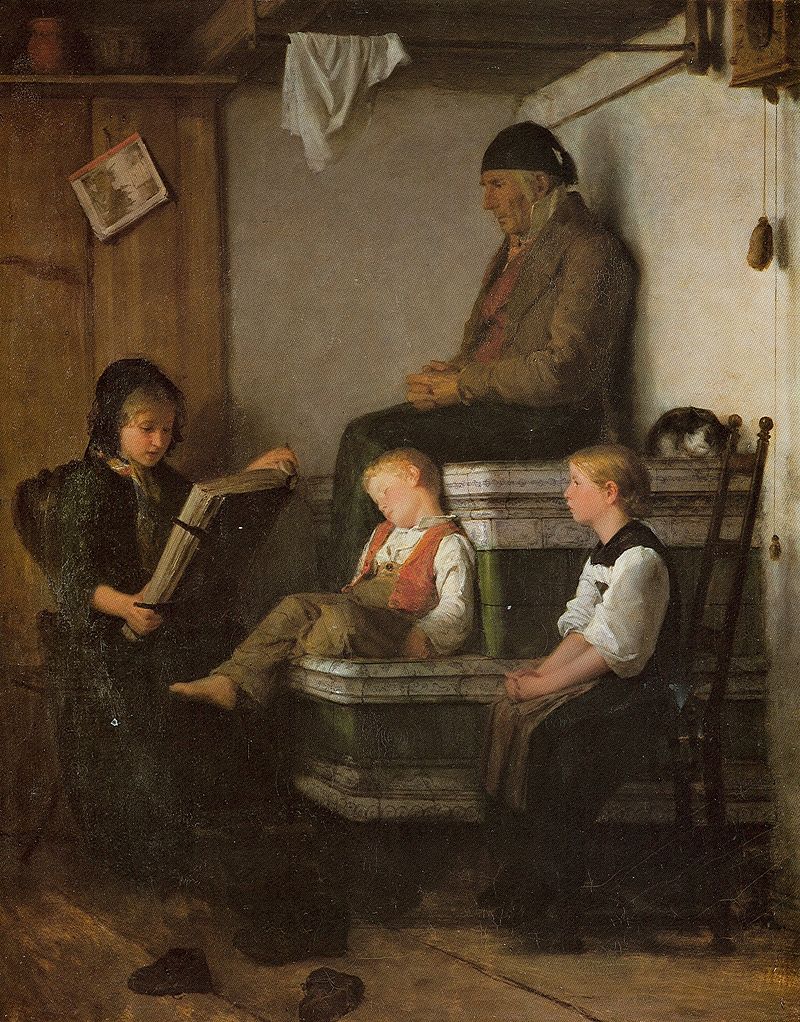
Finding that read-aloud partner is easy at college, where everyone’s engaged in writing all the time. Outside the college setting, though, finding someone willing to listen can be a challenge.800px-Anker_Sonntagnachmittag_1861 People are busy. Few have time to sit still for an hour while some verbose writer drones on. That’s how they’ll imagine it when you propose reading to them. We Americans have lost—or never had—the habit of listening to people read. We had only the shallowest tradition of serial novels, released chapter by chapter as Dickens’ novels were and read to the whole family at fireside. And no comfy pubs—without blaring TVs—like the one where C. S. Lewis, J. R. R. Tolkien, and their writer buddies hung out, drank beer, and read their work to one another. Writers who give public readings these days will tell you it’s hard to get even close friends to attend. Our lives are too busy for read-alouds.

I often recommend to writer friends that they make use of the lonely people in their lives: shut-in relatives, kid-imprisoned friends who wish they had a grownup to talk to, recently retired colleagues with time on their hands. 1280px-Anker-_Die_Andacht_des_Grossvaters_1893It sounds terrible, this “making use” of others, taking advantage of their neediness to assuage your own, but in my experience such mutual exchanges not only helped my writing but also transformed intended acts of mercy—“I should spend more time with my mother-in-law,” I was always telling myself—into pleasurable time together, which we both looked forward to. My mother-in-law not only got longed-for company but also felt needed; I got my warm body but also genuine enjoyment, without having to chide myselfHugo_Bürkner_Lesestunde (usually in vain) to, as Paul recommends, “give what you have decided in your heart to give, not reluctantly or under compulsion, for God loves a cheerful giver” (2 Corinthians 9.7 NRSV). The mutual benefit, I found, guaranteed that cheerfulness, for both of us—because attentive listening and being listened to can’t help but nurture relationships.

My daughter Lulu has been on semester break from college for the past month, with a couple more weeks to go. It’s tricky having a grown daughter home that long. We’ve long since put our Christmas CDs away, but I’m still in the throes of Bing Crosby’s parental prophecy for the season: “And Mom and Dad can hardly wait for school to start again!”

Luckily, Lulu’s engrossed in the final revision stages of her senior project—a hundred-Amédée_Guérard_Bibelstundepage translation of and critical introduction to an East German book—and I’m busy trying to cut 30,000 words from a novel before sending it out, so we have tasks to distract us from the inevitable mother-daughter combat. Also, since we’re in about the same place in our revisions—where what we need most is to hear them aloud and find out if they work—we’ve established a read-aloud schedule: I read her a couple short chapters during her late breakfast, and she reads me one long chapter while I trim vegetables for dinner.

I can’t say it’s the perfect exchange my mother-in-law and I had. Lulu doesn’t end my readings, as my mother-in-law always did, with “That’s the best thing you’ve ever written!” And, as a writer and teacher of writing, I give more critical feedback than Lulu really wants. But our reading fills two hours of our day with mostly pleasurable, mutually beneficial work. More importantly, the listening involved gives us both practice, at this complex juncture of our parental-filial journey, in navigating our new relationship as related but separate adults. As peers, in other words. Equals. Reciprocally heard, appreciated, and loved.

Troubles, Many and Bitter

sail-boat-508183_640 troubles many and bitter post pixabay“Your righteousness, God, reaches to the heavens, You who have done great things. Who is like You, God? Though You have made me see troubles, many and bitter, You will restore my life again; from the depths of the earth You will again bring me up. You will increase my honor and comfort me once more.” Psalm 71:19-21

When the world mourned the passing of Princess Diana, I heard a pastor say, “There is no earthly sorrow that Heaven cannot heal.” In the midst of the darkest days – or even the ones that just don’t measure up to our expectations or hopes – we can be absolutely certain that our Heavenly Father is already, right now in fact, restoring everything.

Everything.

Troubles, though many and bitter, come into our lives; yet these circumstances cannot touch or change the beauty God is already weaving through it all. When you’re walking an unfamiliar pathway, and there doesn’t seem to be any hope in sight, remember that God often does His best work behind the scenes. A better day is coming. Hang onto the promises in His word; remember His faithfulness in the past; and simply breathe in His grace while you exhale whatever prayers you can. Your Heavenly Father has you and He isn’t about to let go of you.

And then, to add grace upon His already extravagant grace, God increases the honor of the one who chooses to praise Him anyway -through the storms and challenges of life. May He find us trusting Him and relying upon Him more and more, regardless of the storm clouds blocking our view of the sun.

Do You Think I’m Insecure?

OLYMPUS DIGITAL CAMERAI usually feel pretty good about myself when I wake up—for the five minutes I refrain from looking in the mirror. That’s when the voices start: “Your thighs have more dimples than a Shirley Temple look-alike convention!” they say, or “What kind of eighties-wannabe haircut is that?”

Then I take my older son to school and notice the work-outside-the-home moms, all coiffed and stylish. The voices deride my writer’s wardrobe of jeans and T-shirts. Later, my fingers poised at the keyboard while my trusty cup of java grows cold beside me, I hear the little demons again: “That paragraph stinks. How are you ever going to keep getting published if you write stuff like that?”

When I pass through the living room and kitchen to go to the bathroom, the hisses continue: “The kitchen counter is filthy. And when was the last time you dusted?” By the time I grab a mid-morning snack, I’m already defeated, and it’s only 9:30 a.m.

Sigh.

I don’t know who said it, but I believe it’s true: Insecurity is the devil’s playground. Or maybe battleground is a better word. His weapons attack from every side and inevitably leave a wound.

file3991282945508Those of us who struggle with perfectionism find it especially difficult to remember that we are wholly loved by our infallible Heavenly Father. It’s a constant war to not let the “How do I measure up as a parent/writer/Christian?” questions run away with my emotions—and my peace.

Maybe you can relate. If my hunch is right, a lack of security is epidemic. And let’s face it: We have plenty to be concerned about. There are our figures, finances, future, and families—just to name a few.

Recently, while at the grocery checkout line, I noticed the headline on a women’s magazine: “Eat right, get fit, get organized, and relax.” Who are they kidding? I barely have time to take a decent shower each day, let alone have a perfect body or a spotless house. And relax while trying to keep it all together? Ha!

So I’ve decided to go on the offensive in this war on my thoughts and emotions. First, I’m going to stop letting the world’s standards rule my mind. With God’s help, I will tune into His Word and turn off the chatter from social media, print media, and television. I will bathe myself in His approval and love, knowing that while pursuing good health is wise, Jesus cares more about the size of my heart than the size of my jeans (can I get an AMEN?).

Second, I’m going to remind myself regularly that the career I have is God-given, and He controls the future. I don’t need to compulsively check my Amazon stats or fret about future book contracts. Instead, I must focus on fine-tuning my craft and being a good steward of the gift of words with which God has entrusted me.

Similarly, I can rest assured that God knows I am doing the best I can as a mother to two strong-willed, energetic boys. He’s the only perfect parent, and I can turn to Him in my frustrations and foibles. I can lean on Him and learn from Him, trusting that He will fill in the gaps my husband and I will ultimately leave.

The bottom line is this: when I focus on His kingdom, He takes care of the rest. 

Bit by bit, the whispers of doubt and defeat fade. Peace overtakes insecurity, and I can concentrate on living moment-by-moment in His grace. Microsoft Word - Grace_Race-v2.docx

You know what else? I’m betting that since Jesus was a carpenter, He doesn’t mind a little dust.

(This post was adapted from “Grace for the Race: Meditations for Busy Moms,” published by Patheos Press.)

The Sound of Silence

Hear that sound? No? That’s because it is the sound of silence. The kind of inexplicable, almost supernatural, silence that expands to fill the void left in the wake of a tornado or an eardrum-shattering fireworks display or, in this case, the Christmas season.

prayer and contemplationMuch is made of the fact that Christmas is a time for peace, for reflection on Christ and the greatest gift ever given–his life, death, and resurrection. In reality, though, if they happen at all, those moments of reflection are generally stolen ones, snatched here and there in the midst of rushing through crowded shopping malls, cooking and cleaning madly before friends and family arrive, and squeals of delight as children tear paper off of gifts spilling out from under the Christmas tree.

All good things. Martha things. Things that should be and need to be done. But things that can so easily distract us from the Mary thing. Sitting and listening. Meditating on the words of Scripture. Contemplating the wonder of some of the most profound and stirring words of all, “And the Word became flesh and dwelt among us” (John 1:1).

Emmanuel. God with us. What an incredible, almost incomprehensible thought.

And not one we can only contemplate at Christmas, thankfully. It is in this time, in the deep silence that follows the noise and (mostly) joyful rushing around and checking off of lists and the general chaos and confusion, this almost supernatural time of stillness, hibernation, and rest, that we are finally able to find minutes, sometimes hours, for uninterrupted, undistracted contemplation.

On the words of Scripture. And on the words given to us as a treasured gift, not to hoard but to give, to share, to continue to pass along the powerful message that the Word dwelt among us. That the Word dwells among us. Not just in Bethlehem, not just at Christmas, but here, now, in the silence and stillness that follows the often frenzied celebration of his birth.

So as we enter into this, a new year, a clean slate, an endless stretch of possibility and potential, may the words of our mouths and the meditation of our hearts be acceptable to him. And may the words he gives us to share with others bless them and draw them back to his presence every day of the year ahead.

Let us continue to share the message of Christmas. That hope came when there was no hope. That light came into deep, impenetrable darkness. That joy came into sadness, grief, and loss. It came two thousand years ago. And it comes today when we are finally still enough to know that he is God. When we stop long enough to listen, to meditate, to contemplate and, in the silence, unwrap, discover, and experience for ourselves the greatest gift of all.

The Word with us.

Comfort for the New Year

Photo/KarenJordan“He comforts us in all our troubles so that we can comfort others. When they are troubled, we will be able to give them the same comfort God has given us” (2 Cor. 1:4 NLT).

A New Year offers new opportunities and challenges. As I sense the needs around me, I often think, “What can I do to help those in need?”

Sometimes it’s hard to know how to respond. In fact, some people may say,”the devil is in the detail,” inferring that there’s some mysterious secret hidden in the details. That term comes from the original phrase “God is in the detail,” which reminds us that the details are always important.

Discovering the mysterious details of how to help others requires wisdom. And God promises to guide us in this discovery process. But He wants us to ask for HIS help first.  “If you need wisdom, ask our generous God, and he will give it to you … ” (Jms. 1:5 NLT).

Seek God first. The Lord promises to provide the guidance we need throughout our lives. Psalm 32:8 says, “I will guide you along the best pathway for your life. I will advise you and watch over you” (NLT).

God often uses my experiences—good and bad—when I seek Him for direction in helping others. At times, He prompts me to share small things—like prayers, concerns, and a listening ear.

When my friend, Kathy, struggled with vertigo following her cancer treatments, I felt helpless to help her since she lived in another state. And I knew the misery of vertigo. When Kathy mentioned that she could not even read her Bible, I was able to read scriptures to her by phone.

Later, Kathy told me, “Your calls helped me survive my cancer treatments.”

Listen. In Matthew 11:15, Jesus asks His disciples, “Are you listening to me? Really listening?” (MSG).

As we seek God and ask questions, it’s important to listen for the answers. Sometimes instead of listening to God, I’m tempted to offer unsolicited advice to friends and family.

Have you ever received a gift that you didn’t want or need? Awkward! Our unsolicited gifts might actually offend instead of blessing others. Perhaps they need godly advice, not just a hasty opinion or thoughtless response.

Ask questions. I also ask questions when I’m trying to discern how to encourage others. What matters most to them? How can I discern how to help? What helped me when I faced a similar problem? What do I wish someone else had offered me when I faced my last crisis?

John 14:26 promises, “… the Advocate, the Holy Spirit, whom the Father will send in my name, will teach you all things and will remind you of everything I have said to you” (NIV).

Tell the stories that matter most. As a Christian writer, I never want to lose sight of the needs of my audience. Author Anne Lamott offers this advice: “Write the books you really wished were out there in the world.”

During a crisis, I look for resources to help me find solutions for my current needs. Encouraging words heal my soul when I’m desperate for answers. And I’m grateful for the writers who have poured their lives into helpful devotionals and books for those troubling days.

So, “… even if I am being poured out like a drink offering on the sacrifice and service coming from your faith, I am glad and rejoice with all of you” (Phil. 2:17 NIV).

As you plan your projects for the New Year, consider offering some words that could help meet the needs of others.

“… Words are powerful; take them seriously” (Matt. 12:36 MSG).

Can you think of a book that helped you through a crisis?