Firmly Established

When I mention the book of Ecclesiastes, what goes through your mind?

 The folk-pop song hit from The Byrds in 1965?

 “Vanity of vanities! All is vanity!”?

 Hopeless despair of anything one does “under the sun”?

100_1867

 Look closer…there’s more to this book than the Preacher’s laments.

 At the very end of Ecclesiastes, the writer switches his voice from the Preacher to the narrator, and writes these words:

“The words of the wise are like goads, and like nails firmly fixed are the collected sayings; they are given by one Shepherd.” Ecclesastes 12:11 ESV

 The goads mentioned in this verse are sticks used for poking and prodding sheep. Sheep are notorious for being slow-witted and stubborn. Even faced with danger, they will not obey the shepherd or sheep dogs if they think doing so would be more dangerous. At these times, the shepherd can resort to using his staff as a goad, poking the sheep to the point of pain, if necessary, to get it going to a safe place.

100_1793

 I don’t know about you, but I’m often like the slow-witted sheep, going blindly down the path toward danger. My Shepherd knows there are times when I would fall off a cliff rather than listen to His word, so He will resort to the goad. I know some of the most painful episodes in my life were used by my Shepherd to move me back to the center of His will.

 The other term used in this verse is “nails.” This same word is also used in Ezra 9:8 and Isaiah 22:23. It gives the picture of a peg or nail fixed firmly and securely into place, as in Ezra, when the Lord established the remnant of the nation of Israel in Jerusalem after the Babylonian captivity. “But now for a brief moment favor has been shown by the LORD our God, to leave us a remnant and to give us a secure hold within his holy place, that our God may brighten our eyes and grant us a little reviving in our slavery.” Ezra 9:8 ESV

 What does this mean for us as writers?

 God’s Word is the goad that keeps us in line with His direction and will. He is the Shepherd who establishes us firmly in our place.

100_1773

 The next verse, Ecclesiastes 12:12, is also appropriate for us: “My son, beware of anything beyond these. Of making many books there is no end, and much study is a weariness of the flesh.”

 Did you see the instruction? “…beware of anything beyond these…” Beyond what? The “words of the wise,” given by “one Shepherd.”

 As Christian writers, our place is putting words on paper – words that point our readers to the One Good Shepherd who seeks the lost and redeems sinners.


Facing Our Fears as Writers

Photo/TaraRoss

We’re going to have to let truth scream louder to our souls than the lies that have infected us. (Beth Moore)

I’m forced to face my fears and weaknesses in many areas of my life, particularly my writing life.

Resistance. What fears haunt you as a writer? I have a long list of my own. Writing for publication demands strength and stamina! We should expect to face resistance, right? Each new project, goal, or idea, may trigger memories of intimidation, shame, rejection, failure, regret, or setback. Or we may even fear the price of our success.

Intimidation. Fearful to let anyone see your first (second or third) drafts? Even the best writers produce shoddy first drafts. Anne Lamott offers an entire chapter on this topic in her outstanding instructional book on writing and life, Bird by Bird.

That’s why we RE-write. And that’s why I recommend finding a critique group or someone who can (and will) edit your work. I’m grateful for my writing friends who are honest enough to wield their red pens and hack on my stuff.

My husband Dan serves as my Editor-in-chief, although most of writers do not advise asking a spouse to edit. But I’ll reserve that debate for another post. Although, I welcome your opinion on that subject in the comments space below.

Shame? Perfectionism and the fear of judgment and criticism can stifle our writing life. Our inner critic may be harder on our work than any reader or editor. “Shame is the most powerful, master emotion. It’s the fear that we’re not good enough” (Dr. Brené Brown).

Rejection? Wow! This can be a monumental hurdle for writers! But many famous authors were rejected before succeeding, like C.S. Lewis and F. Scott Fitzgerald.

If you’re a Christian writer, here are a few encouraging words from Beth Moore, “The next time you feel rejection’s sting, remember God’s words to Samuel: ‘It is not you they have rejected, but they have rejected me’” (1 Sam. 8:7).

Failure? Many writers never pursue writing for publication for fear of failure. But I agree successful author and blogger Jeff Goins: “The cost of not pursuing a dream is greater than the cost of failure.”

Regret? Our mistakes can yield valuable lessons. But we don’t want to focus so much on our missed opportunities or disappointments that we lose sight of hope and dreams for our future.

… I do not consider myself yet to have taken hold of it. But one thing I do: Forgetting what is behind and straining toward what is ahead …  (Phil. 3:13 NIV).

Success? Do you fear having high hopes? Afraid of taking risks? Or maybe you’re counting the cost of success, and you don’t think you have what it takes. Could your fear be the stumbling block that’s keeping your from moving forward?

Setbacks? How do you endure setbacks in your writing life? I’ve learned a few survival tips on the walking trail and on my writing journey. But as I face my fears and take one step at a time by faith, I’m able to go the distance.

And now, … one final thing. Fix your thoughts on what is true, and honorable, and right, and pure, and lovely, and admirable. Think about things that are excellent and worthy of praise. Keep putting into practice all you learned and received … Then the God of peace will be with you. (Phil. 4:8-9 NLT)

What challenges have you faced and what fears have you overcome as a writer?

Being a Writer Means being Relational

I’m looking forward to one of the most intriguing reunions I’ve ever anticipated: reconnecting with a former cocaine dealer who I last saw — and interviewed for a newspaper column — when he was 15 years old.

FreedomThat was nearly 30 years ago.

Before he went to prison. Before his father joined him in the drug-dealing business and killed himself the night before father and son were to go to trial. Before the two of us began writing each other, off and on, for nearly three decades as he bounced from prison to prison.

Now, he’s a free man — and 44 years old. And I’m going to make good on a long-ago promise to buy him dinner to celebrate his freedom.

I sent him a copy of my book 52 Little Lessons from Les Miserables (Thomas Nelson, 2014) because the man is a living, breathing Jean Valjean. Remember? Victor Hugo’s protagonist is released from prison after 19  years, having originally been placed there for stealing a loaf of bread to feed his sister’s family.

But nobody trusts him. Nobody will even give him a room. Except for a bishop, who welcomes him, feeds him and, most importantly, forgives him after Valjean takes off in the night with the bishop’s silverware.

“I’m glad to see you,” says the bishop as Valjean stands before him, flanked by two police officers, “but I gave you the candlesticks, too, which are silver like the rest and would bring two hundred francs. Why didn’t you take them with the cutlery?”

Grace. Second chances. Redemption. The stuff that Jesus is all about.

A rare act that necessarily begins with a relationship. Which is what we as writers of faith should never take for granted: the idea that our profession is about so much more than punching words into a computer. Or even stories.

It’s about relationships. And not just the ones we write about. But the ones we create as we write — with sources, editors, librarians, archivists, a Jewish woman in Jerusalem who wound up translating all my Yiddish for a book on the first nurse to die after the landings at Normandy, American Nightingale (Atria Press, 2004), you name it.

I was 32 when I met that young who just got out of prison. I am now 61. In the intervening years, one of the most important lessons I’ve learned is that we are to be about more than writing. We are to be about relationships.

A Pharisee saw a chance to back Jesus into a corner. What, he asked, was the most important commandment? Jesus didn’t hesitate.

“’Love the Lord your God with all your heart and with all your soul and with all your mind.’ This is the first and greatest commandment. And the second is like it: ‘Love your neighbor as yourself.’ All the Law and the Prophets hang on these two commandments.”

As writers, I’ve often thought our privilege was getting to be four-wheel-drive vehicles with the ability to go where others can’t or won’t.

I would not have met this modern-day Jean Valjean had I not been a newspaper columnist at the time.

I would not be hiking nearly weekly with a new friend had I not met him when writing about his 125-foot fall from atop Oregon’s 9,184-foot Mt. Thielsen.

I would not have had the chance to hear a Belgian innkeeper tell me what it was like, as an 8-year-old boy, to watch Hitler’s army goose-stepping into town in May 1940, had I not been writing a book on that WWII nurses.

There’s this idea that, as writers, we’re to wall ourselves off from the world, light a candle, and write, write, write. And, frankly, I love that part of the job. But our words build bridges to countless people with whom we might be salt and light. And it behooves us to remember that before we were writers, we were — and are — people.

In our case, people called to relationship — with God and with other people.

Rock Bottom

Who we are as writers is a direct result of who we are deep, deep down inside as people.

CliffWSOf course, a lot goes into making us who we are. For me, it’s the entirety of those life experiences that cause me to strive to be a better person tomorrow and vow never to return to the circumstances in which I found myself during those long ago yesterdays.

One night in particular changed everything for me. It was the night I hit rock bottom, the end of my rope, the worst night out of many, many bad ones. It was late Friday, October 2 and the earliest-morning hours of the following day in 1992, and I was in the media parking lot of North Wilkesboro Speedway.

I’d gone through the agony of a divorce back home in Nashville, and after my ex-wife remarried, my son Richard was calling another man Daddy. That was a pain unlike anything I’d ever experienced, even more than the breakup of my marriage.

I’d moved to North Carolina a few weeks before, trying to find my way into the wondrous world of NASCAR. I had no real job, no money and very nearly no home. I was being paid nothing for the stringer work I was doing — nothing for the stories I filed, no expenses, no nothing. The only thing I received was a press pass.

Having covered a race in Martinsville, Virginia the week before, I wound up sneaking food out of the press box for dinner and sleeping in my car. The plan was to do the same the next weekend in North Wilkesboro, but when I arrived, it didn’t take long to figure out that meals wouldn’t be provided to the media until race day on Sunday.

It was Friday morning, and I had not a cent to my name. Panic set in. I was devastated. Scared. Hungry. And worst of all, completely alone. There was nowhere to turn. More than two decades have passed since that day, and even now, I can smell the personal-sized pizzas other reporters were able to buy from the concession stands.

After practice and qualifying that day, I waited until every other media member left the grassy parking lot behind the frontstretch grandstands. No way did I want them to see me setting up shop for the night in my car, and in that car in particular.

The next twelve hours or so were the longest — and emptiest — of my life. I cried that night, not knowing how things were going to turn out. I was more than 400 miles away from anybody I knew well enough to ask for help. I tried to pray, but had no eloquent words. There weren’t even any complete thoughts … all I could manage was the same basic phrase, over and over again.

Oh, God … 

I was scared and saw no way out of the fix I was in.

Oh, God …

Oh, God, please … 

Oh, God …

Sleep was next to impossible. As soon as day broke, I washed off, changed shirts and walked to the garage. Not long afterward, I ran into Deb Williams, the editor of Winston Cup Scene. 

In the NASCAR world, Winston Cup Scene reigned supreme. It was The New York Times, Washington Post and Sports Illustrated of NASCAR, and its writers were the best of the best. Deb let me know a story I’d written was going to run in the next week’s issue. It wasn’t a full time job, but it was at the very least an opening. Maybe I did belong. Maybe.

I headed to the press box overlooking the track, and it was there that I encountered Jerry Lankford, a reporter for the local newspaper in Wilkes County.

“Rick, I don’t know why I didn’t tell you about this yesterday,” he began. “The family that owns the paper I work for owns another one not far from here, and they need a sports editor. Would you be interested?”

Before I could stop myself, I bellowed, “YES!!!” I didn’t ask about the details, because they didn’t matter in the  least. I didn’t ask where the paper was located — it turned out to be in a little town in the mountains of North Carolina called Sparta — or how much it paid. All I cared about was that it was a job, and even better, it was a job with an established newspaper.

Just a few days later, I had my interview. By the time I made it back “home” to the motel where I was staying, I had a call that I’d gotten the job. I was officially the sports editor for The Alleghany News. I started on October 15, 1992 and almost exactly two years later, I landed my dream gig when I was hired as a full-time staff writer for Winston Cup Scene.

Amen … amen … and amen!

Some would call it a simple coincidence that I’d learned of my story running in Winston Cup Scene and the job possibility on the morning after such a terrible, dark, lonely night. No. No way. God heard the simple prayers I prayed that night, and He honored them.

I’ve never forgotten that night. I certainly never want to go back to those kinds of circumstances again, but I don’t want them to slip entirely from my mind, either. I want to remember the bad times so I can rejoice all the more in the good. I want that kind of raw emotion to be present when I write.

Always.

Assets Versus Liabilities

photo by Shelley Hendrix

After months of working my way through the maze of confusion regarding a giant leap of faith into the world of writing and public speaking, I confided this unexpected journey to a trusted friend and mentor. In addition to wise counsel and prayer, as well as encouragement to pursue this dream, Jim said that I needed to write a bio.

*Gulp*

I don’t know about you, but this project was the hardest writing project I think I had ever been given up to that point in my life. (Truth be told, I still don’t like to write my own bio.) For one thing, I hadn’t really done much of anything at that point. I was a shy, behind-the-scenes, let others decide, kind of gal until I went through what I call “God’s Merciful Unveiling” in my life: a season of deep pain, but tremendous spiritual renewal and personal growth. It was through that experience that I began to sense a call on my life to share truth with others that would set their hearts free, too.

I decided to research the bios of other authors and speakers to see what kind of information they included – kind of a template to help me start my own.

Big Mistake.  Or maybe not. It sure felt like one in 2004! The bios I found online were so impressive. These authors and speakers had done so much with their educations, lives, ministries, writing, and families that I began to question whether or not I had actually sensed God’s call on my own life correctly. Who am I to jump into this field when there are so many more qualified and capable people already doing this?

Who would want to hire a mostly-stay-at-home mother of three just because she believed God had called her to step out in faith to share grace and truth with others? I began to feel sick to my stomach as I spent several days wrestling with the seemingly small task of writing my bio. If I have trouble writing my own bio, how in the world am I going to write something people want to read?

I put a rough draft together and apprehensively showed it to a close friend for her honest feedback. I left a copy with her at her house and left before she had a chance to read it in front of me. I imagined her being too kind to tell me what she really thought, which would be, “Who in the world does she think she is?”

It wasn’t too long before she called me. In fact, she called me on my cell phone before I had gotten back home. She told me that soon after I left, her mom called. Her sweet mother was struggling with an unwanted divorce and the painful ripple effects of her former husband’s decision to move into a new relationship after 30+ years of marriage.

My friend said she told her mom that God wasn’t done with her just because a man was. And then she shared my bio with her! My unimpressive, rough draft of a bio. I was perplexed; it seemed like an odd thing to do in such a situation. And she said she told her mother, “Mom, if God can give Shelley new dreams to pursue after what she’s been through, I know God has new dreams for you as well.”

Jaw. Drop. 

I was nearly in tears. She told me this and we chatted briefly and then we hung up. I sat in my car completely overwhelmed with the idea that God could use even my feeble attempt at writing a bio to encourage and strengthen someone else. I thought about Paul’s words in Philippians when he wrote:

“But whatever things were gain to me, those things I have counted as loss for the sake of Christ. More than that, I count all things to be loss in view of the surpassing value of knowing Christ Jesus my Lord…” Philippians 3:7-8

And, then, in ways only the Holy Spirit can do, I realized:

If I give God and others my absolute best qualities and go after it with all my gusto and all my energy, those very assets can turn into my greatest liabilities. But, if I entrust God with everything–and especially what I see as liabilities (like a lack of experience, for example) — and allow Him to live His life through me, He will use them in such a way as to turn them into my greatest assets for Kingdom work. 

I can say now, after over a decade of writing and speaking that I have seen Him do just that – so many, many times!

Like Donald Miller says, “We impress with strength, but we connect at weakness.” It’s almost always those things we view as weaknesses, or liabilities, that God’s light beautifully shines through to brighten another person’s life.

What about you?

What has been the greatest obstacle you’ve faced in your career/calling as a writer?

What helps you overcome insecurities in your calling to be a writer?

How can you help others overcome their fears by sharing your story?

4 Powerful Strategies for Claiming Your Promised Land

” … Now you and all the people prepare to cross over the Jordan to the land I am giving …” (Joshua 1:1)

Photo/AnitaBrooks
Photo/AnitaBrooks

Standing on the banks of the Jordan, I look across to the other side, gazing at my “promised land.”

Perhaps you’ve been here, too. You’ve been given a vision. And you’re waiting to see your dream become a reality.

I remember the years that I spent wandering through the wilderness on the road to publication, wrestling with my doubt, fear, and unbelief. I recall the first time that I considered writing a book. It seemed impossible, doubting that I would ever see my dream fulfilled. Now, I find myself on the shore, looking across to my promised land.

But wait! How can I navigate the rough waters in front of me? The manuscript deadline? The marketing? The on-going platform challenges? What other obstacles will I face as I try to ford the river to my promised land?

I sense the enemy of my soul preparing for another onslaught of roadblocks and dead ends.

Lord, help me!

I inhale slowly—one, two, three, four. Then, I exhale, counting to seven. I inhale again, counting to eight. As I repeat this focused breathing, trying to avoid another panic attack, I relax.

An encouraging promise from God’s Word dispels my fears, “I will be with you; I will never leave you nor forsake you. Be strong and courageous …” (Josh. 1:5-6 NIV).

When I read through this passage, Joshua affirms the promise of the Lord’s presence. He also repeats an exhortation: “Be strong and very courageous.”

Be strong and very courageous. Be careful to obey all the law my servant Moses gave you; do not turn from it to the right or to the left, that you may be successful wherever you go. Keep this Book of the Law always on your lips; meditate on it day and night, so that you may be careful to do everything written in it. Then you will be prosperous and successful. Have I not commanded you? Be strong and courageous. Do not be afraid; do not be discouraged, for the Lord your God will be with you wherever you go. (7-9)

Joshua calls attention to four powerful strategies for claiming our promised land.

  1. Obey God’s Word. After the Lord assured Joshua of His faithful presence, He also instructed him to warn the people of the importance of obeying everything He had commanded them to do.
  2. Meditate on God’s Promises. The LORD also reminded Joshua of the importance of lifting up His Word—meditating on His truths and confessing His promises day and night.
  3. Surrender fears to God. The LORD instructs Joshua to encourage the people to surrender their fears and discouragement to Him, promising to always be with them.
  4. Prepare for battle. As I look across the deep waters of the Jordan into my promised land, I read another warning about impending warfare.

Get your provisions ready. Three days from now you will cross the Jordan here to go in and take possession of the land the Lord your God is giving you for your own … the Lord your God will give you rest … but get ready for battle … (11-14).

Will I still have battles in my promised land of rest? I think this scripture gives me a clear answer to this question.

We must always be aware of our weaknesses, vulnerability, and dependence upon God. As Christian writers, we are called to lead others to claim God’s promised land, too.

So, get “ready for battle … You are to help them until the LORD gives them rest, as he has done for you, and until they too have taken possession of the land the Lord your God is giving them” (14-15).

Are you prepared to claim your promised land?

Photo/AnitaBrooks

Dig it Up

Dig it outThere is a verse in the Psalms that expresses this priceless bit of wisdom and truth. It says, “I praise you because I am fearfully and wonderfully made, your works are wonderful, I know that full well.” (Psalm 139:14) If you study the Hebrew here in this verse, the word for wonderfully carries with it an undertone of “separated” or “distinct.” In other words, this can be read as, “I am wonderfully different, separated, distinct, set apart.” Or another way of saying this: “God, I praise you, because I was made to wonderfully not blend in – you made me to stand out.”

The word fearfully means your uniqueness was designed so well it could produce fear or reverence or awe. Think about this. Think about a time when you saw something so amazing that it scared you. I think of times when I’ve been on a wild ocean, or rafting in white water through the Grand Canyon, or on looking over the edge at the top of Half Dome, or being caught in a blinding snow storm…So what this word “fearfully” means is that you were made in such a way that it should inspire awe and wonder.

The point is, when you choose to blend in, you are robbing us from the wonder and awe we would get from seeing a unique you. Imagine the Mona Lisa being put in a closet forever because she didn’t have the same smile as everyone else. Or like a Beethoven Symphony being thrown away because there was too much passion in it. The truth is that when you to try to blend in, trying to be someone you’re not, that is far weirder than to be who God created you to be.

The bigger tragedy of losing who you truly are is that your heart starts to feel numb, and your life feels less and less alive because you’ve buried the uniqueness that God made you to be—and that is a soul-killer. So, if I may do a little digging around, even a little prying into your soul—what do you think you’ve buried in terms of the amazing person that you are? What talents, desires, dreams, passions, interests or pursuits have you given up on because someone discouraged you, or said you couldn’t do that, or be that? Or how have you decided that conforming and blending in is better than being true to your unique God-fashioned self?

For Reflection: In what way has your passion for life been reduced to a mundane routine of conformity that you hate more than you love? What needs to be dug up, woken from its slumber, and come alive in you again?

Previously published on John Merritt’s blog: this day

Writing Off The Leash

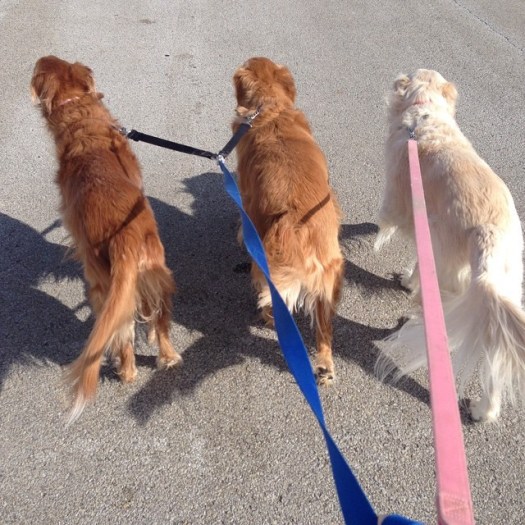
11021249_10205885141785471_6207685168227967330_nToday was the first day above 32 degrees Indiana has seen in forever, so I went gallivanting with my gaggle of golden retrievers. They haven’t had a real walk since the extreme cold came around, so they were giddy. The oldest one (the darkest brown) literally skipped down the street and back. They held their noses high and curled their tails and could hardly keep from tearing themselves from their leashes and running free.


Prior to the walk I’d been at my women’s Bible Study where we talked about 1 Thessalonians 2 and how Paul, Silas and Timothy had to press on with their mission and message despite often overwhelming suffering and odds. In verse 2:2 Paul writes, “Yet our God gave us the courage to declare his Good News to you boldly, in spite of great opposition.”

While not necessarily a Paul-worthy struggle, writing novels does not come easy to me. I write, delete, and rewrite several times over before I get a scene–let alone a plot–to come out right. I question my calling, my ability, my gumption. I call my agent and freak out. I call my husband and freak out. I freak out to my friends on Facebook. But the longer I write, the more I realize that often what hinders me are my own doubts and hang-ups and attempts to write something perfect instead of just…

…writing.

Ray Bradbury, in his book, Zen and the Art of Writing, says as writers, “What we are trying to do is find a way to release the truth that lies in all of us.”

Truth is hard to find. We have to dig for it in the places of our hearts which would rather be left alone. We have to hack through icy corridors of our soul which would rather remain frozen shut. We have to distance, if not remove ourselves, from a world which begs us to tidy up, straighten up, and shut up. Because we can’t release truth into our writing unless we allow ourselves the permission to write poorly, the wisdom to write something wrong, the unencumbered freedom to write the worst thing the world has ever seen.

Beautiful writing, like truth, only emerges when we allow words to roam unhindered across our screens, when we throw off the baggage of perfection and tune out the voices which tell us we are not capable of the task before us.

If you’re called to write, you probably already know the process is a battle, and that you have to be prepared to stay the course despite the worst of odds, the cynicism of the marketplace, and the opposition–whether self-inflicted doubt or another rejection.

My challenge to you is to write off the leash.

Don’t give up.

Spring is coming.

And the words will, too.

Three Lessons From The Abyss

We hear people say that true faith stands regardless of circumstances. It’s easy to love God when life is going well, but what about sustained faith when life is hard? Really hard. What does faith look like when our child is out of control, a parent is dying, we receive a difficult medical diagnosis, or experience betrayal by someone we trust? How do we move forward?

When my daughter fell into active drug addiction, and lived on the streets of our community as a meth addict, I was furious with God. Everything I held dear, and had come to believe in, came into question. The daily uncertainty, not to mention gigantic hole in my heart, were almost more than I could bear.

It was a painful time, and this journey of suffering taught me more than I ever wanted to learn. I’d like to share three key discoveries that helped me cope: Image, woman on beach

1. Seeking God

Even though I was angry with God, I knew I was hopeless without him. James tells us to “draw nigh to God and he will draw nigh to you.” (James 4:8) My drawing nigh became angry, desperate wails in the garage. I all but dared God to account for himself! But I soon discovered he could take it… so I kept wailing.

In desperate times we often think, when is God gonna show up and handle this? We wait for this to happen. But maybe he’s already here and just waiting for us? I discovered that drawing nigh was about me showing up… wails and all.

It was in my garage, at the end of myself and at the point of true surrender, when it became clear to me that God was already there. He spoke into my spirit and said, “Give her to me.” I frankly had to think about that for a while. I found surrender to God’s will a terrifying prospect. Yet it was freeing at the same time. Turning my daughter over to the will of God meant the outcome would not be up to me. But the truth of the matter is, it never was up to me.

2. Choosing joy

Joy is something we often think of as happening to us. You know, a passive event, some blissful occurrence or special blessing. We also sometimes think of joy, or happiness, as something we can attain when “x” happens. I’ll be happy when my child gets her act together, when my spouse shows me more attention, when the front door gets painted or that leaky faucet is fixed… when my book sales soar. I’ll be happy when.

In the darkest time of my life, I discovered I could actually choose joy. Joy came when I took my focus off of problems, off trying to change my daughter, and I set my sights on blessings. It came when I realized my life was so much bigger than any one problem in it. There is a Power, and a purpose, at work in the world that is greater than I am. It’s bigger than my pain, and bigger than my own wants and needs.

I may experience loss, grief, I may even experience suffering. But I always have God, which means I always have hope. For that I can choose joy.

3. Taking care of myself

My pastor’s wife shared not long ago in our women’s Bible study, that she has a wooden plaque in her kitchen which says, “I am here to serve with joy.” I jokingly screeched, “Get rid of that thing!”

Like I said earlier, I’m all for joy. And we are indeed called to serve. But what is often left out of the equation is self-care.

Women, especially Christian women, are notorious for poor self-care. And that was certainly true for me. We are the chief “fixer,” organizer and problem solver, prayer warrior, food preparer, and angel-to-others. Yet we often lose ourselves in the process. Therapist’s offices are filled with well-intentioned women like us who are simply overwhelmed trying to hold up the world.

Most mothers are codependent to at least some extent, and I was no exception. I was motivated by the belief that if I could just try hard enough, I could control everything and everyone, force outcomes, and then life would be ship-shape. I sometimes became so enmeshed in other people’s problems, and in “doing,” that I nearly lost myself.

I learned that self-care begins with solid boundaries, asking for help when needed, and allowing others to be responsible for their own stuff. It means saying “yes” when I want to, and probably saying “no” more often. It means my life is as important as the ones I serve.

Please share how you seek God, choose joy, and care for yourself during tough times.

Leave the Luggage Behind

luggage“Where are your bags?” is the most frequent question I’ve been getting lately from the friends I stay with when I travel for author events. I show up at their doors with a small tote in my hands, and they look around me for the rest.

“This is it,” I say, and they marvel at how little my bag is.

For some reason, I guess everyone expects me to be loaded down with luggage, dragging along a carry-on case, a tote on my shoulder and more bags to come. While that may have been the norm for me years ago on the rare occasions I flew somewhere with my five kids, it’s no longer my style.

These days, I fly with minimal baggage, and I love it. Instead of packing car seats, food snacks, toys, games, and multiple outfits for all, I get a kick out of taking as little as possible. I actually look forward to living out of one small bag for three or four days, since it requires me to trim my wardrobe to only the essentials I need. Once on the road, I don’t have to make any clothing choices since I already made them when I packed; I save time and effort with less to manage. Limiting myself forces me to evaluate priorities and pack accordingly. There’s no room (literally!) for changing my mind, or my clothing options.

The result is perfect for traveling: I have what I need and no more. It makes me feel mentally and emotionally light and free, and I don’t have to physically exhaust myself lugging extra bags. To fly unfettered by baggage is a wonderful thing in a world of extra luggage fees, delays, and lost bags.

If only I could do the same with my journey through life!

“Do not get any gold or silver or copper to take with you in your belts— no bag for the journey or extra shirt or sandals or a staff, for the worker is worth his keep,” Jesus tells his disciples when he sends them out to preach and minister in Matthew 10. Clearly, our Lord knew the value of traveling light! Without all that extra baggage to keep track of, his disciples were free to devote themselves to the work to which they had been called. Unencumbered with material concerns, they could focus on the priorities, the essentials of Christian mission.

I’ve found that is also true of traveling through life as a Christian author: when I keep my eyes on the Kingdom, everything else loses its urgency. Sure, I’d like to make more money (who wouldn’t? travel expenses do mount up no matter how many free beds you can find!) and it would be nice to have readers flocking to me in droves. Yet when I’m focused on the essential task of sharing God with others, it only takes one heart-felt ‘thank-you’ from a reader to know that I am ‘worth my keep.’

How do you pack for your journey?