Asking the Question, “How Do I Get Published?”

Woman_talking_on_phoneNothing dispels the misconception that I am unique more categorically than the internet.

Case in point: Every time I embark on some new project—whether it’s growing asparagus from seed or figuring out whether to read a talked-about novel or advising a student about whether she should negotiate for a better grad school fellowship offer—I always begin by asking Google. Invariably, before I get further than a word or two, Google is already offering me the rest of my question in the searchbox, word for word exactly as I was going to phrase it, from one of the millions before me who’ve already posed it. Whatever I’m asking—however stupid, embarrassing, or arcane my inquiry—the e-populace has already considered it and devoted significant effort to answering it. Wherever I go, the virtual multitudes have already been. Truly there is nothing new under the sun.

That said, experience has also taught me that there are many who don’t seek answers on the internet. Or anyway, there may be plenty of mes out there asking my questions, but, whoever they are, they’re not the would-be authors who show up at my office or email or call wanting to know how to turn their great ideas into published books.
Computer Workstation Variables from WikimediaUsually, I concentrate my authorial-guru expertise on trying to turn their initial question—how to get published—into something more answerable, like how do you write a query letter? Or, how do you write a nonfiction book proposal? Or, do I really need an agent?

I explain to them things I’ve learned about the publishing process over the years—like that agents play an important role in the publishing process by vetting billions of manuscripts out there to find ones worth sending on to publishers. I tell aspiring authors that the 15% of what they may make and are already so reluctant to shell out for their as yet unpublished (and often not yet completed or even begun) books is every penny worth it for someone who not only knows how to navigate the crazily mysterious publishing world and has the connections to do so but who has a vested interest—namely, the desire to make money—in their clients’ success, since that’s where their success will come from.

“What you should be asking,” I say, “is not if you really need an agent but how to get one. And how to motivate yourself to finish a draft. Or how to get started in the first place.”

But they didn’t come to be nagged. They came hoping I’d help them keep on dreaming.

Here’s the thing. Getting published takes work, that’s all. And every answer you have about it has already been asked and answered, in billionuplicate, on the internet. And in more detail than any single author could ever offer. Figuring out how to get published is a matter of asking Google a question and then making your way, site by site, into the vast inter-universe of answers, refining and reasking as you go.

Interested in finding an agent? Here’s how.

Interested in getting a particular agent? Here’s how.

Interested in what clients that agent has had and how successful those clients have been in the past few years? Want to know how long your dream-agent takes to respond to queries? To requests for a partial manuscript? To requests for a full manuscript? It’s all there, often conveniently consolidated into a single, sortable site. Verily I say unto you, there is no mystery more fully unraveled in the webby bowels of the internet than publishing a book.

Which isn’t to say everyone’s in agreement about everything. Or about anything. Far from it. Finding some small clump of consensus, much less an answer you can trust, is as difficult as getting the educated lowdown on a loved one’s disease from the internet. It’s there, but you have to sort through a lot of obvious and sometimes not so obvious nonsense to discover it. Publishing questions are no different. You’ll have to winnow your findings.

But answers to your questions are out there. And, if you’re selective, what you learn is likely to be as trustworthy as and more informed than the answer of any single expert.

So, when you have a publishing question—especially THE publishing question—start with Google. Each question you ask and every answer you receive will take you deeper and a bit more confidently into the publishing world than any one published author can. If you’re lucky, you might even end up somewhere like here, where not just one but an entire community of agented writers are dedicated to encouraging, engaging, and enriching you along your writing journey. Without even being asked.Computer Keyboard

Being a Writer Means being Relational

I’m looking forward to one of the most intriguing reunions I’ve ever anticipated: reconnecting with a former cocaine dealer who I last saw — and interviewed for a newspaper column — when he was 15 years old.

FreedomThat was nearly 30 years ago.

Before he went to prison. Before his father joined him in the drug-dealing business and killed himself the night before father and son were to go to trial. Before the two of us began writing each other, off and on, for nearly three decades as he bounced from prison to prison.

Now, he’s a free man — and 44 years old. And I’m going to make good on a long-ago promise to buy him dinner to celebrate his freedom.

I sent him a copy of my book 52 Little Lessons from Les Miserables (Thomas Nelson, 2014) because the man is a living, breathing Jean Valjean. Remember? Victor Hugo’s protagonist is released from prison after 19  years, having originally been placed there for stealing a loaf of bread to feed his sister’s family.

But nobody trusts him. Nobody will even give him a room. Except for a bishop, who welcomes him, feeds him and, most importantly, forgives him after Valjean takes off in the night with the bishop’s silverware.

“I’m glad to see you,” says the bishop as Valjean stands before him, flanked by two police officers, “but I gave you the candlesticks, too, which are silver like the rest and would bring two hundred francs. Why didn’t you take them with the cutlery?”

Grace. Second chances. Redemption. The stuff that Jesus is all about.

A rare act that necessarily begins with a relationship. Which is what we as writers of faith should never take for granted: the idea that our profession is about so much more than punching words into a computer. Or even stories.

It’s about relationships. And not just the ones we write about. But the ones we create as we write — with sources, editors, librarians, archivists, a Jewish woman in Jerusalem who wound up translating all my Yiddish for a book on the first nurse to die after the landings at Normandy, American Nightingale (Atria Press, 2004), you name it.

I was 32 when I met that young who just got out of prison. I am now 61. In the intervening years, one of the most important lessons I’ve learned is that we are to be about more than writing. We are to be about relationships.

A Pharisee saw a chance to back Jesus into a corner. What, he asked, was the most important commandment? Jesus didn’t hesitate.

“’Love the Lord your God with all your heart and with all your soul and with all your mind.’ This is the first and greatest commandment. And the second is like it: ‘Love your neighbor as yourself.’ All the Law and the Prophets hang on these two commandments.”

As writers, I’ve often thought our privilege was getting to be four-wheel-drive vehicles with the ability to go where others can’t or won’t.

I would not have met this modern-day Jean Valjean had I not been a newspaper columnist at the time.

I would not be hiking nearly weekly with a new friend had I not met him when writing about his 125-foot fall from atop Oregon’s 9,184-foot Mt. Thielsen.

I would not have had the chance to hear a Belgian innkeeper tell me what it was like, as an 8-year-old boy, to watch Hitler’s army goose-stepping into town in May 1940, had I not been writing a book on that WWII nurses.

There’s this idea that, as writers, we’re to wall ourselves off from the world, light a candle, and write, write, write. And, frankly, I love that part of the job. But our words build bridges to countless people with whom we might be salt and light. And it behooves us to remember that before we were writers, we were — and are — people.

In our case, people called to relationship — with God and with other people.

How a Non-Writer Like Me Got Published (Part II)

(Continued from Part I)

I began writing my memoir by starting near the end. That first night, while sitting in front of a blank computer screen, I tapped out the images closest to memory, and likely closest to my heart. It was the account of a remarkable day… the day I delivered my daughter, Annie, to a drug treatment center in California.

 “It wasn’t at all the institutional setting I’d expected for detox… At that late hour, the street was quiet and still. A woman emerged from the far side of the darkened house, brushing by a wall of hydrangeas that cast an eerie glow of amethyst and silver in partial moonlight. Her hushed tones made it seem a clandestine transfer as she took hold of the pull handle on Annie’s bag and turned to escort her inside… Just before both disappeared into the darkness of an open gate, Annie turned around to me and mouthed the words, ‘Thanks Mom.’ I thought I might burst. “

Within a week, I had one, full chapter completed. “Not bad,” my college-aged son reported after a quick read. He showed all the enthusiasm of dry cement. My husband refused to read it at all.Image, post-its and pens

My brother, Paul, on the other hand, provided terrific support for my intentions with the book. He had been the smart one, the accomplished student. While I was sunbathing and reading Cliff Notes during our college years, Paul studied Comparative Literature as a graduate fellow at a top university. “So Goose,” he asked (yes, he calls me Goose), “are you going to write this sequentially or thematically? You also need to pay close attention to your voice. My what? I struggled with how to continue. What was a “voice” and where could I get one? Was I really capable of writing a book? What initially had seemed nothing more than a quick chronicle of a story I already knew, the magnitude of the task ahead started to overwhelm me.

Image, Book binder

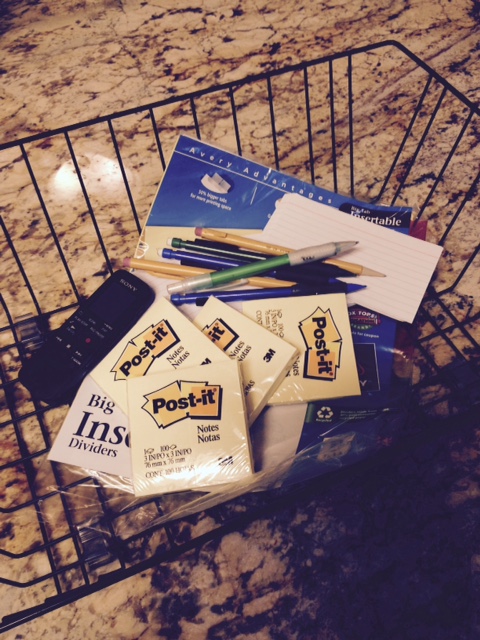
I decided equipment would help. A lover of bins and boxes and anything organizational, I ventured into Office Max and filled my cart with a large black binder, numbered dividers, a year’s supply of yellow sticky notes, white 3×5 cards, and multi-colored mechanical pencils.

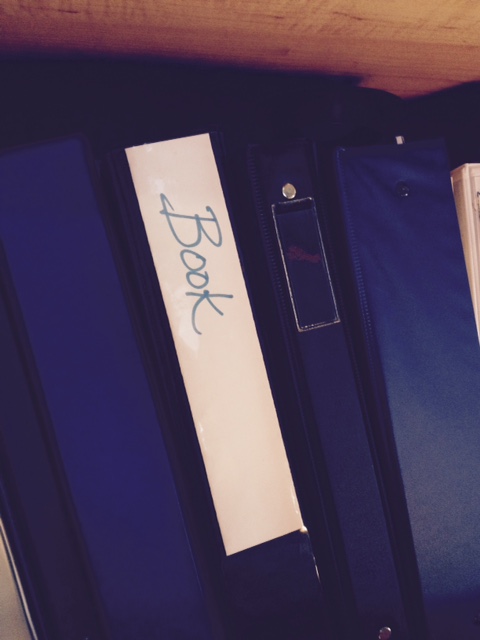
Once home, I affixed a sticker to the spine of the binder with the word “Book” written on it in blue felt tip marker. I placed my new materials throughout the house: at my desk, on the coffee table in the great room, at my bedside table, near the bathroom sink, and in both cars. Ultimately finding it perilous to jot notes while driving, I purchased a small recording device. “Don’t forget to tell them what happened in the garage,” I recorded into the mic.

Each night before I sat to write, I filed the day’s sticky note inspirations onto the dividers throughout the binder. Then I prayed. “This was your idea, God. Help, please!” Six months later I had an outline and about six chapters written. This feat coincided with the weekend visit of a close friend, and one of the smartest people I know. Bright, articulate, and extremely well read, my friend-who-shares-the-same-name-as-me, demanded to read what I’d written. She in fact seemed hurt that I hadn’t yet asked for her input and advice.

I knew better than to share my work so early in the process, and especially with someone who tends to be critical, but I yielded to her insistence. I really hoped for some encouragement. You see it coming, don’t you? My friend emerged from our guest room the next morning, with the “Book” binder in hand, avoiding eye contact as she headed to the coffee pot. Oh boy, I thought.

“So Barb,” she finally said, once settled in at the breakfast bar, “I, uh, think, uh, this is an important story for, uh, people to read. It’s not, uhhhhh, gonna be a best seller or anything, but it’s, uh, good.” She then looked up at me and added enthusiastically, “You sure have a great memory!” I laughed. Kind of.

“Memory isn’t exactly what I was going for. But I guess that’s something. Thanks for reading.” Unable to leave well enough alone, she added, “You sure didn’t use many big words, did you?”

At that point my heart went “thunk”… and I stopped writing. (Stay tuned for Part III when I share how the Jordan River helped me start writing again….)

Your Basic Marketing Tool Kit

tool kitYour book is published! Congratulations! Now you have to go out and sell it, which generally means you’ll be doing book signings, giving talks and attending festivals. Before you walk into your first event, assemble a marketing tool bag you can use at every venue you visit. Even when you’re being hosted by a book store who will be handling all the purchases, you still need some basic promotional tools to make the most of the marketing opportunity. Here’s what goes in a basic author marketing bag:

  1. Book stand. You want to be able to prop up a copy of your book so everyone can see the cover. A simple acrylic one works just fine, and you can find it at office supply stores. In fact, pick up two!
  2. Signage. You want to provide important information for your buyers: price, perhaps a short glowing review, method of payment. Again, acrylic sign holders are at the local office supply store, and they come in a variety of sizes. I use one 8×11 size to display buying information, and I have a 4×6 sign set up next to a small tub inviting folks to sign up for my newsletter. Depending on the event, you can easily customize the sign each time by printing a new one from your home computer. For example, when I’m donating part of my proceeds to a special charity or offering a multiple book price, I can include that on the sign.
  3. Newsletter sign-up sheet/collection box. I have a small plastic container with pens and little notepads in it for people to use to leave their email address for my newsletter subscriber list. I also have a small book-related prize sitting next to the box; every month I draw a winner from those addresses and send out the prize.
  4. Tablecloth. Your host may not have a tablecloth for your use, and you’ll wish you had one. It gives you that professional look!
  5. Handout. Depending on your budget and creativity, this can be anything that will remind the customer about you once you’re no longer in sight. Bookmarks and postcards printed with your book cover work nicely. Do you write sweet romances? Give out candy kisses!
  6. Credit card reader. I resisted getting one for my first few years as an author, and it was a mistake. Few people have the cash on hand to buy your book if you’re doing direct selling, and the last thing you want is for someone who wants to buy the book right then and there to have to walk away and buy it later…because chances are very good, it won’t happen. Research the different options available. I use Phoneswipe, and I know many authors who use Square.
  7. Cash. Some folks do use currency, so you’ll want to bring some cash to make change. I keep a small zipper case in my marketing bag with enough change for five books, and it doubles as a place to keep any cash payments secure.

Is there anything else you’d want in your marketing tool bag?

Have You Heard a Good Book Lately?

The WordServe Water Cooler is please to host Becky Doughty again as she shares her experience in creating audio books.

Welcome back, Becky!

AudioBookFrom as far back as I can remember, I have had a TBR (to be read) pile stacked beside my bed, books waiting for me to lose myself in them. As a child, my favorite time of year was summer, because it meant endless hours of uninterrupted reading time. As an adult, my days are now consumed with working for a living. My non-work hours are filled to overflowing with the joys and responsibilities of my family. Family meals, homework, laundry. Bathrooms to clean, dogs to walk, gardens to plant…. I have replaced my TBR pile with a TBD (to be done) pile. Well, actually, I haven’t replaced it. My TBR pile collects dust by my bedside and I stare at it longingly as I lay my head on my pillow, unable to keep my eyes open a moment longer.

Then I discovered audiobooks. No, they don’t replace hands-on reading, but they DO offer an alternative method of consumption, one that allows me to “read” while I cook, fold laundry, clean bathrooms, walk dogs, plant gardens, commute. They make standing in line at the DMV and waiting for an oil change a pleasure. And when a good narrator brings a book to life, it can be a really wonderful literary experience!

Three Tips for Audiobook Enjoyment:

  1. becky-doughy-braveheart-audiobooks-1Narrators can make or break a story. Thankfully, most audiobook resources, such as Amazon, Audible, iTunes, etc., give up to a 5-minute sample to listen to before purchasing. Take advantage of those samples, considering you’ll be listening to him or her for 8-10 hours.
  2. That being said, don’t pass over a wonderful book just because the narrator doesn’t read in a style you’re accustomed to. We humans have the innate capacity to adapt, so give your ears the chance to hear past the extraneous stuff. More often than not, by the end of the audiobook, all those little things that bugged you at the beginning no longer will.
  3. Audiobooks can be expensive. However, there are lots of ways to enjoy audiobooks on a budget. Look for subscriptions that include special offers and discounts like Audible. iBooks (iTunes) always has package deals and special sales on audiobooks . Amazon has their WhisperSync program that gives you a DEEP discount on the audiobooks of many ebooks you purchase. Audiobooks on this program can run as low as $1.99 when you purchase the ebook!

For authors, turning your book into an audiobook can also be a rewarding experience on many levels. Not only is it another format in which to get your story into the hands—or ears!—of readers, but it’s a little like giving your words a third dimension. And it’s a bit of a thrill to hear your book professionally narrated!

Five tips for a turning your book into an audiobook:

  1. Narrators can make or break a story. There are many, many wonderful voice actors in this industry who can breathe new scope into your words. Don’t settle. Be selective.
  2. Make a list of anything important your narrator needs to know up front –pronunciations, dialect, personality traits, etc.—before production begins.
  3. 99% of your listeners will not follow along with the text. Minor narration errors, such as making two words into a contraction, as long as they do not change the meaning or tone of the book, should not be reason to send an audio file back to production.
  4. Although there are many narrators who work on royalty contracts that require little or no money up front, these contracts usually have a term of 7-10 years. Consider paying for the service up front. It can seem costly, however, paying up front gives you a much broader pool of narrators to choose from, and it immediately frees you from any ties to a third party.
  5. Be knowledgeable about the service you’re requesting. If a narrator charges $200 per finished hour, along with their narration expertise and voice acting talent, this is what you’re paying for:
    • Approximately 9000 words = 1 finished hour of audio.
    • 1 finished hour of audio = approximately 6-8 hours of prep and studio time.
    • A 90,000 word novel = approximately 10 finished hours of audio.

6. A 10-hour audiobook = approximately 60-80 hours to produce.

*******************************************************************************************

becky-doughty-author1Becky Doughty is the author of the best-selling Elderberry Croft series, the controversial Waters Fall, and the voice behind BraveHeart Audiobooks. Raised on the mission field among the indigenous tribes of West Papua, Indonesia, Becky’s ministry is through the written word. Her heart is for people living on the edge–that fine line where grace becomes truly amazing. Married to her champion of more than 25 years, they have three children, two of whom are starting families of their own, and they all live within a few miles of each other in Southern California. You can connect with Becky via her website, Facebook,Twitter and Pinterest.


Easter: From Doubt to Joy

“So the women hurried away from the tomb, afraid yet filled with joy, and ran to tell his disciples” (Mt 28:8, NIV).

ResurrectionToday is Easter – a wonderful time to celebrate new beginnings, God’s grace and the hope of eternal life. While the colorful eggs and the chocolate bunnies may only last a day, the message of Easter can sustain us everyday.

Do Not Be Afraid

The women who came to visit Jesus on Easter morning came in sorrow and grief. They were prepared to anoint Jesus’ body with spices. Instead, they became the first witnesses to the Resurrection.

God is still in the resurrection business. Stalled dreams, broken relationships, frustrations and doubts – all the losses of life are no match for the hope found in the Easter message. The angel told the women, “Do not be afraid.” These words remain relevant for everyone ready to embrace the surprise of joy after a season of waiting in despair.

Come and See

The angel’s next instruction to the women was to “come and see”. God understands our desire for evidence even as we try to live by faith. The women had the chance to examine the empty tomb to bolster their belief in the resurrection. They took advantage of this opportunity and then left the tomb in a rush to share the good news with others. Of course, if their fears had overruled their faith, they might have ran for home without ever stopping to consider the possibility that the good news was true.

The promise of eternal life and forgiveness was waiting just a few steps away, but the women had to take those steps in faith. In any journey from discouragement to hope, from defeat to victory, from promise to fulfillment, we always have to take some steps in faith.

Go and Tell

When the women hurried away from the tomb to share the good news with the disciples, they were “afraid yet filled with joy”. Sometimes something is just so wonderful that it inspires awe bordering on fear. Finding life after death, wholeness after brokenness and direction after confusion can be so fabulous that we become overwhelmed. However, now we are overcome with joy instead of doubt. We have made a discovery worth sharing with the world.

In my book, Questioning Your Doubts: A Harvard PhD Explores Challenges to Faith, I explore how I found the Easter message relevant for everyday life. As a trained scientist, I appreciate the quest for evidence – the call to “come and see”. As a minister and an author, I have answered the call to “go and tell”.

I draw inspiration from the Easter message in the small challenges of life as well as the big decisions. While waiting for a response from an editor or news about the status of a project, Easter reminds me that good things can come after a season of waiting or an experience of loss and closed doors. Life prevails over death as surely as spring comes after a long, barren winter.

How does the Easter message encourage you?

Rock Bottom

Who we are as writers is a direct result of who we are deep, deep down inside as people.

CliffWSOf course, a lot goes into making us who we are. For me, it’s the entirety of those life experiences that cause me to strive to be a better person tomorrow and vow never to return to the circumstances in which I found myself during those long ago yesterdays.

One night in particular changed everything for me. It was the night I hit rock bottom, the end of my rope, the worst night out of many, many bad ones. It was late Friday, October 2 and the earliest-morning hours of the following day in 1992, and I was in the media parking lot of North Wilkesboro Speedway.

I’d gone through the agony of a divorce back home in Nashville, and after my ex-wife remarried, my son Richard was calling another man Daddy. That was a pain unlike anything I’d ever experienced, even more than the breakup of my marriage.

I’d moved to North Carolina a few weeks before, trying to find my way into the wondrous world of NASCAR. I had no real job, no money and very nearly no home. I was being paid nothing for the stringer work I was doing — nothing for the stories I filed, no expenses, no nothing. The only thing I received was a press pass.

Having covered a race in Martinsville, Virginia the week before, I wound up sneaking food out of the press box for dinner and sleeping in my car. The plan was to do the same the next weekend in North Wilkesboro, but when I arrived, it didn’t take long to figure out that meals wouldn’t be provided to the media until race day on Sunday.

It was Friday morning, and I had not a cent to my name. Panic set in. I was devastated. Scared. Hungry. And worst of all, completely alone. There was nowhere to turn. More than two decades have passed since that day, and even now, I can smell the personal-sized pizzas other reporters were able to buy from the concession stands.

After practice and qualifying that day, I waited until every other media member left the grassy parking lot behind the frontstretch grandstands. No way did I want them to see me setting up shop for the night in my car, and in that car in particular.

The next twelve hours or so were the longest — and emptiest — of my life. I cried that night, not knowing how things were going to turn out. I was more than 400 miles away from anybody I knew well enough to ask for help. I tried to pray, but had no eloquent words. There weren’t even any complete thoughts … all I could manage was the same basic phrase, over and over again.

Oh, God … 

I was scared and saw no way out of the fix I was in.

Oh, God …

Oh, God, please … 

Oh, God …

Sleep was next to impossible. As soon as day broke, I washed off, changed shirts and walked to the garage. Not long afterward, I ran into Deb Williams, the editor of Winston Cup Scene. 

In the NASCAR world, Winston Cup Scene reigned supreme. It was The New York Times, Washington Post and Sports Illustrated of NASCAR, and its writers were the best of the best. Deb let me know a story I’d written was going to run in the next week’s issue. It wasn’t a full time job, but it was at the very least an opening. Maybe I did belong. Maybe.

I headed to the press box overlooking the track, and it was there that I encountered Jerry Lankford, a reporter for the local newspaper in Wilkes County.

“Rick, I don’t know why I didn’t tell you about this yesterday,” he began. “The family that owns the paper I work for owns another one not far from here, and they need a sports editor. Would you be interested?”

Before I could stop myself, I bellowed, “YES!!!” I didn’t ask about the details, because they didn’t matter in the  least. I didn’t ask where the paper was located — it turned out to be in a little town in the mountains of North Carolina called Sparta — or how much it paid. All I cared about was that it was a job, and even better, it was a job with an established newspaper.

Just a few days later, I had my interview. By the time I made it back “home” to the motel where I was staying, I had a call that I’d gotten the job. I was officially the sports editor for The Alleghany News. I started on October 15, 1992 and almost exactly two years later, I landed my dream gig when I was hired as a full-time staff writer for Winston Cup Scene.

Amen … amen … and amen!

Some would call it a simple coincidence that I’d learned of my story running in Winston Cup Scene and the job possibility on the morning after such a terrible, dark, lonely night. No. No way. God heard the simple prayers I prayed that night, and He honored them.

I’ve never forgotten that night. I certainly never want to go back to those kinds of circumstances again, but I don’t want them to slip entirely from my mind, either. I want to remember the bad times so I can rejoice all the more in the good. I want that kind of raw emotion to be present when I write.

Always.

How I Discover New Books– Hint, Not in a Bookstore

It’s been said that the reason an author should stick to traditional publishing is book discoverability and distribution by way of a publisher’s marketing budget and sales staff.

bookstore-482970_1280I was fortunate to get a three-book deal with a mid-size Christian publisher who did get behind my book generously with marketing dollars. They even landed me in Sam’s Club with my first two books in hundreds of stores nationwide.

Just, why, didn’t I hit the bestseller lists? I think the books are good. Proof and Poison got starred reviews from Library Journal. Both were nominated (though never won) for awards. Lots of favorable reviews.

In fact, I might even say that landing in Sam’s Club hurt me a little. Why? The issue with Sam’s club is it’s a BIG order. It’s a risk for the publisher. If you’re not a well-known name who can move those novels many are going to get returned and your royalty report is going to look like a defaulted home loan and the bank is knocking on your door.

I began to analyze how I discover books, and does it match with the way a traditional publisher markets novels?

Sure, your best chance of getting into a bookstore is partnering with a traditional publisher but how often are you going to bookstores anymore? I used to go weekly, when they were close. There aren’t any close ones anymore. The one at the mall I would stop in while shopping for other things . . . gone . . . both of them. The closest bookstore is a 15-20 minute drive. And as NYT’s bestselling author Jamie McGuire blogs here— even she wasn’t seeing her novels in bookstores during release week.

Here is a list of how I now discover books.

1. Goodreads Reviews. Goodreads is the place for people who LOVE books and where book lovers leave reviews. I find I have more Goodreads reviews than Amazon reviews. I have close to 2,500 friends on Goodreads. Every day, I get an e-mail of their reviews. I’ve come to know whose reading tastes are similar to mine. A good review of a book will cause me to look further on Amazon. Plus, since I’m friends with so many, I get exposed to a wide variety of books outside my general reading genre (suspense) that I probably wouldn’t have heard about– even browsing bookstore aisles.

2. Amazon Lists. Amazon lists are fun to browse. Of course, there is always the 100 top paid and free Kindle lists but I also look at genre specific top 100 lists. I also pay attention to novels getting a crazy number of reviews and try and read those to see what is catching the reader’s eye. So, from my first two examples, I don’t think any author can say that reviews don’t matter . . . they do.

3. Advertising Lists. There are a couple of advertising lists that I belong to– BookBub and Inspired Reads. On these sites, you can narrow down the types of e-mails you receive to genres you like. Every day you’ll get an e-mail about books that are on sale. Bookbub lists are the primary way I’m buying books. If I see an interesting book cover then I click the buy link for Amazon and check out reviews. Based on the number of reviews, I make a decision about whether or not to buy the novel. BookBub has a very good reputation among authors that though pricey– is generally a good investment of your marketing dollars. I think the same is true with Inspired Reads for their reach/price ratio.

4. Word of Mouth. I’m like every other human being. If a good friend says, “You must read this book.” it will climb up to the top of my TBR list. The more people that say it– the more likely I am to read it. One author I’d almost given up on until a good friend said, “Just read this one. If you don’t like it, I give you permission to never read this author again.” Reading that novel changed my opinion of the author and their work.

What I find is that I’m rarely in a bookstore anymore but I’m discovering a lot more books because these things are available to me every day.

For my fall release, this is how I’m spending my marketing money. I’ll likely not be arranging bookstore book signings, but that’s a topic for another time.

How are you discovering books? Does that determine your marketing plan?