A Writer’s Life: The Waiting Room

Today I’d like to invite you to join me someplace most, if not all, writers are familiar with. Where’s that, you ask?

The Waiting Room.

Oh. My. Word. Your groans probably registered on the Richter scale. Stop it right now and come on in. Yeah, the Waiting Room is crowded. And the magazines are out-of-date. But we’re here to talk, not peruse the 2005 issue of Bowhunter magazine

If you’re a writer, the Waiting Room is unavoidable. Truth is, if you stay the course, you’ll make repeated trips to this room where the hands on the clock never seem to move and you languish forever, wondering when someone will call your name and say, “We’ll see you now.”

Aren’t I just the messenger of all things light and breezy today?

Why, you ask, why the Waiting Room? It’s such a waste of time.

Is it really? 

What can you learn while you wait? (Yes, I know you’d rather get seen and get out of here. But stick with me.)

  1.  Understand attitude is key. If I expect to wait then I avoid the “Woe is me” attitude — or at least succumb to fewer attacks of self-pity. If I get into my appointment on time or — gasp! — early, then I celebrate. Translation: No one is an overnight success. If some author tells you that they were, they’re lying. (You can tell them I said so.)
  2. Come prepared to wait. Do I want to waste time thumbing through magazines I’d never read even if I was stranded on a desert island? Translation: What are you doing while you wait for “the call”? Are you counting time or making time count by revising your manuscript, attending conferences, connecting with other writers — maybe even encouraging other writers?
  3. Realize everyone hates waiting. Medical professionals hate being behind schedule as much as you hate waiting. Translation: Editors wait too. And agents. And publishers. (Side note: Please, no comments with “waiting for my doctor” horror stories.  Not the point of this post. If you really need to vent, email me at beth@bethvogt.com. I’m married to a doctor. I can take it.)
Time for me to sit back and see what y’all have to say about time spent in the Waiting Room. Tell me how you handle waiting for feedback from your critique group. Or from your agent. Or for the “sign here and would you like an advance with that?” phone call. How do you make waiting worthwhile?


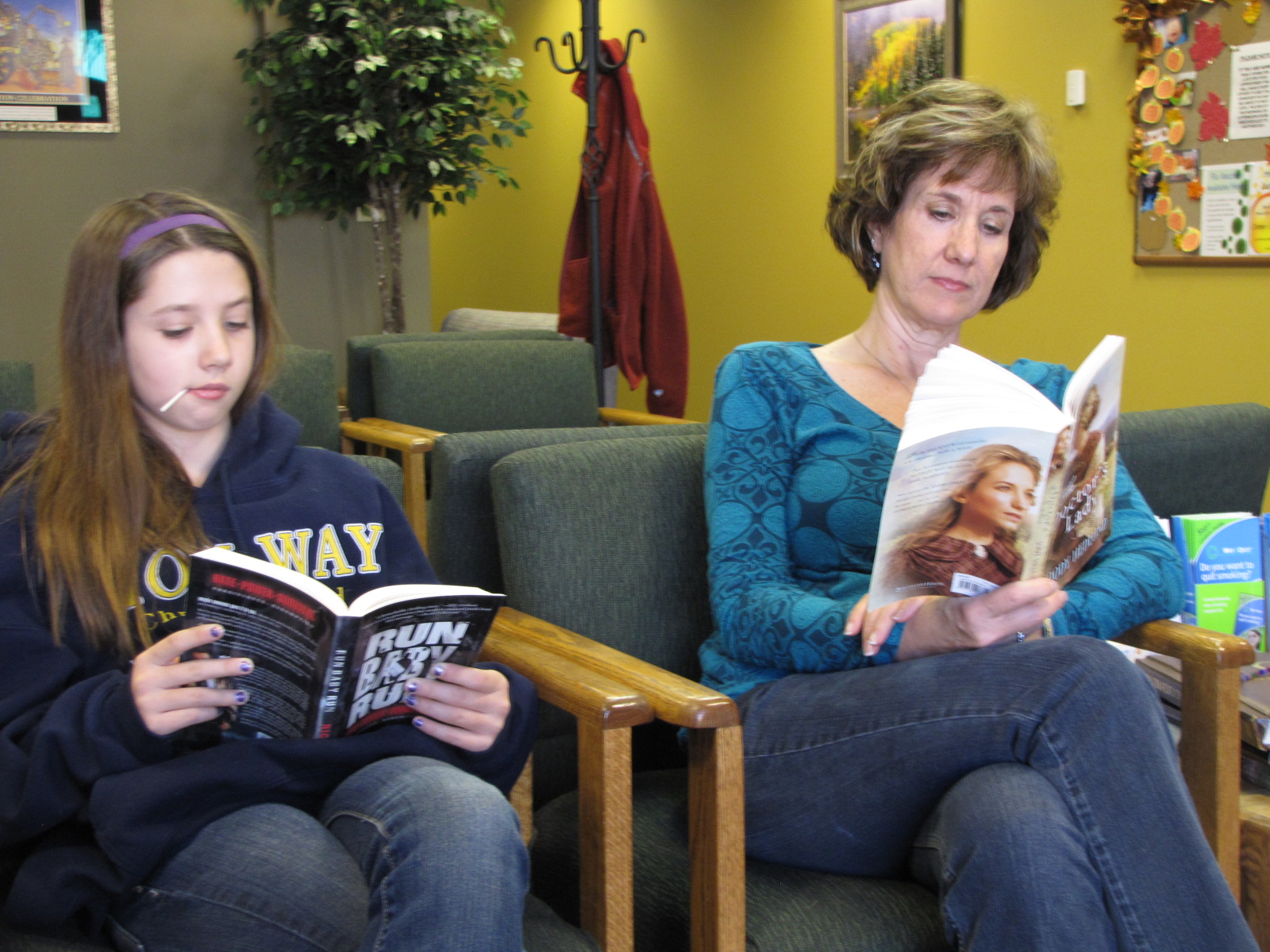
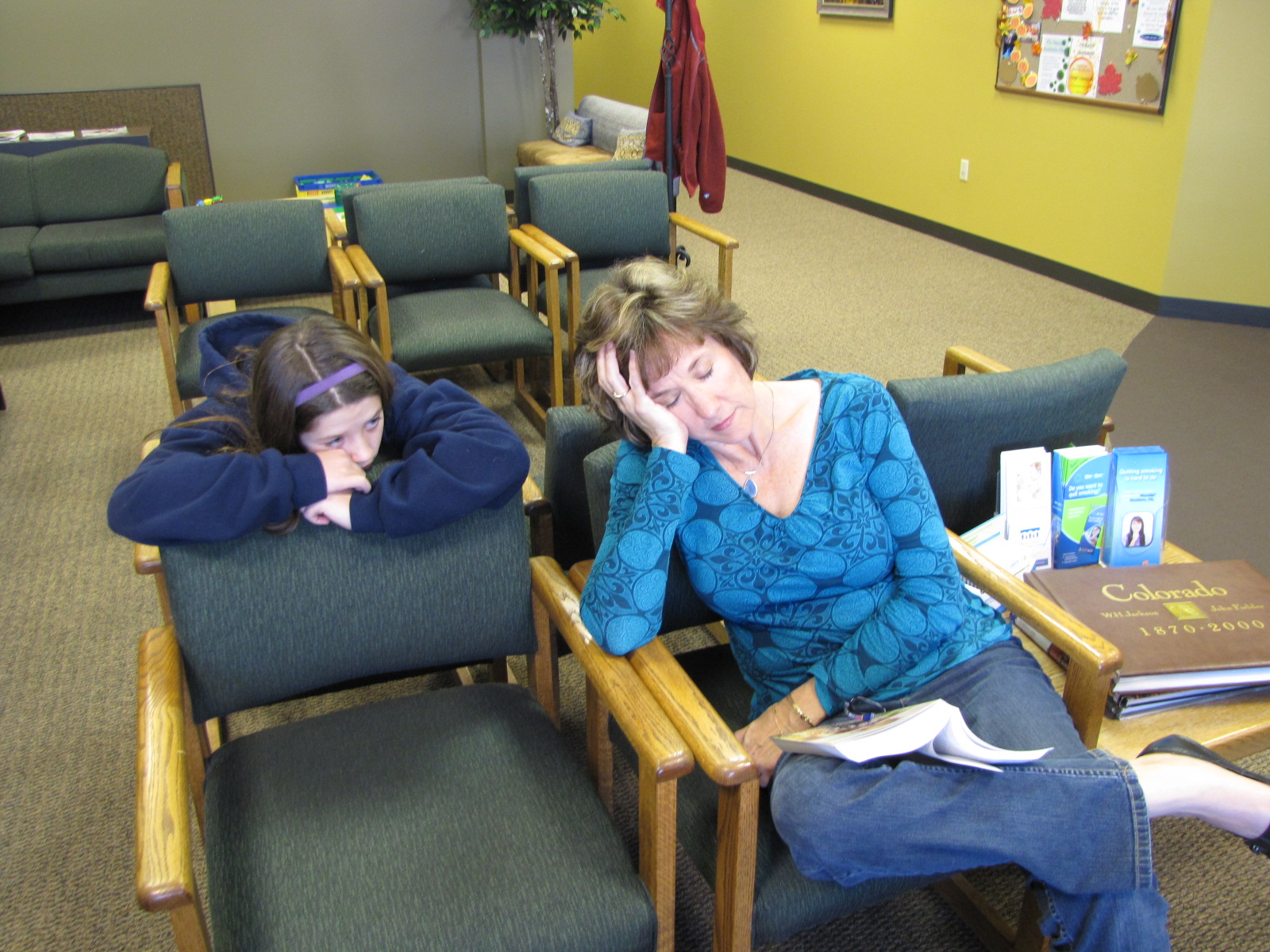
*Photo credit: That’s me and my daughter. In my husband’s waiting room. With a copy of author Jody Hedlund’s latest release, The Doctor’s Lady. The sleeping pose is for the sake of the column — not a statement on Jody’s writing. I loved reading The Doctor’s Lady!

Post Author: Beth K. Vogt

Beth K. Vogt is a non-fiction author and editor who said she’d never write fiction. She’s the wife of an air force physician (now in solo practice) who said she’d never marry a doctor—or anyone in the military. She’s a mom of four who said she’d never have kids. She’s discovered that God’s best often waits behind the doors marked “Never.” She writes contemporary romance because she believes there’s more to happily ever after than the fairy tales tell us.

Social Media – When Less is More

When I first joined Facebook I thought, “This is ridiculous. Who would ever do this?”

But I was told if I ever wanted to be considered by a book publisher, I better have an author platform. One of the foundational ways to build a platform is by using social media venues such as Facebook and Twitter.

So I grudgingly used my Facebook account. I logged in once a week to see what others were up to.  But then a weird thing happened. I discovered I loved social media. I made real friendships online and looked forward to hearing from my “peeps.” I enjoyed getting ideas and opinions from people all over the world. I loved knowing what people were thinking and talking about. I looked forward to laughing, crying, and praying with my online friends.

As soon as I mastered Facebook, I noticed authors talking about something called Twitter. Twitter seemed overwhelming so I read a few books about it:

*Twitter Revolution by Warren Whitlock and Deborah Micek. I wrote about it here

*Twitter Means Business by Julio Ojeda-Zapata You can order it here.

I learned that Twitter is very different from Facebook. Twitter is a powerful tool for specific purposes such as checking how snowy the roads near Vail are, what Judge Belvin Perry is ordering Casey Anthony’s jurors for lunch, discovering what the police are doing near I-70, talking out loud to politicians and celebrities, and telling companies about their bad (or good) service.

As I settled into my social media routine, I saw my heroes adding tens of thousands of friends, so I did likewise. I added and “friend-ed” everyone who crossed my path.

It makes sense. We all want to be part of the group like this little guy:

My friends and followers list grew, but I dreaded getting on my computer. I didn’t know whom I was talking to, and I felt like I was being spammed when I wanted to relate. So one day I deleted all 800 of my Twitter friends and started over.

I carefully and deliberately chose which friends I would follow (now less than 100) and paid little attention to who was following me. Every few months I clean out my Facebook account. I unfriend lurkers, spammers, and people who spew their message but never interact. One thing I’m proud of is that people I interact with on social media are not strangers, they are my friends. I have found several benefits to cutting back:

  • I am more eager to login to my Facebook and Twitter accounts.
  • I have built relationships with my online friends, so when my book gets published I won’t be a nameless face spamming everybody.
  • My friends and followers are more likely to pass my books, videos, and blog links to others.
  • I’m interacting with people who share my interests.
  • I’m filling a social need by relating instead of spamming. Research shows that people form communities on Facebook and Twitter in order to get social needs met.

More and more people, whose expertise I admire, are limiting the ways they interact on social media. As authors we are continually trying new marketing ideas, so we experiment, take risks, and try new things. I don’t know if the way I do social media is right for you…

Do you think more followers and friends are better? Why or Why Not?

Creative Nonfiction: Top Tips for Memorable Memoirs and MORE!

Photo Credit: Simon Howden / http://www.freedigitalphotos.net

My husband parks our silver F150 in a turnoff, which is really a patch of pounded land where folks have repeatedly turned their cars around after realizing the road goes nowhere. I imagine drug dealers, prostitutes, meth heads, and hormonal teens fighting for this spot on steamy summer nights, but for now, it’s just Charles and me. And my doubts.

He turns off the engine, and in the silence, we wait. We are surrounded by thousands of acres of farm fields, old growth hardwoods, and murky cattle ponds. The land is beautiful, and this type of setting would normally calm my nerves, but not this time. Not now, as I’m waiting at the end of the road for a stranger to arrive. My heart races and my breath quickens, as I realize, with sudden alarm, that we might be in danger.

“Should we have brought the gun?” A question I never thought I’d ask. Even though I despise America’s love affair with arsenals, in this position, I wish I was holding a gun.

“What gun?” He’s barely paying attention to me as he checks email on his phone.

“The one in the garage.”

Charles laughs. “It’s a 22.” With sarcasm he insinuates that if we find ourselves going head-to-head with a coyote or a tom cat it might come in handy. A hardened criminal? Not so much.

“Well what if it’s a setup. One of those Craigslist crimes?”

He doesn’t answer. Just keeps emailing.

11:49. No sign of the white Ford truck we are waiting for. “Of course it’s a white Ford,” I say. “Does anyone drive anything else around here?” I’m sure we’ve passed at least forty-seven white trucks since we left the interstate. Forty-six of them, Fords.

I open the door and get out to stretch my legs. The sounds of rubber tires and gasoline engines roar in the distance. Somewhere, within earshot, the newer highway ribbons through these fields, and I feel a little comfort thinking I can run toward the noise if it comes to that.

Then the engine noise comes closer, and the white truck we’ve been waiting for eases its way into a corner field and comes to a stop in front of a metal gate, a rusty chain locking the gate closed.

In the movies, headlights would have flashed, drums would have punched a dramatic rhythm, and a heavy pause would have filled the screen. Instead, Charles’s phone rings. “Yep, I see you. We’re headed that way now.”

I return to my passenger perch and close my door just in time, as Charles is already putting the truck in gear.

“You have the money?” he bites his nails, a habit he’s had all his life.

“Yes,” I check my purse, just to make sure. Cash only, I remember the stranger’s instructions. My pulse shoots flares.

And then it happens. We climb down from the bench seat and enter an isolated pasture with a man we’ve never met.

What’s this scene about? Do you suspect this couple is about to engage in some sort of illegal transaction? Are they in danger? Or is it just a creative twist on something as ordinary and realistic as buying a cow?

If you guessed a cow, you’re right. This is part of a creative non-fiction proposal that enabled me to become the 2012 recipient of the Mississippi Arts Commission’s Literary Arts Fellowship, an honor I am privileged to accept.

Whether writing about cooking or canines, remember non-fiction doesn’t have to be dry.

Try these tips:

  • At some point, let us know exactly where and when the event takes place, but use subtle hints to set the scene (music, tv, news, technology, etc., to hint at the era.)
  • Use sensory details – smells, sounds, sights (avoid writing “I see… I smell…I hear…”)
  • Involve more than one person in the scene…it’s not all about YOU. Describe something specific about the other characters. Use a few snips of dialog and let unique personalities shine.
  • Elicit an emotional response from the reader. How do you want them to FEEL when they read the story?
  • What is the main point of the story? What question do you want to answer? Try to leave the reader with one main thought, all while trying to show rather than tell.

When you write, what approach do you take to make the mundane magnificent? Share your thoughts about creative nonfiction and learn more about this interesting genre by visiting http://www.creativenonfiction.org/

Julie’s first novel, Into the Free, hits shelves February 1. Learn more at www.juliecantrell.com

The Publishing Biz: Will it Break You?

Photo: Bill Longshaw / FreeDigitalPhotos.net

Launch the Internet these days and you’ll find a deluge of opinions on what it takes to make it as a writer. You can glean expertise about search engine optimization, how to build a platform or leverage social media, garner advice on author branding, book promotion and networking, and find out what’s happening right this moment in the explosive world of ebooks. If the odds were against a writer back in the day, they really have their work cut out now.

You might tremble before the daunting writing, publishing and now marketing journey and wonder how you can possibly succeed. Do you look around and ask, “Are my writing dreams even relevant anymore?” Maybe you think…

  • With ebooks at everyone’s fingertips, the number of titles available has skyrocketed. There are simply too many books out there for any one author to garner much attention. Besides, you’ve missed the latest trend. Your chosen genre has been overdone. Editors have seen it all before and you have nothing new to offer.
  • The economy is still too scary, weak or unstable for you to venture into something so uncertain, and few authors earn enough to quite their day jobs anyway, so why bother?
  • Publishing houses aren’t taking many risks on new authors, and if they do, they aren’t investing in them the way they used to. The good old days are over, and while self-publishing is an option, you don’t have money to invest in it, let alone a website and SEO, and it’s all too complicated anyway.
  • Everyone else is better at social media than you. You’re not part of the ‘in’ social media networking crowd, and that train has already left the station without you—agents and publishers will take one look at your Klout score and break a nail trying to hit the ‘thanks, but no thanks’ button. You can’t possibly catch up.
  • You’re too utterly exhausted after working, volunteering, cooking, cleaning, carpooling, commuting, going to church, tweeting and generally living life to step it up in the writing and publishing game, especially to keep up with rules that seem to change everyday. If you thought you didn’t have the time before, you really don’t have the time now.
  • You don’t have a platform—you’re not even sure you know what a platform is. It probably takes too much time and effort to build one, and frankly, you’d rather stick a rusty fork in your eye than have to promote yourself anyway.
  • It’s easier to take a ‘wait and see’ approach. Industry changes may be a passing phase you can wait out—maybe when the kids are grown, you graduate or you retire. Eventually, the world will revert back to the way it was before, when writers had only to write and there was plenty of ozone left in the northern hemisphere.
  • Your old writing dream is in jeopardy, and you can’t come up with a new one you’re as passionate about, so you’re left to lurk about in a fog no one can lead you from with any certainty.

Maybe you believe some of this—maybe not, but the most likely reason you may fail to achieve your writing dreams is you will simply give them up. Any excuse will work. Pick one.

You can be paralyzed by the changes of today and uncertainty of tomorrow, or you can refuse to dwell on the reasons ‘why not’ and learn what works and what doesn’t from trial and error and from those working alongside you—those who keep putting themselves out there so others can keep dreaming.

What about you? Has the industry changed too much for the dream to appeal to you anymore? Or are you in it for better or worse?

Keywording 201 for SEO Prowess: Three Simple To-Dos to Improve SEO

A few weeks ago, I gave you the 411 on how to choose thematic keywords for your site.  And, now that y’all have researched your keywords on Google Adwords and Insights, honed your theme and come up with a strong list of 10-15 keywords (you did that, right?), you’re probably wondering what to do with said list.

Using keywords correctly is complicated.  Really complicated.  And to be honest, figuring out the algorithm takes rocket-scientist brainpower and the ability to focus on complicated things like numbers and graphs for long stretches of time (12 minutes at least).  And, since I’m guessing that doesn’t sound like something you want to do when you could be doing fun things like NaNoWriMoing, I’m going to make it really, really easy for you.  So easy, in fact, that even a busy NaNoWriMoing novelist with less than 4 minutes of free time between soccer drop-off and throwing dinner in the crock-pot can get it done.

Homework caveat:  Before you can complete this to-do list, you’ll need to come up with a list of 10-15 thematic keywords for your blog.  Refer to this post for instructions.

Three Simple To-Dos That Will Improve Your SEO

  1. Use at least ONE of your keywords in the TITLE of a blog post at least one time per week.  (Why?  Title or H1 tags—especially title tags on WordPress which is built for SEO—have a strong SEO value.  That means that when you use a word in the title, the Google crawlers will automatically assume the article has something to do thematically with that word.)
  2. Make a hyperlink to a different blog article on your site in each blog post you write.   BONUS:  If possible, make the word that’s hyperlinked be one of your keywords.   For example:  if your keyword is “women of faith”, try to link the words “women of faith” to a separate article on your site that’s about women of faith.   (Why?  Just like title tags, Google crawlers assume that when your article links to another article, it has strong relevancy to that theme.)
  3.   Try to use at least one of your keywords in every article you write.  (Why?  It’s the thematic relevancy thing again—the more you organically use your words, the more Google is going to assume you know what you’re talking about when it comes to those themes.)

That’s it!  Easy, peasy, right?

Question for you:  What is the hardest thing for you about SEO?

Using Stolen Moments to Write

NaNoWriMo begins today. Around the world, millions of writers are pounding on their keys to produce a novel in 30 days.

Many writers aren’t like Richard Castle with styling offices and ability to write full-time. Most writers I know work full-time inside or outside the home, care for a family, have church responsibilities, act as the family chauffeur, battle dust bunnies from overtaking their homes, and try to squeeze in a decent night’s sleep.

Who has time to write? Well, many of them may not have time to write, but the majority of them MAKE the time to write.

I’m a stay-at-home-work-at-home-mom who owns and operates an in-home family childcare program. Not working isn’t an option. With my My Book Therapy responsibilities, book contracts, family and church commitments, life can be a bit crazy.

A schedule and stolen moments help me find time to write. Also, I’ve encouraged my family to help with housework, laundry and cooking. Plus I use my Crock Pot and bread machine a lot. I write in the evenings so Hubby runs errands and chauffeurs our son.

If you don’t have evenings to write, do you have 15 minutes in your day? The Fly Lady has a great site to help people get their homes and lives in order. One of her principles is you can do anything in 15 minutes … including writing.

I downloaded an egg timer for my computer. When I’m stuck on a scene or needing motivation, I set timer for 15 minutes and free write without editing. When I’m writing my rough drafts, I use my timer to increase my word count. After all, rough drafts are allowed to be rough.

If you are serious about your writing and want to make progress, enlist your family to help out. Delegate household duties, grab the timer and have everyone work for 15 minutes.

Another way to get some writing time is to ask your spouse to take your children for an hour or two each evening. The children and spouse will have a special bonding time and you will have time to write. Turn off the Internet and focus on your manuscript.

If you don’t have a spouse, consider doing a play date swap with a friend or neighbor. Ask a high school student to entertain your kids for an hour or so. Or write after your kids go to bed. If that won’t work, get up an hour earlier in the mornings. If you work outside the home, write during lunch. If you have to chauffeur your kids, take your laptop or a notebook and write while you’re waiting.

Set a daily writing goal and use stolen moments to build your word count. Remember, your first draft doesn’t need to be perfect.

Balancing life with work, family and writing can be a juggling act. Find what works for you. If you don’t take your writing time seriously, no one else will either.

**A bit of self-promotion: My debut novel, Lakeside Reunion, releases today! I’m having contests to promote my book. Visit my Lakeside Reunion Contest Page for more information. The token for this blog is a novel.

Your Turn: Are you participating in NaNoWriMo? How do you find time to write?